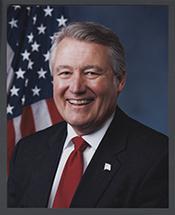
U.S. Representative for Georgia’s 12th district
Republican
119th Congress, two-year term
Missed 1.6% of roll calls. Chamber median 1.9%.
The full voting recordCounts roll calls where most Democrats and most Republicans voted differently, leaving out procedural votes.
How we countFrom FEC filings, Voteview roll calls and Congress.gov.
Republican. In Congress since 2015, 6 terms in total.
Following saves Allen to your list, which Chamber & Street keeps on its server, linked to a cookie on this browser and not to your name or email. Email alerts will come with constituent verification.
Bills and resolutions Allen signed on to as a cosponsor. An original cosponsor signed on the day the bill was introduced. Source: govinfo bill status files, last updated Nov 6, 2026.
Main Street Tax Certainty Act
Sponsor Lloyd Smucker (R). Original cosponsor. 192 cosponsors. H.R. 703 on Congress.gov
Introduced
Main Street Tax Certainty Act
This bill makes permanent the qualified business income (QBI) tax deduction.
Under current law, individuals, estates, and trusts may deduct the lower of (1) 20% of QBI from a qualified business, qualified real estate investment trust dividends, and qualified publicly traded partnership income; or (2) 20% of taxable income less net capital gain. (Some limitations apply.)
However, under current law, the QBI tax deduction expires after December 31, 2025.
Heartbeat Protection Act of 2025
Sponsor Mike Kelly (R). Original cosponsor. 42 cosponsors. H.R. 682 on Congress.gov(opens in a new tab)
Introduced
Heartbeat Protection Act of 2025
This bill makes it a crime for a physician to knowingly perform an abortion (1) without determining whether the unborn child has a detectable heartbeat, (2) without informing the mother of the results, or (3) after determining that an unborn child has a detectable heartbeat.
A physician who performs a prohibited abortion is subject to criminal penalties—a fine, up to five years in prison, or both.
The bill provides an exception for an abortion that is necessary to save the life of a mother whose life is endangered by a physical (but not psychological or emotional) disorder, illness, or condition. It also provides exceptions for certain pregnancies that are the result of rape or incest. A physician who performs or attempts to perform an abortion under an exception must comply with specified requirements.
A woman who undergoes a prohibited abortion may not be prosecuted for violating or conspiring to violate the provisions of this bill.
Ending Chemical Abortions Act of 2025
Sponsor Andrew Ogles (R). Original cosponsor. 21 cosponsors. H.R. 629 on Congress.gov(opens in a new tab)
Introduced
Ensuring Accurate and Complete Abortion Data Reporting Act of 2025
Sponsor Ralph Norman (R). Original cosponsor. 7 cosponsors. H.R. 627 on Congress.gov(opens in a new tab)
Introduced
Ensuring Accurate and Complete Abortion Data Reporting Act of 2025
This bill requires states, as a condition of federal payment under Medicaid for family planning services, to report certain abortion data to the Centers for Disease Control and Prevention (CDC). (Currently, reporting is voluntary.) The CDC must develop standardized questions for states with respect to specified variables (e.g., maternal demographics and methods of abortion).
NO GOTION Act
Sponsor John Moolenaar (R). Original cosponsor. 27 cosponsors. H.R. 524 on Congress.gov(opens in a new tab)
Introduced
No Official Giveaways Of Taxpayers’ Income to Oppressive Nations Act or the NO GOTION Act
This bill prohibits an entity that is created in, organized in, or controlled (in the aggregate) by China, Russia, Iran, or North Korea, or an entity controlled (in the aggregate) by one or more of such entities, from claiming multiple energy-related federal tax credits and incentives.
Specifically, the bill prohibits such entities from claiming the federal tax credits for
• alternative fuel vehicle refueling property,
• second-generation biofuel,
• biodiesel fuel,
• sustainable aviation fuel,
• renewable electricity production,
• carbon sequestration,
• zero-emission nuclear power production,
• clean hydrogen production,
• clean commercial vehicles,
• advanced manufacturing production,
• clean electricity production,
• clean fuel production,
• investments in energy property,
• advanced energy projects,
• clean electricity investment,
• biodiesel mixtures,
• alternative fuel, and
• alternative fuel mixtures.
Further, such entities are prohibited from claiming the federal tax deduction for energy efficient improvements to commercial buildings.
Finally, such entities are not entitled to a credit or refund of federal excise taxes paid on biodiesel, alternative fuel, or sustainable aviation fuel mixtures produced by the entities.
Repealing Big Brother Overreach Act
Sponsor Warren Davidson (R). Joined Jan 16, 2025. 193 cosponsors. H.R. 425 on Congress.gov(opens in a new tab)
Passed committee
Repealing Big Brother Overreach Act
This bill repeals the Corporate Transparency Act. The act requires existing companies and newly created companies to report beneficial ownership information to the Department of the Treasury’s Financial Crimes Enforcement Network for purposes of addressing the financing of terrorism and money laundering.
Import Security and Fairness Act
Sponsor Thomas Suozzi (D). Joined Jan 16, 2025. 3 cosponsors. H.R. 322 on Congress.gov(opens in a new tab)
Introduced
Import Security and Fairness Act
This bill excludes imported articles from nonmarket economy countries or countries on the Priority Watch List from receiving de minimis treatment. (Current law allows for imports under a de minimis threshold to enter the United States free of tariffs and taxes with minimal inspection. In 2016, Congress raised this threshold from $200 to $800.)
Under current law, a nonmarket economy country is any foreign country that the Department of Commerce determines does not operate on market principles of cost or pricing structures, so that sales of merchandise in such country do not reflect the fair value of the merchandise. There are currently 12 countries (e.g., China and Russia) that Commerce has designated as nonmarket economy countries. This bill prohibits imports from receiving de minimis treatment if those imports are from nonmarket economy countries.
Additionally, under current law, the Office of the U.S. Trade Representative must annually review and report on foreign countries that deny adequate and effective protection of intellectual property rights or deny fair and equitable market access to U.S. persons who rely on intellectual property protection. There are currently seven counties (e.g., Argentina and Indonesia) on this list, known as the Priority Watch List. This bill prohibits imports from receiving de minimis treatment if those imports are from countries on the Priority Watch List.
The bill also directs U.S. Customs and Border Protection to collect additional information on merchandise that may qualify for de minimis treatment and establishes requirements related to detained merchandise.
Equal Representation Act of 2025
Sponsor Chuck Edwards (R). Joined Jan 15, 2025. 66 cosponsors. H.R. 151 on Congress.gov(opens in a new tab)
Introduced
Equal Representation Act
This bill requires that the statement sent by the President to Congress after the decennial census indicating the number of persons in each state exclude noncitizens. (This statement is the basis for reapportionment of U.S. Representatives.)
The bill also requires any questionnaire used in the decennial census to include a checkbox or other similar option for respondents to indicate whether the respondent and each household member is (1) a U.S. citizen, (2) a U.S. national but not a citizen, (3) a non-U.S. national (alien under federal law) lawfully residing in the United States, or (4) a non-U.S. national unlawfully residing in the United States.
The Department of Commerce must make public the number of persons in each state, disaggregated by each of these four categories.
Healthcare Freedom and Choice Act
Sponsor Earl Carter (R). Original cosponsor. 11 cosponsors. H.R. 379 on Congress.gov(opens in a new tab)
Introduced
Healthcare Freedom and Choice Act
This bill nullifies a rule regarding short-term, limited-duration health insurance plans. The rule was promulgated by the Internal Revenue Service, Employee Benefits Security Administration, and Department of Health and Human Services; is titled Short-Term, Limited-Duration Insurance and Independent, Noncoordinated Excepted Benefits Coverage; and was published April 3, 2024.
Short-term, limited-duration health insurance plans are plans that may only offer coverage for a limited amount of time and are exempt from the market requirements of the Patient Protection and Affordable Care Act (e.g., coverage of individuals with preexisting conditions).
The rule limits the length of the initial contract period for such a plan to no more than three months and, taking into account any renewals or extensions, the maximum coverage period to no more than four months. The rule also includes within the maximum renewal period limitation a new plan sold by the same issuer, or any issuer that is a member of the same controlled group, to the same policyholder within a 12-month period.
Regulations in effect prior to the rule this bill nullifies permitted short-term, limited-duration health insurance plans with an initial contract period of fewer than 12 months and a maximum coverage period of up to 36 months, including renewals and extensions.
Title X Abortion Provider Prohibition Act
Sponsor Virginia Foxx (R). Original cosponsor. 32 cosponsors. H.R. 343 on Congress.gov(opens in a new tab)
Introduced
Title X Abortion Provider Prohibition Act
This bill prohibits the Department of Health and Human Services (HHS) from awarding family planning grants to entities that perform abortions or provide funding to other entities that perform abortions. To receive a grant, an entity must certify it will refrain from those activities during the grant period.
The bill provides exceptions for abortions (1) in cases of rape or incest; or (2) when the life of the woman is in danger due to a physical disorder, injury, or illness. It also exempts hospitals unless they provide funds to non-hospital entities that provide abortions.
HHS must submit a report to Congress annually on this prohibition.
Protection of Women and Girls in Sports Act of 2025
Sponsor W. Steube (R). Joined Jan 13, 2025. 83 cosponsors. H.R. 28 on Congress.gov(opens in a new tab)
Passed the House
Protection of Women and Girls in Sports Act of 2025
This bill generally prohibits school athletic programs from allowing individuals whose biological sex at birth was male to participate in programs that are for women or girls.
Specifically, the bill provides that it is a violation of Title IX of the Education Amendments of 1972 for federally funded education programs or activities to operate, sponsor, or facilitate athletic programs or activities that allow individuals of the male sex to participate in programs or activities that are designated for women or girls. (Title IX prohibits discrimination on the basis of sex in federally funded education programs or activities, including in public elementary and secondary schools and in colleges and universities.) Under the bill, sex is based on an individual's reproductive biology and genetics at birth.
The bill does not prohibit male individuals from training or practicing with programs or activities for women or girls as long as such training or practice does not deprive any female of corresponding opportunities or benefits.
The Government Accountability Office must report on the benefits for women or girls in single-sex sports that would be lost as a result of male participation. In particular, the report must document the negative psychological, developmental, participatory, and sociological effects of male participation on girls.
Honoring the life, achievements, legacy, and public service of former President James Earl "Jimmy" Carter, Jr.
Sponsor Nikema Williams (D). Original cosponsor. 120 cosponsors. H.Res. 30 on Congress.gov(opens in a new tab)
Introduced
This resolution honors the life, achievements, legacy, and distinguished public service of former President Jimmy Carter. The resolution also (1) acknowledges President Carter's contributions to the state of Georgia, the United States, and the world; and (2) establishes his legacy as one of the great leaders and statesmen of the United States.
Born-Alive Abortion Survivors Protection Act
Sponsor Ann Wagner (R). Joined Jan 9, 2025. 163 cosponsors. H.R. 21 on Congress.gov(opens in a new tab)
Passed the House
Born-Alive Abortion Survivors Protection Act
This bill establishes requirements for the degree of care a health care practitioner must provide in the case of a child born alive following an abortion or attempted abortion.
Specifically, a health care practitioner who is present must (1) exercise the same degree of care as would reasonably be provided to any other child born alive at the same gestational age, and (2) ensure the child is immediately admitted to a hospital. Additionally, a health care practitioner or other employee who has knowledge of a failure to comply with the degree-of-care requirements must immediately report such failure to law enforcement.
A health care practitioner who fails to provide the required degree of care, or a health care practitioner or other employee who fails to report such failure, is subject to criminal penalties—a fine, up to five years in prison, or both.
An individual who intentionally kills or attempts to kill a child born alive is subject to prosecution for murder.
The bill bars the criminal prosecution of a mother of a child born alive under this bill and allows her to bring a civil action against a health care practitioner or other employee for violations.
Proposing an amendment to the Constitution of the United States to limit the number of terms that a Member of Congress may serve.
Sponsor Ralph Norman (R). Original cosponsor. 116 cosponsors. H.J.Res. 12 on Congress.gov(opens in a new tab)
Introduced
This joint resolution proposes an amendment to the Constitution establishing term limits for individuals serving in the Senate and the House of Representatives.
The proposed amendment makes an individual who has served two terms in the Senate ineligible for appointment or election to the Senate and an individual who has served three terms as a Member of the House of Representatives ineligible for election to the House of Representatives.
The joint resolution provides that the amendment shall be valid when ratified by the legislatures of three-fourths of the states within seven years after the date of its submission for ratification.
Under Article V of the Constitution, both chambers of Congress may propose an amendment by a vote of two-thirds of all Members present for such vote. A proposed amendment must be ratified by the states as prescribed in Article V and as specified by Congress.
Pregnant Women Health and Safety Act of 2025
Sponsor Andy Biggs (R). Original cosponsor. 1 cosponsor. H.R. 78 on Congress.gov(opens in a new tab)
Introduced
Pregnant Women Health and Safety Act of 2025
This bill establishes requirements for physicians who perform abortions and abortion clinics.
Specifically, the bill requires a physician who performs an abortion (1) to have admitting privileges at a nearby hospital; and (2) at the time of the abortion, to notify the patient of the hospital location where the patient can receive follow-up care if complications arise.
A physician who fails to comply is subject to criminal penalties—a fine, a prison term of up to two years, or both. A woman who undergoes an abortion may not be prosecuted.
The bill also requires an abortion clinic, in order to receive federal funds or assistance, to (1) be licensed by the state in which it is located, and (2) be in compliance with federal standards for ambulatory surgical centers.
Abortion Is Not Health Care Act of 2025
Sponsor Andy Biggs (R). Original cosponsor. 4 cosponsors. H.R. 73 on Congress.gov(opens in a new tab)
Introduced
Abortion Is Not Health Care Act of 2025
This bill excludes amounts paid for an abortion from the itemized tax deduction for qualified medical and dental expenses.
Under current law, individuals who itemize their tax deductions may deduct qualified medical and dental expenses to the extent that such expenses exceed 7.5% of the individual’s adjusted gross income for the tax year. Further, under current law, the calculation of the itemized tax deduction for medical and dental expenses may include amounts paid for a legal abortion.
FIND Act
Sponsor Jack Bergman (R). Original cosponsor. 154 cosponsors. H.R. 45 on Congress.gov(opens in a new tab)
Introduced
Firearm Industry Non-Discrimination Act or the FIND Act
This bill prohibits the federal government from entering into contracts with an entity that discriminates against firearm trade associations or businesses that deal in firearms, ammunition, or related products.
Specifically, the bill requires a federal agency to include in each contract for the procurement of goods or services awarded by the agency a clause requiring the prime contractor to certify that it (1) has no policy, practice, guidance, or directive that discriminates against a firearm entity or firearm trade association; and (2) will not adopt a policy, practice, guidance, or directive that discriminates against a firearm entity or firearm trade association during the term of the contract.
The bill establishes (1) a similar requirement with respect to subcontracts, and (2) penalties for violations.
The bill makes such prohibition inapplicable to a contract for the procurement of goods or services that is a sole-source contract.
Constitutional Concealed Carry Reciprocity Act of 2025
Sponsor Richard Hudson (R). Original cosponsor. 189 cosponsors. H.R. 38 on Congress.gov(opens in a new tab)
Introduced
Constitutional Concealed Carry Reciprocity Act
This bill establishes a federal statutory framework to regulate the carry or possession of concealed firearms across state lines.
Specifically, an individual who is eligible to carry a concealed firearm in one state may carry or possess a concealed handgun (other than a machine gun or destructive device) in another state that allows its residents to carry concealed firearms.
It sets forth requirements for lawful concealed carry across state lines. The bill preempts most state and local laws related to concealed carry and establishes a private right of action for a person adversely affected by interference with a concealed-carry right established by this bill.
Laken Riley Act
Sponsor Mike Collins (R). Original cosponsor. 54 cosponsors. H.R. 29 on Congress.gov(opens in a new tab)
Passed the House
Laken Riley Act
This bill requires the Department of Homeland Security (DHS) to detain certain non-U.S. nationals (aliens under federal law) who have been arrested for burglary, theft, larceny, or shoplifting. The bill also authorizes states to sue the federal government for decisions or alleged failures related to immigration enforcement.
Under this bill, DHS must detain an individual who (1) is unlawfully present in the United States or did not possess the necessary documents when applying for admission; and (2) has been charged with, arrested for, convicted of, or admits to having committed acts that constitute the essential elements of burglary, theft, larceny, or shoplifting.
The bill also authorizes state governments to sue for injunctive relief over certain immigration-related decisions or alleged failures by the federal government if the decision or failure caused the state or its residents harm, including financial harm of more than $100. Specifically, the state government may sue the federal government over a
• decision to release a non-U.S. national from custody;
• failure to fulfill requirements relating to inspecting individuals seeking admission into the United States, including requirements related to asylum interviews;
• failure to fulfill a requirement to stop issuing visas to nationals of a country that unreasonably denies or delays acceptance of nationals of that country;
• violation of limitations on immigration parole, such as the requirement that parole be granted only on a case-by-case basis; or
• failure to detain an individual who has been ordered removed from the United States.
SAVE Act
Sponsor Chip Roy (R). Original cosponsor. 110 cosponsors. H.R. 22 on Congress.gov(opens in a new tab)
Passed the House
Safeguard American Voter Eligibility Act or the SAVE Act
This bill requires individuals to provide documentary proof of U.S. citizenship when registering to vote in federal elections.
Specifically, the bill prohibits states from accepting and processing an application to register to vote in a federal election unless the applicant presents documentary proof of U.S. citizenship. The bill specifies what documents are considered acceptable proof of U.S. citizenship, such as identification that complies with the REAL ID Act of 2005 that indicates U.S. citizenship.
Further, the bill (1) prohibits states from registering an individual to vote in a federal election unless, at the time the individual applies to register to vote, the individual provides documentary proof of U.S. citizenship; and (2) requires states to establish an alternative process under which an applicant may submit other evidence to demonstrate U.S. citizenship.
Each state must take affirmative steps on an ongoing basis to ensure that only U.S. citizens are registered to vote, which shall include establishing a program to identify individuals who are not U.S. citizens using information supplied by certain sources.
Additionally, states must remove noncitizens from their official lists of eligible voters.
The bill allows for a private right of action against an election official who registers an applicant to vote in a federal election who fails to present documentary proof of U.S. citizenship.
The bill establishes criminal penalties for certain offenses, including registering an applicant to vote in a federal election who fails to present documentary proof of U.S. citizenship.
Regulations from the Executive in Need of Scrutiny Act of 2025
Sponsor Kat Cammack (R). Original cosponsor. 93 cosponsors. H.R. 142 on Congress.gov(opens in a new tab)
Introduced
Regulations from the Executive in Need of Scrutiny Act of 2025
This bill revises provisions relating to congressional review of agency rulemaking.
Specifically, the bill establishes a congressional approval process for a major rule. A major rule may only take effect if Congress approves of the rule. A major rule is a rule that has resulted in or is likely to result in (1) an annual effect on the economy of $100 million or more; (2) a major increase in costs or prices for consumers, individual industries, government agencies, or geographic regions; or (3) significant adverse effects on competition, employment, investment, productivity, innovation, or the ability of U.S.-based enterprises to compete with foreign-based enterprises.
The bill generally preserves the current congressional review process for a nonmajor rule.
Proposing a balanced budget amendment to the Constitution of the United States.
Sponsor Zachary Nunn (R). Original cosponsor. 15 cosponsors. H.J.Res. 10 on Congress.gov(opens in a new tab)
Introduced
This joint resolution proposes a constitutional amendment prohibiting total outlays for a fiscal year from exceeding total receipts for that fiscal year unless Congress authorizes the excess by a three-fifths roll call vote of each chamber. The prohibition excludes outlays for repayment of debt principal and receipts derived from borrowing.
The amendment requires a three-fifths roll call vote of each chamber to increase the public debt limit. It prohibits a bill to increase revenue from becoming law unless it has been approved by a majority roll call vote of each chamber.
The amendment also requires the President to submit an annual budget in which total outlays do not exceed total receipts.
Congress may waive these requirements due to a declaration of war or a military conflict that causes an imminent and serious military threat to national security.