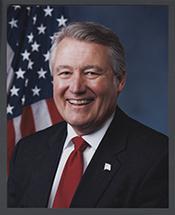
U.S. Representative for Georgia’s 12th district
Republican
119th Congress, two-year term
Missed 1.6% of roll calls. Chamber median 1.9%.
The full voting recordCounts roll calls where most Democrats and most Republicans voted differently, leaving out procedural votes.
How we countFrom FEC filings, Voteview roll calls and Congress.gov.
Republican. In Congress since 2015, 6 terms in total.
Following saves Allen to your list, which Chamber & Street keeps on its server, linked to a cookie on this browser and not to your name or email. Email alerts will come with constituent verification.
Bills and resolutions Allen signed on to as a cosponsor. An original cosponsor signed on the day the bill was introduced. Source: govinfo bill status files, last updated Nov 6, 2026.
Title IX Clarification Act of 2026
Sponsor Jodey Arrington (R). Joined May 14, 2026. 44 cosponsors. H.R. 8781 on Congress.gov
Introduced
Title IX Clarification Act of 2026
This bill defines the terms sex, female, and male for purposes of Title IX of the Education Amendments of 1972. Title IX prohibits discrimination on the basis of sex in education programs that receive federal financial assistance.
Specifically, the bill defines sex as an individual’s biologically determined sex, as either male or female. Therefore, Title IX's prohibition on sex discrimination only applies to biological sex under the bill.
The bill defines female, when used with respect to a natural person, as an individual who naturally has, had, will have, or would have, but for a congenital anomaly, historical accident, or intentional or unintentional disruption, the reproductive system that at some point produces, transports, and utilizes the large gamete (ova) for fertilization.
The bill defines male, when used with respect to a natural person, as an individual who naturally has, had, will have, or would have, but for a congenital anomaly, historical accident, or intentional or unintentional disruption, the reproductive system that at some point produces, transports, and utilizes the small gamete (sperm) for fertilization.
(A January 20, 2025, executive order stated that it is the policy of the United States to recognize two sexes—male and female—which are not changeable. On February 4, 2025, the Department of Education announced its intent to enforce its Title IX regulations consistent with this executive order. For more information on the status of these regulations, see LBS11279.)
Expunging the December 18, 2019, and January 13, 2021, Impeachments of President Donald Trump.
Sponsor Darrell Issa (R). Original cosponsor. 23 cosponsors. H.Res. 1211 on Congress.gov(opens in a new tab)
Introduced
American Broadband Deployment Act of 2025
Sponsor Earl Carter (R). Joined Apr 14, 2026. 14 cosponsors. H.R. 2289 on Congress.gov(opens in a new tab)
Introduced
Proportional Reviews for Broadband Deployment Act
This bill excludes certain requests to modify an existing wireless tower or base station from specified environmental and historic preservation review requirements. Specifically, the bill applies to certain requests to modify an existing wireless tower or base station by collocating, removing, or replacing transmission equipment.
In particular, the bill specifies that such projects are not considered major federal actions under the National Environmental Policy Act of 1969 or undertakings under the National Historic Preservation Act. This excludes the projects from relevant reviews required under those acts.
Riley Gaines Act
Sponsor John McGuire (R). Joined Mar 17, 2026. 10 cosponsors. H.R. 7368 on Congress.gov(opens in a new tab)
Introduced
Dismantle DEI Act of 2025
Sponsor Michael Cloud (R). Joined Mar 16, 2026. 109 cosponsors. H.R. 925 on Congress.gov(opens in a new tab)
Introduced
National Guard Protective Zone Act
Sponsor Sheri Biggs (R). Joined Mar 16, 2026. 4 cosponsors. H.R. 7898 on Congress.gov(opens in a new tab)
Introduced
SAFE Olympic Sports Act
Sponsor Michael Cloud (R). Joined Mar 16, 2026. 17 cosponsors. H.R. 7421 on Congress.gov(opens in a new tab)
Introduced
New Source Review Permitting Improvement Act
Sponsor H. Griffith (R). Joined Mar 16, 2026. 21 cosponsors. H.R. 161 on Congress.gov(opens in a new tab)
Introduced
New Source Review Permitting Improvement Act
This bill modifies terminology for purposes of the New Source Review (NSR) permitting program of the Environmental Protection Agency (EPA).
In order for a change to a stationary source to be a modification (a change to a stationary source that increases the air pollutant emissions or results in new pollutants) for purposes of the NSR permitting program, the maximum hourly emission rate achievable by such source must be higher than the maximum hourly rate achievable by such source during any hour in the 10-year period preceding the change.
A change at a stationary source is not considered to be a modification under the bill if it is designed to (1) reduce the amount of any air pollutant emitted; or (2) restore, maintain, or improve the reliability of operations at, or safety of, the source. However, such changes are not excepted if the EPA determines the increase in the maximum achievable hourly emission rate from such change would cause an adverse effect on human health or the environment.
Construction, in connection with a major emitting facility (a type of stationary source), does not include a change at such a facility that does not result in a significant emissions increase or a significant net emissions increase.
In relation to major emitting facilities in nonattainment areas, the terms modifications and modified do not include changes at such facilities that do not result in a significant emissions increase or a significant net emissions increase.
Recognizing the 10th anniversary of the first export shipment of liquefied natural gas produced in the lower 48 States.
Sponsor Randy Weber (R). Original cosponsor. 34 cosponsors. H.Res. 1076 on Congress.gov(opens in a new tab)
Introduced
Grown in America Act of 2025
Sponsor David Kustoff (R). Joined Feb 23, 2026. 39 cosponsors. H.R. 1707 on Congress.gov(opens in a new tab)
Introduced
Grown in America Act of 2025
This bill establishes a new tax credit (as part of the general business tax credit) for domestically produced agriculture.
Specifically, the bill allows a tax credit for the lesser of (1) 25% of domestically produced agricultural commodity expenses multiplied by the ratio of such expenses to total agricultural commodity expenses (excluding expenses for agricultural commodities that cannot feasibly be produced domestically), or (1) $100 million. (Conditions apply).
To qualify for the tax credit, a business’s average expenses (over three years) for domestically produced agricultural commodities must exceed a certain percentage of total agricultural commodity expenses (excluding expenses for agricultural commodities that cannot feasibly be produced domestically). The required percentage is 50% for 2026 and increases by 5% each year until it reaches 85% for tax years beginning after 2033.
Under the bill, agricultural commodities include
• horticultural, viticultural, and dairy products;
• livestock and livestock products (excluding live animals);
• poultry and bee raising products; and
• farm-raised fish products.
In addition, the general business tax credit limit based on a business’s tax liability is calculated separately for the domestically produced agriculture tax credit, and the credit is generally limited to 50% of a business’s net regular tax liability.
Finally, domestically produced agriculture tax credit amounts in excess of such limitation may be carried forward for 10 years (rather than the 20 years allowed for other business tax credits).
Farmers’ AID Relief Act
Sponsor Earl Carter (R). Original cosponsor. 2 cosponsors. H.R. 7462 on Congress.gov(opens in a new tab)
Introduced
SAVE America Act
Sponsor Chip Roy (R). Joined Feb 10, 2026. 111 cosponsors. H.R. 7296 on Congress.gov(opens in a new tab)
Introduced
Safeguard American Voter Eligibility Act or the SAVE America Act
This bill requires individuals to provide documentary proof of U.S. citizenship when registering to vote, and requires photo identification to vote, in federal elections.
Specifically, the bill prohibits states from accepting and processing an application to register to vote in a federal election unless the applicant presents documentary proof of U.S. citizenship. The bill specifies what documents are considered acceptable proof of U.S. citizenship, such as identification that complies with the REAL ID Act of 2005 that indicates U.S. citizenship.
Further, the bill (1) prohibits states from registering an individual to vote in a federal election unless, at the time the individual applies to register to vote, the individual provides documentary proof of U.S. citizenship; and (2) requires states to establish an alternative process to demonstrate U.S. citizenship.
Each state must take affirmative steps on an ongoing basis to ensure that only U.S. citizens are registered to vote, which shall include establishing a program to identify individuals who are not U.S. citizens using information supplied by certain sources.
Additionally, states must remove noncitizens from their official lists of eligible voters.
The bill (1) provides for a private right of action for certain violations, and (2) establishes criminal penalties for certain offenses.
Individuals voting in federal elections must present an eligible photo identification document. An individual who votes by absentee ballot must submit a copy of their identification document with both the request for, and the submission of, the absentee ballot.
Form 5500 Filing Simplification Act
Sponsor Glenn Grothman (R). Original cosponsor. 11 cosponsors. H.R. 7362 on Congress.gov(opens in a new tab)
Passed committee
No Shari’a Act
Sponsor Randy Fine (R). Joined Feb 4, 2026. 34 cosponsors. H.R. 5512 on Congress.gov(opens in a new tab)
Introduced
Baseload Reliability Protection Act
Sponsor Julie Fedorchak (R). Joined Feb 3, 2026. 26 cosponsors. H.R. 3843 on Congress.gov(opens in a new tab)
Introduced
Make Elections Great Again Act
Sponsor Bryan Steil (R). Original cosponsor. 70 cosponsors. H.R. 7300 on Congress.gov(opens in a new tab)
Introduced
Bridge the Gap for Rural Communities Act
Sponsor Eric Crawford (R). Joined Jan 23, 2026. 31 cosponsors. H.R. 5710 on Congress.gov(opens in a new tab)
Introduced
Buying American Cotton Act of 2026
Sponsor Gregory Murphy (R). Original cosponsor. 102 cosponsors. H.R. 7230 on Congress.gov(opens in a new tab)
Introduced
Supporting the designation of the month of July as "American Families Month".
Sponsor Michael Cloud (R). Joined Jan 21, 2026. 4 cosponsors. H.Res. 735 on Congress.gov(opens in a new tab)
Introduced
Air Permitting Improvements to Protect National Security Act of 2025
Sponsor Gary Palmer (R). Joined Jan 21, 2026. 11 cosponsors. H.R. 6373 on Congress.gov(opens in a new tab)
Introduced
New Health Options Act of 2025
Sponsor Gary Palmer (R). Joined Jan 21, 2026. 3 cosponsors. H.R. 1776 on Congress.gov(opens in a new tab)
Introduced
761st Tank Battalion Congressional Gold Medal Act
Sponsor Gary Palmer (R). Joined Jan 13, 2026. 290 cosponsors. H.R. 1628 on Congress.gov(opens in a new tab)
Introduced
761st Tank Battalion Congressional Gold Medal Act
This bill provides for the award of a Congressional Gold Medal to the 761st Tank Battalion in recognition of their role in the success of Allied forces in Europe during World War II and for the example they set as the first Black soldiers to go to war as part of an American armored unit.
Following the award of the gold medal, the gold medal shall be given to the National Museum of African American History and Culture where it shall be available for display and research.
District of Columbia Medicaid Fairness Act
Sponsor Michael Cloud (R). Joined Jan 6, 2026. 18 cosponsors. H.R. 5815 on Congress.gov(opens in a new tab)
Introduced
American Franchise Act
Sponsor Kevin Hern (R). Joined Dec 10, 2025. 158 cosponsors. H.R. 5267 on Congress.gov(opens in a new tab)
Introduced
Fair Access to Banking Act
Sponsor Andy Barr (R). Joined Dec 9, 2025. 151 cosponsors. H.R. 987 on Congress.gov(opens in a new tab)
Introduced
Fair Access to Banking Act
This bill places restrictions on certain banks, credit unions, and payment card networks if they refuse to do business with a person who complies with the law. Restrictions include prohibiting the use of electronic funds transfer systems and lending programs, termination of an institution's depository insurance, and specified civil penalties.
Banks and other specified financial institutions are allowed to deny financial services to a person only if the denial is justified by a documented failure of that person to meet quantitative, impartial, risk-based standards established in advance by the institution. This justification may not be based upon reputational risks to the institution.
The bill establishes the right for a person to bring a civil action for a violation of this bill.