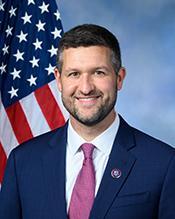
U.S. Representative for New York’s 18th district
Democrat
119th Congress, two-year term
Missed 0.6% of roll calls. Chamber median 1.9%.
The full voting recordCounts roll calls where most Democrats and most Republicans voted differently, leaving out procedural votes.
How we countFrom FEC filings, Voteview roll calls and Congress.gov.
Democrat. In Congress since 2022, 3 terms in total.
Following saves Ryan to your list, which Chamber & Street keeps on its server, linked to a cookie on this browser and not to your name or email. Email alerts will come with constituent verification.
Bills and resolutions Ryan signed on to as a cosponsor. An original cosponsor signed on the day the bill was introduced. Source: govinfo bill status files, last updated Nov 6, 2026.
Safe Schools Improvement Act
Sponsor Linda Sánchez (D). Joined Apr 10, 2025. 218 cosponsors. H.R. 1810 on Congress.gov
Introduced
Safe Schools Improvement Act
This bill requires states to direct their local educational agencies (LEAs) to establish policies that prevent and prohibit bullying and harassment of elementary and secondary school students. In particular, these policies must prohibit bullying and harassment based on race, color, national origin, disability, religion, or sex. Sex includes sexual orientation, gender identity, and sex characteristics (including intersex traits).
Further, LEAs must provide (1) students, parents, and educational professionals with annual notice of the conduct prohibited in their disciplinary policies; (2) students and parents with grievance procedures that target such conduct; and (3) the public with annual data on the incidence and frequency of that conduct at the school and LEA level.
The Department of Education must conduct and report on an independent biennial evaluation of programs and policies to combat bullying and harassment in elementary and secondary schools. The National Center for Education Statistics must collect state data to determine the incidence and frequency of the conduct prohibited by LEA disciplinary policies.
American Family Act
Sponsor Rosa DeLauro (D). Original cosponsor. 215 cosponsors. H.R. 2763 on Congress.gov(opens in a new tab)
Introduced
Raise the Wage Act of 2025
Sponsor Robert Scott (D). Original cosponsor. 177 cosponsors. H.R. 2743 on Congress.gov(opens in a new tab)
Introduced
Invest to Protect Act of 2025
Sponsor Josh Gottheimer (D). Original cosponsor. 51 cosponsors. H.R. 2711 on Congress.gov(opens in a new tab)
Introduced
Invest to Protect Act of 2025
This bill directs the Office of Community Oriented Policing Services within the Department of Justice to award grants to local and tribal governments that employ fewer than 175 law enforcement officers. Grant funds may be used for various activities, including to provide de-escalation training and improve recruitment and retention.
No Tax Breaks for Union Busting (NTBUB) Act
Sponsor Donald Norcross (D). Original cosponsor. 137 cosponsors. H.R. 2692 on Congress.gov(opens in a new tab)
Introduced
No Tax Breaks for Union Busting (NTBUB) Act
This bill excludes from the tax deduction for ordinary and necessary business expenses amounts paid or incurred to influence employees with respect to labor organizations or labor organization activities. The bill also imposes information reporting requirements related to such expenses and imposes penalties for failure to comply.
Under the bill, amounts paid to influence employees with respect to labor organizations include amounts paid (including wages and other costs)
• in connection with an action that results in a complaint or settlement related to an unfair labor practice or a finding of interference, influence, or coercion related to railway employees’ rights to organize and bargain collectively;
• for any meeting or training attended by employees and at which labor organizations are discussed; and
• that require certain employer disclosures and financial reporting.
(Some exceptions apply.)
The bill requires employers to file a return reporting certain information related to expenses paid to influence employees with respect to labor organizations and imposes a penalty for noncompliance. The amount of the penalty is the greater of (1) $10,000, or (2) $1,000 multiplied by the number full-time equivalent employees. Additional penalties apply for violations that continue for more than 90 days.
The bill also imposes information reporting requirements on persons conducting activities on behalf of another person to influence employees with respect to labor organizations.
The bill allows certain penalties for noncompliance with the reporting requirements to be waived if noncompliance is due to reasonable cause and not willful neglect.
Tax Fairness for Workers Act
Sponsor Brendan Boyle (D). Original cosponsor. 176 cosponsors. H.R. 2671 on Congress.gov(opens in a new tab)
Introduced
Workplace Violence Prevention for Health Care and Social Service Workers Act
Sponsor Joe Courtney (D). Joined Apr 7, 2025. 134 cosponsors. H.R. 2531 on Congress.gov(opens in a new tab)
Introduced
Workplace Violence Prevention for Health Care and Social Service Workers Act
This bill requires the Department of Labor to address workplace violence in health care, social service, and similar sectors.
Specifically, Labor must issue an occupational safety and health standard that requires certain employers to take actions to protect workers and other personnel from workplace violence. The standard applies to employers in the health care sector, in the social service sector, and in sectors that conduct activities similar to those in the health care and social service sectors. Among other elements, the standard must require each employer to (1) develop a workplace violence prevention plan, (2) promptly investigate incidents of workplace violence, and (3) provide relevant training and education to employees.
The bill requires certain hospitals and skilled nursing facilities to comply with this standard as a condition of Medicare participation.
Honor Farmer Contracts Act
Sponsor Gabe Vasquez (D). Joined Apr 7, 2025. 13 cosponsors. H.R. 2396 on Congress.gov(opens in a new tab)
Introduced
Honor Farmer Contracts Act
This bill requires the Department of Agriculture (USDA) to unfreeze funding for agreements and contracts and prohibits USDA from closing certain offices and service centers without notifying Congress in advance.
Specifically, USDA must (1) unfreeze funding for, and implement, all agreements and contracts entered into by USDA prior to the bill's enactment; and (2) pay all related past due amounts owed by USDA as rapidly as possible.
Further, the bill prohibits USDA from canceling a signed agreement or contract with a farmer or an entity providing assistance to farmers (unless the farmer or entity is not in compliance with the terms and conditions of the contract).
Finally, the bill prohibits USDA from closing Farm Service Agency county offices, Natural Resources Conservation Service field offices, or Rural Development Service Centers without providing written notice and a justification to Congress at least 60 days before the closure.
Puppy Protection Act of 2025
Sponsor Brian Fitzpatrick (R). Joined Apr 7, 2025. 219 cosponsors. H.R. 2253 on Congress.gov(opens in a new tab)
Introduced
CARE Act of 2025
Sponsor Mike Carey (R). Original cosponsor. 48 cosponsors. H.R. 2538 on Congress.gov(opens in a new tab)
Introduced
Comprehensive Alternative Response for Emergencies Act of 2025 or the CARE Act of 2025
This bill requires the Center for Medicare and Medicaid Innovation (CMMI) to test a five-year model that provides for Medicare payment for ground ambulance services that do not result in the transport of the patient.
Under the model, Medicare payment may be furnished for ground ambulance services when an ambulance is dispatched in response to an emergency medical call but the ambulance does not end up transporting the patient. Payment rates under the model must generally align with the payment rates that apply when there is an actual transport.
The Government Accountability Office must report on the general access of Medicare beneficiaries to emergency medical services, including the impact of the model on beneficiary access and outcomes.
Promoting Resilient Supply Chains Act of 2025
Sponsor John James (R). Joined Apr 1, 2025. 4 cosponsors. H.R. 2444 on Congress.gov(opens in a new tab)
Passed the House
Promoting Resilient Supply Chains Act of 2025
This bill requires the Industry and Analysis office of the International Trade Administration of the Department of Commerce to monitor and respond to disruptions in critical industries and supply chains.
Specifically, the office must (1) establish the Supply Chain Resilience Working Group; (2) assess, map, and model critical supply chains; (3) identify high-priority supply chain gaps and vulnerabilities in critical industries; (4) identify and evaluate the effect of potential supply chain disruptions on market stability; and (5) collaborate with other governmental bodies and key international partners to identify opportunities to reduce supply chain gaps and vulnerabilities.
Additionally, the office, in consultation with the working group and specified nongovernmental entities, must make recommendations and implement a strategy to improve the security and resiliency of manufacturing capacity and supply chains for critical industries (including critical industries for emerging technologies).
The bill includes various reporting requirements.
Paycheck Fairness Act
Sponsor Rosa DeLauro (D). Original cosponsor. 221 cosponsors. H.R. 17 on Congress.gov(opens in a new tab)
Introduced
Access to Family Building Act
Sponsor Laura Gillen (D). Joined Mar 18, 2025. 77 cosponsors. H.R. 2049 on Congress.gov(opens in a new tab)
Introduced
Access to Family Building Act
This bill provides a statutory right to access assisted reproductive technology (e.g., in vitro fertilization).
Specifically, under the bill, individuals have the right to access assisted reproductive technology, and to retain all rights with respect to the use or disposition of reproductive genetic materials (e.g., eggs or sperm), without prohibitions or unreasonable restrictions. Health care providers and insurers also have the right to provide and cover these services, respectively.
The bill does not affect state or local health and safety regulations that achieve their purpose in the least restrictive manner possible.
The Department of Justice may bring civil actions against states, localities, or government officials or entities that enact or enforce limitations or requirements that violate this bill. Individuals and health care providers who are affected by violations may also bring civil actions for relief.
25th Anniversary of 9/11 Commemorative Coin Act
Sponsor Daniel Goldman (D). Joined Mar 18, 2025. 302 cosponsors. H.R. 1993 on Congress.gov(opens in a new tab)
Passed the House
25th Anniversary of 9/11 Commemorative Coin Act
This bill directs the Department of the Treasury to mint and issue coins to commemorate the 25th anniversary of the September 11, 2001, terrorist attacks on the United States and the establishment of the National September 11 Memorial and Museum at the World Trade Center.
The sale of all coins issued under this bill must include a surcharge to be paid to the National September 11 Memorial and Museum at the World Trade Center to support operations and maintenance. However, if the issuance of this commemorative coin exceeds certain annual limits, no surcharge may be included.
Major Richard Star Act
Sponsor Gus Bilirakis (R). Original cosponsor. 340 cosponsors. H.R. 2102 on Congress.gov(opens in a new tab)
Introduced
Major Richard Star Act
This bill allows a veteran with a combat-related disability to receive retirement pay, without reduction, concurrently with their disability compensation. This includes veterans with a combat-related disability and fewer than 20 years of creditable service. (Currently, veterans who receive combat-related special compensation and retirement pay are subject to an offset in retirement pay for concurrent receipt of such benefits.)
Prevent Interruptions in Physical Therapy Act of 2025
Sponsor Gus Bilirakis (R). Joined Mar 14, 2025. 63 cosponsors. H.R. 1517 on Congress.gov(opens in a new tab)
Introduced
Prevent Interruptions in Physical Therapy Act of 2025
This bill allows a physical therapist to receive payment under Medicare for services provided to the physical therapist's patients by another physical therapist through a qualifying temporary arrangement, regardless of the geographic area or population served. Currently, physical therapists may only receive payment with respect to such arrangements for services provided in medically underserved, rural, or health professional shortage areas.
Stop Comstock Act
Sponsor Becca Balint (D). Original cosponsor. 146 cosponsors. H.R. 2029 on Congress.gov(opens in a new tab)
Introduced
Smithsonian American Women’s History Museum Act
Sponsor Nicole Malliotakis (R). Joined Mar 10, 2025. 231 cosponsors. H.R. 1329 on Congress.gov(opens in a new tab)
Introduced
Smithsonian American Women’s History Museum Act
This bill authorizes the Smithsonian American Women's History Museum to be located on a particular site within the Reserve of the National Mall in Washington, DC.
Specifically, the bill designates the South Monument site as the location for the museum; however, the President may designate an alternative site within 180 days of the bill's enactment. (The site is the undeveloped land across the National Mall from the National Museum of African American History and Culture.) Administrative jurisdiction of the site must be transferred to the Smithsonian Institution.
The Board of Regents of the Smithsonian Institution must have the approval of specified federal entities (e.g., the Commission of Fine Arts) to plan, design, and construct a museum building. The bill (1) outlines the criteria for considering site and design proposals, and (2) requires the Smithsonian Institution to reimburse for costs resulting from the building approval process.
The bill directs the museum to be dedicated to preserving, researching, and presenting the history, achievements, and lived experiences of biological women in the United States. Under this bill, the museum may not identify, present, describe, or depict any biological male as a female.
In carrying out its duties, the museum's advisory council must (1) seek and utilize guidance from a broad array of knowledgeable and respected sources reflecting the diversity of the political viewpoints and authentic experiences held by women in the United States, and (2) seek guidance for the creation and substantial revision of exhibits and programs.
Honoring Our Fallen Heroes Act of 2025
Sponsor Mary Gay Scanlon (D). Joined Mar 10, 2025. 180 cosponsors. H.R. 1269 on Congress.gov(opens in a new tab)
Introduced
Honoring Our Fallen Heroes Act of 2025
This bill extends death and disability benefits under the Public Safety Officers' Benefits Program (PSOB) to certain public safety officers who suffer from exposure-related cancer while on duty and their survivors. The PSOB program provides death, disability, and education benefits to public safety officers who are killed or injured in the line of duty and their survivors.
The bill specifies that exposure to a carcinogen shall be presumed to constitute a personal injury in the line of duty if
• the exposure occurred while the officer was in the line of duty;
• the officer began serving as an officer not fewer than 5 years before the date of the diagnosis of an exposure-related cancer and the diagnosis occurred not more than 15 years after the last date of active service; and
• the exposure-related cancer directly and proximately resulted in the death or permanent and total disability of the officer.
The Department of Justice's Bureau of Justice Assistance must periodically review the definition of exposure-related cancer and update the definition if appropriate based on medical evidence and in accordance with the requirements of a petition process.
Department of Defense PFAS Discharge Prevention Act
Sponsor Jennifer McClellan (D). Original cosponsor. 18 cosponsors. H.R. 1938 on Congress.gov(opens in a new tab)
Introduced
Richard L. Trumka Protecting the Right to Organize Act of 2025
Sponsor Robert Scott (D). Original cosponsor. 217 cosponsors. H.R. 20 on Congress.gov(opens in a new tab)
Introduced
John R. Lewis Voting Rights Advancement Act of 2025
Sponsor Terri Sewell (D). Original cosponsor. 221 cosponsors. H.R. 14 on Congress.gov(opens in a new tab)
Introduced
John R. Lewis Voting Rights Advancement Act of 2025
This bill establishes new criteria for determining which states and political subdivisions must obtain preclearance before changes to voting practices may take effect. Preclearance is the process of receiving preapproval from the Department of Justice (DOJ) or the U.S. District Court for the District of Columbia before making legal changes that would affect voting rights.
A state and all of its political subdivisions shall be subject to preclearance of voting practice changes for a 10-year period if, during the previous 25 years:
• 15 or more voting rights violations occurred in the state;
• 10 or more violations occurred, at least 1 of which was committed by the state itself; or
• 3 or more violations occurred and the state administers the elections.
A political subdivision as a separate unit shall also be subject to preclearance for a 10-year period if three or more voting rights violations occurred there during the previous 25 years.
States and political subdivisions that meet certain thresholds regarding minority groups must preclear covered practices before implementation, such as redistricting.
States and political subdivisions must notify the public of changes to voting practices.
The bill authorizes DOJ to require states or political subdivisions to provide certain documents or answers to questions for enforcing voting rights.
The bill outlines factors courts must consider when hearing challenges to voting practices, such as the extent of any history of official voting discrimination in the state or political subdivision.
Humane Cosmetics Act of 2025
Sponsor Donald Beyer (D). Joined Mar 4, 2025. 161 cosponsors. H.R. 1657 on Congress.gov(opens in a new tab)
Introduced
Humane Cosmetics Act of 2025
This bill generally prohibits animal testing in the evaluation of cosmetic products, and it prohibits the sale or transport of cosmetics developed using animal testing, subject to civil penalties. These prohibitions begin one year after enactment.
The bill specifies exceptions to these prohibitions, including if such animal testing (1) is conducted outside the United States to comply with a foreign regulatory authority; (2) is pursuant to a finding by the Food and Drug Administration (FDA) that there are no nonanimal alternatives to test the safety of a potentially dangerous cosmetic product or ingredient; (3) is of a product or ingredient for a drug or device subject to regulation by the FDA; or (4) is required for a noncosmetic purpose pursuant to a state, federal, or foreign regulatory authority.
Further, evidence derived from animal testing conducted more than one year after the bill's enactment may not be used to establish the safety of a cosmetic product or ingredient that is regulated by the FDA, subject to limited exceptions.
Access to Reproductive Care for Servicemembers Act
Original cosponsor. 80 cosponsors. H.R. 1742 on Congress.gov(opens in a new tab)
Progress not on file
Standard FEES Act
Sponsor Gary Palmer (R). Original cosponsor. 2 cosponsors. H.R. 1731 on Congress.gov(opens in a new tab)
Passed committee
Standard Fees to Expedite Evaluation and Streamlining Act or the Standard FEES Act
This bill requires the General Services Administration (GSA) to establish, and federal agencies to adopt, a uniform schedule of fees for applications to place, modify, or maintain communications facilities in, over, or on federally owned buildings and property.
The fees established by the GSA must be competitively neutral with respect to other application fees for similar uses of federal buildings and property and based on the direct and actual costs of processing such applications. The GSA may establish exceptions to the fee schedule to be granted by agencies on a case-by-case basis, provided the exceptions are competitively neutral with respect to the categories of individuals or entities granted exceptions and meet certain other requirements.
Agencies may only use fees collected to cover the costs of processing applications, and only to the extent that the funds are provided in advance in appropriations acts.