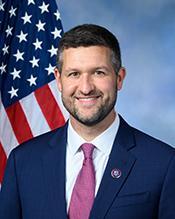
U.S. Representative for New York’s 18th district
Democrat
119th Congress, two-year term
Missed 0.6% of roll calls. Chamber median 1.9%.
The full voting recordCounts roll calls where most Democrats and most Republicans voted differently, leaving out procedural votes.
How we countFrom FEC filings, Voteview roll calls and Congress.gov.
Democrat. In Congress since 2022, 3 terms in total.
Following saves Ryan to your list, which Chamber & Street keeps on its server, linked to a cookie on this browser and not to your name or email. Email alerts will come with constituent verification.
Bills and resolutions Ryan signed on to as a cosponsor. An original cosponsor signed on the day the bill was introduced. Source: govinfo bill status files, last updated Nov 6, 2026.
Expressing strong disapproval of the President's announcement to withdraw the United States from the Paris Agreement.
Sponsor Bradley Schneider (D). Joined Jan 28, 2025. 162 cosponsors. H.Res. 68 on Congress.gov
Introduced
Holocaust Education and Antisemitism Lessons Act
Sponsor Josh Gottheimer (D). Original cosponsor. 112 cosponsors. H.R. 768 on Congress.gov(opens in a new tab)
Introduced
Holocaust Education and Antisemitism Lessons Act
This bill directs the U.S. Holocaust Memorial Museum to study and report on Holocaust education efforts in states, local educational agencies (LEAs), and public elementary and secondary schools. Among other elements, the study must (1) determine whether states and LEAs require Holocaust education as part of the curriculum taught in public elementary and secondary schools, (2) identify the standards and requirements relating to Holocaust education, and (3) identify the types of instructional material used to teach students about the Holocaust.
Whole Milk for Healthy Kids Act of 2025
Sponsor Glenn Thompson (R). Original cosponsor. 118 cosponsors. H.R. 649 on Congress.gov(opens in a new tab)
Introduced
Whole Milk for Healthy Kids Act of 2025
This bill revises requirements for milk provided by the National School Lunch Program of the Department of Agriculture (USDA).
Currently, schools participating in the program must provide milk that is consistent with the most recent Dietary Guidelines for Americans; USDA regulations require milk to be fat-free or low-fat and allow milk to be flavored or unflavored. The bill modifies these restrictions and instead permits schools to offer students whole, reduced-fat, low-fat, and fat-free flavored and unflavored milk. The milk that is offered may be organic or nonorganic. Further, USDA may not prohibit a participating school from offering students any of these milk choices.
Further, schools currently must provide a substitute for fluid milk, on receipt of a written statement from a licensed physician, for students whose disability restricts their diet. Under the bill, a parent or legal guardian may also provide the written statement.
In addition, schools currently participating in the program must provide meals that meet certain nutrition requirements; USDA regulations require that the average saturated fat content of the meals offered must be less than 10% of the total calories. Under the bill, fluid milk is excluded from the saturated fat content calculation; milk fat included in any fluid milk provided by the program must not be considered saturated fat for the purposes of measuring compliance with USDA regulations.
Finally, the bill prohibits schools participating in the program from purchasing or offering milk produced by Chinese state-owned enterprises.
Agricultural Environmental Stewardship Act of 2025
Sponsor Hillary Scholten (D). Joined Jan 22, 2025. 3 cosponsors. H.R. 536 on Congress.gov(opens in a new tab)
Introduced
Agricultural Environmental Stewardship Act of 2025
This bill extends for one year the energy investment tax credit for qualified biogas property (property that converts biomass into methane and captures the gas for sale or productive use).
Under the bill, the energy investment tax credit (as part of the general business tax credit) is allowed for investments in qualified biogas property for which construction begins on or before December 31, 2025. (Under current law, to qualify for the tax credit, construction of qualified biogas property must begin on or before December 31, 2024.)
HALT Fentanyl Act
Sponsor H. Griffith (R). Joined Jan 22, 2025. 61 cosponsors. H.R. 27 on Congress.gov(opens in a new tab)
Passed the House
Halt All Lethal Trafficking of Fentanyl Act or the HALT Fentanyl Act
This bill permanently places fentanyl-related substances as a class into schedule I of the Controlled Substances Act. A schedule I controlled substance is a drug, substance, or chemical that has a high potential for abuse; has no currently accepted medical value; and is subject to regulatory controls and administrative, civil, and criminal penalties under the Controlled Substances Act.
Under the bill, offenses involving fentanyl-related substances are triggered by the same quantity thresholds and subject to the same penalties as offenses involving fentanyl analogues (e.g., offenses involving 100 grams or more trigger a 10-year mandatory minimum prison term).
Additionally, the bill establishes a new, alternative registration process for certain schedule I research.
The bill also makes several other changes to registration requirements for conducting research with controlled substances, including
• permitting a single registration for related research sites in certain circumstances,
• waiving the requirement for a new inspection in certain situations, and
• allowing a registered researcher to perform certain manufacturing activities with small quantities of a substance without obtaining a manufacturing registration.
Finally, the bill expresses the sense that Congress agrees with the interpretation of Controlled Substances Act in United States v. McCray, a 2018 case decided by the U.S. District Court for the Western District of New York. In that case, the court held that butyryl fentanyl, a controlled substance, can be considered an analogue of fentanyl even though, under the Controlled Substances Act, the term controlled substance analogue specifically excludes a controlled substance.
Vietnam Veterans Liver Fluke Cancer Study Act
Sponsor Nick LaLota (R). Original cosponsor. 8 cosponsors. H.R. 586 on Congress.gov(opens in a new tab)
Passed the House
Vietnam Veterans Liver Fluke Cancer Study Act
This bill requires the Department of Veterans Affairs (VA) to conduct an epidemiological study and report on the prevalence of cholangiocarcinoma (bile duct cancer) in veterans who served in the Vietnam theater of operations during the Vietnam era. The study must identify the rate of incidence of cholangiocarcinoma in such veterans and in U.S. residents.
The bill also requires the VA to track and report on the prevalence of cholangiocarcinoma using the Veterans Affairs Central Cancer Registry. Additionally, the VA must periodically submit follow-up reports to Congress regarding the epidemiological study and information collected from the cancer registry regarding the prevalence of bile duct cancer.
Supporting Veteran Families in Need Act
Sponsor Nick LaLota (R). Original cosponsor. 10 cosponsors. H.R. 585 on Congress.gov(opens in a new tab)
Introduced
Supporting Veteran Families in Need Act
This bill permanently extends authorization for the Supportive Services for Veteran Families program of the Department of Veterans Affairs, which provides supportive services to very low-income veterans (and their families) occupying or transitioning to permanent housing.
ACES Act
Sponsor August Pfluger (R). Original cosponsor. 35 cosponsors. H.R. 530 on Congress.gov(opens in a new tab)
Passed the House
ACES Act
This bill requires the Department of Veterans Affairs to enter into an agreement with the National Academies of Sciences, Engineering, and Medicine to study and report on the prevalence and mortality of cancers among veterans who served on active duty as aircrew members and regularly flew in fixed-wing aircraft.
Veterans Member Business Loan Act
Sponsor Vicente Gonzalez (D). Original cosponsor. 73 cosponsors. H.R. 507 on Congress.gov(opens in a new tab)
Introduced
Veterans Member Business Loan Act
This bill excludes from credit union aggregate loan limitations member business loans made to veterans.
PFC Joseph P. Dwyer Peer Support Program Act
Sponsor Nick LaLota (R). Original cosponsor. 32 cosponsors. H.R. 438 on Congress.gov(opens in a new tab)
Introduced
PFC Joseph P. Dwyer Peer Support Program Act
This bill requires the Department of Veterans Affairs (VA) to establish the PFC Joseph P. Dwyer Peer Support Program to make grants to eligible entities for peer-to-peer mental health programs for veterans.
Eligible entities include (1) a nonprofit organization that has historically served the mental health needs of veterans; (2) a congressionally chartered veteran service organization; or (3) a state, local, or tribal veteran service agency, director, or commissioner.
The VA shall establish an advisory committee to create appropriate program standards.
SALT Deductibility Act
Sponsor Andrew Garbarino (R). Original cosponsor. 25 cosponsors. H.R. 430 on Congress.gov(opens in a new tab)
Introduced
Securing Access to Lower Taxes by ensuring Deductibility Act or the SALT Deductibility Act
This bill repeals the limitation on the federal tax deduction for state and local taxes (commonly known as the SALT deduction cap).
Under current law, a SALT deduction cap of $10,000 ($5,000 for married individuals filing separate federal income tax returns) applies for tax years 2018 through 2025 and expires beginning in 2026.
To designate the facility of the United States Postal Service located at 216 Cumberland Street in Rochester, New York, as the "Minister Franklin Florence Memorial Post Office".
Sponsor Joseph Morelle (D). Joined Jan 15, 2025. 25 cosponsors. H.R. 397 on Congress.gov(opens in a new tab)
Passed committee
This bill designates the facility of the United States Postal Service located at 216 Cumberland Street in Rochester, New York, as the "Minister Franklin Florence Memorial Post Office".
To designate the facility of the United States Postal Service located at 80 Prospect Street in Avon, New York, as the "Officer Anthony Mazurkiewicz Memorial Post Office Building".
Sponsor Claudia Tenney (R). Joined Jan 15, 2025. 24 cosponsors. H.R. 323 on Congress.gov(opens in a new tab)
Passed the House
This bill designates the facility of the United States Postal Service located at 80 Prospect Street in Avon, New York, as the "Officer Anthony Mazurkiewicz Memorial Post Office Building".
National Law Enforcement Officers Remembrance, Support, and Community Outreach Act
Sponsor Troy Nehls (R). Original cosponsor. 124 cosponsors. H.R. 309 on Congress.gov(opens in a new tab)
Passed the House
National Law Enforcement Officers Remembrance, Support and Community Outreach Act. [sic]
This bill temporarily directs the Department of the Interior to award a grant to the National Law Enforcement Officers Memorial Fund for the expenses associated with operating and enhancing the community outreach, public education, and officer safety and wellness programs of the National Law Enforcement Museum.
Washington, D.C. Admission Act
Sponsor Eleanor Norton (D). Original cosponsor. 209 cosponsors. H.R. 51 on Congress.gov(opens in a new tab)
Introduced
Washington, D.C. Admission Act
This bill provides for the establishment of the State of Washington, Douglass Commonwealth, and its admission into the United States.
The state is composed of most of the territory of the District of Columbia (DC), excluding a specified area that encompasses the U.S. Capitol, the White House, the U.S. Supreme Court building, federal monuments, and federal office buildings adjacent to the National Mall and the U.S. Capitol. The excluded territory shall be known as the Capital and serve as the seat of the government of the United States, as provided for in Article I of the Constitution. The state may not impose taxes on federal property except as Congress permits.
The bill provides for the DC Mayor to issue a proclamation for the first elections to Congress of two Senators and one Representative of the state. The bill eliminates the office of Delegate to the House of Representatives.
The bill applies current DC laws to the state. DC judicial proceedings and contractual obligations shall continue under the state’s authority. The bill also provides for specified federal obligations to transfer to the state upon its certification that it has funds and laws in place to assume the obligations. These include maintaining a retirement fund for judges and operating public defender services.
The bill establishes a commission that is generally comprised of members who are appointed by DC and federal government officials to advise on an orderly transition to statehood.