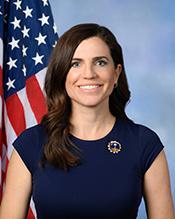
U.S. Representative for South Carolina’s 1st district
Republican
119th Congress, two-year term
Missed 17.8% of roll calls. Chamber median 1.9%.
The full voting recordCounts roll calls where most Democrats and most Republicans voted differently, leaving out procedural votes.
How we countFrom FEC filings, Voteview roll calls and Congress.gov.
Republican. In Congress since 2021, 3 terms in total.
Following saves Mace to your list, which Chamber & Street keeps on its server, linked to a cookie on this browser and not to your name or email. Email alerts will come with constituent verification.
Bills and resolutions Mace signed on to as a cosponsor. An original cosponsor signed on the day the bill was introduced. Source: govinfo bill status files, last updated Nov 6, 2026.
Fund and Complete the Border Wall Act
Sponsor Andy Biggs (R). Original cosponsor. 1 cosponsor. H.R. 76 on Congress.gov
Introduced
Fund and Complete the Border Wall Act
This bill establishes funding for a U.S.-Mexico border barrier and revises how border patrol agents are compensated for overtime.
The Department of the Treasury shall set up an account for funding the design, construction, and maintenance of the barrier. The funds in the account are appropriated only for that purpose and for vehicles and equipment for border patrol agents.
For each fiscal year, financial assistance to a country shall be reduced by $2,000 for each citizen or national of that country apprehended for illegally entering the United States through its southern border. The reduced amount shall be transferred to the border barrier account. The Department of State may opt not to reduce amounts appropriated to Mexico for various military and law enforcement-related activities.
This bill establishes a 5% fee on foreign remittance transfers and increases the fee for the arrival/departure I-94 form for various aliens entering the United States, with part of the fees going to the border barrier account.
By December 31, 2025, the Department of Homeland Security shall (1) take all actions necessary, including constructing barriers, to prevent illegal crossings along the U.S.-Mexico barrier; and (2) achieve operational control over all U.S. international borders.
The bill changes how border patrol agents receive overtime pay when working up to 100 hours in a two-week period. For hours worked above 80, an agent shall receive at least 150% of the agent's regular hourly rate.
Voter Integrity Protection Act
Sponsor Andy Biggs (R). Original cosponsor. 3 cosponsors. H.R. 58 on Congress.gov(opens in a new tab)
Introduced
Voter Integrity Protection Act
This bill imposes additional immigration-related penalties for non-U.S. nationals (aliens under federal law) who vote in an election for federal office.
It shall be an aggravated felony for a non-U.S. national who is unlawfully present to violate an existing prohibition against a non-U.S. national voting in a federal election. (An aggravated felony conviction carries various immigration consequences, such as rendering the non-U.S. national inadmissible, deportable, and barred from establishing good moral character for naturalization.)
A non-U.S. national who is unlawfully present and who knowingly violates the prohibition against voting in a federal election shall be deportable.
Ending Catch and Release Act of 2025
Sponsor Andy Biggs (R). Original cosponsor. 3 cosponsors. H.R. 57 on Congress.gov(opens in a new tab)
Introduced
Ending Catch and Release Act of 2025
This bill changes the treatment of certain non-U.S. nationals (aliens under federal law) without lawful immigration status, including by prohibiting the release of asylum seekers into the United States while their cases are pending.
The Department of Homeland Security (DHS) may not (with some exceptions) release an individual who is not clearly entitled to admission into the United States while the individual's case is pending, even if the individual is an asylum seeker. DHS may instead detain the individual or return the individual to a neighboring country in certain situations.
The bill also expands expedited removal from the United States (i.e., removal without further hearing or review) to include individuals present in the United States without being admitted, with certain exceptions. Under current law, individuals are subject to expedited removal if they lack proper documentation or obtained an immigration benefit through fraud; such individuals are still subject to expedited removal under the bill.
The bill also modifies the standard for establishing a credible fear of persecution to avoid expedited removal. Generally, an asylum seeker may avoid expedited removal if an asylum officer finds such a credible fear. Under this bill, an officer may find credible fear if it is more likely than not the individual can establish their eligibility for asylum, whereas under current law, the officer may find credible fear if there is a significant possibility that the individual can establish their eligibility.
WHO Withdrawal Act
Sponsor Andy Biggs (R). Original cosponsor. 22 cosponsors. H.R. 54 on Congress.gov(opens in a new tab)
Introduced
WHO Withdrawal Act
This bill requires the President to immediately withdraw the United States from the World Health Organization (WHO) and prohibits using any federal funds to provide for U.S. participation in the WHO.
The bill also repeals the 1948 act authorizing the United States to join the WHO.
Constitutional Concealed Carry Reciprocity Act of 2025
Sponsor Richard Hudson (R). Original cosponsor. 189 cosponsors. H.R. 38 on Congress.gov(opens in a new tab)
Introduced
Constitutional Concealed Carry Reciprocity Act
This bill establishes a federal statutory framework to regulate the carry or possession of concealed firearms across state lines.
Specifically, an individual who is eligible to carry a concealed firearm in one state may carry or possess a concealed handgun (other than a machine gun or destructive device) in another state that allows its residents to carry concealed firearms.
It sets forth requirements for lawful concealed carry across state lines. The bill preempts most state and local laws related to concealed carry and establishes a private right of action for a person adversely affected by interference with a concealed-carry right established by this bill.
Laken Riley Act
Sponsor Mike Collins (R). Original cosponsor. 54 cosponsors. H.R. 29 on Congress.gov(opens in a new tab)
Passed the House
Laken Riley Act
This bill requires the Department of Homeland Security (DHS) to detain certain non-U.S. nationals (aliens under federal law) who have been arrested for burglary, theft, larceny, or shoplifting. The bill also authorizes states to sue the federal government for decisions or alleged failures related to immigration enforcement.
Under this bill, DHS must detain an individual who (1) is unlawfully present in the United States or did not possess the necessary documents when applying for admission; and (2) has been charged with, arrested for, convicted of, or admits to having committed acts that constitute the essential elements of burglary, theft, larceny, or shoplifting.
The bill also authorizes state governments to sue for injunctive relief over certain immigration-related decisions or alleged failures by the federal government if the decision or failure caused the state or its residents harm, including financial harm of more than $100. Specifically, the state government may sue the federal government over a
• decision to release a non-U.S. national from custody;
• failure to fulfill requirements relating to inspecting individuals seeking admission into the United States, including requirements related to asylum interviews;
• failure to fulfill a requirement to stop issuing visas to nationals of a country that unreasonably denies or delays acceptance of nationals of that country;
• violation of limitations on immigration parole, such as the requirement that parole be granted only on a case-by-case basis; or
• failure to detain an individual who has been ordered removed from the United States.
Protection of Women and Girls in Sports Act of 2025
Sponsor W. Steube (R). Original cosponsor. 83 cosponsors. H.R. 28 on Congress.gov(opens in a new tab)
Passed the House
Protection of Women and Girls in Sports Act of 2025
This bill generally prohibits school athletic programs from allowing individuals whose biological sex at birth was male to participate in programs that are for women or girls.
Specifically, the bill provides that it is a violation of Title IX of the Education Amendments of 1972 for federally funded education programs or activities to operate, sponsor, or facilitate athletic programs or activities that allow individuals of the male sex to participate in programs or activities that are designated for women or girls. (Title IX prohibits discrimination on the basis of sex in federally funded education programs or activities, including in public elementary and secondary schools and in colleges and universities.) Under the bill, sex is based on an individual's reproductive biology and genetics at birth.
The bill does not prohibit male individuals from training or practicing with programs or activities for women or girls as long as such training or practice does not deprive any female of corresponding opportunities or benefits.
The Government Accountability Office must report on the benefits for women or girls in single-sex sports that would be lost as a result of male participation. In particular, the report must document the negative psychological, developmental, participatory, and sociological effects of male participation on girls.
Federal Reserve Transparency Act of 2025
Sponsor Thomas Massie (R). Original cosponsor. 46 cosponsors. H.R. 24 on Congress.gov(opens in a new tab)
Introduced
Federal Reserve Transparency Act of 2025
This bill directs the Government Accountability Office (GAO) to complete, within 12 months, an audit of the Federal Reserve Board and Federal Reserve banks. In addition, the bill allows the GAO to audit the Federal Reserve Board and Federal Reserve banks with respect to (1) international financial transactions; (2) deliberations, decisions, or actions on monetary policy matters; (3) transactions made under the direction of the Federal Open Market Committee; and (4) discussions or communications among Federal Reserve officers, board members, and employees regarding any of these matters.
SAVE Act
Sponsor Chip Roy (R). Original cosponsor. 110 cosponsors. H.R. 22 on Congress.gov(opens in a new tab)
Passed the House
Safeguard American Voter Eligibility Act or the SAVE Act
This bill requires individuals to provide documentary proof of U.S. citizenship when registering to vote in federal elections.
Specifically, the bill prohibits states from accepting and processing an application to register to vote in a federal election unless the applicant presents documentary proof of U.S. citizenship. The bill specifies what documents are considered acceptable proof of U.S. citizenship, such as identification that complies with the REAL ID Act of 2005 that indicates U.S. citizenship.
Further, the bill (1) prohibits states from registering an individual to vote in a federal election unless, at the time the individual applies to register to vote, the individual provides documentary proof of U.S. citizenship; and (2) requires states to establish an alternative process under which an applicant may submit other evidence to demonstrate U.S. citizenship.
Each state must take affirmative steps on an ongoing basis to ensure that only U.S. citizens are registered to vote, which shall include establishing a program to identify individuals who are not U.S. citizens using information supplied by certain sources.
Additionally, states must remove noncitizens from their official lists of eligible voters.
The bill allows for a private right of action against an election official who registers an applicant to vote in a federal election who fails to present documentary proof of U.S. citizenship.
The bill establishes criminal penalties for certain offenses, including registering an applicant to vote in a federal election who fails to present documentary proof of U.S. citizenship.
SEND THEM BACK Act of 2025
Sponsor Andrew Ogles (R). Original cosponsor. 5 cosponsors. H.R. 190 on Congress.gov(opens in a new tab)
Introduced
Sending Evading Non-Documented Threats Home Especially Migrants Biden Accepted Carelessly and Knowingly Act of 2025 or the SEND THEM BACK Act of 2025
This bill subjects non-U.S. nationals (aliens under federal law) who illegally entered the United States on or after January 20, 2021, to expedited removal (i.e., removal without further hearing or review). This applies even if such an individual indicated an intention to apply for asylum or expressed a fear of persecution. The bill does not apply to an individual serving in the Armed Forces as of January 1, 2025.
Finish the Wall Act
Sponsor Clay Higgins (R). Original cosponsor. 29 cosponsors. H.R. 163 on Congress.gov(opens in a new tab)
Introduced
Finish the Wall Act
This bill requires the Department of Homeland Security (DHS) to resume activities related to the construction of a barrier system along the U.S.-Mexico border and addresses other border-related issues.
DHS must resume all such construction activities that were planned or underway prior to January 20, 2021. DHS must also expend all funds appropriated or explicitly obligated since October 1, 2016, for construction of this barrier system. DHS may not cancel contracts for activities related to such construction entered into on or before January 20, 2021.
Furthermore, within 14 days of this bill's enactment, DHS must certify to Congress that U.S. Customs and Border Protection facilities that process adults taken into custody at the border are fully compliant with certain laws related to the collection of DNA. (Among other things, these laws allow for the collection of DNA samples from non-U.S. persons detained under U.S. authority.)