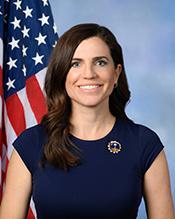
U.S. Representative for South Carolina’s 1st district
Republican
119th Congress, two-year term
Missed 17.8% of roll calls. Chamber median 1.9%.
The full voting recordCounts roll calls where most Democrats and most Republicans voted differently, leaving out procedural votes.
How we countFrom FEC filings, Voteview roll calls and Congress.gov.
Republican. In Congress since 2021, 3 terms in total.
Following saves Mace to your list, which Chamber & Street keeps on its server, linked to a cookie on this browser and not to your name or email. Email alerts will come with constituent verification.
Bills and resolutions Mace signed on to as a cosponsor. An original cosponsor signed on the day the bill was introduced. Source: govinfo bill status files, last updated Nov 6, 2026.
FOCA Act of 2025
Sponsor Clay Higgins (R). Original cosponsor. 107 cosponsors. H.R. 2126 on Congress.gov
Introduced
Fair and Open Competition Act of 2025 or the FOCA Act of 2025
This bill requires that federal contracts for construction projects neither require nor prohibit a bidder, offeror, contractor, or subcontractor from entering into agreements with one or more labor organizations with respect to such projects or related projects.
Under the bill, the controlling documents for federal construction contracts (such as bid specifications and project agreements) may not require or prohibit a bidder, offeror, contractor, or subcontractor from entering into or adhering to such labor agreements. Additionally, the controlling documents may not discriminate against or give preference to a bidder, offeror, contractor, or subcontractor who signs or refuses to sign such a labor agreement.
These requirements also apply to any (1) construction manager acting on behalf of the federal government with respect to such contract, (2) recipient of a federal grant or financial assistance for construction projects or construction manager acting on the recipient's behalf, and (3) party to a federal cooperative agreement for construction projects or construction managers acting on the party's behalf.
An agency may exempt a project from this prohibition to avert an imminent threat to public health or safety or to serve the national security.
Major Richard Star Act
Sponsor Gus Bilirakis (R). Original cosponsor. 340 cosponsors. H.R. 2102 on Congress.gov(opens in a new tab)
Introduced
Major Richard Star Act
This bill allows a veteran with a combat-related disability to receive retirement pay, without reduction, concurrently with their disability compensation. This includes veterans with a combat-related disability and fewer than 20 years of creditable service. (Currently, veterans who receive combat-related special compensation and retirement pay are subject to an offset in retirement pay for concurrent receipt of such benefits.)
Birthright Citizenship Act of 2025
Sponsor Brian Babin (R). Joined Mar 11, 2025. 95 cosponsors. H.R. 569 on Congress.gov(opens in a new tab)
Introduced
Birthright Citizenship Act of 2025
This bill limits birthright citizenship by redefining what it means to be subject to the jurisdiction of the United States.
Currently, a person born in the United States and subject to U.S. jurisdiction is entitled to citizenship. Under the bill, a person is subject to U.S. jurisdiction if he or she is born to a parent who is (1) a U.S. citizen or national, (2) a lawful permanent resident residing in the United States, or (3) a non-U.S. national (alien under federal law) with a lawful immigration status who is performing active service in the Armed Forces.
The bill does not affect the citizenship or nationality status of any person born before the bill's enactment date.
Save Our Shrimpers Act
Sponsor Troy Nehls (R). Original cosponsor. 20 cosponsors. H.R. 2071 on Congress.gov(opens in a new tab)
Passed the House
Save Our Shrimpers Act
This bill prohibits federal funds from being made available to international financial institutions (e.g., the International Monetary Fund) for financing activities related to foreign shrimp farms. The bill also requires an annual report on compliance by U.S. leadership of international financial institutions with policies to oppose financing for certain commodities or minerals.
Specifically, the bill requires the Department of the Treasury to condition any provision of federal funds to an international financial institution on the requirement that the funds not be used to finance any activity related to shrimp farming, shrimp processing, or the export of shrimp in any foreign country.
Under current law, Treasury must instruct U.S. leadership of international financial institutions to oppose providing financial assistance for the production or extraction of any commodity or mineral for export if (1) the commodity or mineral is in surplus on world markets, and (2) the export of such commodity or mineral will cause substantial injury to U.S. producers of a competing commodity or mineral (or of the same or a similar commodity or mineral). This bill requires the Government Accountability Office to investigate and annually report to Congress on the extent to which U.S. leadership at these institutions have carried out Treasury's instructions.
Pay Our Troops Act of 2025
Sponsor Jennifer Kiggans (R). Joined Mar 10, 2025. 34 cosponsors. H.R. 1932 on Congress.gov(opens in a new tab)
Introduced
Pay Our Troops Act of 2025
This bill provides continuing appropriations for military pay for any period during which interim or full-year appropriations for FY2025 are not in effect (i.e., a government shutdown).
Specifically, the bill provides FY2025 continuing appropriations for the pay and allowances of (1) members of the Armed Forces, including reserve components, who perform active service during the period; and (2) civilian personnel and contractors of the Department of Defense (and the Department of Homeland Security in the case of the Coast Guard) who are providing support to such members of the Armed Forces.
If a government shutdown occurs, the bill provides the continuing appropriations until the earlier of (1) the enactment into law of specified appropriations legislation, or (2) January 1, 2026.
Deporting Fraudsters Act of 2026
Sponsor David Taylor (R). Original cosponsor. 34 cosponsors. H.R. 1958 on Congress.gov(opens in a new tab)
Passed the House
Deporting Fraudsters Act of 2026
This bill makes certain acts related to public benefits fraud grounds for (1) barring a non-U.S. national (alien under federal law) from admission into the United States, or (2) deporting the individual. The bill also makes such an individual ineligible for immigration enforcement relief, including relief for an individual in danger of subjection to torture.
Specifically, this bill applies to individuals who have been convicted of, admit to having committed, or admit to acts which constitute certain offenses. Offenses covered by this bill include (1) fraud involving Supplemental Nutrition Assistance Program (SNAP) benefits, (2) fraud involving Social Security benefits, (3) fraud involving programs that receive federal funds, and (4) the production of fraudulent identification documents.
Anti-CBDC Surveillance State Act
Sponsor Tom Emmer (R). Original cosponsor. 135 cosponsors. H.R. 1919 on Congress.gov(opens in a new tab)
Passed the House
Anti-CBDC Surveillance State Act
This bill prohibits a Federal Reserve bank from offering products or services directly to an individual, maintaining an account on behalf of an individual, or issuing a central bank digital currency (i.e., a digital dollar). Further, the Board of Governors of the Federal Reserve System is prohibited from using a central bank digital currency to implement monetary policy or from testing, studying, creating, or implementing a central bank digital currency, with exceptions as provided by the bill.
Pay Our Border Patrol and Customs Agents Act of 2025
Sponsor Monica De La Cruz (R). Original cosponsor. 20 cosponsors. H.R. 1916 on Congress.gov(opens in a new tab)
Introduced
Pay Our Border Patrol and Customs Agents Act of 2025
This bill provides FY2025 appropriations for the salaries and expenses of certain U.S. Customs and Border Protection (CBP) employees who are required to work during a lapse in appropriations (i.e., government shutdown) in FY2025.
Specifically, the bill provides appropriations to CBP for the salaries and expenses of agents of the U.S. Border Patrol and officers of the Office of Field Operations who are excepted from furlough (i.e., required to work) during a lapse in discretionary appropriations in FY2025.
ALYSSA Act
Sponsor Josh Gottheimer (D). Joined Mar 6, 2025. 23 cosponsors. H.R. 1524 on Congress.gov(opens in a new tab)
Introduced
Alyssa's Legacy Youth in Schools Safety Alert Act or the ALYSSA Act
This bill requires each local educational agency (LEA), as a condition of receiving federal elementary and secondary education funds, to ensure that each elementary and secondary school served by the LEA is equipped with at least one silent panic alarm for use in a school security emergency.
Justice for Jocelyn Act
Sponsor Troy Nehls (R). Joined Mar 5, 2025. 7 cosponsors. H.R. 355 on Congress.gov(opens in a new tab)
Introduced
Justice for Jocelyn Act
This bill limits Immigration and Customs Enforcement’s (ICE’s) Alternatives to Detention program, which supervises non-U.S. nationals (aliens under federal law) subject to removal who are released from the custody of the Department of Homeland Security (DHS). Specifically, releases under this program are prohibited unless all detention beds are filled and DHS found no alternatives after exercising and exhausting all reasonable options.
The bill requires all individuals on ICE’s nondetained docket to be enrolled in the program and be subject to continuous GPS monitoring and curfew.
Further, the bill requires a non-U.S. national who was arrested and released to be removed in absentia if an immigration officer submits an affidavit to an immigration judge stating that the individual failed to comply with a condition of release.
Sunshine Protection Act of 2025
Sponsor Vern Buchanan (R). Joined Mar 5, 2025. 34 cosponsors. H.R. 139 on Congress.gov(opens in a new tab)
Passed the House
Sunshine Protection Act of 2025
This bill makes daylight saving time the new, permanent standard time.
States with areas exempt from daylight saving time may choose the standard time for those areas.
No Tax Dollars for the United Nation’s Immigration Invasion Act
Sponsor Lance Gooden (R). Original cosponsor. 18 cosponsors. H.R. 1792 on Congress.gov(opens in a new tab)
Introduced
PAST Act of 2025
Sponsor Brian Fitzpatrick (R). Original cosponsor. 207 cosponsors. H.R. 1684 on Congress.gov(opens in a new tab)
Introduced
Prevent All Soring Tactics Act of 2025 or the PAST Act of 2025
This bill increases protections for horses at shows, exhibitions, sales, or auctions (horse events) to prevent the practice of soring horses. Generally, the soring of horses includes certain actions taken on horses' limbs to produce higher gaits that may cause pain, distress, inflammation, or lameness.
Specifically, the bill expands existing soring prohibitions under the Horse Protection Act, including by banning the use of certain action devices (e.g., nonprotective boots) on specified horse breeds.
The bill also requires soring inspectors at horse events to be assigned by the Animal and Plant Health Inspection Service (APHIS) of the Department of Agriculture rather than appointed by the management of horse events. APHIS must also license, train, and oversee inspectors to detect and diagnose soring at such events.
Additionally, the bill increases penalties for violations of the act. It also directs APHIS to disqualify horses found to be sore from being shown or exhibited for specified periods. Further, APHIS may permanently disqualify violators from participating in horse events after the third or any subsequent violation.
By way of background, APHIS issued a rule in 2024 to increase efforts to protect horses from soring practices. However, in 2025, a court vacated parts of the rule as exceeding APHIS' statutory authority (e.g., prohibiting the use of certain action devices) while deeming other parts acceptable (e.g., establishing APHIS-designated inspectors). APHIS subsequently delayed the effective date of the rule to December 31, 2026.
Expressing support for the Iranian people's desires for a democratic, secular, and nonnuclear Republic of Iran, and condemning the Iranian regime's terrorism, regional proxy war, internal suppression, and for other purposes.
Sponsor Tom McClintock (R). Original cosponsor. 230 cosponsors. H.Res. 166 on Congress.gov(opens in a new tab)
Introduced
Educational Choice for Children Act of 2025
Sponsor Adrian Smith (R). Joined Feb 24, 2025. 91 cosponsors. H.R. 833 on Congress.gov(opens in a new tab)
Introduced
To repeal the authorizations for use of military force against Iraq.
Sponsor Gregory Meeks (D). Original cosponsor. 37 cosponsors. H.R. 1488 on Congress.gov(opens in a new tab)
Introduced
Freedom to Invest in Tomorrow’s Workforce Act
Sponsor Robert Wittman (R). Joined Feb 21, 2025. 203 cosponsors. H.R. 1151 on Congress.gov(opens in a new tab)
Introduced
Freedom to Invest in Tomorrow’s Workforce Act
This bill expands the expenses eligible for tax-free withdrawals from a qualified tuition program (known as a 529 plan) to include tuition, fees (including test fees), books, supplies, equipment, and other expenses related to the enrollment or attendance in a recognized postsecondary credentialing program.
Under the bill, a recognized postsecondary credentialing program includes certain programs identified by a state as providing training services, a program listed in the Web Enabled Approval Management System (WEAMS) maintained by the Department of Veterans Affairs, certain examinations required to obtain or maintain a credential, and other reputable credentialing programs.
Further, under the bill, such programs must be designed for an individual to obtain
• an industry-recognized postsecondary employment credential (e.g., project management professional certificate, advanced emergency medical technician certificate, and welding supervisor certificate),
• a certificate of completion of a registered and certified apprenticeship,
• an occupational or professional license issued or recognized by a state or the federal government (and any certification required for obtaining such license), or
• an associate or baccalaureate degree.
No Asylum for Criminals Act of 2025
Sponsor Mark Harris (R). Original cosponsor. 10 cosponsors. H.R. 1312 on Congress.gov(opens in a new tab)
Introduced
No Asylum for Criminals Act of 2025
This bill bars an individual who has been convicted of a felony or misdemeanor from receiving asylum, with limited exceptions. Specifically, the Department of Homeland Security may designate political offenses committed outside of the United States that shall not be considered a crime for this purpose.
Currently, an individual shall be barred from receiving asylum for only certain types of criminal convictions, such as if the individual is convicted for (1) an aggravated felony, or (2) a particularly serious crime and as a result deemed a danger to the United States.
Death Tax Repeal Act
Sponsor Randy Feenstra (R). Original cosponsor. 182 cosponsors. H.R. 1301 on Congress.gov(opens in a new tab)
Introduced
Abolish the Fogarty International Center Act of 2025
Sponsor Brandon Gill (R). Joined Feb 13, 2025. 5 cosponsors. H.R. 1120 on Congress.gov(opens in a new tab)
Introduced
Abolish the Fogarty International Center Act of 2025
This bill abolishes the John E. Fogarty International Center for Advanced Study in the Health Sciences. (The Fogarty International Center is a research center at the National Institutes of Health that focuses on global health research and international collaboration activities.)
National Right-to-Work Act
Sponsor Joe Wilson (R). Original cosponsor. 129 cosponsors. H.R. 1232 on Congress.gov(opens in a new tab)
Introduced
CARGO Act of 2025
Sponsor Troy Nehls (R). Joined Feb 12, 2025. 29 cosponsors. H.R. 1085 on Congress.gov(opens in a new tab)
Introduced
Cease Animal Research Grants Overseas Act of 2025 or the CARGO Act of 2025
This bill prohibits the National Institutes of Health from awarding support for any research that uses live animals unless the research occurs in the United States (including U.S. territories and possessions).
SHIELD Act of 2025
Sponsor Jefferson Van Drew (R). Original cosponsor. 14 cosponsors. H.R. 1218 on Congress.gov(opens in a new tab)
Introduced
Stopping Harmful Image Exploitation and Limiting Distribution Act of 2025 or the SHIELD Act of 2025
This bill establishes new federal criminal offenses related to the distribution of sexual exploitative content.
First, the bill makes it a crime to knowingly mail or distribute (or intentionally threaten to mail or distribute) an intimate visual depiction of a recognizable adult engaged in sexual conduct. To constitute a crime, certain elements must be met, including that the distribution must be nonconsensual; the depiction is not a matter of public concern; and the distribution must be intended to cause harm or cause harm. A violator is subject to a fine, a prison term of up to two years, or both; mandatory restitution; and the forfeiture of material involved in the offense, property constituting or derived from the proceeds from the offense, and property used to commit or facilitate the offense.
Second, the bill makes it a crime to knowingly mail or distribute (or intentionally threaten to mail or distribute) a visual depiction of a nude minor with intent to abuse, humiliate, harass, or degrade the minor, or to arouse or gratify the sexual desire of any person. A violator is subject to a fine, a prison term of up to three years, or both; mandatory restitution; and the forfeiture of material involved in the offense, property constituting or derived from the proceeds from the offense, and property used to commit or facilitate the offense.
Protecting Federal Funds from Human Trafficking and Smuggling Act of 2025
Sponsor Lance Gooden (R). Original cosponsor. 10 cosponsors. H.R. 1168 on Congress.gov(opens in a new tab)
Introduced
Protecting Federal Funds from Human Trafficking and Smuggling Act of 2025
This bill prohibits a nonprofit entity from receiving federal funds (and denies a tax exemption) unless the entity certifies compliance with certain federal laws (e.g., laws with respect to human trafficking and smuggling).
The bill also establishes reporting requirements, including that the Government Accountability Office must annually report to Congress on those nonprofit entities that do not certify their compliance with these laws.
Finally, the bill removes the provision of federal law that exempts nonprofit charitable organizations that provide federal public benefits from having to verify the eligibility of program participants.
Crime Victims Fund Stabilization Act of 2025
Sponsor Ann Wagner (R). Joined Feb 6, 2025. 327 cosponsors. H.R. 909 on Congress.gov(opens in a new tab)
Passed the House
Crime Victims Fund Stabilization Act of 2025
This bill adds a new source of revenue for the Crime Victims Fund (CVF). Specifically, the bill requires certain civil monetary penalties collected from settlements and judgments in cases involving fraud and false claims against the federal government to be deposited into the CVF through FY2029.
The CVF supports federal, state, and local programs and activities to compensate and assist victims of crimes. Currently, the CVF is funded by deposits from a variety of sources, including federal criminal fines, penalties, and assessments; forfeited bail bonds; and certain other gifts, donations, and bequests.