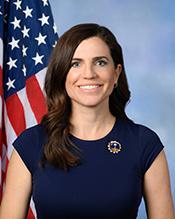
U.S. Representative for South Carolina’s 1st district
Republican
119th Congress, two-year term
Missed 17.8% of roll calls. Chamber median 1.9%.
The full voting recordCounts roll calls where most Democrats and most Republicans voted differently, leaving out procedural votes.
How we countFrom FEC filings, Voteview roll calls and Congress.gov.
Republican. In Congress since 2021, 3 terms in total.
Following saves Mace to your list, which Chamber & Street keeps on its server, linked to a cookie on this browser and not to your name or email. Email alerts will come with constituent verification.
Bills and resolutions Mace signed on to as a cosponsor. An original cosponsor signed on the day the bill was introduced. Source: govinfo bill status files, last updated Nov 6, 2026.
Love Lives On Act of 2025
Sponsor Richard Hudson (R). Joined Sep 26, 2025. 183 cosponsors. H.R. 1004 on Congress.gov
Introduced
Love Lives On Act of 2025
This bill extends entitlement for various benefit programs and services for surviving spouses of deceased members of the Armed Forces or veterans.
The bill provides that the remarriage of a surviving spouse must not bar the furnishing of dependency and indemnity compensation or special pension benefits to such spouse.
Additionally, the Department of Defense may not terminate the payment of an annuity for a surviving spouse under the Survivor Benefit Plan solely because the surviving spouse remarries.
The bill also expands the definition of a dependent under TRICARE to include a remarried widow or widower whose subsequent marriage has ended due to death, divorce, or annulment.
Strengthening Agency Management and Oversight of Software Assets Act
Sponsor Shontel Brown (D). Original cosponsor. 3 cosponsors. H.R. 5457 on Congress.gov(opens in a new tab)
Passed the House
Strengthening Agency Management and Oversight of Software Assets Act
This bill requires federal agencies and Intelligence Community (IC) elements to assess their software inventory and develop software management plans.
The bill requires each agency and each IC element to complete a comprehensive assessment of the software paid for by, in use at, or deployed throughout the agency or element. The assessment must include information such as (1) the current inventory of software; (2) contracts and other arrangements used to acquire, build, deploy, or use the software; (3) costs and fees not included in the initial contract or agreement; and (4) the interoperability of the software and restrictions on its use.
Each agency and IC element must use their assessment to develop a plan to consolidate software entitlements, develop procedures for cost-effective acquisition strategies, and restrict subordinate entities from using any software entitlement without approval. (A software entitlement is software that has been purchased, leased, or licensed by or billed to an agency and that is subject to use limitations.) Such plans must be submitted to the Office of Management and Budget (OMB) and Congress.
Within two years of enactment, OMB must submit recommendations to Congress regarding government software procurement policies and practices to
• increase the interoperability of software licenses;
• consolidate licenses when appropriate;
• reduce costs;
• improve performance; and
• modernize the management and oversight of agency software.
The GAO must report on certain related topics, including governmentwide trends in agency software asset management practices and comparisons of such practices among agencies.
Pay Our Troops Act of 2026
Sponsor Jennifer Kiggans (R). Original cosponsor. 210 cosponsors. H.R. 5401 on Congress.gov(opens in a new tab)
Introduced
Pay Our Troops Act of 2026
This bill provides continuing appropriations for military pay for any period during which interim or full-year appropriations for FY2026 are not in effect (i.e., a government shutdown).
Specifically, the bill provides FY2026 continuing appropriations for the pay and allowances of (1) members of the Armed Forces, including reserve components, who perform active service during the period; and (2) civilian personnel and contractors of the Department of Defense (and the Department of Homeland Security in the case of the Coast Guard) who are providing support to such members of the Armed Forces.
If a government shutdown occurs, the bill provides the continuing appropriations until the earlier of (1) the enactment into law of specified appropriations legislation, or (2) January 1, 2027.
Condemning the assassination of Charlie Kirk and honoring his life and legacy.
Sponsor Mike Kennedy (R). Joined Sep 15, 2025. 48 cosponsors. H.Res. 700 on Congress.gov(opens in a new tab)
Introduced
This resolution condemns the assassination of Charlie Kirk, extends condolences and sympathies to his family, and honors his commitment to civil discussion and debate.
SAFE Driving Laws Act
Sponsor Mary Miller (R). Original cosponsor. 25 cosponsors. H.R. 5330 on Congress.gov(opens in a new tab)
Introduced
Restore Trust in Congress Act
Sponsor Chip Roy (R). Joined Sep 8, 2025. 145 cosponsors. H.R. 5106 on Congress.gov(opens in a new tab)
Introduced
Empower Parents to Protect their Kids Act
Sponsor Mary Miller (R). Original cosponsor. 15 cosponsors. H.R. 5116 on Congress.gov(opens in a new tab)
Introduced
Empower Parents to Protect their Kids Act
This bill prohibits an elementary or secondary school from receiving federal funds unless the school notifies parents about a student's gender identity and obtains parental consent for any associated school accommodations.
Among other requirements, school employees may not withhold information from parents about a minor student's purported identity that is incongruent with the student's sex, the student's discomfort with their sex, or the student's desire to undergo a gender transition procedure. Schools must also obtain parental consent before proceeding with any accommodations for such students. The Department of Justice or a parent or guardian may bring a civil action against a school for violations.
Stop Greenlighting Driver Licenses for Illegal Immigrants Act
Sponsor Jodey Arrington (R). Original cosponsor. 16 cosponsors. H.R. 5108 on Congress.gov(opens in a new tab)
Introduced
GRACE Act
Sponsor W. Steube (R). Original cosponsor. 26 cosponsors. H.R. 5075 on Congress.gov(opens in a new tab)
Introduced
Safety and Opportunity for Girls Act of 2025
Sponsor Mary Miller (R). Original cosponsor. 16 cosponsors. H.R. 5050 on Congress.gov(opens in a new tab)
Introduced
SAFE Act of 2025
Sponsor Vern Buchanan (R). Joined Aug 22, 2025. 238 cosponsors. H.R. 1661 on Congress.gov(opens in a new tab)
Introduced
Save America's Forgotten Equines Act of 2025 or the SAFE Act of 2025
This bill permanently prohibits the slaughter of equines (e.g., horses and mules) for human consumption. (Current law prohibits the slaughter of dogs and cats for human consumption. This bill extends the prohibition to equines.)
Specifically, this bill prohibits a person from knowingly (1) slaughtering an equine for human consumption; or (2) shipping, transporting, possessing, purchasing, selling, or donating an equine to be slaughtered for human consumption or equine parts for human consumption.
The bill subjects a violator to a fine.
The bill applies to conduct in or affecting interstate or foreign commerce or within the special maritime and territorial jurisdiction of the United States. However, it does not apply to an activity carried out by an Indian for a religious ceremony.
As background, in recent years, the appropriations acts have prohibited the Department of Agriculture (USDA) from using federal funds to inspect horses before they are slaughtered for human consumption. Therefore, there are currently no USDA-inspected horse slaughter facilities in the United States.
Sanctuary Penalty and Public Protection Act of 2025
Sponsor Chip Roy (R). Original cosponsor. 29 cosponsors. H.R. 5005 on Congress.gov(opens in a new tab)
Introduced
Recognizing the national debt as a threat to national security.
Sponsor Andy Biggs (R). Joined Aug 8, 2025. 9 cosponsors. H.Res. 631 on Congress.gov(opens in a new tab)
Introduced
This resolution recognizes that the national debt is a threat to national security and that deficits are unsustainable, irresponsible, and dangerous. It also commits to (1) restoring regular order to the appropriations process, and (2) addressing the fiscal crisis faced by the United States.
Modernizing Access to Our Public Oceans Act
Sponsor Russell Fry (R). Joined Aug 8, 2025. 15 cosponsors. H.R. 3340 on Congress.gov(opens in a new tab)
Introduced
Modernizing Access to Our Public Oceans Act
This bill directs the National Oceanic and Atmospheric Administration (NOAA) to publish geospatial data related to public recreational use of federal waterways (e.g., boating and fishing).
Under the bill, NOAA must consult with relevant stakeholders (including state and local governments, Indian tribes, and Native Hawaiian organizations) to develop and adopt standards for the coordination and dissemination of geospatial data relating to fishing restrictions and recreational vessels' use of federal waterways, including the exclusive economic zone of the United States (EEZ). (The EEZ generally includes waters between 3 and 200 miles seaward from the U.S. coastline.)
Within four years after the bill is enacted, NOAA must provide geographic information system data on a public website that identifies and describes the locations where and conditions under which certain recreational activities are restricted in federal waterways. Specifically, the website must identify (1) locations where fishing restrictions are imposed, (2) areas in the EEZ with restrictions on specified recreational vessel types, and (3) federally protected areas (e.g., National Marine Sanctuaries). NOAA must also continue to provide digitized navigation information related to the EEZ and make the information available on the website to the extent practicable.
The bill allows NOAA to coordinate and partner with nonfederal entities to carry out this bill. It also directs NOAA to work with other federal agencies to ensure compatibility and interoperability among federal databases with respect to collecting and disseminating geospatial data related to the public outdoor recreational use of the EEZ.
POWER Act of 2025
Sponsor Wesley Hunt (R). Joined Aug 8, 2025. 27 cosponsors. H.R. 2599 on Congress.gov(opens in a new tab)
Introduced
PRIME Act
Sponsor Thomas Massie (R). Original cosponsor. 48 cosponsors. H.R. 4700 on Congress.gov(opens in a new tab)
Introduced
Processing Revival and Intrastate Meat Exemption Act or the PRIME Act
This bill exempts from federal inspection requirements animals and meats that are slaughtered and prepared at custom animal slaughter facilities for distribution within the state. Under current law, a custom slaughter exemption applies if the meat is slaughtered exclusively for personal, household, guest, or employee uses.
Specifically, the bill expands the federal inspection exemption to include the slaughter of animals or the preparation of carcasses, meat, and meat food products that are
• slaughtered and prepared at a custom slaughter facility in accordance with the laws of the state where the facility is located; and
• prepared exclusively for distribution to household consumers in the state or restaurants, hotels, boarding houses, grocery stores, or other establishments in the state that either prepare meals served directly to consumers or offer meat and food products for sale directly to consumers in the state.
The bill does not preempt any state law concerning (1) the slaughter of animals or the preparation of carcasses, meat, and meat food products at a custom slaughter facility; or (2) the sale of meat or meat food products.
End the Vaccine Carveout Act
Sponsor Paul Gosar (R). Original cosponsor. 30 cosponsors. H.R. 4668 on Congress.gov(opens in a new tab)
Introduced
End the Vaccine Carveout Act
This bill removes liability protections for manufacturers and administrators for vaccine-related injuries, and removes limitations on bringing civil actions for vaccine-related injuries or seeking compensation, under the National Vaccine Injury Compensation Program (VICP). It also excludes COVID-19 vaccines from liability protections under the Countermeasures Injury Compensation Program (CICP).
Under current law, the VICP provides compensation for alleged injuries caused by certain routinely administered vaccines. Individuals generally may not file a civil action in court unless a VICP claim is filed and the resulting judgement is rejected. The VICP also limits the types of claims and amount of damages that may be sought (e.g., no liability for unavoidable side effects or failure to directly warn), and it imposes deadlines for filing claims. The bill removes the requirement to first file a claim under the VICP before pursuing a civil action, so individuals alleging vaccine-related injuries may choose to either bring a civil action or utilize the VICP. It also removes the restrictions on the types of civil actions and damages. The bill also removes the deadlines for filing claims under the VICP and applies this change retroactively.
Additionally, under current law, the CICP provides compensation for alleged injuries caused by certain medical countermeasures during public health emergencies, including COVID-19 vaccines. The bill excludes COVID-19 vaccines from being considered as medical countermeasures. Therefore, under the bill, individuals may file civil actions against manufacturers of COVID-19 vaccines rather than filing claims under the CICP.
Providing for congressional disapproval under chapter 8 of title 5, United States Code, of the rule submitted by the United States Fish and Wildlife Service relating to "Barred Owl Management Strategy".
Sponsor Troy Nehls (R). Original cosponsor. 42 cosponsors. H.J.Res. 111 on Congress.gov(opens in a new tab)
Introduced
Restoring Biological Truth to the Workplace Act
Sponsor W. Steube (R). Original cosponsor. 7 cosponsors. H.R. 4554 on Congress.gov(opens in a new tab)
Introduced
Providing for consideration of the bill (H.R. 185) to advance responsible policies.
Sponsor Thomas Massie (R). Joined Jul 17, 2025. 50 cosponsors. H.Res. 581 on Congress.gov(opens in a new tab)
Introduced
This resolution provides a special rule for consideration of H.R. 185 and amends that bill to direct the Department of Justice (DOJ) to make publicly available certain records related to Jeffrey Epstein or Ghislaine Maxwell.
Under H.R. 185, as amended by the resolution, DOJ must publicly disclose all unclassified records, documents, communications, and investigative materials in its possession that relate to Epstein or Maxwell. The records include unclassified records referring or relating to Epstein's detention and death; flight logs of aircraft owned or used by Epstein; individuals named in connection with Epstein’s criminal activities, civil settlements, or immunity or plea agreements; immunity deals, sealed settlements, or plea bargains of Epstein or his associates; entities with ties to Epstein’s trafficking or financial networks; and internal Department of Justice communications concerning decisions to investigate or charge Epstein or his associates.
However, under the amended bill, DOJ may withhold or redact portions of records with written justification that such portions contain (1) victims' personally identifiable information; (2) child sexual abuse materials; (3) images of death, physical abuse, or injury; (4) information which would jeopardize an active federal investigation or prosecution; or (5) classified information. DOJ may not withhold or redact records on the basis of embarrassment, reputational harm, or political sensitivity.
Further, within 15 days of completing the required disclosures, DOJ must provide Congress with a report listing all categories of records released and withheld, all redactions made and their legal basis, and all government officials and politically exposed persons named or referenced in the released materials.
LEDGER Act
Sponsor Mike Haridopolos (R). Joined Jul 17, 2025. 60 cosponsors. H.R. 4091 on Congress.gov(opens in a new tab)
Introduced
Locating Every Disbursement in Government Expenditure Records Act or the LEDGER Act
This bill requires the Department of the Treasury to implement a system that tracks all outlays from each appropriation, receipt, or other fund account in the Treasury by each department, agency, office, or other establishment in the executive, legislative, or judicial branches of the federal government. The system must also track the period of availability of the amounts in the applicable appropriation, receipt, or other fund account.
Restoring Equal Opportunity Act
Sponsor Brandon Gill (R). Original cosponsor. 61 cosponsors. H.R. 4448 on Congress.gov(opens in a new tab)
Introduced
Defend Girls Athletics Act
Sponsor Andy Barr (R). Original cosponsor. 57 cosponsors. H.R. 4363 on Congress.gov(opens in a new tab)
Introduced
Reliable Grid Act
Sponsor Eric Burlison (R). Joined Jul 10, 2025. 6 cosponsors. H.R. 3751 on Congress.gov(opens in a new tab)
Introduced
Fallen Servicemembers Religious Heritage Restoration Act
Sponsor Debbie Wasserman Schultz (D). Joined Jul 10, 2025. 41 cosponsors. H.R. 2701 on Congress.gov(opens in a new tab)
Passed the House
Fallen Servicemembers Religious Heritage Restoration Act
This bill requires the American Battle Monuments Commission (ABMC) to establish the Fallen Servicemembers Religious Heritage Restoration Program to identify deceased members of the Armed Forces who were Jewish and buried in a U.S. military cemetery located outside of the United States under a marker indicating the member was not Jewish. The program must contact survivors and descendants of such members.
The ABMC must seek to enter into a contract with a nonprofit organization to carry out the program during the first 10 fiscal years beginning after the date of enactment of the bill.