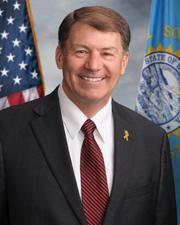
U.S. Senator for South Dakota
Republican
Senate term end not loaded yet
Missed 0.9% of roll calls. Chamber median 2.1%.
The full voting recordCounts roll calls where most Democrats and most Republicans voted differently, leaving out procedural votes.
How we countFrom FEC filings, Voteview roll calls and Congress.gov.
Republican. In Congress since 2015, 2 terms in total.
Following saves Rounds to your list, which Chamber & Street keeps on its server, linked to a cookie on this browser and not to your name or email. Email alerts will come with constituent verification.
Bills and resolutions Rounds signed on to as a cosponsor. An original cosponsor signed on the day the bill was introduced. Source: govinfo bill status files, last updated Nov 6, 2026.
1071 Repeal to Protect Small Business Lending Act
Sponsor John Kennedy (R). Original cosponsor. 15 cosponsors. S. 557 on Congress.gov
Introduced
1071 Repeal to Protect Small Business Lending Act
This bill repeals the statute that requires financial institutions to collect data regarding applications for women-owned, minority-owned, or small business loans. Currently, financial institutions must collect and report to the Consumer Financial Protection Bureau information on (1) how many applications were received; (2) the disposition of each application; (3) the type of loan; (4) the amount applied for; (5) the amount approved; and (6) each applicant’s census tract, revenue, race, sex, and ethnicity.
Protecting Access for Hunters and Anglers Act of 2025
Sponsor Steve Daines (R). Original cosponsor. 36 cosponsors. S. 537 on Congress.gov(opens in a new tab)
Introduced
Protecting Access for Hunters and Anglers Act of 2025
This bill bars the Fish and Wildlife Service (FWS), the Bureau of Land Management (BLM), and the Forest Service from prohibiting or regulating the use of lead ammunition or tackle on federal land or water. The bill makes exceptions for specified existing regulations and where the FWS, the BLM, or the Forest Service determines that a decline in wildlife population at the specific unit of federal land or water is primarily caused by the use of lead in ammunition or tackle, based on the field data from such unit, and the state approves the regulations.
National Right-to-Work Act
Sponsor Rand Paul (R). Original cosponsor. 23 cosponsors. S. 533 on Congress.gov(opens in a new tab)
Introduced
A concurrent resolution expressing the sense of Congress that tax-exempt fraternal benefit societies have historically provided and continue to provide critical benefits to the people and communities of the United States.
Sponsor Mike Crapo (R). Joined Feb 11, 2025. 31 cosponsors. S.Con.Res. 6 on Congress.gov(opens in a new tab)
Introduced
This concurrent resolution expresses the sense of Congress that tax-exempt fraternal benefit societies serve as a private economic and social support system, providing benefits to their members is necessary to support the charitable and fraternal activities of the volunteer chapters, and their work should continue to be promoted.
Pharmacy Benefit Manager Transparency Act of 2025
Sponsor Chuck Grassley (R). Original cosponsor. 14 cosponsors. S. 526 on Congress.gov(opens in a new tab)
Introduced
‘Protect Small Businesses from Excessive Paperwork Act of 2025
Sponsor Tim Scott (R). Original cosponsor. 12 cosponsors. S. 505 on Congress.gov(opens in a new tab)
Introduced
Protect Small Businesses from Excessive Paperwork Act of 2025
This bill extends the deadline for certain companies that are required to file beneficial ownership information with the Financial Crimes Enforcement Network (FinCEN). Specifically, the bill requires companies formed or registered before January 1, 2024, to submit this information to FinCEN by January 1, 2026, instead of by January 1, 2025, as required under current regulations.
CONTAINER Act
Sponsor Marsha Blackburn (R). Joined Feb 11, 2025. 10 cosponsors. S. 157 on Congress.gov(opens in a new tab)
Introduced
Creating Obstructions Necessary to Address Illegal and Nefarious Entry Rapidly Act or CONTAINER Act
This bill requires the Department of the Interior and the Forest Service to allow border states to place temporary, movable structures on federal lands adjacent to the U.S.-Canada and U.S.-Mexico borders without a special use authorization.
Border states may place these structures on such lands for the purpose of securing the northern or southern border for a period of not more than one year. Interior and the Forest Service must approve extension requests in 90-day increments if U.S. Customs and Border Protection determines that operational control of the border area has not been achieved.
Expediting Forest Restoration and Recovery Act of 2025
Sponsor John Thune (R). Joined Feb 10, 2025. 2 cosponsors. S. 449 on Congress.gov(opens in a new tab)
Introduced
Expediting Forest Restoration and Recovery Act of 2025
This bill excludes from environmental review certain projects that reduce the risk of damage to National Forests from wildfires or insect infestations. It also makes permanent the authority for states to retain and use revenues from good neighbor agreement timber sales for certain restoration services.
The bill exempts such projects from federal environmental review requirements if the projects are carried out in (1) insect and disease treatment areas where timber harvest activities are allowed; or (2) areas in Fire Regime Group IV, which are areas that typically burn every 35-200 years with high severity. However, the exemption does not apply to National Wilderness Preservation System lands or certain roadless areas.
The Forest Service must conduct an environmental review for such a project if it is carried out in (1) an area where significant resource concerns exist; or (2) an insect and disease treatment area larger than a certain size.
In the case of environmental reviews of other projects addressing wildfires or insect infestations, the Forest Service only must describe (1) the proposed agency action, and (2) the alternative of no agency action.
In insect and disease treatment areas, the Forest Service must prioritize reducing the risks of insect infestations and wildfires over other objectives in forest plans.
A resolution supporting the goals and ideals of "Career and Technical Education Month".
Sponsor Timothy Kaine (D). Original cosponsor. 51 cosponsors. S.Res. 66 on Congress.gov(opens in a new tab)
Passed the Senate
This resolution supports the designation of Career and Technical Education Month to celebrate career and technical education across the United States.
A joint resolution providing for congressional disapproval under chapter 8 of title 5, United States Code, of the rule submitted by the Forest Service of the Department of Agriculture relating to "Law Enforcement; Criminal Prohibitions".
Sponsor Cynthia Lummis (R). Original cosponsor. 3 cosponsors. S.J.Res. 17 on Congress.gov(opens in a new tab)
Introduced
Protection of Women and Girls in Sports Act of 2025
Sponsor Tommy Tuberville (R). Joined Feb 6, 2025. 44 cosponsors. S. 9 on Congress.gov(opens in a new tab)
Introduced
Protection of Women and Girls in Sports Act of 2025
This bill generally prohibits school athletic programs from allowing individuals whose biological sex at birth was male to participate in programs that are for women or girls.
Specifically, the bill provides that it is a violation of Title IX of the Education Amendments of 1972 for federally funded education programs or activities to operate, sponsor, or facilitate athletic programs or activities that allow individuals of the male sex to participate in programs or activities that are designated for women or girls. (Title IX prohibits discrimination on the basis of sex in federally funded education programs or activities, including in public elementary and secondary schools and in colleges and universities.) Under the bill, sex is based on an individual's reproductive biology and genetics at birth.
Regulations from the Executive in Need of Scrutiny Act of 2025
Sponsor Rand Paul (R). Original cosponsor. 23 cosponsors. S. 485 on Congress.gov(opens in a new tab)
Introduced
Regulations from the Executive in Need of Scrutiny Act of 2025
This bill expands congressional review of federal agency rules and establishes additional procedures for major rules and agency guidance.
Specifically, the bill requires the enactment of a joint resolution for a major rule to take effect. A major rule is a rule that has resulted in or is likely to result in (1) an annual economic effect of at least $100 million; (2) a major increase in costs or prices for consumers, individual industries, government agencies, or geographic regions; or (3) significant adverse effects on competition, employment, investment, productivity, or innovation.
Additionally, major rules approved by a joint resolution under the bill expire, and are no longer effective, 10 years after the enactment of such joint resolution. Further, each agency must annually designate at least 10% of the agency’s major rules that are currently in effect for review and approval by a joint resolution of Congress. Such rules that are not approved shall no longer be in effect.
Under the bill, agency guidance documents are considered rules and certain significant guidance documents are considered major rules. Significant guidance documents include guidance anticipated to lead to an annual effect of at least $100 million, or adversely affect in a material way the economy, the environment, public health, or state or local government.
The Office of Management and Budget must establish an federal regulatory budget specifying the net amount of incremental regulatory costs allowed by the federal government for the next fiscal year.
Securing our Border Act
Sponsor Tim Scott (R). Original cosponsor. 4 cosponsors. S. 481 on Congress.gov(opens in a new tab)
Introduced
Securing our Border Act
This bill addresses issues concerning border security and immigration, including by transferring unobligated funds from the Internal Revenue Service to certain border-related projects.
Specifically, the bill transfers certain unobligated funds previously appropriated for tax enforcement activities (e.g., collecting owed taxes and conducting criminal investigations) to fund (1) nonintrusive inspection systems along the northern border and southwest border of the United States, and (2) the construction of a border wall system along the southwest border.
The bill also authorizes the U.S. Customs and Border Protection to pay recruitment, retention, and relocation bonuses, subject to various requirements and limitations. For example, a relocation bonus may not exceed 15% of the agent's annual basic bay and must be conditioned on the agent agreeing to serve for at least three years at the new duty station.
The bill also modifies the treatment of non-U.S. nationals (aliens under federal law) arriving by land from a country next to the United States. Specifically, if such an individual is not clearly entitled to admission into the United States, the Department of Justice must (1) return the individual to that neighboring country or a safe third country while removal proceedings are pending, or (2) detain the individual while the individual's asylum application is under consideration. (Current law authorizes DOJ to return the individual to the neighboring country but does not require such action or detention.)
Veterans 2nd Amendment Protection Act of 2025
Sponsor John Kennedy (R). Original cosponsor. 40 cosponsors. S. 478 on Congress.gov(opens in a new tab)
Introduced
Veterans 2nd Amendment Protection Act of 2025
This bill prohibits the Department of Veterans Affairs (VA) from transmitting certain information to the National Instant Criminal Background Check System (NICS) utilized by licensed importers or dealers of firearms.
Specifically, the bill prohibits the VA from transmitting personally identifying information of a veteran or a beneficiary to the NICS solely on the basis that such veteran or beneficiary has an appointed fiduciary to manage their benefits, unless there is an order or finding of a judicial authority that such veteran or beneficiary is a danger to themselves or others.
Family Farm and Small Business Exemption Act
Sponsor Joni Ernst (R). Original cosponsor. 13 cosponsors. S. 469 on Congress.gov(opens in a new tab)
Introduced
Family Farm and Small Business Exemption Act
This bill restores an exemption for certain family farms and small businesses on the Free Application for Federal Student Aid (FAFSA) form. The bill applies to the net worth of (1) a family farm on which the family resides, or (2) a small business with not more than 100 full-time or full-time equivalent employees that is owned and controlled by the family.
Prior to recent changes made to the FAFSA, the net worth of these family farms and small businesses were excluded as assets when calculating a student's financial need to determine federal student aid eligibility. Beginning with the 2024-2025 academic year, the net worth of these farms and businesses are treated as an asset and therefore included in the calculation. This bill restores the exemption to exclude such net worth from the calculation.
Fire Management Assistance Grants for Tribal Governments Act
Sponsor Gary Peters (D). Original cosponsor. 1 cosponsor. S. 443 on Congress.gov(opens in a new tab)
Introduced
Fire Management Assistance Grants for Tribal Governments Act
This bill allows Indian tribal governments to directly participate in the Federal Emergency Management Agency (FEMA) Fire Management Assistance Grant (FMAG) program, as opposed to participating through states.
Currently, only states may submit requests to FEMA for declarations authorizing FMAG assistance, and Indian tribal governments affected by a fire must use a state’s authorization to receive FMAG assistance. The bill authorizes Indian tribal governments to submit FMAG declaration requests directly to FEMA and receive FMAG assistance under their own declarations. Indian tribal governments may still choose instead to receive FMAG assistance under an authorization requested by a state.
Also, the bill requires FEMA to update its FMAG regulations within one year after enactment to carry out the bill.
Veterans’ Assuring Critical Care Expansions to Support Servicemembers (ACCESS) Act of 2025
Sponsor Jerry Moran (R). Joined Feb 6, 2025. 15 cosponsors. S. 275 on Congress.gov(opens in a new tab)
Passed committee
Veterans' Assuring Critical Care Expansions to Support Servicemembers (ACCESS) Act of 2025
This bill addresses the administration of the Veterans Community Care Program (VCCP) and other Department of Veterans Affairs (VA) health care matters.
Among other provisions regarding the VCCP, the bill
• establishes in statute access standards that determine when a veteran is eligible to receive non-VA care through the VCCP,
• requires the VA to notify veterans regarding their eligibility for care within two business days after the VA is aware the veteran is seeking care, and
• extends the deadline for the submittal of claims under the VCCP by health care entities and providers.
The VA must address its mental health treatment programs by
• establishing a standardized screening process to determine whether a veteran satisfies criteria for priority or routine admission to a mental health residential rehabilitation treatment program or a program for residential care for mental health and substance abuse disorders,
• tracking the performance of medical facilities and Veterans Integrated Service Networks in meeting the requirements for mental health treatment screenings and timely admission to treatment programs under such screenings, and
• establishing an appeal process for when a veteran is denied admission to a covered treatment program or is accepted into a program but not offered bed placement in a timely manner.
Additionally, the VA must establish an online self-service module for veterans to request and manage appointments, track referrals, and appeal and track decisions related to requests for care.
American Beef Labeling Act of 2025
Sponsor John Thune (R). Original cosponsor. 11 cosponsors. S. 421 on Congress.gov(opens in a new tab)
Introduced
American Beef Labeling Act of 2025
This bill reinstates mandatory country-of-origin labeling (COOL) requirements for beef. COOL is a labeling law that requires retailers, such as full-line grocery stores, supermarkets, and club warehouse stores, to provide information to customers regarding the source of certain foods.
Specifically, the bill requires the Office of the U.S. Trade Representative (USTR), in consultation with the Department of Agriculture (USDA), to determine a means of reinstating mandatory COOL for beef that is compliant with World Trade Organization rules. The USTR and USDA must implement the means of reinstating mandatory COOL for beef within one year of the bill's enactment.
Love Lives On Act of 2025
Sponsor Jerry Moran (R). Original cosponsor. 61 cosponsors. S. 410 on Congress.gov(opens in a new tab)
Passed committee
Love Lives On Act of 2025
This bill extends entitlement for various benefit programs and services for surviving spouses of deceased members of the Armed Forces or veterans.
The bill provides that the remarriage of a surviving spouse must not bar the furnishing of dependency and indemnity compensation or special pension benefits to such spouse.
Additionally, the Department of Defense may not terminate the payment of an annuity for a surviving spouse under the Survivor Benefit Plan solely because the surviving spouse remarries.
The bill also expands the definition of a dependent under TRICARE to include a remarried widow or widower whose subsequent marriage has ended due to death, divorce, or annulment.
A joint resolution providing for congressional disapproval under chapter 8 of title 5, United States Code, of the rule submitted by the Environmental Protection Agency relating to "Waste Emissions Charge for Petroleum and Natural Gas Systems: Procedures for Facilitating Compliance, Including Netting and Exemptions".
Sponsor John Hoeven (R). Original cosponsor. 26 cosponsors. S.J.Res. 12 on Congress.gov(opens in a new tab)
Introduced
This joint resolution nullifies the Environmental Protection Agency (EPA) rule titled Waste Emissions Charge for Petroleum and Natural Gas Systems: Procedures for Facilitating Compliance, Including Netting and Exemptions and published on November 18, 2024. The rule outlines compliance requirements under the Methane Emissions Reduction Program. Under the program, the EPA collects an annual charge on emissions of methane and other greenhouse gases from entities in the oil and gas sector if their emissions exceed specified waste emissions thresholds.
BADGES for Native Communities Act
Sponsor Catherine Cortez Masto (D). Original cosponsor. 3 cosponsors. S. 390 on Congress.gov(opens in a new tab)
Passed the Senate
Bridging Agency Data Gaps and Ensuring Safety for Native Communities Act or the BADGES for Native Communities Act
This bill revises federal policies and procedures related to information sharing, reporting, and investigating cases of missing, unidentified, or murdered Indians.
Among other elements, the bill requires the Department of Justice to (1) establish a grant program for specified entities (e.g., tribes) to implement changes to enhance their responses to missing person cases and death investigations of interest to tribes, and (2) work with the Department of Health and Human Services to ensure that federal training resources and culturally appropriate mental health and wellness programs are available to tribal and Bureau of Indian Affairs (BIA) law enforcement officers.
The Department of the Interior must establish a five-year demonstration program for the purpose of conducting or adjudicating personnel background investigations for applicants for law enforcement positions in the BIA.
The bill also requires the Government Accountability Office to conduct specified studies, including a study on the evidence collection, handling, response times, and processing procedures and practices of federal law enforcement agencies.
Nancy Gardner Sewell Medicare Multi-Cancer Early Detection Screening Coverage Act
Sponsor Mike Crapo (R). Joined Feb 4, 2025. 68 cosponsors. S. 339 on Congress.gov(opens in a new tab)
Introduced
Nancy Gardner Sewell Medicare Multi-Cancer Early Detection Screening Coverage Act
This bill allows, beginning in 2028, for Medicare coverage and payment for multi-cancer early detection screening tests that are approved by the Food and Drug Administration and that are used to screen for cancer across many cancer types, if the Centers for Medicare & Medicaid Services determines such coverage is appropriate. Coverage is limited to those under a certain age (age 68 in 2028, increased by one year every year thereafter) and to one test every 11 months.
Hearing Protection Act
Sponsor Mike Crapo (R). Original cosponsor. 39 cosponsors. S. 364 on Congress.gov(opens in a new tab)
Introduced
A resolution designating the week beginning February 3, 2025, as "National Tribal Colleges and Universities Week".
Sponsor Martin Heinrich (D). Original cosponsor. 22 cosponsors. S.Res. 49 on Congress.gov(opens in a new tab)
Passed the Senate
This resolution designates the week beginning on February 3, 2025, as National Tribal Colleges and Universities Week.
HALT Fentanyl Act
Sponsor Bill Cassidy (R). Original cosponsor. 31 cosponsors. S. 331 on Congress.gov(opens in a new tab)
Became law
Halt All Lethal Trafficking of Fentanyl Act or the HALT Fentanyl Act
This act permanently places fentanyl-related substances as a class into schedule I of the Controlled Substances Act. A schedule I controlled substance is a drug, substance, or chemical that has a high potential for abuse; has no currently accepted medical value; and is subject to regulatory controls and administrative, civil, and criminal penalties under the Controlled Substances Act.
Under the act, offenses involving fentanyl-related substances are triggered by the same quantity thresholds and subject to the same penalties as offenses involving fentanyl analogues (e.g., offenses involving 100 grams or more trigger a 10-year mandatory minimum prison term).
Additionally, the act establishes a new, alternative registration process for certain schedule I research.
The act also makes several other changes to registration requirements for conducting research with controlled substances, including
• permitting a single registration for related research sites in certain circumstances,
• waiving the requirement for a new inspection in certain situations, and
• allowing a registered researcher to perform certain manufacturing activities with small quantities of a substance without obtaining a manufacturing registration.
Finally, the act expresses the sense that Congress agrees with the interpretation of the Controlled Substances Act in United States v. McCray, a 2018 case decided by the U.S. District Court for the Western District of New York. In that case, the court held that butyryl fentanyl, a controlled substance, can be considered an analogue of fentanyl even though, under the Controlled Substances Act, the term controlled substance analogue specifically excludes a controlled substance.