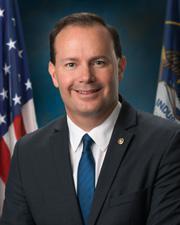
U.S. Senator for Utah
Republican
Senate term end not loaded yet
Missed 3.1% of roll calls. Chamber median 2.1%.
The full voting recordCounts roll calls where most Democrats and most Republicans voted differently, leaving out procedural votes.
How we countFrom FEC filings, Voteview roll calls and Congress.gov.
Republican. In Congress since 2011, 3 terms in total.
Following saves Lee to your list, which Chamber & Street keeps on its server, linked to a cookie on this browser and not to your name or email. Email alerts will come with constituent verification.
Bills and resolutions Lee signed on to as a cosponsor. An original cosponsor signed on the day the bill was introduced. Source: govinfo bill status files, last updated Nov 6, 2026.
A bill to terminate the Department of Education.
Sponsor Rand Paul (R). Original cosponsor. 2 cosponsors. S. 1148 on Congress.gov
Introduced
This bill terminates the Department of Education on December 31, 2026.
A bill to amend the National Trails System Act to direct the Secretary of the Interior to conduct a study on the feasibility of designating the Bonneville Shoreline Trail.
Sponsor John Curtis (R). Original cosponsor. 1 cosponsor. S. 1135 on Congress.gov(opens in a new tab)
Passed committee
PARTS Act of 2025
Sponsor Tim Sheehy (R). Original cosponsor. 11 cosponsors. S. 1039 on Congress.gov(opens in a new tab)
Introduced
A resolution commemorating the centennial of Delta Air Lines.
Sponsor Jon Ossoff (D). Original cosponsor. 3 cosponsors. S.Res. 125 on Congress.gov(opens in a new tab)
Introduced
This resolution commemorates the centennial of Delta Air Lines.
Public Health Improvement Act
Sponsor Eric Schmitt (R). Original cosponsor. 1 cosponsor. S. 999 on Congress.gov(opens in a new tab)
Introduced
Public Health Improvement Act
This bill narrows the authority of the Department of Health and Human Services (HHS) with respect to the control of communicable diseases and renewals of public health emergencies. It also limits the priorities of the Centers for Disease Control and Prevention (CDC) to solely communicable diseases.
Specifically, the bill removes HHS' discretion to take measures it deems necessary to prevent the spread of communicable diseases. It also narrows the objectives and priorities of the CDC by removing noncommunicable diseases, injuries, occupational and environmental hazards, and discretionary priorities from its strategic plan.
Also, the bill removes the authority of HHS to renew a declaration of a public health emergency and instead requires Congress to issue a renewal.
The bill also limits the terms of the directors of the CDC and the National Institutes of Health (NIH) to 12 years and requires members of the Advisory Committee to the Director of the CDC to be appointed by members of Congress and other officials (currently appointed by the director). Additionally, the bill transfers eight offices from the CDC to the NIH (e.g., the National Institute for Occupational Safety and Health).
Preserving Choice in Vehicle Purchases Act of 2025
Original cosponsor. 20 cosponsors. S. 996 on Congress.gov(opens in a new tab)
Progress not on file
Preserving Choice in Vehicle Purchases Act of 2025
This bill modifies the waiver process under the Clean Air Act related to state emission control standards for new motor vehicles (or new motor vehicle engines).
Under current law, states are preempted from adopting or enforcing emission control standards for new motor vehicles (or new motor vehicle engines) unless the Environmental Protection Agency (EPA) provides a waiver authorizing a state to adopt such standards if certain requirements are met.
The bill provides that state standards that directly or indirectly limit the sale or use of new motor vehicles with internal combustion engines are not eligible for waivers. The bill also prohibits the EPA from determining that any state standards amended after the bill's enactment are within the scope of an existing waiver.
Additionally, the bill requires the EPA to revoke waivers granted between January 1, 2022, and the date of enactment of this bill if the standards directly or indirectly limit the sale or use of new motor vehicles with internal combustion engines.
Freedom to Haul Act of 2025
Sponsor Dan Sullivan (R). Original cosponsor. 17 cosponsors. S. 990 on Congress.gov(opens in a new tab)
Introduced
Protecting Life and Integrity in Research Act of 2025
Sponsor Cindy Hyde-Smith (R). Original cosponsor. 10 cosponsors. S. 987 on Congress.gov(opens in a new tab)
Introduced
Protecting Life and Integrity in Research Act of 2025
This bill prohibits federal agencies from supporting research involving, and prohibits any entity from soliciting or knowingly acquiring, human fetal tissue obtained pursuant to an induced abortion.
Specifically, the bill prohibits any federal agency from conducting, funding, approving, or otherwise supporting research involving such tissue. Federal agencies may conduct or support research involving human fetal tissue obtained after a miscarriage or stillbirth.
Additionally, the bill prohibits any entity from soliciting or knowingly acquiring, receiving, or accepting a donation of human fetal tissue where the entity knows it was obtained pursuant to an induced abortion. Entities violating this prohibition are subject to criminal penalties. The bill provides an exception for transfers for purposes of autopsy or burial.
End Taxpayer Funding of Gender Experimentation Act of 2025
Sponsor Roger Marshall (R). Original cosponsor. 14 cosponsors. S. 977 on Congress.gov(opens in a new tab)
Introduced
Federal Workforce Freedom Act
Sponsor Marsha Blackburn (R). Original cosponsor. 1 cosponsor. S. 1006 on Congress.gov(opens in a new tab)
Introduced
Justice for Murder Victims Act
Sponsor Chuck Grassley (R). Original cosponsor. 2 cosponsors. S. 960 on Congress.gov(opens in a new tab)
Passed the Senate
Justice for Murder Victims Act
This bill allows a prosecution to be instituted for any federal homicide offense without regard to the time that elapsed between the act or omission that caused the death of the victim and the death of the victim.
A bill to prohibit natural asset companies from entering into any agreement with respect to land in the State of Utah or natural assets on or in land in the State of Utah.
Sponsor John Curtis (R). Original cosponsor. 1 cosponsor. S. 941 on Congress.gov(opens in a new tab)
Introduced
GATE Act of 2025
Sponsor Tom Cotton (R). Original cosponsor. 6 cosponsors. S. 929 on Congress.gov(opens in a new tab)
Introduced
Recover Fraudulent COVID Funds Act
Sponsor James Lankford (R). Joined Mar 10, 2025. 17 cosponsors. S. 121 on Congress.gov(opens in a new tab)
Introduced
Recover Fraudulent COVID Funds Act
This bill extends the statute of limitations (i.e., time limit for bringing a legal action) to 10 years for criminal and civil violations involving specified COVID-19 pandemic relief programs, such as violations involving fraudulent activity. Under current law, the statute of limitations is generally five years for violations concerning these pandemic-era programs. The Paycheck Protection Program and the Economic Injury Disaster Loan Program currently have 10-year statutes of limitations relating to program fraud.
REPORT Act
Sponsor Maggie Hassan (D). Original cosponsor. 1 cosponsor. S. 848 on Congress.gov(opens in a new tab)
Passed committee
Reporting Efficiently to Proper Officials in Response to Terrorism Act of 2025 or the REPORT Act
This bill requires the Department of Homeland Security, the Department of Justice, the Federal Bureau of Investigation, and (as appropriate) the National Counterterrorism Center to submit a report to specified congressional committees whenever an act of domestic or international terrorism occurs in the United States.
Specifically, within one year after completion of the government investigation of the act of terrorism, these entities must submit a publicly accessible report including the facts of the event and recommendations for improving homeland or national security to prevent similar future acts. Information that could jeopardize an ongoing investigation or prosecution may be withheld. The requirement sunsets five years after the bill’s enactment.
A joint resolution providing for congressional disapproval under chapter 8 of title 5, United States Code, of the rule submitted by the National Park Service relating to "Glen Canyon National Recreation Area; Motor Vehicles".
Sponsor John Curtis (R). Original cosponsor. 1 cosponsor. S.J.Res. 30 on Congress.gov(opens in a new tab)
Passed committee
This joint resolution nullifies the final rule issued by the National Park Service titled Glen Canyon National Recreation Area; Motor Vehicles and published on January 13, 2025. The rule modified regulations concerning the Glen Canyon National Recreation Area, which is located in northern Arizona and southeastern Utah. For example, the rule limited the use of off-road vehicles, such as off-highway vehicles and all-terrain vehicles, in certain areas.
Credit Union Board Modernization Act
Sponsor Bill Hagerty (R). Joined Mar 3, 2025. 63 cosponsors. S. 522 on Congress.gov(opens in a new tab)
Introduced
Credit Union Board Modernization Act
This bill revises the required frequency of meetings held by a credit union's board of directors. Specifically, new credit unions and credit unions with a low soundness rating must meet monthly. All other credit unions must hold at least six meetings annually, with at least one meeting held during each fiscal quarter. Currently, all credit union boards must meet at least once a month.
ENABLE Act
Sponsor Eric Schmitt (R). Joined Feb 27, 2025. 16 cosponsors. S. 627 on Congress.gov(opens in a new tab)
Introduced
No Bailout for Sanctuary Cities Act
Sponsor James Risch (R). Original cosponsor. 10 cosponsors. S. 707 on Congress.gov(opens in a new tab)
Introduced
No Bailout for Sanctuary Cities Act
This bill makes a state or political subdivision of a state ineligible for any federal funds that the jurisdiction intends to use to benefit non-U.S. nationals (i.e., aliens under federal law) who are unlawfully present if the jurisdiction withholds information about citizenship or immigration status or does not cooperate with immigration detainers.
Specifically, such funds are denied to any jurisdiction that has a law, policy, or practice that prohibits or restricts any government entity from
• maintaining, sending, or receiving information regarding the citizenship or immigration status of any individual;
• exchanging information regarding an individual's citizenship or immigration status with a federal, state, or local government entity;
• complying with a valid immigration detainer from the Department of Homeland Security (DHS); or
• notifying DHS about an individual's release from custody.
The funding restriction does not apply to a law, policy, or practice that only applies to an individual who comes forward as a victim of or a witness to a criminal offense.
DHS must annually provide to specified congressional committees a list of jurisdictions that have failed to comply with a DHS detainer or have failed to notify DHS of an individual’s release.
The funding restriction begins 60 days after the bill's enactment or on the first day of the fiscal year following the bill's enactment, whichever is earlier.
Ending China's Unfair Advantage Act of 2025
Sponsor John Barrasso (R). Original cosponsor. 12 cosponsors. S. 680 on Congress.gov(opens in a new tab)
Introduced
Protecting Investors’ Personally Identifiable Information Act
Sponsor John Kennedy (R). Original cosponsor. 8 cosponsors. S. 658 on Congress.gov(opens in a new tab)
Introduced
Protecting Investors' Personally Identifiable Information Act
This bill prohibits the Securities and Exchange Commission (SEC) from requiring a national securities exchange or association (or a member of either) to provide a market participant's personally identifiable information to satisfy the reporting requirements of the Consolidated Audit Trail (i.e., data used to track market activity). However, this information must be provided to the SEC upon request if the information is related to a securities investigation. The SEC must destroy the information not later than one day after the conclusion of the matter for which this information was required.
Defund Planned Parenthood Act
Sponsor Rand Paul (R). Joined Feb 20, 2025. 11 cosponsors. S. 203 on Congress.gov(opens in a new tab)
Introduced
Defund Planned Parenthood Act
This bill prohibits providing federal funding to Planned Parenthood Federation of America or its affiliates.
A joint resolution disapproving the rule submitted by the Bureau of Consumer Financial Protection relating to "Overdraft Lending: Very Large Financial Institutions".
Sponsor Tim Scott (R). Joined Feb 19, 2025. 16 cosponsors. S.J.Res. 18 on Congress.gov(opens in a new tab)
Became law
This joint resolution nullifies the final rule issued by the Consumer Financial Protection Bureau titled Overdraft Lending: Very Large Financial Institutions and published on December 30, 2024. The rule revises provisions regarding charges for insufficient funds in a customer’s bank account (i.e., overdrafts) at very large financial institutions. Under the rule, these institutions must (1) cap overdraft charges at $5; (2) with justification, cap charges at a higher amount; or (3) handle overdrafts as credit and comply with applicable Truth in Lending Act disclosure requirements.
Chemical Tax Repeal Act
Sponsor Ted Cruz (R). Original cosponsor. 7 cosponsors. S. 615 on Congress.gov(opens in a new tab)
Introduced
Chemical Tax Repeal Act
This bill repeals the Hazardous Substance Superfund excise tax imposed on certain chemicals and chemical substances.
Under current law, an excise tax is imposed through December 31, 2031, on taxable chemicals and taxable chemical substances that are (1) manufactured or produced in the United States, or (2) imported into the United States. The excise tax rate varies between 44 cents per ton to $9.74 per ton, depending on the chemical and certain other variables. (There are 42 listed taxable chemicals and 151 listed taxable chemical substances.)
Further, under current law, amounts collected from the excise tax on taxable chemicals and taxable chemical substances are deposited into the Hazardous Substance Superfund, which finances the remediation of certain environmentally contaminated sites.
Death Tax Repeal Act of 2025
Sponsor John Thune (R). Original cosponsor. 46 cosponsors. S. 587 on Congress.gov(opens in a new tab)
Introduced