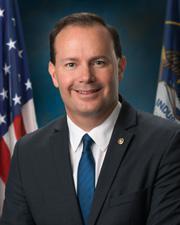
U.S. Senator for Utah
Republican
Senate term end not loaded yet
Missed 3.1% of roll calls. Chamber median 2.1%.
The full voting recordCounts roll calls where most Democrats and most Republicans voted differently, leaving out procedural votes.
How we countFrom FEC filings, Voteview roll calls and Congress.gov.
Republican. In Congress since 2011, 3 terms in total.
Following saves Lee to your list, which Chamber & Street keeps on its server, linked to a cookie on this browser and not to your name or email. Email alerts will come with constituent verification.
Bills and resolutions Lee signed on to as a cosponsor. An original cosponsor signed on the day the bill was introduced. Source: govinfo bill status files, last updated Nov 6, 2026.
Keep Your Coins Act of 2025
Sponsor Ted Budd (R). Original cosponsor. 2 cosponsors. S. 2284 on Congress.gov
Introduced
Keep Your Coins Act of 2025
This bill prohibits federal agencies from restricting a person's use of convertible virtual currency for their own purposes or to conduct transactions through a self-hosted wallet.
Equal Representation Act
Sponsor Bill Hagerty (R). Original cosponsor. 20 cosponsors. S. 2205 on Congress.gov(opens in a new tab)
Introduced
Open App Markets Act
Sponsor Marsha Blackburn (R). Original cosponsor. 5 cosponsors. S. 2153 on Congress.gov(opens in a new tab)
Introduced
A resolution condemning the rise in ideologically motivated attacks on Jewish individuals in the United States, including the recent violent assault in Boulder, Colorado, and reaffirming the commitment of the Senate to combating antisemitism and politically motivated violence.
Sponsor David McCormick (R). Original cosponsor. 40 cosponsors. S.Res. 288 on Congress.gov(opens in a new tab)
Passed the Senate
A concurrent resolution expressing support for America's law enforcement professionals.
Sponsor Bill Cassidy (R). Original cosponsor. 11 cosponsors. S.Con.Res. 15 on Congress.gov(opens in a new tab)
Passed the Senate
Enhanced Penalties for Criminal Flag Burners Act
Sponsor Josh Hawley (R). Original cosponsor. 2 cosponsors. S. 2079 on Congress.gov(opens in a new tab)
Introduced
SHORT Act
Sponsor Roger Marshall (R). Joined Jun 10, 2025. 23 cosponsors. S. 1162 on Congress.gov(opens in a new tab)
Introduced
Delivering On Government Efficiency in Spending Act
Sponsor Joni Ernst (R). Original cosponsor. 15 cosponsors. S. 1991 on Congress.gov(opens in a new tab)
Introduced
No WHO Pandemic Preparedness Treaty Without Senate Approval Act
Sponsor Ron Johnson (R). Original cosponsor. 18 cosponsors. S. 1983 on Congress.gov(opens in a new tab)
Introduced
Life Month Resolution
Sponsor Ted Cruz (R). Original cosponsor. 32 cosponsors. S.J.Res. 56 on Congress.gov(opens in a new tab)
Introduced
Expedited Access to Biosimilars Act
Sponsor Rand Paul (R). Joined Jun 3, 2025. 2 cosponsors. S. 1414 on Congress.gov(opens in a new tab)
Passed committee
Expedited Access to Biosimilars Act
This bill modifies statutory requirements for demonstrating that a proposed biological product (e.g., a drug or vaccine) is biosimilar to a reference (brand-name) product. Specifically, the bill eliminates the need for a clinical efficacy study unless the Food and Drug Administration (FDA) determines such a study is necessary.
Under current law, applicants seeking FDA approval of a proposed biosimilar must submit certain studies and assessments, including a clinical efficacy study demonstrating the safety, purity, and potency of the proposed biosimilar in relevant conditions of use. However, the FDA has discretion not to require studies and assessments it deems unnecessary. (For example, the FDA released draft guidance in October 2025 indicating that clinical efficacy studies may be unnecessary for a class of proposed biosimilars, known as therapeutic protein products, in some circumstances.)
The bill generally eliminates the requirement that a biosimilar applicant submit a clinical efficacy study but authorizes the FDA to require such a study if necessary. If requiring a clinical efficacy study, the FDA must provide a written determination of necessity to the applicant within a specified period.
Separately, the bill eliminates a requirement that a biosimilar application be reviewed by the same FDA division responsible for review of the reference application.
A resolution honoring the life, achievements, and legacy of former United States Senator Christopher "Kit" Bond of Missouri.
Sponsor Josh Hawley (R). Original cosponsor. 99 cosponsors. S.Res. 255 on Congress.gov(opens in a new tab)
Passed the Senate
Expedited Removal of Criminal Aliens Act
Sponsor Ashley Moody (R). Joined May 22, 2025. 7 cosponsors. S. 1827 on Congress.gov(opens in a new tab)
Introduced
DEFIANCE Act of 2025
Sponsor Richard Durbin (D). Original cosponsor. 8 cosponsors. S. 1837 on Congress.gov(opens in a new tab)
Passed the Senate
Disrupt Explicit Forged Images And Non-Consensual Edits Act of 2025 or the DEFIANCE Act of 2025
This bill expands civil remedies for the nonconsensual disclosure of intimate images (i.e., nonconsensual pornography). The bill also establishes a new federal civil action for nonconsensual conduct involving intimate digital forgeries (i.e., deepfakes). The term intimate digital forgery means any intimate visual depiction of an identifiable individual created using software, machine learning, artificial intelligence, or other computer-generated or technological means that looks authentic.
With respect to the nonconsensual disclosure of intimate images, current law allows an identifiable individual to recover civil remedies, including litigation costs, damages, and injunctive relief. This bill increases the available damages by allowing the individual to recover punitive damages and by including, as part of actual damages, profits of the defendant that are attributable to the conduct at issue.
The bill also allows an identifiable individual who is the subject of an intimate digital forgery to file a federal civil action against anyone who knowingly discloses, produces or possesses with intent to disclose, or solicits and receives the intimate digital forgery without the individual's consent. Under the bill, the identifiable individual may recover the same expanded civil remedies that are available for the nonconsensual disclosure of intimate images.
Finally, the bill establishes a 10-year statute of limitations for filing civil actions involving nonconsensual intimate digital forgeries or nonconsensual disclosure of intimate images. The statute begins to run when the individual discovers the violation or turns 18, whichever is later.
Drone Espionage Act
Sponsor Ashley Moody (R). Original cosponsor. 13 cosponsors. S. 1809 on Congress.gov(opens in a new tab)
Passed committee
Drone Espionage Act
This bill makes it a federal crime under the Espionage Act to engage in certain activities related to obtaining, receiving, or transmitting video of national defense information. The term national defense information means information or other material that is related to national defense.
The Espionage Act prohibits certain activities related to obtaining, receiving, or transmitting national defense information that could harm the United States or aid a foreign nation. Under current law, the prohibitions only apply if national defense information is obtained, received, or transmitted by certain means, such as a sketch, photograph, photographic negative, blueprint, plan, map, model, instrument, appliance, document, writing, or note. Under current law, a violator is subject to criminal penalties—a fine, a prison term of up to 10 years, or both.
This bill makes the criminal prohibitions under the Espionage Act applicable if national defense information is obtained, received, or transmitted by means of video. Under this bill, a violator is subject to the same penalties as under existing law—a fine, a prison term of up to 10 years, or both.
Veterans 2nd Amendment Protection Act of 2025
Sponsor John Kennedy (R). Joined May 19, 2025. 40 cosponsors. S. 478 on Congress.gov(opens in a new tab)
Introduced
Veterans 2nd Amendment Protection Act of 2025
This bill prohibits the Department of Veterans Affairs (VA) from transmitting certain information to the National Instant Criminal Background Check System (NICS) utilized by licensed importers or dealers of firearms.
Specifically, the bill prohibits the VA from transmitting personally identifying information of a veteran or a beneficiary to the NICS solely on the basis that such veteran or beneficiary has an appointed fiduciary to manage their benefits, unless there is an order or finding of a judicial authority that such veteran or beneficiary is a danger to themselves or others.
International Nuclear Energy Act of 2025
Sponsor James Risch (R). Original cosponsor. 3 cosponsors. S. 1801 on Congress.gov(opens in a new tab)
Passed committee
Combating Global Poverty Through Energy Development Act
Sponsor John Barrasso (R). Original cosponsor. 6 cosponsors. S. 1783 on Congress.gov(opens in a new tab)
Introduced
Supersonic Aviation Modernization Act
Sponsor Ted Budd (R). Original cosponsor. 5 cosponsors. S. 1759 on Congress.gov(opens in a new tab)
Passed committee
Supersonic Aviation Modernization Act
This bill directs the Federal Aviation Administration (FAA) to allow civil aircraft to operate at speeds above Mach 1 (i.e., supersonic) over land in the United States under certain conditions.
Specifically, the FAA must issue or revise regulations to allow for the operation of civil aircraft at speeds greater than Mach 1 in the national airspace system without a special authorization, so long as no sonic boom reaches the ground in the United States.
Current regulations prohibit civil aircraft from operating above Mach 1 speeds over land in the United States without a special flight authorization issued by the FAA.
Conscience Protection Act of 2025
Sponsor James Lankford (R). Original cosponsor. 23 cosponsors. S. 1756 on Congress.gov(opens in a new tab)
Introduced
Conscience Protection Act of 2025
This bill explicitly prohibits penalizing health care entities (e.g., health care providers, insurers) for declining to participate in or facilitate abortion services. It also allows individuals to bring civil actions for violations of certain federal conscience laws, and it specifically authorizes Department of Health and Human Services (HHS) rulemaking and enforcement relating to such laws. (In general, the existing federal conscience laws referenced in the bill prohibit entities that receive federal funds from requiring providers or patients to participate in health care services they find religiously or morally objectionable.)
Specifically, the bill prohibits the federal government and entities receiving federal health-related funding (e.g., states) from penalizing health care entities that decline to provide, refer for, provide insurance coverage for, or facilitate abortions. The bill does not (1) affect federal requirements for providing emergency stabilizing treatment for pregnant women or unborn children, or (2) prevent health care entities from voluntarily participating in or providing coverage for abortions where not prohibited by law.
Also, the bill authorizes individuals or entities adversely affected by a violation of a federal conscience law to bring a civil action for relief, including against state governmental entities.
Additionally, the bill provides broad statutory authority for HHS to induce compliance with federal conscience laws by terminating HHS funding or referring violations to the Department of Justice for civil actions. It also explicitly authorizes HHS to issue regulations and resolve complaints under such laws. (HHS' Office for Civil Rights currently handles such complaints.)
A resolution designating the week of May 11 through May 17, 2025, as "National Police Week".
Sponsor Chuck Grassley (R). Original cosponsor. 83 cosponsors. S.Res. 220 on Congress.gov(opens in a new tab)
Passed the Senate
WEST Act of 2025
Sponsor John Barrasso (R). Joined May 12, 2025. 8 cosponsors. S. 530 on Congress.gov(opens in a new tab)
Introduced
Protecting Privacy in Purchases Act
Sponsor Bill Hagerty (R). Original cosponsor. 32 cosponsors. S. 1715 on Congress.gov(opens in a new tab)
Introduced
DRIVE Act
Sponsor Steve Daines (R). Original cosponsor. 9 cosponsors. S. 1696 on Congress.gov(opens in a new tab)
Introduced
Deregulating Restrictions on Interstate Vehicles and Eighteen-wheelers Act or the DRIVE Act
This bill prohibits the Federal Motor Carrier Safety Administration (FMCSA) from issuing any rule or regulation to require a commercial motor vehicle to be equipped with a speed limiting device set to a maximum speed. The FMCSA issued an advance notice of supplemental proposed rulemaking on this subject on May 4, 2022.
A commercial motor vehicle includes a vehicle operating in interstate commerce that (1) has a gross vehicle weight of 10,001 pounds or more, (2) is designed or used to transport more than 8 passengers for compensation, (3) is designed or used to transport more than 15 passengers and is not used to transport passengers for compensation, or (4) is used to transport certain quantities of hazardous materials.
RESTORE Act
Sponsor Ted Cruz (R). Original cosponsor. 3 cosponsors. S. 1641 on Congress.gov(opens in a new tab)
Introduced