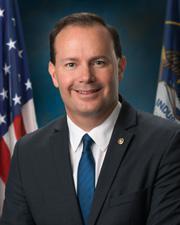
U.S. Senator for Utah
Republican
Senate term end not loaded yet
Missed 3.1% of roll calls. Chamber median 2.1%.
The full voting recordCounts roll calls where most Democrats and most Republicans voted differently, leaving out procedural votes.
How we countFrom FEC filings, Voteview roll calls and Congress.gov.
Republican. In Congress since 2011, 3 terms in total.
Following saves Lee to your list, which Chamber & Street keeps on its server, linked to a cookie on this browser and not to your name or email. Email alerts will come with constituent verification.
Bills and resolutions Lee signed on to as a cosponsor. An original cosponsor signed on the day the bill was introduced. Source: govinfo bill status files, last updated Nov 6, 2026.
NDO Fairness Act of 2026
Sponsor Christopher Coons (D). Original cosponsor. 5 cosponsors. S. 3663 on Congress.gov
Introduced
NDO Fairness Act of 2026
This bill increases the requirements the government must meet to obtain a nondisclosure order (NDO) under the Stored Communications Act (SCA).
The SCA generally prohibits providers of remote computing services or electronic communication services (providers) from disclosing stored electronic communications or records (e.g., emails) or information pertaining to customers or subscribers. However, the SCA authorizes the government seek a warrant, order, or subpoena to compel providers to disclose electronic communications or records or information pertaining to customers or subscribers during an investigation. Providers may notify customers and subscribers of the warrant, order, or subpoena unless the government obtains a court order—an NDO—that delays the notification.
This bill raises the standard the government must meet to obtain (or extend) an NDO. The bill also requires the court, before issuing an NDO, to issue a written determination that the standard was met based on specific and articulable facts, and to review the underlying warrant, order, or subpoena.
The bill requires NDOs to be narrowly tailored. It also limits their duration to 90 days for most investigations, though it permits a duration of up to one year for investigations pertaining to an offense involving child pornography or sexual exploitation of children.
Finally, the bill requires the Department of Justice to report annually on NDO-related data, including the number of customers or subscribers targeted; applications for orders; orders granted, extended, or denied; and orders targeting members of the media or conduct related to certain protected activities.
Safe Cloud Storage Act
Sponsor Marsha Blackburn (R). Joined Jan 8, 2026. 9 cosponsors. S. 3023 on Congress.gov(opens in a new tab)
Passed the Senate
Safe Cloud Storage Act
This bill limits the civil and criminal liability of vendors that contract with law enforcement agencies to provide digital storage services (e.g., remote or cloud-based storage) for storing, maintaining, and processing child sexual abuse material (CSAM) in investigations of online child sexual exploitation.
Under current law, the National Center for Missing & Exploited Children (NCMEC) receives reports of online child sexual exploitation via its CyberTipline, evaluates and prioritizes the reports, and refers the reports to law enforcement agencies to investigate. Currently, federal law limits the liability of vendors that contract directly with the NCMEC to store and transfer CSAM. However, federal law does not limit the liability of vendors that contract with law enforcement agencies to assist in investigations.
This bill establishes liability protections for vendors that contract with federal, state, and local law enforcement agencies to store, maintain, and process CSAM in investigations of online child sexual exploitation. Specifically, the bill prohibits a civil claim or criminal charge in federal or state court against such a vendor, so long as the vendor has not engaged in intentional misconduct or negligent conduct, acted with malice or reckless disregard, or acted for a purpose unrelated to its contractual duties.
The bill requires vendors to comply with cybersecurity requirements for CSAM that is stored, maintained, or processed. The bill also requires vendors to comply with storage requirements for CSAM that is retained as evidence.
State Veterans Homes Inspection Simplification Act
Sponsor Mike Crapo (R). Original cosponsor. 7 cosponsors. S. 3532 on Congress.gov(opens in a new tab)
Introduced
CLEAR Act of 2025
Sponsor Cynthia Lummis (R). Original cosponsor. 4 cosponsors. S. 3520 on Congress.gov(opens in a new tab)
Introduced
EQIP Improvement Act of 2025
Sponsor Cory Booker (D). Original cosponsor. 2 cosponsors. S. 3498 on Congress.gov(opens in a new tab)
Introduced
EQIP Improvement Act of 2025
This bill modifies payment limitations and reduces the federal cost share and required payments for certain projects authorized under the Environmental Quality Incentives Program (EQIP). As background, this Department of Agriculture program provides technical and financial assistance to agricultural producers and forest landowners to address natural resource concerns.
Specifically, the bill limits the total payments available to a person or legal entity under EQIP to $150,000 over a specified five-year period. (A $450,000 statutory limit was in effect for FY2019-FY2024, and a regulatory contract limit of $450,000 currently applies.)
The bill also reduces the maximum federal cost share to 40% (from 75%) for the costs associated with planning, installation, or maintenance for specified conservation practices (e.g., access roads, dams, and waste storage facilities) and removes a requirement that 50% of EQIP funding for payments go to practices related to livestock production.
A resolution designating December 6, 2025, as "National Miners Day".
Sponsor James Justice (R). Original cosponsor. 18 cosponsors. S.Res. 545 on Congress.gov(opens in a new tab)
Passed the Senate
No Bounties on Badges Act
Sponsor Rick Scott (R). Original cosponsor. 5 cosponsors. S. 3453 on Congress.gov(opens in a new tab)
Introduced
Back the Blue Act of 2025
Sponsor John Cornyn (R). Original cosponsor. 38 cosponsors. S. 3366 on Congress.gov(opens in a new tab)
Introduced
Back the Blue Act of 2025
This bill establishes new criminal offenses for violent conduct against judicial officers and law enforcement officers and makes related changes. The bill also broadens the authority of certain law enforcement officers to carry firearms.
Specifically, the bill prohibits killing, attempting to kill, or conspiring to kill a federal judge, a federal law enforcement officer, or a public safety or judicial officer for a state, local, or tribal agency that receives federal funding. The bill also prohibits fleeing to avoid prosecution, custody, or confinement for an offense.
Additionally, the bill prohibits killing former federal judges, former federal law enforcement officers, or former public safety or judicial officers for state, local, or tribal agencies that receive federal funding.
The bill also prohibits certain assaults on state or local law enforcement officers for state (or District of Columbia) agencies that receive federal funding.
The bill limits federal court review of challenges to state court convictions for killing a public safety officer or judge. The bill also limits the recoverability of damages and attorney's fees in a proceeding to enforce a civil rights violation during or relating to conduct by the injured person that constitutes a felony or crime of violence.
The bill allows federal, state, and local law enforcement officers to carry firearms if authorized by law. The bill also allows qualified law enforcement officers to carry concealed firearms and ammunition (including magazines) in school zones and in certain federal facilities that are open to the public.
A bill to direct the United States Postal Service to designate a single, unique ZIP Code for Highland City, Utah.
Sponsor John Curtis (R). Original cosponsor. 1 cosponsor. S. 3338 on Congress.gov(opens in a new tab)
Introduced
More Affordable Care Act
Sponsor Rick Scott (R). Joined Dec 3, 2025. 2 cosponsors. S. 3264 on Congress.gov(opens in a new tab)
Introduced
Chloe Cole Act
Sponsor Marsha Blackburn (R). Joined Dec 3, 2025. 12 cosponsors. S. 2907 on Congress.gov(opens in a new tab)
Introduced
Inspector General Access Act of 2025
Sponsor Richard Durbin (D). Original cosponsor. 9 cosponsors. S. 3307 on Congress.gov(opens in a new tab)
Introduced
RECAPTURE Act
Sponsor Joni Ernst (R). Joined Dec 1, 2025. 5 cosponsors. S. 3259 on Congress.gov(opens in a new tab)
Introduced
A resolution expressing opposition to congressional spending on earmarks.
Sponsor Rick Scott (R). Original cosponsor. 3 cosponsors. S.Res. 517 on Congress.gov(opens in a new tab)
Introduced
GUARD Act
Sponsor Josh Hawley (R). Joined Nov 19, 2025. 20 cosponsors. S. 3062 on Congress.gov(opens in a new tab)
Passed committee
Guidelines for User Age-verification and Responsible Dialogue Act of 2026 or the GUARD Act
This bill establishes requirements for and limitations on entities that provide publicly available artificial intelligence (AI) chatbots, including AI companions.
Under the bill, an AI chatbot is an application or program that simulates human conversation by generating responses to user prompts. An AI companion is a type of AI chatbot that simulates a sustained interpersonal relationship or emotional interaction with the user.
The bill makes it a federal crime to provide an AI chatbot that exposes minors to sexual content or encourages minors to commit suicide or carry out nonsuicidal self-injury, unlawful physical or sexual violence, or homicide. A violation is subject to a criminal fine of up to $250,000 per offense.
Additionally, the bill prohibits minors from accessing AI companions. Under the bill, an entity that provides an AI chatbot must require each individual who accesses an AI companion to set up a user account and must also verify that the user is an adult. A violation is subject to a civil penalty of up to $250,000 per violation.
Finally, the bill requires an AI chatbot that is publicly available to disclose that the AI chatbot is not a human and is not a licensed professional (e.g. doctor, lawyer, or therapist). A violation is subject to a civil penalty of up to $250,000 per violation.
Preventing Foreign Interference in American Elections Act
Sponsor Bill Hagerty (R). Original cosponsor. 7 cosponsors. S. 3129 on Congress.gov(opens in a new tab)
Introduced
Deporting Fraudsters Act of 2025
Sponsor Ted Cruz (R). Original cosponsor. 3 cosponsors. S. 3113 on Congress.gov(opens in a new tab)
Introduced
A resolution recognizing the week of November 3 through November 7, 2025, as "National Veterans Small Business Week".
Sponsor Joni Ernst (R). Original cosponsor. 62 cosponsors. S.Res. 482 on Congress.gov(opens in a new tab)
Passed the Senate
Reciprocity Ensures Streamlined Use of Lifesaving Treatments Act of 2025
Sponsor Ted Cruz (R). Original cosponsor. 1 cosponsor. S. 3081 on Congress.gov(opens in a new tab)
Introduced
Reciprocity Ensures Streamlined Use of Lifesaving Treatments Act of 2025
This bill establishes a reciprocal marketing approval process that allows for the sale of a drug, biological product, or medical device that has not been approved by the Food and Drug Administration (FDA) if the product is approved for sale in another country and there is an unmet need for the product.
Specifically, in order to receive reciprocal approval, the bill requires the product's sponsor to demonstrate, among other things, that (1) the product has been approved in one of the countries specified in the bill, (2) neither the FDA nor any of the specified countries have withdrawn approval for the product because of safety or effectiveness concerns, and (3) there is a public health or unmet medical need for the product.
The FDA may decline approval if it determines that the product is not safe or effective. The FDA may condition reciprocal approval on the conduct of postmarket studies.
The FDA must issue a decision on whether to grant a request for reciprocal marketing approval within 30 days of receiving the request.
Congress may pass a joint resolution to grant reciprocal marketing approval of a product that the FDA declines to approve through the reciprocal process.
American Beef Labeling Act of 2025
Sponsor John Thune (R). Joined Oct 28, 2025. 11 cosponsors. S. 421 on Congress.gov(opens in a new tab)
Introduced
American Beef Labeling Act of 2025
This bill reinstates mandatory country-of-origin labeling (COOL) requirements for beef. COOL is a labeling law that requires retailers, such as full-line grocery stores, supermarkets, and club warehouse stores, to provide information to customers regarding the source of certain foods.
Specifically, the bill requires the Office of the U.S. Trade Representative (USTR), in consultation with the Department of Agriculture (USDA), to determine a means of reinstating mandatory COOL for beef that is compliant with World Trade Organization rules. The USTR and USDA must implement the means of reinstating mandatory COOL for beef within one year of the bill's enactment.
Pay Our Military Act of 2025
Sponsor Dan Sullivan (R). Original cosponsor. 22 cosponsors. S. 3030 on Congress.gov(opens in a new tab)
Passed committee
Pay Our Military Act of 2025
This bill provides continuing appropriations for military pay for any period during which continuing or full-year appropriations for FY2026 are not in effect (i.e., a government shutdown).
Specifically, the bill provides FY2026 continuing appropriations for pay, allowances, and certain benefits for members of the Armed Forces, including reserve components, who perform active service during the period. The benefits funded by the bill include individual clothing, subsistence, interest on deposits, gratuities, permanent change of station travel, and monthly payments to surviving spouses who care for a child of a member or former member of the Armed Forces.
The bill also provides FY2026 continuing appropriations for
• pay and allowances for Department of Defense (DOD) civilian personnel (and Department of Homeland Security [DHS] personnel in the case of the Coast Guard) who are providing support to such members of the Armed Forces, and
• payments for DOD contractors (and DHS contractors in the case of the Coast Guard) who are providing support to the members of the Armed Forces.
A federal agency may not use funds provided by this bill during any period in which continuing appropriations are available for the same payments, allowances, and benefits that are funded by this bill.
If a government shutdown occurs, the bill provides the continuing appropriations until the earlier of (1) the enactment into law of specified appropriations legislation, or (2) September 30, 2026.
ENFORCE Act
Sponsor John Cornyn (R). Original cosponsor. 3 cosponsors. S. 3021 on Congress.gov(opens in a new tab)
Passed the Senate
Enhancing Necessary Federal Offenses Regarding Child Exploitation Act or the ENFORCE Act
This bill broadens the scope of prohibited conduct and increases criminal penalties for child pornography offenses involving the production or distribution of an adapted or modified depiction of an identifiable minor. The bill also expands federal enforcement of criminal offenses involving the possession, receipt, distribution, or production of obscene visual representations of the sexual abuse of children.
A resolution designating the week beginning on October 19, 2025, as "Coal Week".
Sponsor Cynthia Lummis (R). Original cosponsor. 9 cosponsors. S.Res. 457 on Congress.gov(opens in a new tab)
Introduced
A resolution condemning attacks on Federal law enforcement in the State of Illinois.
Sponsor Rick Scott (R). Joined Oct 20, 2025. 3 cosponsors. S.Res. 451 on Congress.gov(opens in a new tab)
Introduced
Shutdown Fairness Act
Sponsor Ron Johnson (R). Joined Oct 20, 2025. 13 cosponsors. S. 3012 on Congress.gov(opens in a new tab)
Introduced
Shutdown Fairness Act
This bill provides appropriations to pay federal employees who work during a government shutdown.
Specifically, the bill provides appropriations for federal agencies to provide standard rates of pay, allowances, pay differentials, benefits, and other payments to excepted employees for work performed during any period in which interim continuing appropriations or full-year appropriations are not in effect for a fiscal year (i.e., a government shutdown). An excepted employee is an employee who is required to work during a government shutdown.
Under current law, excepted employees are not paid until the government shutdown is over. This bill provides appropriations to pay excepted employees during a government shutdown. The bill also specifies that the term excepted employee includes certain contractors who support federal employees during a government shutdown and members of the Armed Forces who are on active duty.
A federal agency may not use the funds provided by this bill during any period in which continuing appropriations are in effect for the purpose of paying excepted employees of the agency.
The bill must take effect as if it had been enacted on September 30, 2025.