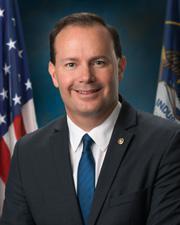
U.S. Senator for Utah
Republican
Senate term end not loaded yet
Missed 3.1% of roll calls. Chamber median 2.1%.
The full voting recordCounts roll calls where most Democrats and most Republicans voted differently, leaving out procedural votes.
How we countFrom FEC filings, Voteview roll calls and Congress.gov.
Republican. In Congress since 2011, 3 terms in total.
Following saves Lee to your list, which Chamber & Street keeps on its server, linked to a cookie on this browser and not to your name or email. Email alerts will come with constituent verification.
Bills and resolutions Lee signed on to as a cosponsor. An original cosponsor signed on the day the bill was introduced. Source: govinfo bill status files, last updated Nov 6, 2026.
Natural Gas Tax Repeal Act
Sponsor Ted Cruz (R). Original cosponsor. 17 cosponsors. S. 143 on Congress.gov
Introduced
Natural Gas Tax Repeal Act
This bill eliminates a program administered by the Environmental Protection Agency that provides support for reducing methane emissions from the oil and gas sector. It also repeals a charge on methane emissions from facilities that contain petroleum and natural gas systems and emit 25,000 metric tons or more of greenhouse gases per year.
AMERICANS Act
Sponsor Ted Cruz (R). Original cosponsor. 14 cosponsors. S. 117 on Congress.gov(opens in a new tab)
Introduced
Allowing Military Exemptions, Recognizing Individual Concerns About New Shots Act of 2025 or the AMERICANS Act
This bill prohibits the Department of Defense (DOD) from issuing any COVID-19 vaccine mandate as a replacement for the rescinded vaccine mandate of August 24, 2021, unless the mandate is expressly authorized by Congress. The bill also provides that DOD must establish an application process for remedies for members of the Armed Forces who were discharged or subject to adverse action under the rescinded mandate.
Any administrative discharge of a member on the sole basis of a failure to receive a COVID-19 vaccine must be categorized as an honorable discharge, and DOD is prohibited from taking any adverse action against such a member for that reason.
DOD must try to retain unvaccinated members and provide such members with professional development, promotion and leadership opportunities, and consideration equal to that of their peers.
Additionally, DOD may only consider the COVID-19 vaccination status of members in making certain decisions (e.g., deployments in countries where it is the law) and must establish a process to provide exemptions to certain members for such decisions.
Members who were separated from the Armed Forces for refusing to receive a COVID-19 vaccine are not required to repay any bonuses and must be reimbursed if they repaid any portion of a bonus prior to this bill's enactment.
This bill applies to all members of the Armed Forces, regardless of whether they sought an accommodation to any DOD COVID-19 vaccination policy.
Born-Alive Abortion Survivors Protection Act
Sponsor James Lankford (R). Original cosponsor. 50 cosponsors. S. 6 on Congress.gov(opens in a new tab)
Introduced
Born-Alive Abortion Survivors Protection Act
This bill establishes requirements for the degree of care a health care practitioner must provide in the case of a child born alive following an abortion or attempted abortion.
Specifically, a health care practitioner who is present must (1) exercise the same degree of care as would reasonably be provided to any other child born alive at the same gestational age, and (2) ensure the child is immediately admitted to a hospital. Additionally, a health care practitioner or other employee who has knowledge of a failure to comply with the degree-of-care requirements must immediately report such failure to law enforcement.
A health care practitioner who fails to provide the required degree of care, or a health care practitioner or other employee who fails to report such failure, is subject to criminal penalties—a fine, up to five years in prison, or both.
An individual who intentionally kills or attempts to kill a child born alive is subject to prosecution for murder.
The bill bars the criminal prosecution of a mother of a child born alive under this bill and allows her to bring a civil action against a health care practitioner or other employee for violations.
Repealing Big Brother Overreach Act
Sponsor Tommy Tuberville (R). Original cosponsor. 34 cosponsors. S. 100 on Congress.gov(opens in a new tab)
Introduced
Repealing Big Brother Overreach Act
This bill repeals the Corporate Transparency Act. The act requires existing companies and newly created companies to report beneficial ownership information to the Department of the Treasury’s Financial Crimes Enforcement Network for purposes of addressing the financing of terrorism and money laundering.
A resolution designating October 10, 2025, as "American Girls in Sports Day".
Sponsor Marsha Blackburn (R). Original cosponsor. 31 cosponsors. S.Res. 21 on Congress.gov(opens in a new tab)
Introduced
This resolution recognizes October 10, 2025, as American Girls in Sports Day. The resolution also calls on sports-governing bodies in the United States and abroad to protect biological women and girls in sports.
A resolution honoring the life and legacy of President Jimmy Carter and commending President Jimmy Carter for his life-long career of public service, humanitarian leadership, diplomacy, and courageous advocacy.
Sponsor Raphael Warnock (D). Original cosponsor. 98 cosponsors. S.Res. 19 on Congress.gov(opens in a new tab)
Passed the Senate
This resolution (1) mourns the passing of former President Jimmy Carter and extends sympathy to his family; and (2) honors his life, legacy, and contributions to the United States.
Constitutional Concealed Carry Reciprocity Act of 2025
Sponsor John Cornyn (R). Original cosponsor. 49 cosponsors. S. 65 on Congress.gov(opens in a new tab)
Introduced
Constitutional Concealed Carry Reciprocity Act of 2025
This bill allows a qualified individual to carry a concealed handgun into or possess a concealed handgun in another state that allows its residents to carry concealed firearms.
A qualified individual must (1) be eligible to possess, transport, or receive a firearm under federal law; (2) carry a valid photo identification document; and (3) carry a valid state-issued concealed carry permit, or be eligible to carry a concealed firearm in his or her state of residence.
End Child Trafficking Now Act
Sponsor Marsha Blackburn (R). Original cosponsor. 10 cosponsors. S. 52 on Congress.gov(opens in a new tab)
Introduced
End Child Trafficking Now Act
This bill imposes restrictions related to adult non-U.S. nationals (aliens under federal law) being admitted into the United States with a minor.
Such an adult may not be admitted with a minor unless the adult (1) presents documents and witness testimony proving that the adult is a relative or guardian of the minor, or (2) submits to a DNA test that proves such a relationship. The Department of Homeland Security may request a DNA test only if the required relationship cannot be established by the presented documents and witness testimony. An adult who does not consent to a requested DNA test shall be inadmissible.
If the required relationship cannot be established and the immigration officer believes the adult is guilty of a felony offense, the officer may arrest the adult.
The bill makes it a crime for an adult to knowingly use a minor to whom the adult is not a relative or guardian to enter the United States.
A joint resolution proposing an amendment to the Constitution of the United States relative to limiting the number of terms that a Member of Congress may serve.
Sponsor Ted Cruz (R). Original cosponsor. 19 cosponsors. S.J.Res. 1 on Congress.gov(opens in a new tab)
Introduced
This joint resolution proposes an amendment to the Constitution establishing term limits for individuals serving in the Senate and the House of Representatives.
The proposed amendment makes an individual who has served two terms in the Senate ineligible for appointment or election to the Senate and an individual who has served three terms as a Member of the House of Representatives ineligible for election to the House of Representatives.
The joint resolution provides that the amendment shall be valid when ratified by the legislatures of three-fourths of the states within seven years after the date of its submission for ratification.
Under Article V of the Constitution, both chambers of Congress may propose an amendment by a vote of two-thirds of all Members present for such vote. A proposed amendment must be ratified by the states as prescribed in Article V and as specified by Congress.
Protection of Women and Girls in Sports Act of 2025
Sponsor Tommy Tuberville (R). Original cosponsor. 44 cosponsors. S. 9 on Congress.gov(opens in a new tab)
Introduced
Protection of Women and Girls in Sports Act of 2025
This bill generally prohibits school athletic programs from allowing individuals whose biological sex at birth was male to participate in programs that are for women or girls.
Specifically, the bill provides that it is a violation of Title IX of the Education Amendments of 1972 for federally funded education programs or activities to operate, sponsor, or facilitate athletic programs or activities that allow individuals of the male sex to participate in programs or activities that are designated for women or girls. (Title IX prohibits discrimination on the basis of sex in federally funded education programs or activities, including in public elementary and secondary schools and in colleges and universities.) Under the bill, sex is based on an individual's reproductive biology and genetics at birth.
Laken Riley Act
Sponsor Katie Britt (R). Original cosponsor. 53 cosponsors. S. 5 on Congress.gov(opens in a new tab)
Became law
Laken Riley Act
This act requires the Department of Homeland Security (DHS) to detain certain non-U.S. nationals (aliens under federal law) who have been arrested for burglary, theft, larceny, shoplifting, assault of a law enforcement officer, or any crime that results in death or serious bodily injury to another person. The act also authorizes states to sue the federal government for decisions or alleged failures related to immigration enforcement.
Under this act, DHS must detain an individual who (1) is unlawfully present in the United States or did not possess the necessary documents when applying for admission; and (2) has been charged with, arrested for, convicted of, or admits to having committed acts that constitute the essential elements of the above crimes.
The act also authorizes state governments to sue for injunctive relief over certain immigration-related decisions or alleged failures by the federal government if the decision or failure caused the state or its residents harm, including financial harm of more than $100. Specifically, the state government may sue the federal government over a
• decision to release a non-U.S. national from custody;
• failure to fulfill requirements relating to inspecting individuals seeking admission into the United States, including requirements related to asylum interviews;
• failure to fulfill a requirement to stop issuing visas to nationals of a country that unreasonably denies or delays acceptance of nationals of that country;
• violation of limitations on immigration parole, such as the requirement that parole be granted only on a case-by-case basis; or
• failure to detain an individual who has been ordered removed from the United States.