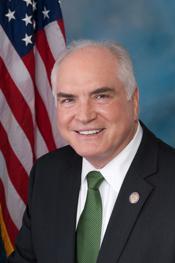
U.S. Representative for Pennsylvania’s 16th district
Republican
119th Congress, two-year term
Missed 1.6% of roll calls. Chamber median 1.9%.
The full voting recordCounts roll calls where most Democrats and most Republicans voted differently, leaving out procedural votes.
How we countFrom FEC filings, Voteview roll calls and Congress.gov.
Republican. In Congress since 2011, 8 terms in total.
Following saves Kelly to your list, which Chamber & Street keeps on its server, linked to a cookie on this browser and not to your name or email. Email alerts will come with constituent verification.
Bills and resolutions Kelly signed on to as a cosponsor. An original cosponsor signed on the day the bill was introduced. Source: govinfo bill status files, last updated Nov 6, 2026.
Tax-Free Pell Grant Act
Sponsor Lloyd Doggett (D). Original cosponsor. 3 cosponsors. H.R. 2543 on Congress.gov
Introduced
James Earl Jones Congressional Gold Medal Act
Sponsor Michael Lawler (R). Joined Apr 1, 2025. 47 cosponsors. H.R. 1933 on Congress.gov(opens in a new tab)
Introduced
Honoring Our Fallen Heroes Act of 2025
Sponsor Mary Gay Scanlon (D). Joined Apr 1, 2025. 180 cosponsors. H.R. 1269 on Congress.gov(opens in a new tab)
Introduced
Honoring Our Fallen Heroes Act of 2025
This bill extends death and disability benefits under the Public Safety Officers' Benefits Program (PSOB) to certain public safety officers who suffer from exposure-related cancer while on duty and their survivors. The PSOB program provides death, disability, and education benefits to public safety officers who are killed or injured in the line of duty and their survivors.
The bill specifies that exposure to a carcinogen shall be presumed to constitute a personal injury in the line of duty if
• the exposure occurred while the officer was in the line of duty;
• the officer began serving as an officer not fewer than 5 years before the date of the diagnosis of an exposure-related cancer and the diagnosis occurred not more than 15 years after the last date of active service; and
• the exposure-related cancer directly and proximately resulted in the death or permanent and total disability of the officer.
The Department of Justice's Bureau of Justice Assistance must periodically review the definition of exposure-related cancer and update the definition if appropriate based on medical evidence and in accordance with the requirements of a petition process.
Protecting First Responders from Secondary Exposure Act of 2025
Sponsor David Joyce (R). Joined Mar 31, 2025. 28 cosponsors. H.R. 621 on Congress.gov(opens in a new tab)
Introduced
Protecting First Responders from Secondary Exposure Act of 2025
This bill expands the allowable uses of grant funds under the Comprehensive Opioid, Stimulant, and Substance Use Program administered by the Department of Justice.
Specifically, the bill allows grants to be used for purchasing containment devices for first responders and training first responders on the use of containment devices to prevent secondary exposure to fentanyl and other potentially lethal substances.
FIND Act
Sponsor Jack Bergman (R). Joined Mar 31, 2025. 154 cosponsors. H.R. 45 on Congress.gov(opens in a new tab)
Introduced
Firearm Industry Non-Discrimination Act or the FIND Act
This bill prohibits the federal government from entering into contracts with an entity that discriminates against firearm trade associations or businesses that deal in firearms, ammunition, or related products.
Specifically, the bill requires a federal agency to include in each contract for the procurement of goods or services awarded by the agency a clause requiring the prime contractor to certify that it (1) has no policy, practice, guidance, or directive that discriminates against a firearm entity or firearm trade association; and (2) will not adopt a policy, practice, guidance, or directive that discriminates against a firearm entity or firearm trade association during the term of the contract.
The bill establishes (1) a similar requirement with respect to subcontracts, and (2) penalties for violations.
The bill makes such prohibition inapplicable to a contract for the procurement of goods or services that is a sole-source contract.
SAVE Act
Sponsor Chip Roy (R). Joined Mar 31, 2025. 110 cosponsors. H.R. 22 on Congress.gov(opens in a new tab)
Passed the House
Safeguard American Voter Eligibility Act or the SAVE Act
This bill requires individuals to provide documentary proof of U.S. citizenship when registering to vote in federal elections.
Specifically, the bill prohibits states from accepting and processing an application to register to vote in a federal election unless the applicant presents documentary proof of U.S. citizenship. The bill specifies what documents are considered acceptable proof of U.S. citizenship, such as identification that complies with the REAL ID Act of 2005 that indicates U.S. citizenship.
Further, the bill (1) prohibits states from registering an individual to vote in a federal election unless, at the time the individual applies to register to vote, the individual provides documentary proof of U.S. citizenship; and (2) requires states to establish an alternative process under which an applicant may submit other evidence to demonstrate U.S. citizenship.
Each state must take affirmative steps on an ongoing basis to ensure that only U.S. citizens are registered to vote, which shall include establishing a program to identify individuals who are not U.S. citizens using information supplied by certain sources.
Additionally, states must remove noncitizens from their official lists of eligible voters.
The bill allows for a private right of action against an election official who registers an applicant to vote in a federal election who fails to present documentary proof of U.S. citizenship.
The bill establishes criminal penalties for certain offenses, including registering an applicant to vote in a federal election who fails to present documentary proof of U.S. citizenship.
Unfair Tax Prevention Act
Sponsor Ron Estes (R). Original cosponsor. 24 cosponsors. H.R. 2423 on Congress.gov(opens in a new tab)
Introduced
Revitalizing Downtowns and Main Streets Act
Sponsor Mike Carey (R). Original cosponsor. 57 cosponsors. H.R. 2410 on Congress.gov(opens in a new tab)
Introduced
Affirming the alliance between the United States and the Republic of Korea.
Sponsor Thomas Suozzi (D). Joined Mar 26, 2025. 68 cosponsors. H.Res. 64 on Congress.gov(opens in a new tab)
Passed committee
This resolution reaffirms the importance of the alliance between the United States and South Korea, particularly with regard to security in the Indo-Pacific. The resolution also celebrates the important contributions of Korean Americans to American society and supports the goals of Korean Culture-Kimchi Day.
Collegiate Housing and Infrastructure Act of 2025
Sponsor Blake Moore (R). Original cosponsor. 24 cosponsors. H.R. 2355 on Congress.gov(opens in a new tab)
Introduced
HELPER Act of 2025
Sponsor John Rutherford (R). Joined Mar 26, 2025. 154 cosponsors. H.R. 2094 on Congress.gov(opens in a new tab)
Introduced
Homes for Every Local Protector, Educator, and Responder Act of 2025 or the HELPER Act of 2025
This bill establishes a program administered by the Department of Housing and Urban Development to provide mortgage assistance to law enforcement officers, elementary and secondary school teachers, firefighters, or other first responders. Specifically, these individuals may be eligible for a first-time mortgage on a primary family residence with no down payment. Instead, the mortgage is subject to a one-time, up-front mortgage insurance premium.
Credit for Caring Act of 2025
Sponsor Mike Carey (R). Joined Mar 21, 2025. 145 cosponsors. H.R. 2036 on Congress.gov(opens in a new tab)
Introduced
Bonus Tax Relief for America’s Seniors Act
Sponsor Nicole Malliotakis (R). Joined Mar 21, 2025. 7 cosponsors. H.R. 1130 on Congress.gov(opens in a new tab)
Introduced
Bonus Tax Relief for America’s Seniors Act
This bill increases to $5,000 (adjusted for inflation) the amount of the additional standard deduction allowed for individual taxpayers who are 65 years old or older.
Under the bill, the additional standard deduction amount of $5,000 applies to each individual taxpayer who is 65 years or older, regardless of filing status. Thus, married spouses who are both 65 years old or older and who file a joint income tax return may claim an additional standard deduction amount of $10,000 (adjusted for inflation).
As background, the basic standard deduction amount may be increased for taxpayers who attain the age of 65 before the end of the tax year (generally referred to as the additional standard deduction). Under current law, for 2025, the additional standard deduction amount is (1) $1,600 for individuals who are 65 years old or older, or (2) $2,000 if the individual is also unmarried and not a surviving spouse.
Chiropractic Medicare Coverage Modernization Act of 2025
Sponsor W. Steube (R). Joined Mar 18, 2025. 174 cosponsors. H.R. 539 on Congress.gov(opens in a new tab)
Introduced
Chiropractic Medicare Coverage Modernization Act of 2025
This bill expands Medicare coverage of chiropractic services to include all services provided by chiropractors, rather than only subluxation corrections through manual manipulation of the spine.
SLOT Act of 2025
Sponsor Dina Titus (D). Original cosponsor. 11 cosponsors. H.R. 2233 on Congress.gov(opens in a new tab)
Introduced
Commission to Study the Creation of a National Museum of Irish American History
Sponsor Brian Fitzpatrick (R). Original cosponsor. 18 cosponsors. H.R. 2121 on Congress.gov(opens in a new tab)
Introduced
Major Richard Star Act
Sponsor Gus Bilirakis (R). Original cosponsor. 340 cosponsors. H.R. 2102 on Congress.gov(opens in a new tab)
Introduced
Major Richard Star Act
This bill allows a veteran with a combat-related disability to receive retirement pay, without reduction, concurrently with their disability compensation. This includes veterans with a combat-related disability and fewer than 20 years of creditable service. (Currently, veterans who receive combat-related special compensation and retirement pay are subject to an offset in retirement pay for concurrent receipt of such benefits.)
Mental Health Research Accelerator Act of 2025
Sponsor Mike Thompson (D). Original cosponsor. 7 cosponsors. H.R. 2085 on Congress.gov(opens in a new tab)
Introduced
Military Spouse Hiring Act
Sponsor Donald Beyer (D). Original cosponsor. 130 cosponsors. H.R. 2033 on Congress.gov(opens in a new tab)
Introduced
Military Spouse Hiring Act
This bill allows employers to claim a tax credit for a percentage of qualified wages paid to an employee who is a military spouse by expanding the federal Work Opportunity Tax Credit (WOTC) to add qualified military spouses as a targeted group. (The WOTC applies to employers who hire members of specific targeted groups, such as veterans, ex-felons, and long-term unemployment recipients, and is generally equal to a percentage of the wages paid to such individuals in the first year of employment, up to a maximum amount. Under current law, the wages must be paid before 2026.)
The bill defines a qualified military spouse as any individual who is certified by a state workforce agency as being (as of the hiring date) a spouse of a member of the Armed Forces.
American Innovation and R&D Competitiveness Act of 2025
Sponsor Ron Estes (R). Original cosponsor. 81 cosponsors. H.R. 1990 on Congress.gov(opens in a new tab)
Introduced
Primary Care Enhancement Act of 2025
Sponsor Lloyd Smucker (R). Joined Mar 10, 2025. 8 cosponsors. H.R. 1026 on Congress.gov(opens in a new tab)
Introduced
US-Kazakhstan Trade Modernization Act
Sponsor Jimmy Panetta (D). Joined Mar 10, 2025. 35 cosponsors. H.R. 1024 on Congress.gov(opens in a new tab)
Introduced
US-Kazakhstan Trade Modernization Act
This bill addresses trade between the United States and Kazakhstan.
Specifically, the bill authorizes the President to determine that Section 402 of the Trade Act of 1974 (commonly known as the Jackson-Vanik amendment) does not apply to Kazakhstan. The Jackson-Vanik amendment denies normal trade relations (NTR) status to some current and former nonmarket economy countries unless they comply with certain freedom-of-emigration requirements. Under a provision of this amendment, the President may extend NTR status to a country affected by the amendment by waiving the freedom-of-emigration requirements or determining that the country is not in violation of those requirements, subject to an annual review. Kazakhstan has received temporary NTR status since 1992.
Additionally, the bill authorizes the President to extend permanent NTR status to Kazakhstan.
Anti-CBDC Surveillance State Act
Sponsor Tom Emmer (R). Original cosponsor. 135 cosponsors. H.R. 1919 on Congress.gov(opens in a new tab)
Passed the House
Anti-CBDC Surveillance State Act
This bill prohibits a Federal Reserve bank from offering products or services directly to an individual, maintaining an account on behalf of an individual, or issuing a central bank digital currency (i.e., a digital dollar). Further, the Board of Governors of the Federal Reserve System is prohibited from using a central bank digital currency to implement monetary policy or from testing, studying, creating, or implementing a central bank digital currency, with exceptions as provided by the bill.
Protecting American Students Act
Sponsor Vern Buchanan (R). Original cosponsor. 8 cosponsors. H.R. 1905 on Congress.gov(opens in a new tab)
Introduced
Providing for congressional disapproval under chapter 8 of title 5, United States Code, of the rule submitted by the Internal Revenue Service relating to Rules for Supervisory Approval of Penalties.
Sponsor Glenn Grothman (R). Joined Mar 6, 2025. 8 cosponsors. H.J.Res. 65 on Congress.gov(opens in a new tab)
Introduced
This joint resolution nullifies the rule titled Rules for Supervisory Approval of Penalties, which was issued by the Internal Revenue Service (IRS) on December 23, 2024. The rule addresses the timing of supervisory approvals required for certain federal tax penalties assessed by the IRS.