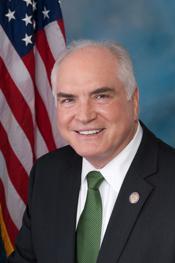
U.S. Representative for Pennsylvania’s 16th district
Republican
119th Congress, two-year term
Missed 1.6% of roll calls. Chamber median 1.9%.
The full voting recordCounts roll calls where most Democrats and most Republicans voted differently, leaving out procedural votes.
How we countFrom FEC filings, Voteview roll calls and Congress.gov.
Republican. In Congress since 2011, 8 terms in total.
Following saves Kelly to your list, which Chamber & Street keeps on its server, linked to a cookie on this browser and not to your name or email. Email alerts will come with constituent verification.
Bills and resolutions Kelly signed on to as a cosponsor. An original cosponsor signed on the day the bill was introduced. Source: govinfo bill status files, last updated Nov 6, 2026.
Generating Retirement Ownership through Long-Term Holding
Sponsor Beth Van Duyne (R). Joined Sep 3, 2025. 130 cosponsors. H.R. 2089 on Congress.gov
Introduced
Susan Muffley Act of 2025
Sponsor Michael Turner (R). Joined Sep 3, 2025. 41 cosponsors. H.R. 1357 on Congress.gov(opens in a new tab)
Introduced
Susan Muffley Act of 2025
This bill restores the full vested monthly benefits for eligible participants of certain pension plans that were sponsored by Delphi Corporation and terminated as a result of General Motors' bankruptcy in 2009.
The Pension Benefit Guaranty Corporation (PBGC) must recalculate and adjust each plan participant's monthly benefits payment. The PBGC must also apply the recalculation to previously-made monthly payments and make a lump-sum payment for any additional benefits based on the recalculation.
The bill establishes and provides appropriations to a fund for the payment of these benefits and specifies how the lump-sum payments are treated for tax purposes.
SERVICE Act of 2025
Sponsor Dale Strong (R). Joined Sep 2, 2025. 24 cosponsors. H.R. 3312 on Congress.gov(opens in a new tab)
Introduced
Supporting Every at-Risk Veteran In Critical Emergencies Act of 2025 or the SERVICE Act of 2025
This bill authorizes the Office of Community Oriented Policing Services within the Department of Justice to make grants to support the creation and operation of veterans' response teams in state, local, and tribal law enforcement agencies.
Maintaining Investments in New Innovation Act
Sponsor Donald Davis (D). Joined Sep 2, 2025. 51 cosponsors. H.R. 1672 on Congress.gov(opens in a new tab)
Introduced
Maintaining Investments in New Innovation Act
This bill requires drug products with genetically targeted technology to have had market approval for at least 11 years in order to qualify for the Medicare Drug Price Negotiation Program. (The program requires the Centers for Medicare & Medicaid Services to negotiate the prices of certain prescription drugs under Medicare beginning in 2026. Among other requirements, drugs must have had market approval for at least 7 years (for drug products) or 11 years (for biologics) to qualify for negotiation.)
Ensuring Justice for Camp Lejeune Victims Act of 2025
Sponsor Gregory Murphy (R). Joined Aug 29, 2025. 102 cosponsors. H.R. 4145 on Congress.gov(opens in a new tab)
Introduced
Crime Victims Fund Stabilization Act of 2025
Sponsor Ann Wagner (R). Joined Aug 26, 2025. 327 cosponsors. H.R. 909 on Congress.gov(opens in a new tab)
Passed the House
Crime Victims Fund Stabilization Act of 2025
This bill adds a new source of revenue for the Crime Victims Fund (CVF). Specifically, the bill requires certain civil monetary penalties collected from settlements and judgments in cases involving fraud and false claims against the federal government to be deposited into the CVF through FY2029.
The CVF supports federal, state, and local programs and activities to compensate and assist victims of crimes. Currently, the CVF is funded by deposits from a variety of sources, including federal criminal fines, penalties, and assessments; forfeited bail bonds; and certain other gifts, donations, and bequests.
Emergency Care Improvement Act
Sponsor Jodey Arrington (R). Joined Aug 12, 2025. 15 cosponsors. H.R. 3134 on Congress.gov(opens in a new tab)
Introduced
College Transparency Act
Sponsor Raja Krishnamoorthi (D). Original cosponsor. 23 cosponsors. H.R. 4806 on Congress.gov(opens in a new tab)
Introduced
College Transparency Act
This bill requires the National Center for Education Statistics (NCES) to establish a secure and privacy-protected data system that contains information about postsecondary students.
Specifically, the data system must
• evaluate student enrollment patterns, progression, completion, and postcollegiate outcomes, and higher education costs and financial aid;
• provide complete and customizable information for students and families making decisions about postsecondary education;
• reduce the requirements for reporting by institutions of higher education; and
• periodically match with other federal systems of data.
The bill also establishes a postsecondary student data system advisory committee.
SHARE Plan Act
Sponsor Thomas Suozzi (D). Original cosponsor. 13 cosponsors. H.R. 4739 on Congress.gov(opens in a new tab)
Introduced
Spotted Lanternfly Research and Development Act
Sponsor Joseph Morelle (D). Original cosponsor. 40 cosponsors. H.R. 4708 on Congress.gov(opens in a new tab)
Introduced
Spotted Lanternfly Research and Development Act
This bill includes combatting the spotted lanternfly (Lycorma delicatula) as a Department of Agriculture (USDA) high-priority research and extension area and reauthorizes other USDA research and extension initiatives.
The bill specifically allows grants for developing and disseminating research-based tools and treatments to combat the spotted lanternfly, which is an invasive species native to Asia that feeds on a wide range of crops and plants (e.g., grapes, apples, hops, walnuts, and hardwood trees).
Further, the bill reauthorizes USDA grants to support competitive specialized research and extension activities, including high-priority areas, through FY2030. The bill also specifically reauthorizes through FY2030
• the Pulse Crop Health Initiative;
• the Comprehensive Food Safety Training Network;
• pollinator protection research and extension grants;
• increased USDA capacity and infrastructure to address and conduct research on colony collapse disorder and other pollinator issues; and
• a USDA-conducted nationwide honey bee pest, pathogen, health, and population status surveillance program.
Bubble Tax Modernization Act of 2025
Sponsor Andrea Salinas (D). Original cosponsor. 10 cosponsors. H.R. 4613 on Congress.gov(opens in a new tab)
Introduced
Holy Sovereignty Protection Act
Sponsor Jeff Hurd (R). Original cosponsor. 6 cosponsors. H.R. 4501 on Congress.gov(opens in a new tab)
Introduced
Holy Sovereignty Protection Act
This bill provides that the U.S. citizenship of an individual elected as the Supreme Pontiff of the Roman Catholic Church may not be revoked and exempts such individual from federal income taxes for tax years during which the individual serves in such role for any part of the tax year. (As background, the income of a U.S. citizen generally is subject to U.S. income tax regardless of where such income is earned or received or where the individual resides.)
SHIELD Act
Sponsor Rudy Yakym (R). Original cosponsor. 14 cosponsors. H.R. 4424 on Congress.gov(opens in a new tab)
Introduced
DIGNIDAD (Dignity) Act of 2025
Sponsor Maria Salazar (R). Original cosponsor. 39 cosponsors. H.R. 4393 on Congress.gov(opens in a new tab)
Introduced
Dignity for Immigrants while Guarding our Nation to Ignite and Deliver the American Dream Act of 2025 or as the DIGNIDAD (Dignity) Act of 2025
This bill addresses various immigration-related issues, including by requiring higher pay for U.S. Border Patrol agents, deferring the removal of eligible individuals without lawful immigration status, and implementing a mandatory electronic employment eligibility verification system patterned off the E-Verify system.
The bill establishes several programs for individuals present in the United States without lawful status, including a path to lawful permanent resident status for qualified individuals, including those with deferred action for childhood arrival (DACA) status. In addition, the bill establishes the Dignity Program, which defers the removal of eligible individuals without lawful immigration status on a seven-year, renewable basis, provided individuals meet employment or education requirements, pay restitution, and satisfy other conditions.
The bill also makes various changes to penalties and processes applicable to individuals entering the United States, for example by
• increasing the maximum criminal penalty for individuals previously removed or denied admission to the United States who attempt to reenter,
• authorizing the use of DNA testing to verify family relationships of immigrants, and
• establishing campuses at the border to process asylees.
The Department of Homeland Security (DHS) must create, and U.S. employers must use, a nationwide electronic employment eligibility verification system.
Furthermore, DHS may grant relatives of U.S. citizens relief from removal.
The bill also increases the per country percentage ceiling for family-sponsored and employment-based visas.
Donald J. Trump $250 Bill Act
Sponsor Joe Wilson (R). Joined Jul 15, 2025. 16 cosponsors. H.R. 1761 on Congress.gov(opens in a new tab)
Introduced
Donald J. Trump $250 Bill Act
This bill requires the Department of the Treasury to print paper currency in the denomination of $250 featuring a portrait of President Donald Trump.
Under current law, U.S. currency may only feature the portrait of a deceased person. The bill creates an exception for individuals who are or were President of the United States.
SAMS Act of 2025
Sponsor Gary Palmer (R). Original cosponsor. 48 cosponsors. H.R. 4370 on Congress.gov(opens in a new tab)
Introduced
Secret Service Recording Accountability Act of 2025
Sponsor Stephanie Bice (R). Original cosponsor. 1 cosponsor. H.R. 4364 on Congress.gov(opens in a new tab)
Introduced
Constitutional Concealed Carry Reciprocity Act of 2025
Sponsor Richard Hudson (R). Joined Jul 14, 2025. 189 cosponsors. H.R. 38 on Congress.gov(opens in a new tab)
Introduced
Constitutional Concealed Carry Reciprocity Act
This bill establishes a federal statutory framework to regulate the carry or possession of concealed firearms across state lines.
Specifically, an individual who is eligible to carry a concealed firearm in one state may carry or possess a concealed handgun (other than a machine gun or destructive device) in another state that allows its residents to carry concealed firearms.
It sets forth requirements for lawful concealed carry across state lines. The bill preempts most state and local laws related to concealed carry and establishes a private right of action for a person adversely affected by interference with a concealed-carry right established by this bill.
Expressing support for the designation of June 28, 2025, as "Community is Stronger than Cancer Day".
Sponsor Debbie Dingell (D). Original cosponsor. 3 cosponsors. H.Res. 555 on Congress.gov(opens in a new tab)
Introduced
SCREENS for Cancer Act of 2025
Sponsor Joseph Morelle (D). Joined Jun 27, 2025. 74 cosponsors. H.R. 2381 on Congress.gov(opens in a new tab)
Introduced
Expressing the sense of the House of Representatives that Social Security should be preserved and protected for current beneficiaries, and for future generations to come.
Sponsor Claudia Tenney (R). Original cosponsor. 9 cosponsors. H.Res. 506 on Congress.gov(opens in a new tab)
Introduced
Flow Act
Sponsor Claudia Tenney (R). Original cosponsor. 8 cosponsors. H.R. 3892 on Congress.gov(opens in a new tab)
Introduced
Stop Dangerous Sanctuary Cities Act
Sponsor Nicholas Langworthy (R). Original cosponsor. 20 cosponsors. H.R. 3881 on Congress.gov(opens in a new tab)
Introduced
Stop Dangerous Sanctuary Cities Act
This bill addresses issues related to state and local government cooperation with federal immigration enforcement efforts, including by prohibiting uncooperative jurisdictions from receiving certain grants.
Specifically, the bill prohibits a sanctuary jurisdiction from receiving grants under certain Economic Development Assistance Programs and the Community Development Block Grant Program. Under the bill, a sanctuary jurisdiction is a state or local government that has in effect a statute, policy, or practice that prohibits or restricts (1) information sharing with another government entity about an individual's immigration status, or (2) compliance with a lawfully issued Department of Homeland Security (DHS) detainer request or notification of release request.
When complying with a DHS-issued detainer, a state or local government shall be deemed to be acting as an agent of DHS with all authority available to DHS officers and employees. The bill also limits the legal liability of a state or local government for complying with a detainer.
FIREARM Act
Sponsor Darrell Issa (R). Joined Jun 10, 2025. 41 cosponsors. H.R. 3770 on Congress.gov(opens in a new tab)
Passed committee
Fighting Irrational Regulatory Enforcement to Avert Retailers’ Misfortune Act or the FIREARM Act
This bill prohibits the Bureau of Alcohol, Tobacco, Firearms and Explosives (ATF) from bringing an enforcement action to revoke or deny renewal of a federal firearms license on the basis of a self-reported violation that is correctable, so long as the violation did not involve the transfer of a firearm to a prohibited person.
The term self-reported violation means a violation of a statutory provision or implementing regulation by a federal firearms licensee (e.g., a gun dealer) that the licensee reports to the ATF before it is discovered during a compliance inspection.
The bill applies retroactively.
CARE Act of 2025
Sponsor Mike Carey (R). Joined Jun 10, 2025. 48 cosponsors. H.R. 2538 on Congress.gov(opens in a new tab)
Introduced
Comprehensive Alternative Response for Emergencies Act of 2025 or the CARE Act of 2025
This bill requires the Center for Medicare and Medicaid Innovation (CMMI) to test a five-year model that provides for Medicare payment for ground ambulance services that do not result in the transport of the patient.
Under the model, Medicare payment may be furnished for ground ambulance services when an ambulance is dispatched in response to an emergency medical call but the ambulance does not end up transporting the patient. Payment rates under the model must generally align with the payment rates that apply when there is an actual transport.
The Government Accountability Office must report on the general access of Medicare beneficiaries to emergency medical services, including the impact of the model on beneficiary access and outcomes.