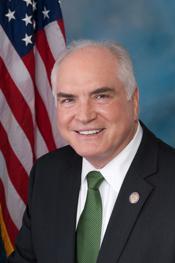
U.S. Representative for Pennsylvania’s 16th district
Republican
119th Congress, two-year term
Missed 1.6% of roll calls. Chamber median 1.9%.
The full voting recordCounts roll calls where most Democrats and most Republicans voted differently, leaving out procedural votes.
How we countFrom FEC filings, Voteview roll calls and Congress.gov.
Republican. In Congress since 2011, 8 terms in total.
Following saves Kelly to your list, which Chamber & Street keeps on its server, linked to a cookie on this browser and not to your name or email. Email alerts will come with constituent verification.
Bills and resolutions Kelly signed on to as a cosponsor. An original cosponsor signed on the day the bill was introduced. Source: govinfo bill status files, last updated Nov 6, 2026.
REMAIN in Mexico Act of 2025
Sponsor Brandon Gill (R). Joined Jan 13, 2025. 110 cosponsors. H.R. 273 on Congress.gov
Introduced
Return Excessive Migrants and Asylees to International Neighbors in Mexico Act of 2025 or the REMAIN in Mexico Act of 2025
This bill requires the Department of Homeland Security (DHS) to implement the Migrant Protection Protocols as outlined in the January 25, 2019, memo titled Policy Guidance for Implementation of the Migrant Protection Protocols.
(The protocols generally required aliens who are not clearly admissible, including those seeking asylum, arriving by land along the U.S.-Mexico border to be returned to Mexico while their immigration proceedings are pending, rather than remain in the United States. On January 21, 2021, DHS stopped applying the protocols to newly-arrived individuals.)
National Law Enforcement Officers Remembrance, Support, and Community Outreach Act
Sponsor Troy Nehls (R). Original cosponsor. 124 cosponsors. H.R. 309 on Congress.gov(opens in a new tab)
Passed the House
National Law Enforcement Officers Remembrance, Support and Community Outreach Act. [sic]
This bill temporarily directs the Department of the Interior to award a grant to the National Law Enforcement Officers Memorial Fund for the expenses associated with operating and enhancing the community outreach, public education, and officer safety and wellness programs of the National Law Enforcement Museum.
GLRI Act of 2025
Sponsor David Joyce (R). Original cosponsor. 44 cosponsors. H.R. 284 on Congress.gov(opens in a new tab)
Introduced
Great Lakes Restoration Initiative Act of 2025 or the GLRI Act of 2025
This bill reauthorizes through FY2031 the Great Lakes Restoration Initiative, which carries out programs and projects to protect and restore the Great Lakes.
Protecting Life and Taxpayers Act of 2025
Sponsor Michelle Fischbach (R). Original cosponsor. 45 cosponsors. H.R. 272 on Congress.gov(opens in a new tab)
Introduced
Protecting Life and Taxpayers Act of 2025
This bill requires entities receiving federal funds to certify that they will not, subject to certain exceptions, perform abortions or provide funding to other entities that perform abortions.
The bill provides exceptions for abortions performed in cases of rape or incest or when necessary to resolve a physical condition that endangers a woman's life.
Defund Planned Parenthood Act of 2025
Sponsor Michelle Fischbach (R). Original cosponsor. 60 cosponsors. H.R. 271 on Congress.gov(opens in a new tab)
Introduced
Defund Planned Parenthood Act of 2025
This bill restricts federal funding for Planned Parenthood Federation of America, Inc. or any of its affiliates or clinics for one year.
Specifically, it prohibits providing federal funding to those entities unless they certify that the affiliates and clinics will not perform, and will not provide funds to entities that perform, abortions during that year. If the certification requirement is not met, the Department of Health and Human Services and the Department of Agriculture must recoup any federal assistance received by those entities.
However, the bill's funding restriction does not apply to abortions performed in cases of rape or incest or when necessary to resolve a physical condition that endangers a woman's life.
The bill also provides additional funding for community health centers for the one-year period. These funds are subject to the same abortion-related restrictions and exceptions.
TCJA Permanency Act
Sponsor Vern Buchanan (R). Joined Jan 9, 2025. 53 cosponsors. H.R. 137 on Congress.gov(opens in a new tab)
Introduced
TCJA Permanency Act
This bill makes permanent multiple federal tax provisions enacted in 2017 by the Tax Cuts and Jobs Act.
The bill makes permanent the
• individual tax rates of 10%, 12%, 22%, 24%, 32%, 35%, and 37%;
• increased standard deduction;
• personal exemption allowance repeal;
• exclusion from income of student loans discharged due to death or disability;
• qualified business income tax deduction (199A tax deduction);
• allowance of ABLE account contributions in excess of the annual gift tax exclusion amount;
• base estate and gift tax exclusion amount of $10 million (adjusted annually); and
• alternative minimum tax exemption and phaseout amounts for noncorporate taxpayers.
The bill makes permanent the child tax credit amounts of $2,000 per child and $500 for dependents, the $200,000 phaseout threshold ($400,000 for joint filers), and the refundable portion of the tax credit.
The bill expands the expenses eligible for tax-free withdrawals from qualified tuition plans (529 plans) to include additional expenses associated with homeschool and elementary and secondary schools (e.g., instructional materials, tutoring, test and enrollment fees, and educational therapies).
The bill permanently eliminates certain miscellaneous itemized deductions and makes permanent the
• state and local tax deduction limit of $10,000 ($5,000 for married individuals filing separately),
• mortgage interest tax deduction limit of $750,000 ($375,000 for married individuals filing separately),
• limit on the deduction of cash charitable contributions to 60% of a taxpayer’s adjusted gross income, and
• certain limits on casualty loss tax deductions.
The bill also permanently eliminates the exclusion from income for employer-reimbursed bicycle commuting expenses.
Clergy Act
Sponsor Vince Fong (R). Original cosponsor. 21 cosponsors. H.R. 227 on Congress.gov(opens in a new tab)
Became law
Clergy Act
This act establishes a two-year window for members of the clergy who have opted out of Social Security and Medicare taxes (and are thus ineligible for benefits under those programs) to opt back in.
Under current law, certain ministers, members of religious orders, and Christian Science practitioners who object to participation in public insurance programs on religious or conscientious grounds may apply to the Internal Revenue Service (IRS) for an exemption from Social Security and Medicare taxes on ministerial earnings. Individuals who are approved for the exemption do not receive Social Security or Medicare benefits in retirement unless they have qualifying credits from other employment. The exemption is irrevocable.
Under the act, clergy members may choose to revoke their exemption by filing an application with the IRS by the due date of their federal income tax return for the second taxable year after December 31, 2028 (i.e., April 15, 2031, unless an individual obtains an extension to file their taxes). A clergy member may choose for the revocation to take effect in taxable year 2029 or taxable year 2030. A revocation under the act is permanent.
Clergy members who opt back in will generally need 10 years of covered employment (40 credits) to be eligible for Social Security and Medicare benefits, as is currently required for these programs.
The IRS must develop a plan to inform clergy members of their eligibility to revoke prior exemptions, pursuant to the act's changes.
To amend the Internal Revenue Code of 1986 to provide special rules for the taxation of certain residents of Taiwan with income from sources within the United States.
Sponsor Jason Smith (R). Joined Jan 6, 2025. 46 cosponsors. H.R. 33 on Congress.gov(opens in a new tab)
Passed the House
Family and Small Business Taxpayer Protection Act
Sponsor Adrian Smith (R). Original cosponsor. 36 cosponsors. H.R. 196 on Congress.gov(opens in a new tab)
Introduced
Family and Small Business Taxpayer Protection Act
This bill rescinds unobligated funds that were provided by the Inflation Reduction Act of 2022 to the Internal Revenue Service (IRS) for enforcement activities related to the determination and collection of taxes, for operations support for taxpayer services and enforcement activities, and for a task force to research options for a free, direct electronic filing (e-filing) tax return system.
The bill also rescinds unobligated funds that were provided by the Inflation Reduction Act of 2022 for expenses of the
• Treasury Inspector General for Tax Administration,
• Office of Tax Policy,
• U.S. Tax Court, and
• offices within the Department of the Treasury that provide oversight and support for the IRS.