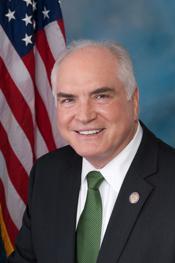
U.S. Representative for Pennsylvania’s 16th district
Republican
119th Congress, two-year term
Missed 1.6% of roll calls. Chamber median 1.9%.
The full voting recordCounts roll calls where most Democrats and most Republicans voted differently, leaving out procedural votes.
How we countFrom FEC filings, Voteview roll calls and Congress.gov.
Republican. In Congress since 2011, 8 terms in total.
Following saves Kelly to your list, which Chamber & Street keeps on its server, linked to a cookie on this browser and not to your name or email. Email alerts will come with constituent verification.
Bills and resolutions Kelly signed on to as a cosponsor. An original cosponsor signed on the day the bill was introduced. Source: govinfo bill status files, last updated Nov 6, 2026.
National Right-to-Work Act
Sponsor Joe Wilson (R). Original cosponsor. 129 cosponsors. H.R. 1232 on Congress.gov
Introduced
Alternatives to PAIN Act
Sponsor Mariannette Miller-Meeks (R). Original cosponsor. 116 cosponsors. H.R. 1227 on Congress.gov(opens in a new tab)
Introduced
Alternatives to Prevent Addiction In the Nation Act or the Alternatives to PAIN Act
This bill reduces cost-sharing and prohibits the imposition of certain utilization requirements under the Medicare prescription drug benefit for certain non-opioid pain management drugs.
Specifically, the bill requires such drugs to be covered without a deductible and to be placed on the lowest cost-sharing tier (if any). The bill also prohibits the imposition of prior authorization requirements (i.e., requiring prior approval from a plan) or step therapy requirements (i.e., requiring the use of alternative drugs before a drug is covered under a plan) with respect to such drugs.
Improve and Enhance the Work Opportunity Tax Credit Act
Sponsor Lloyd Smucker (R). Original cosponsor. 17 cosponsors. H.R. 1177 on Congress.gov(opens in a new tab)
Introduced
Improve and Enhance the Work Opportunity Tax Credit Act
This bill increases the work opportunity tax credit (WOTC) for wages paid during the first year of employment to certain employees. The bill also eliminates the maximum age limit applicable to Supplemental Nutrition Assistance Program (SNAP) benefit recipients for purposes of the WOTC.
Under current law, an employer generally may claim a WOTC in the amount of 40% of up to $6,000 (or of up to $24,000 for certain veterans, $3,000 for summer youth employees, and $10,000 for long-term family aid recipients) of qualified wages paid during the first year of employment to an employee who is a member of a targeted group. (Exceptions and limitations apply.)
The bill increases the WOTC to (1) 50% of up to $6,000 (or of up to $24,000 for certain veterans) of qualified first-year wages paid to an employee who is a member of a targeted group (other than a summer youth employee or recipient of long-term family aid), and (2) 50% of up to $12,000 (or of up to $48,000 for certain veterans) of qualified wages paid during the first year of employment to such employee if the employee works at least 400 hours during the year.
Finally, the bill eliminates the maximum age limit applicable to SNAP benefit recipients and, thus, allows an employer to claim the WOTC for qualified first-year wages paid to an employee who is at least 18 years old and receiving SNAP benefits for a certain period of time.
Pandemic Unemployment Fraud Enforcement Act
Sponsor Jason Smith (R). Original cosponsor. 25 cosponsors. H.R. 1156 on Congress.gov(opens in a new tab)
Passed the House
Pandemic Unemployment Fraud Enforcement Act
This bill extends from 5 to 10 years the statute of limitations for federal criminal charges or civil enforcement actions for fraud related to several unemployment insurance programs that were established during the COVID-19 pandemic.
The extension applies to Pandemic Unemployment Assistance, Federal Pandemic Unemployment Compensation, Mixed Earners Unemployment Compensation, and Pandemic Emergency Unemployment Compensation. The bill extends the statute of limitations for (1) criminal charges related to fraud, including aggravated identity theft, wire fraud, and conspiracy to commit fraud; and (2) civil actions involving false claims. However, the bill does not apply to a criminal prosecution or civil enforcement action if the applicable statute of limitations expired before the date of the bill's enactment.
Additionally, the bill rescinds specified unobligated funds that were provided in the American Rescue Plan Act of 2021 to the Department of Labor for anti-fraud and program integrity activities.
Family Farm and Small Business Exemption Act
Sponsor Tracey Mann (R). Original cosponsor. 89 cosponsors. H.R. 1131 on Congress.gov(opens in a new tab)
Introduced
Family Farm and Small Business Exemption Act
This bill restores an exemption for certain family farms and small businesses on the Free Application for Federal Student Aid (FAFSA) form. The bill applies to the net worth of (1) a family farm on which the family resides, or (2) a small business with not more than 100 full-time or full-time equivalent employees that is owned and controlled by the family.
Prior to recent changes made to the FAFSA, the net worth of these family farms and small businesses were excluded as assets when calculating a student's financial need to determine federal student aid eligibility. Beginning with the 2024-2025 academic year, the net worth of these farms and businesses are treated as an asset and therefore included in the calculation. This bill restores the exemption to exclude such net worth from the calculation.
New Markets Tax Credit Extension Act of 2025
Sponsor Claudia Tenney (R). Original cosponsor. 54 cosponsors. H.R. 1103 on Congress.gov(opens in a new tab)
Introduced
Veterans 2nd Amendment Protection Act
Sponsor Mike Bost (R). Original cosponsor. 70 cosponsors. H.R. 1041 on Congress.gov(opens in a new tab)
Passed the House
Veterans 2nd Amendment Protection Act
This bill prohibits the Department of Veterans Affairs (VA) from transmitting certain information to the National Instant Criminal Background Check System (NICS) utilized by licensed importers or dealers of firearms.
Specifically, the bill prohibits the VA from transmitting personally identifying information of a veteran or a beneficiary to the NICS solely on the basis that such veteran or beneficiary has an appointed fiduciary to manage their benefits, unless there is an order or finding of a judicial authority that such veteran or beneficiary is a danger to themselves or others.
Student Empowerment Act
Sponsor Kevin Hern (R). Original cosponsor. 5 cosponsors. H.R. 939 on Congress.gov(opens in a new tab)
Introduced
Student Empowerment Act
This bill expands the education-related expenses that may be paid for with tax-free distributions from a qualified tuition program (also known as a 529 plan) to include certain expenses related to elementary, secondary, and homeschool education.
Under current law, distributions from a 529 plan are excluded from gross income if they are used to pay for qualified higher education expenses, which includes up to $10,000 (per year and per beneficiary) for tuition at an elementary or secondary public, private, or religious school.
The bill expands the education-related expenses that may be paid for with tax-free distributions from a 529 plan to include tuition related to homeschooling and the following expenses related to elementary, secondary, and homeschool education:
• curriculum and curricular materials,
• books or other instructional materials,
• online educational materials,
• tutoring or educational classes outside the home,
• testing fees,
• fees for dual enrollment in an institution of higher education, and
• educational therapies for students with disabilities.
Charitable Act
Sponsor Blake Moore (R). Joined Feb 4, 2025. 54 cosponsors. H.R. 801 on Congress.gov(opens in a new tab)
Introduced
Charitable Act
This bill allows an individual taxpayer who does not itemize their tax deductions to claim a tax deduction for charitable contributions and eliminates the tax penalty for overstating charitable contributions. (Some limitations apply).
Under the bill, for tax years beginning in 2026 or 2027, an individual taxpayer who does not itemize their tax deductions may deduct charitable contributions of up to one-third of the standard deduction allowed to such individual. (Under current law, an individual taxpayer generally must itemize their tax deductions to deduct charitable contributions.)
The bill also eliminates the tax penalty for an underpayment of taxes attributable to overstated charitable contributions by taxpayers who do not itemize deductions. (Under current law, taxpayers who claim a deduction under this bill may be assessed a tax penalty in the amount of 50% of the portion of an understatement of tax liability attributable to overstated charitable contributions.)
Educational Choice for Children Act of 2025
Sponsor Adrian Smith (R). Original cosponsor. 91 cosponsors. H.R. 833 on Congress.gov(opens in a new tab)
Introduced
To amend the Internal Revenue Code of 1986 to allow a credit against tax for charitable donations to nonprofit organizations providing education scholarships to qualified elementary and secondary students.
Sponsor Adrian Smith (R). Original cosponsor. 27 cosponsors. H.R. 817 on Congress.gov(opens in a new tab)
Introduced
Educational Choice for Children Act of 2025
This bill establishes a nonrefundable tax credit for contributions (cash or stock) made by an individual to a tax-exempt organization that provides scholarships for qualified elementary and secondary school expenses to eligible students (scholarship granting organization), subject to limitations.
Under the bill, the tax credit is limited to the greater of $5,000 or 10% of adjusted gross income.
Further, the bill establishes a $5 billion annual volume cap (for 2025-2028) for the tax credit (which may be increased under certain circumstances). The volume cap is allocated by the Department of the Treasury for the tax credit on a first-come, first-serve basis (based on the contribution date). However, under the bill, 10% of the volume cap must be divided evenly among states for allocation to individuals residing in those states.
The bill allows any portion of the tax credit that exceeds the individual’s tax liability (less certain other tax credits) to be carried forward for up to five tax years.
The bill also
• establishes specific requirements for a scholarship granting organization,
• requires a scholarship granting organization to distribute all contributions within a specific timeframe (exceptions apply), and
• excludes from gross income scholarships received by an individual from a scholarship granting organization.
Finally, the bill prohibits federal, state, and local government entities, officers, and employees from imposing requirements that prevent the use of scholarship funds for private or religious elementary or secondary education expenses or discouraging the use of scholarship funds at such education institutions.
Expressing the sense of Congress that tax-exempt fraternal benefit societies have historically provided and continue to provide critical benefits to the people and communities of the United States.
Sponsor Darin LaHood (R). Original cosponsor. 122 cosponsors. H.Con.Res. 4 on Congress.gov(opens in a new tab)
Introduced
This concurrent resolution expresses the sense of Congress that tax-exempt fraternal benefit societies serve as a private economic and social support system, providing benefits to their members is necessary to support the charitable and fraternal activities of the volunteer chapters, and their work should continue to be promoted.
Life at Conception Act
Sponsor Eric Burlison (R). Original cosponsor. 116 cosponsors. H.R. 722 on Congress.gov(opens in a new tab)
Introduced
Life at Conception Act
This bill declares that the right to life guaranteed by the Constitution is vested in each human being at all stages of life, including the moment of fertilization, cloning, or other moment at which an individual comes into being.
Nothing in this bill shall be construed to authorize the prosecution of any woman for the death of her unborn child.
Expressing support for the designation of the week of January 26 through February 1, 2025, as "National School Choice Week".
Sponsor John Moolenaar (R). Original cosponsor. 36 cosponsors. H.Res. 63 on Congress.gov(opens in a new tab)
Introduced
This resolution supports the designation of National School Choice Week.
Main Street Tax Certainty Act
Sponsor Lloyd Smucker (R). Original cosponsor. 192 cosponsors. H.R. 703 on Congress.gov(opens in a new tab)
Introduced
Main Street Tax Certainty Act
This bill makes permanent the qualified business income (QBI) tax deduction.
Under current law, individuals, estates, and trusts may deduct the lower of (1) 20% of QBI from a qualified business, qualified real estate investment trust dividends, and qualified publicly traded partnership income; or (2) 20% of taxable income less net capital gain. (Some limitations apply.)
However, under current law, the QBI tax deduction expires after December 31, 2025.
Whole Milk for Healthy Kids Act of 2025
Sponsor Glenn Thompson (R). Original cosponsor. 118 cosponsors. H.R. 649 on Congress.gov(opens in a new tab)
Introduced
Whole Milk for Healthy Kids Act of 2025
This bill revises requirements for milk provided by the National School Lunch Program of the Department of Agriculture (USDA).
Currently, schools participating in the program must provide milk that is consistent with the most recent Dietary Guidelines for Americans; USDA regulations require milk to be fat-free or low-fat and allow milk to be flavored or unflavored. The bill modifies these restrictions and instead permits schools to offer students whole, reduced-fat, low-fat, and fat-free flavored and unflavored milk. The milk that is offered may be organic or nonorganic. Further, USDA may not prohibit a participating school from offering students any of these milk choices.
Further, schools currently must provide a substitute for fluid milk, on receipt of a written statement from a licensed physician, for students whose disability restricts their diet. Under the bill, a parent or legal guardian may also provide the written statement.
In addition, schools currently participating in the program must provide meals that meet certain nutrition requirements; USDA regulations require that the average saturated fat content of the meals offered must be less than 10% of the total calories. Under the bill, fluid milk is excluded from the saturated fat content calculation; milk fat included in any fluid milk provided by the program must not be considered saturated fat for the purposes of measuring compliance with USDA regulations.
Finally, the bill prohibits schools participating in the program from purchasing or offering milk produced by Chinese state-owned enterprises.
No Taxpayer Funding for Abortion and Abortion Insurance Full Disclosure Act of 2025
Sponsor Christopher Smith (R). Original cosponsor. 133 cosponsors. H.R. 7 on Congress.gov(opens in a new tab)
Introduced
No Taxpayer Funding for Abortion and Abortion Insurance Full Disclosure Act of 2025
This bill modifies provisions relating to federal funding for, and health insurance coverage of, abortions.
Specifically, the bill prohibits the use of federal funds for abortions or for health coverage that includes abortions. Such restrictions extend to the use of funds in the budget of the District of Columbia. Additionally, abortions may not be provided in a federal health care facility or by a federal employee.
Historically, language has been included in annual appropriations bills for the Department of Health and Human Services (HHS) that prohibits the use of federal funds for abortions—such language is commonly referred to as the Hyde Amendment. Similar language is also frequently included in appropriations bills for other federal agencies and the District of Columbia. The bill makes these restrictions permanent and extends the restrictions to all federal funds (rather than specific agencies).
The bill's restrictions regarding the use of federal funds do not apply in cases of rape, incest, or where a physical disorder, injury, or illness endangers a woman's life unless an abortion is performed. The Hyde Amendment provides the same exceptions.
The bill also prohibits qualified health plans from including coverage for abortions. Currently, qualified health plans may cover abortion, but the portion of the premium attributable to abortion coverage is not eligible for subsidies.
Defending American Jobs and Investment Act
Sponsor Jason Smith (R). Original cosponsor. 25 cosponsors. H.R. 591 on Congress.gov(opens in a new tab)
Introduced
Defending American Jobs and Investment Act
This bill provides for the enforcement of remedies against foreign countries that have extraterritorial or discriminatory taxes.
Specifically, the bill requires the Department of the Treasury to periodically submit a report to Congress that lists each foreign country that has one or more extraterritorial or discriminatory taxes.
Treasury must commence enhanced bilateral engagement with each foreign country included in the report. This engagement must (1) express the concern of the United States with respect to the adverse trade and economic effects of tax policies that violate bilateral tax treaties and international tax norms, (2) urge the repeal of extraterritorial and discriminatory taxes that target U.S. persons, and (3) advise the foreign country of remedial actions (as outlined by this bill).
The bill increases income tax and withholding tax rates on certain foreign citizens, corporations, and partnerships of any foreign country listed in Treasury's report.
The bill provides the executive branch with additional tools to enforce against extraterritorial and discriminatory taxes. These tools include
• authorizing the President to prohibit government contracting for or procurement of goods or services from a foreign country listed in Treasury's report,
• directing Treasury to consider these taxes in assessing whether to enter into or update a bilateral tax treaty with the foreign country, and
• requiring the Office of the U.S. Trade Representative and the Department of Commerce to consider these taxes in assessing whether to enter into any free trade agreement or executive agreement with the foreign country.
Travel Trailer and Camper Tax Parity Act
Sponsor Rudy Yakym (R). Joined Jan 21, 2025. 11 cosponsors. H.R. 332 on Congress.gov(opens in a new tab)
Introduced
Travel Trailer and Camper Tax Parity Act
This bill expands the exclusion of interest on floor plan financing from the limit on the tax deduction for business interest expenses to include interest on floor plan financing of certain non-motorized, towable campers and trailers.
Under current law, the tax deduction for business interest expenses is generally limited to 30% of adjusted taxable income. (Some exceptions apply.) However, under current law, interest on floor plan financing (financing used to acquire inventory for sale or lease) of motorized vehicles (e.g., self-propelled vehicles designed to transport people) is excluded from the limit on the tax deduction for business interest expenses.
Under the bill, the exclusion of interest on floor plan financing from the limit on the tax deduction for business interest expenses is expanded to include interest on floor plan financing of any camper or trailer designed to (1) provide temporary living quarters for recreational, camping, or seasonal use; and (2) be towed by, or affixed to, a motor vehicle.
Federal Employee Return to Work Act
Sponsor Dan Newhouse (R). Joined Jan 21, 2025. 21 cosponsors. H.R. 236 on Congress.gov(opens in a new tab)
Introduced
Federal Employee Return to Work Act
This bill prohibits providing certain annual or locality-based pay increases to teleworking federal employees.
Currently, federal law mandates annual adjustments to General Schedule (GS) pay rates according to (1) a formula based on the annual percentage change in the Employment Cost Index (a measure of labor costs in the private sector); and (2) the difference between public and private sector pay rates in an employee's locality, if that difference exceeds 5%. For example, in 2025, the default annual rate of pay for a GS-7 (step 1) employee is $49,960; the adjusted annual rate of pay for a GS-7 (step 1) employee in the locality pay area that includes Washington, DC, is $57,164.
The bill makes executive agency employees who telework at least one day each week (or, in the case of an alternative work schedule, 20% or more each week) ineligible for these payments.
The bill is effective on the first day of the fiscal year beginning after the bill's enactment.
Born-Alive Abortion Survivors Protection Act
Sponsor Ann Wagner (R). Joined Jan 21, 2025. 163 cosponsors. H.R. 21 on Congress.gov(opens in a new tab)
Passed the House
Born-Alive Abortion Survivors Protection Act
This bill establishes requirements for the degree of care a health care practitioner must provide in the case of a child born alive following an abortion or attempted abortion.
Specifically, a health care practitioner who is present must (1) exercise the same degree of care as would reasonably be provided to any other child born alive at the same gestational age, and (2) ensure the child is immediately admitted to a hospital. Additionally, a health care practitioner or other employee who has knowledge of a failure to comply with the degree-of-care requirements must immediately report such failure to law enforcement.
A health care practitioner who fails to provide the required degree of care, or a health care practitioner or other employee who fails to report such failure, is subject to criminal penalties—a fine, up to five years in prison, or both.
An individual who intentionally kills or attempts to kill a child born alive is subject to prosecution for murder.
The bill bars the criminal prosecution of a mother of a child born alive under this bill and allows her to bring a civil action against a health care practitioner or other employee for violations.
NO GOTION Act
Sponsor John Moolenaar (R). Original cosponsor. 27 cosponsors. H.R. 524 on Congress.gov(opens in a new tab)
Introduced
No Official Giveaways Of Taxpayers’ Income to Oppressive Nations Act or the NO GOTION Act
This bill prohibits an entity that is created in, organized in, or controlled (in the aggregate) by China, Russia, Iran, or North Korea, or an entity controlled (in the aggregate) by one or more of such entities, from claiming multiple energy-related federal tax credits and incentives.
Specifically, the bill prohibits such entities from claiming the federal tax credits for
• alternative fuel vehicle refueling property,
• second-generation biofuel,
• biodiesel fuel,
• sustainable aviation fuel,
• renewable electricity production,
• carbon sequestration,
• zero-emission nuclear power production,
• clean hydrogen production,
• clean commercial vehicles,
• advanced manufacturing production,
• clean electricity production,
• clean fuel production,
• investments in energy property,
• advanced energy projects,
• clean electricity investment,
• biodiesel mixtures,
• alternative fuel, and
• alternative fuel mixtures.
Further, such entities are prohibited from claiming the federal tax deduction for energy efficient improvements to commercial buildings.
Finally, such entities are not entitled to a credit or refund of federal excise taxes paid on biodiesel, alternative fuel, or sustainable aviation fuel mixtures produced by the entities.
Miracle on Ice Congressional Gold Medal Act
Sponsor Pete Stauber (R). Original cosponsor. 299 cosponsors. H.R. 452 on Congress.gov(opens in a new tab)
Became law
Miracle on Ice Congressional Gold Medal Act
This act provides for the award of Congressional Gold Medals to the members of the 1980 U.S. Olympic men's ice hockey team in recognition of the team's achievement at the 1980 Winter Olympic Games.
Healthcare Freedom and Choice Act
Sponsor Earl Carter (R). Original cosponsor. 11 cosponsors. H.R. 379 on Congress.gov(opens in a new tab)
Introduced
Healthcare Freedom and Choice Act
This bill nullifies a rule regarding short-term, limited-duration health insurance plans. The rule was promulgated by the Internal Revenue Service, Employee Benefits Security Administration, and Department of Health and Human Services; is titled Short-Term, Limited-Duration Insurance and Independent, Noncoordinated Excepted Benefits Coverage; and was published April 3, 2024.
Short-term, limited-duration health insurance plans are plans that may only offer coverage for a limited amount of time and are exempt from the market requirements of the Patient Protection and Affordable Care Act (e.g., coverage of individuals with preexisting conditions).
The rule limits the length of the initial contract period for such a plan to no more than three months and, taking into account any renewals or extensions, the maximum coverage period to no more than four months. The rule also includes within the maximum renewal period limitation a new plan sold by the same issuer, or any issuer that is a member of the same controlled group, to the same policyholder within a 12-month period.
Regulations in effect prior to the rule this bill nullifies permitted short-term, limited-duration health insurance plans with an initial contract period of fewer than 12 months and a maximum coverage period of up to 36 months, including renewals and extensions.
Small Business Growth Act
Sponsor Blake Moore (R). Joined Jan 14, 2025. 8 cosponsors. H.R. 354 on Congress.gov(opens in a new tab)
Introduced