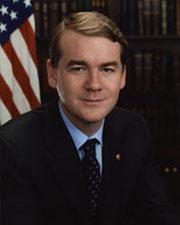
U.S. Senator for Colorado
Democrat
Senate term end not loaded yet
Missed 9.0% of roll calls. Chamber median 2.1%.
The full voting recordCounts roll calls where most Democrats and most Republicans voted differently, leaving out procedural votes.
How we countFrom FEC filings, Voteview roll calls and Congress.gov.
Democrat. In Congress since 2009, 3 terms in total.
Following saves Bennet to your list, which Chamber & Street keeps on its server, linked to a cookie on this browser and not to your name or email. Email alerts will come with constituent verification.
Bills and resolutions where Bennet is the primary sponsor. Most bills never leave committee; that is normal for every member. Source: Congress.gov, last updated Oct 29, 2026.
33 of 84 have at least one cosponsor from the other party.
A resolution to recognize and celebrate the 30th anniversary of the Denver International Airport.
Introduced Feb 27, 2025. 1 cosponsor. S.Res. 102 on Congress.gov
Introduced
This resolution recognizes February 28th, 2025, as the 30th anniversary of Denver International Airport in Denver, Colorado.
Edward J. Dwight, Jr. Congressional Gold Medal Act of 2025
Introduced Feb 25, 2025. 6 cosponsors, 2 from the other party. S. 734 on Congress.gov(opens in a new tab)
Introduced
Edward J. Dwight, Jr., Congressional Gold Medal Act of 2025
This bill provides for the award of a Congressional Gold Medal to Edward J. Dwight, Jr., the first African American astronaut candidate in the United States, in recognition of his historic service to the United States, his example of excellence during times of struggle and overt racism, and his contributions in art and Black history.
Protect the West Act of 2025
Introduced Feb 20, 2025. 4 cosponsors. S. 670 on Congress.gov(opens in a new tab)
Introduced
Gold King Mine Spill Compensation Act of 2025
Introduced Feb 13, 2025. 1 cosponsor. S. 568 on Congress.gov(opens in a new tab)
Introduced
Gold King Mine Spill Compensation Act of 2025
This bill authorizes and provides funding for compensation for certain homeowners, livestock grazers, farmers, and companies who suffered damages as a result of the Gold King Mine spill on August 5, 2015, in southwest Colorado.
To be eligible for compensation, a homeowner, livestock grazer, farmer, or company (1) must have submitted an administrative claim to the Environmental Protection Agency on or before August 5, 2017, that was denied or not fully compensated; and (2) must not have entered a settlement with the United States for an amount exceeding $2,500.
Under the bill, covered damages include lost business income, expenses arising from relocating livestock and providing alternative water supplies, and crop loss or diminished crop yield.
High Rise Fire Sprinkler Incentive Act of 2025
Introduced Feb 10, 2025. 1 cosponsor, 1 from the other party. S. 504 on Congress.gov(opens in a new tab)
Introduced
Bolts Ditch Act
Introduced Feb 3, 2025. 1 cosponsor. S. 365 on Congress.gov(opens in a new tab)
Introduced
Bolts Ditch Act
This bill allows additional entities—the Eagle River Water and Sanitation District and the Upper Eagle Regional Water Authority—to access and use the Bolts Ditch and its headgate within the Holy Cross Wilderness in Colorado for the purposes of the diversion of water and use, maintenance, and repair of such ditch and headgate.
Finish the Arkansas Valley Conduit Act
Introduced Jan 29, 2025. 1 cosponsor. S. 296 on Congress.gov(opens in a new tab)
Introduced
Finish the Arkansas Valley Conduit Act
This bill reduces payments that communities within the Arkansas River Valley must pay to the Bureau of Reclamation for the construction of the Arkansas Valley Conduit, a pipeline in Colorado for delivering water from the Pueblo Reservoir to such communities. Specifically, it removes interest payments and extends the repayment period to 100 years.
Tim’s Act
Introduced Jan 28, 2025. 0 cosponsors. S. 279 on Congress.gov(opens in a new tab)
Introduced
Tim Hart Wildland Firefighter Classification and Pay Parity Act or Tim's Act
This bill increases compensation and establishes additional benefits and programs for federal wildland firefighters. (These individuals are employed by the Department of Agriculture, the Department of the Interior, or tribal governments.)
The bill increases the minimum rate of basic pay for wildland firefighters at General Schedule (GS) levels 1 through 15 by percentages specified in the bill, with smaller increases for higher GS levels. The bill also requires comparable increases to the hourly rates paid to prevailing rate employees who are wildland firefighters. It also establishes premium pay for wildland firefighters who respond to certain prolonged fire incidents and are deployed outside of their normal duty stations or to an area adjacent to the incident. These changes take effect after other temporary pay increases for wildland firefighters expire.
The bill also (1) establishes paid rest and recuperation leave; (2) allows certain prior service to be credited for retirement purposes; and (3) provides housing allowances, tuition assistance, and other benefits for wildland firefighters.
Further, the bill directs the Office of Workers' Compensation Programs within the Department of Labor to ensure that psychological stress-related injuries and illnesses correlated to fire response are compensated and to expedite related claims.
The bill also establishes programs to (1) assist the next-of-kin of wildland firefighters and fire support personnel who are critically injured or killed while in the line of duty, and (2) support the mental and physical health of wildland firefighters.
Cleaner Air Spaces Act of 2025
Introduced Jan 17, 2025. 8 cosponsors. S. 147 on Congress.gov(opens in a new tab)
Introduced
Cleaner Air Spaces Act of 2025
This bill requires the Environmental Protection Agency to provide grants to air pollution control agencies, including at least one tribal agency with jurisdiction over air quality, to implement cleaner air space programs (i.e., programs to provide clean air to the public during wildland fire smoke events). Generally, such programs must be located in areas at risk of exposure to wildland fire smoke and must help provide educational materials, clean air centers (i.e., one or more clean air rooms in a publicly accessible building), and air filtration units to certain households. Clean air rooms are rooms designed to keep levels of harmful air pollutants as low as possible during wildland fire smoke events.
Under the bill, air pollution control agencies must partner with at least one community-based organization in implementing such programs.