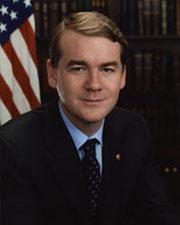
U.S. Senator for Colorado
Democrat
Senate term end not loaded yet
Missed 9.0% of roll calls. Chamber median 2.1%.
The full voting recordCounts roll calls where most Democrats and most Republicans voted differently, leaving out procedural votes.
How we countFrom FEC filings, Voteview roll calls and Congress.gov.
Democrat. In Congress since 2009, 3 terms in total.
Following saves Bennet to your list, which Chamber & Street keeps on its server, linked to a cookie on this browser and not to your name or email. Email alerts will come with constituent verification.
Bills and resolutions Bennet signed on to as a cosponsor. An original cosponsor signed on the day the bill was introduced. Source: govinfo bill status files, last updated Nov 6, 2026.
Bennet also withdrew as a cosponsor from 1 bill, not listed here.
A resolution dissenting from the United States delegation's February 24, 2025, vote at the United Nations General Assembly.
Sponsor Jeanne Shaheen (D). Joined Mar 3, 2025. 27 cosponsors. S.Res. 100 on Congress.gov
Introduced
A resolution condemning the rejection by the United States of a United Nations resolution condemning the illegal invasion of Ukraine by the Russian Federation.
Sponsor Ruben Gallego (D). Original cosponsor. 4 cosponsors. S.Res. 103 on Congress.gov(opens in a new tab)
Introduced
A resolution celebrating Black History Month.
Sponsor Cory Booker (D). Original cosponsor. 42 cosponsors. S.Res. 99 on Congress.gov(opens in a new tab)
Passed the Senate
This resolution recognizes Black History Month as an opportunity to reflect on U.S. history and to commemorate the contributions of African Americans. It calls for the United States to (1) honor the contribution of pioneers who helped to ensure its legacy; and (2) move forward as a nation "indivisible, with liberty and justice for all."
Truth and Healing Commission on Indian Boarding School Policies Act of 2025
Sponsor Lisa Murkowski (R). Original cosponsor. 26 cosponsors. S. 761 on Congress.gov(opens in a new tab)
Passed committee
Truth and Healing Commission on Indian Boarding School Policies Act of 2025
This bill establishes the Truth and Healing Commission on Indian Boarding School Policies in the United States within the legislative branch and sets forth its powers, duties, and membership.
Among other duties, the commission must investigate the impacts and ongoing effects of the Indian Boarding School Policies (federal policies under which American Indian, Alaska Native, and Native Hawaiian children were forcibly removed from their family homes and placed in boarding schools).
Further, the commission must develop recommendations on ways to (1) protect unmarked graves and accompanying land protections; (2) support repatriation and identify the tribal nations from which children were taken; and (3) discontinue the removal of American Indian, Alaska Native, and Native Hawaiian children from their families and tribal communities by state social service departments, foster care agencies, and adoption agencies.
Accelerating Kids’ Access to Care Act
Sponsor Chuck Grassley (R). Original cosponsor. 45 cosponsors. S. 752 on Congress.gov(opens in a new tab)
Introduced
Accelerating Kids’ Access to Care Act
This bill requires states to establish a process through which qualifying out-of-state providers may temporarily treat children under Medicaid and the Children's Health Insurance Program (CHIP) without undergoing additional screening requirements.
Specifically, states must establish a process through which qualifying out-of-state providers may enroll for five years as participating providers to treat individuals under the age of 21 without undergoing additional screening requirements.
A qualifying out-of-state provider (1) must not have been excluded or terminated from participating in a federal health care program or state Medicaid program; and (2) must have been successfully enrolled in Medicare or a state Medicaid program based on a determination that the provider posed a limited risk of fraud, waste, or abuse.
The bill’s changes take effect three years after enactment.
Ethan's Law
Sponsor Richard Blumenthal (D). Original cosponsor. 40 cosponsors. S. 726 on Congress.gov(opens in a new tab)
Introduced
Ethan's Law
This bill establishes a framework to regulate the storage of firearms on residential premises at the federal, state, and tribal levels.
At the federal level, the bill establishes statutory requirements for firearms on residential premises to be safely stored if a minor is likely to gain access without permission or if a resident is ineligible to possess a firearm.
An individual who violates the requirements is subject to criminal penalties. A firearm stored in violation of the requirements is subject to seizure and forfeiture.
At the state and tribal levels, the bill requires the Department of Justice to award grants to implement functionally identical requirements for the safe storage of firearms.
Voluntary Public Access Improvement Act of 2025
Sponsor Steve Daines (R). Original cosponsor. 5 cosponsors. S. 704 on Congress.gov(opens in a new tab)
Introduced
Voluntary Public Access Improvement Act of 2025
This bill reauthorizes through FY2029 and increases funding for the Voluntary Public Access and Habitat Incentive Program (VPA-HIP). This Natural Resources Conservation Service program provides state and tribal governments competitive grants to encourage owners and operators of privately-held land (i.e., farm, ranch, and forest land) to allow public access for hunting, fishing, and other wildlife-dependent recreation.
The bill also reauthorizes through FY2029 VPA-HIP funding to encourage public access to land covered by wetland reserve easements through agreements with states and tribal governments.
Veterans Mental Health and Addiction Therapy Quality of Care Act
Sponsor John Cornyn (R). Original cosponsor. 8 cosponsors. S. 702 on Congress.gov(opens in a new tab)
Passed committee
Veterans Mental Health and Addiction Therapy Quality of Care Act
This bill requires the Department of Veterans Affairs (VA) to seek to enter into an agreement with an independent and objective organization to study the difference in quality of mental health and addiction therapy care provided by the VA compared to non-VA providers across various modalities. The organization must publish its findings publicly.
Protecting Our Guests During Hostilities in Ukraine Act
Sponsor Richard Durbin (D). Joined Feb 25, 2025. 15 cosponsors. S. 696 on Congress.gov(opens in a new tab)
Introduced
A resolution acknowledging the third anniversary of Russia's further invasion of Ukraine and expressing support for the people of Ukraine.
Sponsor Jeanne Shaheen (D). Original cosponsor. 21 cosponsors. S.Res. 91 on Congress.gov(opens in a new tab)
Introduced
A bill to amend the Internal Revenue Code of 1986 to provide special rules for the taxation of certain residents of Taiwan with income from sources within the United States.
Sponsor Mike Crapo (R). Joined Feb 24, 2025. 48 cosponsors. S. 199 on Congress.gov(opens in a new tab)
Introduced
A resolution expressing gratitude to the Joint Congressional Committee on Inaugural Ceremonies, the Architect of the Capitol, the Sergeant at Arms, the Secretary of the Senate, law enforcement officers, emergency personnel, and volunteers for their support in making the Presidential Inauguration a success.
Sponsor Mike Rounds (R). Original cosponsor. 44 cosponsors. S.Res. 80 on Congress.gov(opens in a new tab)
Passed the Senate
First Rhode Island Regiment Congressional Gold Medal Act
Sponsor Sheldon Whitehouse (D). Original cosponsor. 67 cosponsors. S. 567 on Congress.gov(opens in a new tab)
Passed the Senate
First Rhode Island Regiment Congressional Gold Medal Act
This bill provides for the award of a single Congressional Gold Medal to the First Rhode Island Regiment, collectively, in recognition of their dedicated service during the Revolutionary War.
REPLACE Act
Sponsor John Hickenlooper (D). Original cosponsor. 3 cosponsors. S. 566 on Congress.gov(opens in a new tab)
Introduced
Antisemitism Awareness Act of 2025
Sponsor Tim Scott (R). Original cosponsor. 47 cosponsors. S. 558 on Congress.gov(opens in a new tab)
Introduced
Antisemitism Awareness Act of 2025
This bill provides statutory authority for the requirement that the Department of Education’s Office for Civil Rights take into consideration the International Holocaust Remembrance Alliance's (IHRA's) working definition of antisemitism when reviewing or investigating complaints of discrimination based on race, color, or national origin in programs or activities that receive federal financial assistance. According to the IHRA's working definition, antisemitism is a certain perception of Jews, which may be expressed as hatred toward Jews.
A resolution supporting the goals and ideals of "Career and Technical Education Month".
Sponsor Timothy Kaine (D). Original cosponsor. 51 cosponsors. S.Res. 66 on Congress.gov(opens in a new tab)
Passed the Senate
This resolution supports the designation of Career and Technical Education Month to celebrate career and technical education across the United States.
Foreign Assistance Accountability and Oversight Act
Sponsor Timothy Kaine (D). Original cosponsor. 21 cosponsors. S. 491 on Congress.gov(opens in a new tab)
Introduced
Air Guard STATUS Act of 2025
Sponsor John Hoeven (R). Original cosponsor. 4 cosponsors. S. 489 on Congress.gov(opens in a new tab)
Introduced
Air Guard Standardizing Tuition Assistance To Unify the Services Act of 2025 or the Air Guard STATUS Act of 2025
This bill requires the Department of the Air Force to establish a permanent program to pay all or a portion of tuition or expenses at an educational institution for members of the Air National Guard who are in compliance with training requirements (i.e., required field exercises and drills).
Alternatives to PAIN Act
Sponsor Thomas Tillis (R). Original cosponsor. 36 cosponsors. S. 475 on Congress.gov(opens in a new tab)
Introduced
Alternatives to Prevent Addiction In the Nation Act or the Alternatives to PAIN Act
This bill reduces cost-sharing and prohibits the imposition of certain utilization requirements under the Medicare prescription drug benefit for certain non-opioid pain management drugs.
Specifically, the bill requires such drugs to be covered without a deductible and to be placed on the lowest cost-sharing tier (if any). The bill also prohibits the imposition of prior authorization requirements (i.e., requiring prior approval from a plan) or step therapy requirements (i.e., requiring the use of alternative drugs before a drug is covered under a plan) with respect to such drugs.
Ski Hill Resources for Economic Development Act
Sponsor John Barrasso (R). Original cosponsor. 13 cosponsors. S. 472 on Congress.gov(opens in a new tab)
Passed committee
Ski Hill Resources for Economic Development Act
This bill allows National Forest System (NFS) units to keep the majority of ski area permit rental fees that were generated within their boundaries and outlines how revenues from those fees may be used. Such fees are collected by the Department of Agriculture (USDA) from ski area operators on NFS land.
Within the NFS unit where the fees were generated, USDA must expend (1) 60%-48% of the collected fees for activities such as administration of the ski area permit program, visitor information, or reducing the likelihood of wildfire in or adjacent to a recreation site; and (2) 20% of the collected fees for activities such as repair of a Forest Service-owned facility, habitat restoration, or search and rescue activities.
The remainder of the collected fees must be expended by USDA at any NFS unit for any of the activities specified in this bill.
Family Farm and Small Business Exemption Act
Sponsor Joni Ernst (R). Original cosponsor. 13 cosponsors. S. 469 on Congress.gov(opens in a new tab)
Introduced
Family Farm and Small Business Exemption Act
This bill restores an exemption for certain family farms and small businesses on the Free Application for Federal Student Aid (FAFSA) form. The bill applies to the net worth of (1) a family farm on which the family resides, or (2) a small business with not more than 100 full-time or full-time equivalent employees that is owned and controlled by the family.
Prior to recent changes made to the FAFSA, the net worth of these family farms and small businesses were excluded as assets when calculating a student's financial need to determine federal student aid eligibility. Beginning with the 2024-2025 academic year, the net worth of these farms and businesses are treated as an asset and therefore included in the calculation. This bill restores the exemption to exclude such net worth from the calculation.
End Double Taxation of Successful Consumer Claims Act
Sponsor Catherine Cortez Masto (D). Original cosponsor. 6 cosponsors. S. 467 on Congress.gov(opens in a new tab)
Introduced
End Double Taxation of Successful Consumer Claims Act
This bill allows an above-the-line tax deduction for court costs and attorney’s fees awarded to an individual as part of a settlement or judgment for a claim related to certain consumer protection violations, subject to limitations. (An above-the-line deduction is subtracted from gross income to calculate adjusted gross income.)
Under current law, court costs and attorney’s fees awarded to an individual as part of a settlement or judgment are included in the individual’s gross income, even if such attorney’s fees are contingent upon the outcome of the claim or paid directly to the individual’s attorney. (Some exceptions apply.) However, under current law, an above-the-line tax deduction is allowed for court costs and attorney’s fees awarded in connection with certain employment and civil rights discrimination claims.
This bill expands the above-the-line tax deduction for court costs and attorney’s fees paid in connection with certain discrimination claims to include court costs and attorney’s fees awarded as part of a settlement or judgment in a claim for
• unfair, deceptive, or abusive trade or credit practices;
• harm to an individual by a seller or provider of property, services, securities or other investments, money, or credit; or
• certain other consumer protection violations.
The deduction is allowed to the extent that such amounts are includible in the individual's gross income.
Protecting Sensitive Locations Act
Sponsor Richard Blumenthal (D). Original cosponsor. 33 cosponsors. S. 455 on Congress.gov(opens in a new tab)
Introduced
Protecting Sensitive Locations Act
This bill prohibits immigration enforcement actions within 1,000 feet of a sensitive location except in exigent circumstances, such as the imminent risk of death, violence, or physical harm to any person.
Sensitive locations include
• health care facilities;
• schools and school bus stops;
• places that provide assistance for people such as children, pregnant women, and abuse victims;
• child care facilities;
• places that provide disaster or emergency services;
• places of worship;
• courthouses and lawyers’ offices;
• facilities used as polling places;
• certain labor union facilities; and
• public assistance offices.
The prohibition shall apply to Department of Homeland Security officers and agents, as well as state employees pursuing immigration enforcement actions.
If an enforcement action is carried out in violation of this prohibition (1) no information resulting from the action may be entered into the record in a resulting removal proceeding, and (2) the affected individual may move to immediately terminate such a proceeding.
U.S. Immigration and Customs Enforcement and U.S. Customs and Border Protection shall annually report to Congress about enforcement actions taken at sensitive locations in the preceding year.
Right to Contraception Act
Sponsor Edward Markey (D). Original cosponsor. 41 cosponsors. S. 422 on Congress.gov(opens in a new tab)
Introduced
NO BAN Act
Sponsor Christopher Coons (D). Original cosponsor. 36 cosponsors. S. 398 on Congress.gov(opens in a new tab)
Introduced
National Origin-Based Antidiscrimination for Nonimmigrants Act or the NO BAN Act
This bill imposes limitations on the President's authority to suspend or restrict aliens from entering the United States. It also prohibits religious discrimination in various immigration-related decisions, such as whether to issue an immigrant or nonimmigrant visa, unless there is a statutory basis for such discrimination.
The President may temporarily restrict the entry of any aliens or class of aliens after the Department of State determines that the restriction would address specific and credible facts that threaten U.S. interests such as public safety.
The bill also imposes limitations on such restrictions, such as requiring the President, State Department, and the Department of Homeland Security (DHS) to (1) only issue a restriction when required to address a compelling government interest, and (2) narrowly tailor the suspension to use the least restrictive means to achieve such an interest.
Before imposing a restriction, the State Department and DHS shall consult with Congress. The State Department and DHS shall report to Congress about the restriction within 48 hours of the restriction's imposition. If such a report is not made, the restriction shall immediately terminate.
Individuals or entities present in the United States and unlawfully harmed by such a restriction may sue in federal court.
The bill transfers the authority to suspend the entry of aliens traveling to the United States on a commercial airline that failed to comply with regulations related to detecting fraudulent travel documents from the Department of Justice to DHS.