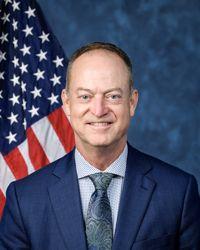
U.S. Representative for Indiana’s 8th district
Republican
119th Congress, two-year term
Missed 1.9% of roll calls. Chamber median 1.9%.
The full voting recordCounts roll calls where most Democrats and most Republicans voted differently, leaving out procedural votes.
How we countFrom FEC filings, Voteview roll calls and Congress.gov.
Republican. In Congress since 2025, 1 term in total.
Following saves Messmer to your list, which Chamber & Street keeps on its server, linked to a cookie on this browser and not to your name or email. Email alerts will come with constituent verification.
Bills and resolutions Messmer signed on to as a cosponsor. An original cosponsor signed on the day the bill was introduced. Source: govinfo bill status files, last updated Nov 6, 2026.
Messmer also withdrew as a cosponsor from 3 bills, not listed here.
Expressing support for the designation of May 2025 as Renewable Fuels Month to recognize the important role that renewable fuels play in reducing carbon impacts, lowering fuel prices for consumers, supporting rural communities, and lessening reliance on foreign adversaries.
Sponsor Zachary Nunn (R). Joined May 5, 2025. 15 cosponsors. H.Res. 375 on Congress.gov
Passed the House
To amend the Internal Revenue Code of 1986 to modify the railroad track maintenance credit.
Sponsor Mike Kelly (R). Joined May 5, 2025. 183 cosponsors. H.R. 516 on Congress.gov(opens in a new tab)
Introduced
This bill increases the annual limit on the tax credit for qualified railroad track maintenance expenses (also referred to as the short line railroad tax credit) and expands eligibility for claiming the credit.
Under current law, the tax credit is limited each tax year to $3,500 multiplied by the sum of the number of miles of railroad track owned or leased by the taxpayer (miles owned or leased) and the number of railroad track miles assigned to the taxpayer by a Class II or III railroad (miles assigned). This bill increases the annual limit to $6,100 multiplied by the sum of miles owned or leased and miles assigned. The $6,100 amount used in the calculation of the tax credit limit is adjusted for inflation for tax years beginning after 2025.
The bill also expands eligibility for the tax credit to include gross expenses for maintaining railroad tracks owned or leased as of January 1, 2024. Under current law, the tax credit is limited to gross expenses for maintaining railroad tracks owned or leased as of January 1, 2015.
SHIPS for America Act of 2025
Sponsor Trent Kelly (R). Original cosponsor. 146 cosponsors. H.R. 3151 on Congress.gov(opens in a new tab)
Introduced
Providing congressional disapproval under chapter 8 of title 5, United States Code, of the rule submitted by the Environmental Protection Agency relating to "California State Motor Vehicle and Engine and Nonroad Engine Pollution Control Standards; The 'Omnibus' Low NOX Regulation; Waiver of Preemption; Notice of Decision".
Sponsor Jay Obernolte (R). Joined Apr 28, 2025. 32 cosponsors. H.J.Res. 89 on Congress.gov(opens in a new tab)
Became law
This joint resolution revokes the waiver granted to the California Air Resources Board regarding new emissions standards for new 2024 and subsequent model year on-road heavy-duty vehicles and engines, off-road diesel engines, and off-road diesel-fueled auxiliary power units. (Under the Clean Air Act, California may seek waivers of the preemption prohibiting states from enacting certain emission standards.)
Specifically, the joint resolution nullifies the Environmental Protection Agency notice titled California State Motor Vehicle and Engine and Nonroad Engine Pollution Control Standards; The ‘Omnibus’ Low NOX Regulation; Waiver of Preemption; Notice of Decision.
Providing congressional disapproval under chapter 8 of title 5, United States Code, of the rule submitted by the Environmental Protection Agency relating to "California State Motor Vehicle and Engine Pollution Control Standards; Advanced Clean Cars II; Waiver of Preemption; Notice of Decision".
Sponsor John Joyce (R). Joined Apr 28, 2025. 41 cosponsors. H.J.Res. 88 on Congress.gov(opens in a new tab)
Became law
This joint resolution revokes the waiver granted to the California Air Resources Board regarding its Advanced Clean Cars II (ACC II) regulations, which include new requirements for low-emission vehicles and zero-emission vehicles. (Under the Clean Air Act, California may seek waivers of the preemption prohibiting states from enacting certain emission standards.)
Specifically, the joint resolution nullifies the Environmental Protection Agency notice titled California State Motor Vehicle and Engine Pollution Control Standards; Advanced Clean Cars II; Waiver of Preemption; Notice of Decision.
Providing congressional disapproval under chapter 8 of title 5, United States Code, of the rule submitted by the Environmental Protection Agency relating to "California State Motor Vehicle and Engine Pollution Control Standards; Heavy-Duty Vehicle and Engine Emission Warranty and Maintenance Provisions; Advanced Clean Trucks; Zero Emission Airport Shuttle; Zero-Emission Power Train Certification; Waiver of Preemption; Notice of Decision".
Sponsor John James (R). Joined Apr 28, 2025. 24 cosponsors. H.J.Res. 87 on Congress.gov(opens in a new tab)
Became law
This joint resolution revokes waivers granted to the California Air Resources Board regarding several of its regulations, including the Heavy-Duty Vehicle and Engine Emission Warranty Regulations and Maintenance Provisions. (Under the Clean Air Act, California may seek waivers of the preemption prohibiting states from enacting certain emission standards.)
Specifically, the joint resolution nullifies the Environmental Protection Agency notice titled California State Motor Vehicle and Engine Pollution Control Standards; Heavy-Duty Vehicle and Engine Emission Warranty and Maintenance Provisions; Advanced Clean Trucks; Zero Emission Airport Shuttle; Zero-Emission Power Train Certification; Waiver of Preemption; Notice of Decision.
Safeguarding American Property Act of 2025
Sponsor Troy Downing (R). Original cosponsor. 36 cosponsors. H.R. 2708 on Congress.gov(opens in a new tab)
Introduced
FIRM Act
Sponsor Andy Barr (R). Original cosponsor. 19 cosponsors. H.R. 2702 on Congress.gov(opens in a new tab)
Introduced
Financial Integrity and Regulation Management Act or the FIRM Act
This bill prohibits the consideration of reputational risk by federal banking agencies when regulating, examining, or supervising a depository institution or credit union. The bill defines reputational risk as the potential for negative publicity or public attention to decrease confidence in the institution, lead to litigation, reduce revenues, or result in other adverse impacts to the institution.
Agencies must report on the implementation of this bill.
Veterans Readiness and Employment Transparency Act of 2025
Sponsor Abraham Hamadeh (R). Joined Apr 8, 2025. 26 cosponsors. H.R. 1793 on Congress.gov(opens in a new tab)
Introduced
Repealing Big Brother Overreach Act
Sponsor Warren Davidson (R). Joined Apr 7, 2025. 193 cosponsors. H.R. 425 on Congress.gov(opens in a new tab)
Passed committee
Repealing Big Brother Overreach Act
This bill repeals the Corporate Transparency Act. The act requires existing companies and newly created companies to report beneficial ownership information to the Department of the Treasury’s Financial Crimes Enforcement Network for purposes of addressing the financing of terrorism and money laundering.
SHOPP Act of 2025
Sponsor Jasmine Crockett (D). Joined Apr 7, 2025. 18 cosponsors. H.R. 1782 on Congress.gov(opens in a new tab)
Introduced
Supporting all Healthy Options when Purchasing Produce Act of 2025 or the SHOPP Act of 2025
This bill modifies the Gus Schumacher Nutrition Incentive Program (GusNIP) to include fresh frozen fruits and vegetables.
GusNIP is a Department of Agriculture (USDA) program that provides grants for projects that increase low-income consumers' purchases of fruits and vegetables. It is made up of three competitive grant programs, including the GusNIP Nutrition Incentive Program, which provides grants for projects that provide incentives for Supplemental Nutrition Assistance Program (SNAP) participants to purchase fruits and vegetables.
The bill directs USDA, in awarding GusNIP Nutrition Incentive Program grants, to give priority to projects that increase year-round availability of nutrition incentives by offering fresh frozen fruits or vegetables in the program.
In addition, the bill amends another GusNIP program, the Produce Prescription Program, to include fresh frozen fruits and vegetables, as well as fresh and fresh frozen legumes. Currently, only fresh fruits and vegetables are covered under the program.
The GusNIP Produce Prescription Program supports projects that demonstrate and evaluate the impact of fruit and vegetable prescriptions on increasing procurement and consumption of fruits and vegetables, reducing individual and household food insecurity, and reducing healthcare usage and associated costs.
Iranian Terror Prevention Act
Sponsor W. Steube (R). Original cosponsor. 35 cosponsors. H.R. 2581 on Congress.gov(opens in a new tab)
Introduced
To provide for the rescission of certain waivers and licenses relating to Iran, and for other purposes.
Sponsor August Pfluger (R). Original cosponsor. 22 cosponsors. H.R. 2575 on Congress.gov(opens in a new tab)
Introduced
No Iranian Energy Act
Sponsor August Pfluger (R). Original cosponsor. 21 cosponsors. H.R. 2574 on Congress.gov(opens in a new tab)
Introduced
Worker Enfranchisement Act
Sponsor Robert Onder (R). Original cosponsor. 9 cosponsors. H.R. 2572 on Congress.gov(opens in a new tab)
Introduced
Major Richard Star Act
Sponsor Gus Bilirakis (R). Joined Apr 1, 2025. 340 cosponsors. H.R. 2102 on Congress.gov(opens in a new tab)
Introduced
Major Richard Star Act
This bill allows a veteran with a combat-related disability to receive retirement pay, without reduction, concurrently with their disability compensation. This includes veterans with a combat-related disability and fewer than 20 years of creditable service. (Currently, veterans who receive combat-related special compensation and retirement pay are subject to an offset in retirement pay for concurrent receipt of such benefits.)
Fighter Force Preservation and Recapitalization Act of 2025
Sponsor Don Bacon (R). Joined Apr 1, 2025. 40 cosponsors. H.R. 1851 on Congress.gov(opens in a new tab)
Introduced
Marc Fischer Memorial Act
Sponsor Don Bacon (R). Joined Apr 1, 2025. 135 cosponsors. H.R. 1046 on Congress.gov(opens in a new tab)
Introduced
Accreditation for College Excellence Act of 2025
Sponsor Burgess Owens (R). Original cosponsor. 12 cosponsors. H.R. 2516 on Congress.gov(opens in a new tab)
Introduced
Free Speech Fairness Act
Sponsor Mark Harris (R). Original cosponsor. 38 cosponsors. H.R. 2501 on Congress.gov(opens in a new tab)
Introduced
SAVE Act
Sponsor Chip Roy (R). Joined Mar 31, 2025. 110 cosponsors. H.R. 22 on Congress.gov(opens in a new tab)
Passed the House
Safeguard American Voter Eligibility Act or the SAVE Act
This bill requires individuals to provide documentary proof of U.S. citizenship when registering to vote in federal elections.
Specifically, the bill prohibits states from accepting and processing an application to register to vote in a federal election unless the applicant presents documentary proof of U.S. citizenship. The bill specifies what documents are considered acceptable proof of U.S. citizenship, such as identification that complies with the REAL ID Act of 2005 that indicates U.S. citizenship.
Further, the bill (1) prohibits states from registering an individual to vote in a federal election unless, at the time the individual applies to register to vote, the individual provides documentary proof of U.S. citizenship; and (2) requires states to establish an alternative process under which an applicant may submit other evidence to demonstrate U.S. citizenship.
Each state must take affirmative steps on an ongoing basis to ensure that only U.S. citizens are registered to vote, which shall include establishing a program to identify individuals who are not U.S. citizens using information supplied by certain sources.
Additionally, states must remove noncitizens from their official lists of eligible voters.
The bill allows for a private right of action against an election official who registers an applicant to vote in a federal election who fails to present documentary proof of U.S. citizenship.
The bill establishes criminal penalties for certain offenses, including registering an applicant to vote in a federal election who fails to present documentary proof of U.S. citizenship.
Designating March 27, 2025, as "National Women in Agriculture Day".
Sponsor Kat Cammack (R). Original cosponsor. 18 cosponsors. H.Res. 260 on Congress.gov(opens in a new tab)
Introduced
This resolution recognizes the important role of women in agriculture as producers, educators, leaders, mentors, and more.
Stop Illegal Reentry Act
Sponsor Stephanie Bice (R). Joined Mar 27, 2025. 15 cosponsors. H.R. 749 on Congress.gov(opens in a new tab)
Introduced
Stop Illegal Reentry Act
This bill increases criminal penalties for certain non-U.S. nationals (aliens under federal law) who illegally reenter the United States after removal or exclusion.
Generally, an individual who had been denied entry into or removed from the United States and who later enters or attempts to enter the United States without prior approval from the Department of Homeland Security shall be fined, imprisoned for up to five years, or both. Current law requires a fine, imprisonment for up to two years, or both, for such an individual.
An individual who had been denied entry or removed three or more times and who later enters or attempts to enter the United States shall be fined, imprisoned for up to 10 years, or both.
An individual who was convicted of an aggravated felony or convicted at least two times before removal or departure and who subsequently enters or tries to enter the United States shall be imprisoned at least 5 years and for up to 20 years and may also be fined. Currently, there is no minimum term of imprisonment for an individual who reenters after a conviction for an aggravated felony, and there are no criminal penalties for a reentering individual who had been convicted at least two times (other than the penalties for illegal reentry generally).
Black Vulture Relief Act
Sponsor John Rose (R). Original cosponsor. 26 cosponsors. H.R. 2462 on Congress.gov(opens in a new tab)
Introduced
Black Vulture Relief Act of 2025
This bill allows livestock producers and their employees to take certain actions against black vultures to protect livestock. (Black vultures are protected under the Migratory Bird Treaty Act.)
Specifically, livestock producers and their employees may (1) take (i.e., capture, kill, or disperse, or transport the carcass of) a black vulture that they reasonably believe will cause death, injury, or destruction to livestock; or (2) in the course of taking or attempting to take the black vulture, cause injury to the bird. However, they may not take or attempt to take a black vulture through the use of poison.
Livestock producers and their employees must submit an annual report to the U.S. Fish and Wildlife Service (FWS) on black vultures taken under this bill. The FWS must develop a reporting form and make this reporting form available on its website.
Currently, the FWS has a permit process under the Migratory Bird Treaty Act for the taking of black vultures.
No Harm Act
Sponsor Robert Onder (R). Joined Mar 27, 2025. 8 cosponsors. H.R. 2387 on Congress.gov(opens in a new tab)
Introduced
No Harm Act
This bill prohibits federal funding for sex-trait altering treatment for minors, authorizes civil actions for harm caused by such procedures, and subjects certain procedures to potential criminal penalties. The bill defines sex-trait altering treatment as generally meaning medical treatment altering the physical or physiological characteristics of an individual’s biological sex (except for treating sexual development disorders, severe injuries, or injuries caused by sex-trait altering treatments).
The bill prohibits federal funds for
• supporting sex-trait altering treatment for minors,
• government regulatory action promoting such treatment,
• medical institutions providing such treatment, and
• elementary or secondary schools allowing school personnel to provide or support such treatment without parental consent.
The bill prohibits discrimination against, or penalization of, providers who decline to perform such treatment. Additionally, parents of a minor have a right to decline such treatment for the minor. States that require providers to furnish such treatment, or that do not require parental consent, may not receive certain federal funds.
The bill establishes a private right of action against health care providers for harm caused by such treatment or for not obtaining parental consent. It also generally establishes a private right of action against individuals or entities that violate the bill's other provisions.
Finally, the bill makes changes to the existing federal criminal prohibition on performing female genital mutilation on a minor. The bill specifies that the performance of sex-altering surgery on a minor is not considered medically necessary and thus may be subject to the applicable criminal penalties.