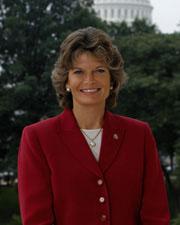
U.S. Senator for Alaska
Republican
Senate term end not loaded yet
Missed 4.2% of roll calls. Chamber median 2.1%.
The full voting recordCounts roll calls where most Democrats and most Republicans voted differently, leaving out procedural votes.
How we countFrom FEC filings, Voteview roll calls and Congress.gov.
Republican. In Congress since 2003, 4 terms in total.
Following saves Murkowski to your list, which Chamber & Street keeps on its server, linked to a cookie on this browser and not to your name or email. Email alerts will come with constituent verification.
Bills and resolutions where Murkowski is the primary sponsor. Most bills never leave committee; that is normal for every member. Source: Congress.gov, last updated Oct 29, 2026.
47 of 61 have at least one cosponsor from the other party.
A bill to establish an Ambassador-at-Large for Arctic Affairs.
Introduced Mar 12, 2025. 10 cosponsors, 7 from the other party. S. 1000 on Congress.gov
Passed committee
Cape Fox Land Entitlement Finalization Act of 2025
Introduced Mar 12, 2025. 1 cosponsor. S. 1008 on Congress.gov(opens in a new tab)
Passed committee
Cape Fox Land Entitlement Finalization Act of 2025
This bill waives a statutory core township selection requirement for the Cape Fox Corporation and allows Cape Fox to receive other lands to fulfill its remaining land entitlement. Cape Fox is an Alaska Native village corporation for the Alaska Native village of Saxman, Alaska.
Specifically, the bill states that Cape Fox shall not be required to receive its previously selected land of approximately 185 acres located within the township in which the Alaska Native village of Saxman, Alaska, is located. Instead, the bill allows Cape Fox to receive land outside of Cape Fox's current exterior selection boundary upon written notice of the new selection to the Department of the Interior.
In particular, if Cape Fox submits written notice of its selection of approximately 180 acres of surface land within the Tongass National Forest in Alaska to Interior within 90 days of the bill's enactment, then Interior must convey the federal land to Cape Fox. Upon conveyance of the surface estate of the federal land to Cape Fox, Interior must convey the subsurface estate of the federal land to Sealaska Corporation (the Alaska Native regional corporation representing southeastern Alaska).
The bill reserves a public access easement on the federal land conveyed to Cape Fox and Sealaska.
Native ELDER Act
Introduced Mar 5, 2025. 1 cosponsor, 1 from the other party. S. 870 on Congress.gov(opens in a new tab)
Introduced
Enhancing Native Elders' Longevity, Dignity, Empowerment, and Respect Act or the Native ELDER Act
This bill establishes a tribal advisory committee, revises certain grants, and requires reporting related to older (i.e., aged 60 or older) American Indians, Alaska Natives, and Native Hawaiians.
Specifically, the bill directs the Administration on Aging (AOA) to establish a tribal advisory committee to provide advice and guidance on matters relating to older Native Americans.
Additionally, the bill specifies that the technical assistance and training programs provided to grant recipients (e.g., tribal organizations providing supportive services) may include topics such as program management, data development and use, basic business skills, grant development, program and service innovations, and staff training and certification.
The bill directs the AOA, when making grants to tribal organizations to provide supportive services for older Native Americans, to prioritize organizations that will use these grants for necessary home modifications that will facilitate the ability of older Native Americans to remain at home.
The AOA must also report to Congress on (1) the feasibility of modeling the Native American Caregiver Support Program after the Program of Comprehensive Assistance for Family Caregivers, (2) the level of need for in-home services that include accessible home modifications for older Native Americans, and (3) the barriers to Indian tribes accessing programs for older Native Americans. This report must be made publicly available.
The Department of Labor must report to Congress on how recipients of funding under the Senior Community Service Employment Program are serving older Native Americans.
Truth and Healing Commission on Indian Boarding School Policies Act of 2025
Introduced Feb 26, 2025. 26 cosponsors, 26 from the other party. S. 761 on Congress.gov(opens in a new tab)
Passed committee
Truth and Healing Commission on Indian Boarding School Policies Act of 2025
This bill establishes the Truth and Healing Commission on Indian Boarding School Policies in the United States within the legislative branch and sets forth its powers, duties, and membership.
Among other duties, the commission must investigate the impacts and ongoing effects of the Indian Boarding School Policies (federal policies under which American Indian, Alaska Native, and Native Hawaiian children were forcibly removed from their family homes and placed in boarding schools).
Further, the commission must develop recommendations on ways to (1) protect unmarked graves and accompanying land protections; (2) support repatriation and identify the tribal nations from which children were taken; and (3) discontinue the removal of American Indian, Alaska Native, and Native Hawaiian children from their families and tribal communities by state social service departments, foster care agencies, and adoption agencies.
Justice for ALS Veterans Act of 2025
Introduced Feb 26, 2025. 12 cosponsors, 9 from the other party. S. 749 on Congress.gov(opens in a new tab)
Introduced
Justice for ALS Veterans Act of 2025
This bill extends increased dependency and indemnity compensation to the surviving spouse of a veteran whom the Department of Veterans Affairs has determined died from amyotrophic lateral sclerosis (ALS or Lou Gehrig's disease) regardless of how long the veteran had such disease prior to death. Under current law, such compensation is paid for a service-connected disability that was rated totally disabling for a continuous period of at least eight years immediately preceding death.
Under the bill, such extension of increased compensation applies retroactively to veterans who died from ALS on or after October 1, 2022.
Tribal Forest Protection Act Amendments Act of 2025
Introduced Feb 25, 2025. 2 cosponsors, 1 from the other party. S. 719 on Congress.gov(opens in a new tab)
Passed the Senate
Tribal Forest Protection Act Amendments Act of 2025
This bill reauthorizes through FY2031 the Tribal Forest Protection Act (TFPA) and expands the lands and activities eligible for inclusion in the TFPA.
Currently under the TFPA, the Department of the Interior and the Department of Agriculture (USDA) may enter into contracts and agreements with Indian tribes for tribes to carry out land management projects on federal lands. These projects are designed to protect Indian forest lands and rangelands from wildfire, disease, and other threats coming from federal lands. However, the TFPA is currently limited to projects on federal lands that border or are adjacent to Indian forest lands and rangelands under the jurisdiction of the tribe.
This bill removes certain limitations of the TFPA, first by expanding the definition of Indian forest land or rangeland to include land in Alaska that is held by Alaska Native corporations, thereby allowing these corporations to participate in TFPA projects.
Additionally, the bill removes the requirement that TFPA projects must occur on federal lands that border or are adjacent to Indian forest lands or rangelands. The bill instead requires the federal land involved to have a special geographic, historical, or cultural significance to the tribe.
The bill allows TFPA projects to be carried out directly on Indian forest lands and rangelands. (Currently, the TFPA only applies to work conducted on federal lands and not on tribal lands.)
The bill also updates a requirement for Interior and USDA to report to Congress on TFPA activities.
Veterinary Services to Improve Public Health in Rural Communities Act
Introduced Feb 18, 2025. 3 cosponsors, 3 from the other party. S. 620 on Congress.gov(opens in a new tab)
Passed the Senate
Veterinary Services to Improve Public Health in Rural Communities Act
This bill expands support for public health veterinary services (e.g., disease surveillance or vaccination) in tribal communities to address zoonotic infectious diseases (i.e., diseases that spread between humans and animals).
Specifically, the bill authorizes the Department of Health and Human Services (HHS), acting through the Indian Health Service (IHS), to expend funds for public health veterinary services to prevent and control zoonotic disease infection and transmission in IHS areas where the risk for disease occurrence in humans and wildlife is endemic.
HHS may assign or deploy veterinary public health officers from the U.S. Public Health Service (USPHS) Commissioned Corps to IHS areas.
Additionally, HHS must submit a biennial report to Congress on the use of funds, the assignment and deployment of veterinary public health officers from the USPHS Commissioned Corps, data related to the monitoring and disease surveillance of zoonotic diseases, and related services.
The bill also includes the IHS as a coordinating agency in the National One Health Framework. (This framework addresses zoonotic diseases and advances public health preparedness in the United States.)
The bill requires the Department of Agriculture to conduct a feasibility study on the delivery of oral rabies vaccines to wildlife reservoir species that are connected to the transmission of rabies to tribal members living in Arctic regions of the United States. The study must (1) evaluate the efficacy of the oral rabies vaccines, and (2) make recommendations to improve the delivery of these vaccines.
A bill to designate a mountain in the State of Alaska as Denali.
Introduced Feb 13, 2025. 4 cosponsors, 3 from the other party. S. 573 on Congress.gov(opens in a new tab)
Introduced
Maritime Fuel Tax Parity Act
Introduced Feb 12, 2025. 2 cosponsors, 1 from the other party. S. 549 on Congress.gov(opens in a new tab)
Introduced
An original resolution authorizing expenditures by the Committee on Indian Affairs.
Introduced Feb 5, 2025. 0 cosponsors. S.Res. 60 on Congress.gov(opens in a new tab)
Introduced
FASD Respect Act
Introduced Jan 16, 2025. 11 cosponsors, 8 from the other party. S. 139 on Congress.gov(opens in a new tab)
Introduced
Advancing FASD Research, Services and Prevention Act or the FASD Respect Act
This bill reauthorizes and modifies programs that are administered by the Department of Health and Human Services (HHS) to address fetal alcohol spectrum disorders (FASD), including educational and research programs.
The bill also establishes FASD Centers for Excellence to support FASD prevention, such as through screenings, public awareness campaigns, and trainings, particularly at the state and local levels.