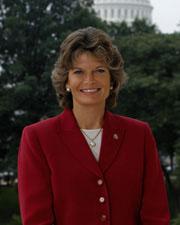
U.S. Senator for Alaska
Republican
Senate term end not loaded yet
Missed 4.2% of roll calls. Chamber median 2.1%.
The full voting recordCounts roll calls where most Democrats and most Republicans voted differently, leaving out procedural votes.
How we countFrom FEC filings, Voteview roll calls and Congress.gov.
Republican. In Congress since 2003, 4 terms in total.
Following saves Murkowski to your list, which Chamber & Street keeps on its server, linked to a cookie on this browser and not to your name or email. Email alerts will come with constituent verification.
Bills and resolutions Murkowski signed on to as a cosponsor. An original cosponsor signed on the day the bill was introduced. Source: govinfo bill status files, last updated Nov 6, 2026.
Fighting Foreign Illegal Seafood Harvests Act of 2025
Sponsor Dan Sullivan (R). Joined Mar 24, 2025. 9 cosponsors. S. 688 on Congress.gov
Passed the Senate
Broadband Grant Tax Treatment Act
Sponsor Jerry Moran (R). Joined Mar 24, 2025. 15 cosponsors. S. 674 on Congress.gov(opens in a new tab)
Introduced
Broadband Grant Tax Treatment Act
This bill excludes from gross income (for federal tax purposes) certain grants received for broadband deployment.
As background, contributions of capital to a corporation generally are not taxable income. However, under an exception enacted in 2017 by the Tax Cuts and Jobs Act, grants from a government or civic organization are not contributions to capital and, thus, treated as taxable income. Prior to the Tax Cuts and Jobs Act, the Internal Revenue Service (IRS) considered certain grants from a government or civic organization contributions of capital and, thus, not taxable income.
The bill specifically excludes from gross income grants received for broadband deployment from the
• National Telecommunications and Information Administration (NTIA) Broadband Equity, Access, and Deployment Program;
• NTIA State Digital Equity Capacity Grant Program;
• NTIA Digital Equity Competitive Grant Program;
• NTIA Enabling Middle Mile Broadband Infrastructure Program;
• Department of Agriculture ReConnect Program;
• Coronavirus State and Local Fiscal Recovery Funds and the Coronavirus Capital Projects Fund; and
• NTIA Tribal Broadband Connectivity Program and the Broadband Infrastructure Program.
The bill also requires the IRS to issue guidance on the exclusion from gross income of such grants.
The bill applies to funds received in tax years ending after March 11, 2021.
Major Richard Star Act
Sponsor Richard Blumenthal (D). Original cosponsor. 80 cosponsors. S. 1032 on Congress.gov(opens in a new tab)
Introduced
Major Richard Star Act
This bill allows a veteran with a combat-related disability to receive retirement pay, without reduction, concurrently with their disability compensation. This includes veterans with a combat-related disability and fewer than 20 years of creditable service. (Currently, veterans who receive combat-related special compensation and retirement pay are subject to an offset in retirement pay for concurrent receipt of such benefits.)
Military Spouse Hiring Act
Sponsor Timothy Kaine (D). Original cosponsor. 39 cosponsors. S. 1027 on Congress.gov(opens in a new tab)
Introduced
Military Spouse Hiring Act
This bill allows employers to claim a tax credit for a percentage of qualified wages paid to an employee who is a military spouse by expanding the federal Work Opportunity Tax Credit (WOTC) to add qualified military spouses as a targeted group. (The WOTC applies to employers who hire members of specific targeted groups, such as veterans, ex-felons, and long-term unemployment recipients, and is generally equal to a percentage of the wages paid to such individuals in the first year of employment, up to a maximum amount. Under current law, the wages must be paid before 2026.)
The bill defines a qualified military spouse as any individual who is certified by a state workforce agency as being (as of the hiring date) a spouse of a member of the Armed Forces.
A bill to require the Federal Energy Regulatory Commission to extend the time period during which licensees are required to commence construction of certain hydropower projects.
Sponsor Steve Daines (R). Original cosponsor. 7 cosponsors. S. 1020 on Congress.gov(opens in a new tab)
Became law
This act authorizes the Federal Energy Regulatory Commission (FERC) to extend construction deadlines for hydropower projects that were issued a license before March 13, 2020. FERC is authorized, upon the request of the licensees, to extend the deadline for beginning construction on such projects an additional six years beyond the eight-year extension FERC is authorized to provide under current law. The extension must consist of no more than three consecutive two-year periods.
The act also provides that FERC may reinstate certain expired licenses for projects with construction deadlines extended under this act, effective as of the date they expire.
A bill to amend the Small Business Act to eliminate certain requirements relating to the award of construction subcontracts within the county or State of performance.
Sponsor Dan Sullivan (R). Original cosponsor. 2 cosponsors. S. 991 on Congress.gov(opens in a new tab)
Introduced
This bill eliminates a requirement that, to the maximum extent practicable, certain construction subcontracts awarded by the Small Business Administration must be awarded within the county or state where the work is to be performed.
Space National Guard Establishment Act of 2025
Sponsor Mike Crapo (R). Joined Mar 12, 2025. 11 cosponsors. S. 963 on Congress.gov(opens in a new tab)
Introduced
Space National Guard Establishment Act of 2025
This bill establishes a Space National Guard as the reserve component of the U.S. Space Force, specifically in Alaska, California, Colorado, Florida, Hawaii, New York, and Ohio. The Space National Guard consists of specified units of the Air National Guard and must use existing facilities, infrastructure, and installations.
Pay Our Military Act of 2025
Sponsor Dan Sullivan (R). Joined Mar 11, 2025. 2 cosponsors. S. 876 on Congress.gov(opens in a new tab)
Introduced
Pay Our Military Act of 2025
This bill provides continuing appropriations for military pay for any period during which interim or full-year appropriations for FY2025 are not in effect (i.e., a government shutdown).
Specifically, the bill provides FY2025 continuing appropriations for the pay and allowances of (1) members of the Armed Forces, including reserve components, who perform active service during the period; and (2) civilian personnel and contractors of the Department of Defense (and the Department of Homeland Security in the case of the Coast Guard) who are providing support to such members of the Armed Forces.
If a government shutdown occurs, the bill provides the continuing appropriations until the earlier of (1) the enactment into law of specified appropriations legislation, or (2) January 1, 2026.
Pay Our Coast Guard Act
Sponsor Ted Cruz (R). Joined Mar 11, 2025. 9 cosponsors. S. 802 on Congress.gov(opens in a new tab)
Introduced
Pay Our Coast Guard Act
This bill provides continuing appropriations to the Coast Guard for pay and benefits when there is a Coast Guard-specific funding lapse.
Under the bill, a Coast Guard-specific funding lapse occurs when (1) a bill providing appropriations for the Coast Guard for a fiscal year has not been enacted before the beginning of that fiscal year, and no joint resolution providing continuing appropriations for the Coast Guard is in effect; and (2) a bill providing appropriations for the Department of Defense (DOD) for the fiscal year has been enacted before the beginning of the fiscal year, or a joint resolution providing continuing appropriation for DOD is in effect.
If a Coast Guard-specific funding lapse occurs, the bill provides appropriations to the Coast Guard for
• pay and allowances for military members of the Coast Guard who perform active service or inactive-duty training;
• pay and benefits for certain civilian employees and contract employees;
• the payment of a death gratuity;
• payments for travel related to funerals, the dignified transfer of remains, and unit memorial services; and
• the temporary continuation of the basic allowance for housing for dependents of members of the Coast Guard dying on active duty.
The bill generally provides the appropriations to the Coast Guard until the earlier of (1) the enactment of specified Coast Guard appropriations legislation, or (2) the termination of the availability of appropriations for DOD.
Peer to Peer Mental Health Support Act
Sponsor John Hickenlooper (D). Original cosponsor. 3 cosponsors. S. 906 on Congress.gov(opens in a new tab)
Introduced
HELP Copays Act
Sponsor Roger Marshall (R). Original cosponsor. 28 cosponsors. S. 864 on Congress.gov(opens in a new tab)
Introduced
A concurrent resolution supporting the Local Radio Freedom Act.
Sponsor John Barrasso (R). Original cosponsor. 25 cosponsors. S.Con.Res. 8 on Congress.gov(opens in a new tab)
Introduced
This concurrent resolution declares that Congress should not impose any new performance fee, tax, royalty, or other charge relating to the public performance of sound recordings on a local radio station for broadcasting sound recordings over the air, or on any business for the public performance of sound recordings broadcast on a local radio station.
Alaska Native Vietnam Era Veterans Land Allotment Extension Act
Sponsor Dan Sullivan (R). Original cosponsor. 1 cosponsor. S. 785 on Congress.gov(opens in a new tab)
Introduced
Alaska Native Vietnam Era Veterans Land Allotment Extension Act
This bill extends for an additional five years the time period during which an eligible Alaska Native veteran may apply for a land allotment under the Alaska Native Vietnam Era Veterans Land Allotment Program. The program makes Alaska Native veterans who served in the Armed Forces in Vietnam between August 5, 1964, and December 31, 1971, or their heirs eligible to receive up to 160 acres of federal land in Alaska.
Under the current program, the Department of the Interior's Bureau of Land Management may accept applications through December 29, 2025. This bill extends this time period for an additional five years to December 29, 2030.
EARLY Minds Act
Sponsor Alex Padilla (D). Original cosponsor. 3 cosponsors. S. 779 on Congress.gov(opens in a new tab)
Introduced
Lactation Spaces for Veteran Moms Act
Sponsor Jacky Rosen (D). Original cosponsor. 1 cosponsor. S. 778 on Congress.gov(opens in a new tab)
Passed the Senate
Lactation Spaces for Veteran Moms Act
This bill requires the Department of Veterans Affairs to ensure that each of its medical centers contains a hygienic lactation space that is not a bathroom and meets other specifications (e.g., must be easy to locate).
Accelerating Kids’ Access to Care Act
Sponsor Chuck Grassley (R). Original cosponsor. 45 cosponsors. S. 752 on Congress.gov(opens in a new tab)
Introduced
Accelerating Kids’ Access to Care Act
This bill requires states to establish a process through which qualifying out-of-state providers may temporarily treat children under Medicaid and the Children's Health Insurance Program (CHIP) without undergoing additional screening requirements.
Specifically, states must establish a process through which qualifying out-of-state providers may enroll for five years as participating providers to treat individuals under the age of 21 without undergoing additional screening requirements.
A qualifying out-of-state provider (1) must not have been excluded or terminated from participating in a federal health care program or state Medicaid program; and (2) must have been successfully enrolled in Medicare or a state Medicaid program based on a determination that the provider posed a limited risk of fraud, waste, or abuse.
The bill’s changes take effect three years after enactment.
A resolution designating the week of February 24 through February 28, 2025, as "Public Schools Week".
Sponsor Susan Collins (R). Original cosponsor. 21 cosponsors. S.Res. 96 on Congress.gov(opens in a new tab)
Passed the Senate
This resolution designates February 24-February 28, 2025, as Public Schools Week.
Helping Heroes Act
Sponsor Patty Murray (D). Original cosponsor. 11 cosponsors. S. 701 on Congress.gov(opens in a new tab)
Introduced
Helping Heroes Act
This bill requires the Department of Veterans Affairs (VA) to establish the Veteran Family Resource Program to address social determinants of health challenges experienced in veterans’ family units and ensure veterans and their families have access to services and resources to support wellness within the family units.
In implementing the program, the VA must (1) appoint at least one family coordinator in each Veterans Integrated Service Network (regional VA health care administrative areas), and (2) ensure adequate staffing and resources to ensure family coordinators are able to carry out their duties and functions. Under the bill, a family coordinator’s function is generally to serve at a VA medical center as a point person regarding VA and community resources for veterans, their families, and caregivers and survivors of veterans.
The VA may expand the program to additional medical centers as appropriate.
Not later than one year after the date of enactment of this bill, and not less frequently than once every five years after, the VA must survey disabled veterans and their families to identify and better understand their needs.
Protecting Our Guests During Hostilities in Ukraine Act
Sponsor Richard Durbin (D). Joined Feb 25, 2025. 15 cosponsors. S. 696 on Congress.gov(opens in a new tab)
Introduced
A resolution designating February 16, 2025, as "National Elizabeth Peratrovich Day".
Sponsor Dan Sullivan (R). Original cosponsor. 1 cosponsor. S.Res. 92 on Congress.gov(opens in a new tab)
Passed the Senate
This resolution designates February 16, 2025, as National Elizabeth Peratrovich Day. It also encourages the people of the United States and Members of Congress to commemorate the life and civil rights advocacy of Elizabeth Wanamaker Peratrovich by continuing the important work of ensuring equality for Alaska Natives and Native Americans.
A resolution acknowledging the third anniversary of Russia's further invasion of Ukraine and expressing support for the people of Ukraine.
Sponsor Jeanne Shaheen (D). Original cosponsor. 21 cosponsors. S.Res. 91 on Congress.gov(opens in a new tab)
Introduced
A bill to amend the Native American Tourism and Improving Visitor Experience Act to authorize grants to Indian tribes, tribal organizations, and Native Hawaiian organizations, and for other purposes.
Sponsor Brian Schatz (D). Original cosponsor. 1 cosponsor. S. 612 on Congress.gov(opens in a new tab)
Passed the Senate
This bill authorizes grants to Indian tribes, tribal organizations, and Native Hawaiian organizations for activities related to recreational travel and tourism.
Specifically, the bill authorizes (1) the Bureau of Indian Affairs to make these grants to and enter into agreements with Indian tribes and tribal organizations; (2) the Office of Native Hawaiian Relations to make these grants to and enter into agreements with Native Hawaiian organizations; and (3) other federal agencies to make these grants to and enter into agreements with tribes, tribal organizations, and Native Hawaiian organizations.
A resolution expressing gratitude to the Joint Congressional Committee on Inaugural Ceremonies, the Architect of the Capitol, the Sergeant at Arms, the Secretary of the Senate, law enforcement officers, emergency personnel, and volunteers for their support in making the Presidential Inauguration a success.
Sponsor Mike Rounds (R). Original cosponsor. 44 cosponsors. S.Res. 80 on Congress.gov(opens in a new tab)
Passed the Senate
Department of Energy Quantum Leadership Act of 2025
Sponsor Richard Durbin (D). Original cosponsor. 5 cosponsors. S. 579 on Congress.gov(opens in a new tab)
Introduced
Department of Energy Quantum Leadership Act of 2025
This bill modifies and reauthorizes various Department of Energy (DOE) programs related to quantum research and development and establishes several new, related research programs.
Specifically, the bill expands the scope of DOE’s quantum information science research program to include research, development, and demonstration on quantum information science, engineering, and technology. Among other requirements, DOE must (1) establish an early-stage research and development program in high-performance quantum computing; (2) study quantum science, engineering, and technology supply chain needs; and (3) establish a university-led trainee program to address quantum workforce development needs.
The bill also reauthorizes the National Quantum Information Science Research Centers and the Quantum User Expansion for Science and Technology program through FY2030. Further, the bill modifies DOE’s quantum network infrastructure program to require research related to the development of (1) quantum network and entanglement distribution protocols or applications, and (2) high-efficiency room-temperature photon detectors for quantum photonic applications.
Finally, the bill establishes an instrumentation and infrastructure program to maintain U.S. leadership in quantum information science, engineering, and technology; develop domestic quantum supply chains; and provide resources for the broader scientific community. In carrying out the program, DOE must develop, design, build, purchase, and commercialize specialized equipment, laboratory infrastructure, and state-of-the-art instrumentation. In coordination with industry and institutions of higher education, DOE must support the development of quantum foundries focused on meeting the device, hardware, software, and materials needs of the scientific community and the quantum supply chain.
SOLES Act
Sponsor Dan Sullivan (R). Original cosponsor. 2 cosponsors. S. 553 on Congress.gov(opens in a new tab)
Introduced
Save our Lone Emergency Services Act or the SOLES Act
This bill requires Medicare payments to sole community hospitals in Alaska or Hawaii to cover at least 94% of the reasonable costs of covered outpatient services.