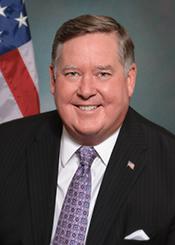
U.S. Representative for California’s 41st district
Republican
119th Congress, two-year term
Missed 0.3% of roll calls. Chamber median 1.9%.
The full voting recordCounts roll calls where most Democrats and most Republicans voted differently, leaving out procedural votes.
How we countFrom FEC filings, Voteview roll calls and Congress.gov.
Republican. In Congress since 1993, 17 terms in total.
Following saves Calvert to your list, which Chamber & Street keeps on its server, linked to a cookie on this browser and not to your name or email. Email alerts will come with constituent verification.
Bills and resolutions Calvert signed on to as a cosponsor. An original cosponsor signed on the day the bill was introduced. Source: govinfo bill status files, last updated Nov 6, 2026.
No Paydays for Hostage-Takers Act
Sponsor Michael Baumgartner (R). Joined Apr 9, 2025. 13 cosponsors. H.R. 2619 on Congress.gov
Passed committee
Affordable Housing Credit Improvement Act of 2025
Sponsor Darin LaHood (R). Original cosponsor. 168 cosponsors. H.R. 2725 on Congress.gov(opens in a new tab)
Introduced
Save Our Sequoias Act
Sponsor Vince Fong (R). Original cosponsor. 29 cosponsors. H.R. 2709 on Congress.gov(opens in a new tab)
Passed the House
Save Our Sequoias Act
This bill provides for the conservation of giant sequoia trees (Sequoiadendron giganteum) in California.
Specifically, it provides statutory authority for the Giant Sequoia Lands Coalition and outlines the coalition's duties. The coalition must submit a Giant Sequoia Health and Resiliency Assessment and annually update it. The information from the assessment must be made available so the information can be integrated into certain other plans. The coalition must also create and maintain a website that contains the assessment, educational materials, searchable information about individual giant sequoia groves, and a searchable database to track the status and costs of reforestation and rehabilitation activities.
In addition, the bill declares an emergency on certain public lands and allows officials to carry out protection plans during the emergency to respond to the threat of wildfires, insects, and drought. The emergency expires after seven years.
The Department of the Interior must develop and implement a Giant Sequoia Reforestation and Rehabilitation Strategy.
Finally, the bill establishes a variety of programs and funds to support the conservation of giant sequoias.
Firearm Due Process Protection Act of 2025
Sponsor Tom Emmer (R). Joined Apr 8, 2025. 24 cosponsors. H.R. 2184 on Congress.gov(opens in a new tab)
Introduced
Firearm Due Process Protection Act of 2025
This bill expands the grounds for pursuing judicial remedies related to the denial of certain firearm transfers. Additionally, the bill establishes procedural rules applicable to actions for judicial remedies.
Current law authorizes judicial remedies for an individual who is erroneously denied a firearm (e.g., an individual is denied a firearm but the individual is eligible to receive or possess a firearm). This bill authorizes remedies for an individual who experiences an extended delay (i.e., a delay of more than 60 days) on a firearm transfer.
Additionally, the bill requires an expedited hearing on an action for judicial remedies and places the burden of proof on the respondent (i.e., the government) to show that the individual was ineligible to receive or possess a firearm.
Election Results Accountability Act
Sponsor Jay Obernolte (R). Original cosponsor. 13 cosponsors. H.R. 2694 on Congress.gov(opens in a new tab)
Introduced
Election Results Accountability Act
This bill establishes deadlines for states to count ballots and certify results in federal elections.
Specifically, the bill requires a state to count not less than 90% of the ballots cast in a federal election held in the state not later than 72 hours after polls close and make the result of the count publicly available. Further, the state must certify and make publicly available the complete election results not later than two weeks after the election.
The bill provides exceptions to these deadlines, including for bona fide emergencies (e.g., major disasters) or technical difficulties (e.g., malfunctioning election equipment or software).
The bill prohibits a state from receiving federal election administration funds for subsequent elections if the state does not comply with the deadlines established by the bill. However, a state may regain eligibility for these funds if (1) the state submits a compliance plan to the Election Assistance Commission (EAC) and the Department of Justice (DOJ), and (2) the EAC and DOJ each certify that the state has taken actions to comply with the plan.
25th Anniversary of 9/11 Commemorative Coin Act
Sponsor Daniel Goldman (D). Joined Apr 7, 2025. 302 cosponsors. H.R. 1993 on Congress.gov(opens in a new tab)
Passed the House
25th Anniversary of 9/11 Commemorative Coin Act
This bill directs the Department of the Treasury to mint and issue coins to commemorate the 25th anniversary of the September 11, 2001, terrorist attacks on the United States and the establishment of the National September 11 Memorial and Museum at the World Trade Center.
The sale of all coins issued under this bill must include a surcharge to be paid to the National September 11 Memorial and Museum at the World Trade Center to support operations and maintenance. However, if the issuance of this commemorative coin exceeds certain annual limits, no surcharge may be included.
To amend the Federal Food, Drug, and Cosmetic Act to exempt the premium cigar industry from certain regulations.
Sponsor Byron Donalds (R). Joined Apr 2, 2025. 16 cosponsors. H.R. 2111 on Congress.gov(opens in a new tab)
Introduced
Crime Victims Fund Stabilization Act of 2025
Sponsor Ann Wagner (R). Joined Mar 31, 2025. 327 cosponsors. H.R. 909 on Congress.gov(opens in a new tab)
Passed the House
Crime Victims Fund Stabilization Act of 2025
This bill adds a new source of revenue for the Crime Victims Fund (CVF). Specifically, the bill requires certain civil monetary penalties collected from settlements and judgments in cases involving fraud and false claims against the federal government to be deposited into the CVF through FY2029.
The CVF supports federal, state, and local programs and activities to compensate and assist victims of crimes. Currently, the CVF is funded by deposits from a variety of sources, including federal criminal fines, penalties, and assessments; forfeited bail bonds; and certain other gifts, donations, and bequests.
Protect and Serve Act of 2025
Sponsor John Rutherford (R). Joined Mar 31, 2025. 120 cosponsors. H.R. 1551 on Congress.gov(opens in a new tab)
Introduced
Recognizing the 250th anniversary of the United States Marine Corps.
Sponsor Jack Bergman (R). Original cosponsor. 64 cosponsors. H.Res. 254 on Congress.gov(opens in a new tab)
Introduced
Mikaela Naylon Give Kids a Chance Act
Sponsor Michael McCaul (R). Joined Mar 25, 2025. 313 cosponsors. H.R. 1262 on Congress.gov(opens in a new tab)
Passed the House
Give Kids a Chance Act of 2025
This bill expands the Food and Drug Administration’s (FDA’s) authority with respect to research on rare pediatric diseases, including by permitting the FDA to take enforcement action against drug sponsors that fail to satisfy pediatric study requirements and by reauthorizing programs that support pediatric research.
Specifically, the bill
• modifies requirements relating to molecularly targeted pediatric cancer investigations to permit research on new drugs in combination with active ingredients that have already been approved, provided certain conditions are met;
• permits the FDA to take enforcement action against drug sponsors that fail to comply with pediatric study requirements, if such sponsors demonstrated a lack of due diligence in satisfying the requirement;
• renews the FDA’s authority to award priority review vouchers to sponsors of new products intended to treat rare pediatric diseases through September 30, 2029; and
• reauthorizes through FY2027 certain funding for the National Institutes of Health to support priority pediatric research.
The bill also provides statutory authority for the FDA’s interpretation of the orphan drug exclusivity period. The bill specifies, consistent with FDA regulations, that the seven-year market exclusivity period for drugs for rare diseases or conditions (i.e., orphan drugs) prohibits the approval of the same drug for the same approved use or indication with respect to the disease or condition. (In Catalyst Pharmaceuticals, Inc. v. Becerra, a court rejected the FDA’s interpretation and held that orphan drug exclusivity extends to all uses or indications for the disease or condition.)
Tanning Tax Repeal Act of 2025
Sponsor Carol Miller (R). Joined Mar 24, 2025. 26 cosponsors. H.R. 1940 on Congress.gov(opens in a new tab)
Introduced
Tanning Tax Repeal Act of 2025
This bill repeals the 10% excise tax imposed on the amount paid for indoor tanning services.
Disaster Mitigation and Tax Parity Act of 2025
Joined Mar 21, 2025. 32 cosponsors. H.R. 1849 on Congress.gov(opens in a new tab)
Progress not on file
Disaster Mitigation and Tax Parity Act of 2025
This bill excludes from gross income, for federal income tax purposes, payments received from a state catastrophe loss mitigation program by an individual for the purpose of making improvements to the individual’s property that mitigate the impact of certain disasters.
Under current law, individuals may exclude from gross income, for federal income tax purposes, payments received under the Robert T. Stafford Disaster Relief and Emergency Assistance Act or the National Flood Insurance Act (as in effect on April 15, 2005) for hazard mitigation. (Some exceptions apply.) Further, under current law, such payments do not increase the basis of the property for which the payments are made.
The bill allows a similar exclusion from gross income for certain payments received by an individual from a program established by
• a state (or any political subdivision or instrumentality of the state),
• a joint powers authority, or
• an entity that was established by the state to provide essential or basic property insurance and is regulated by the state.
Under the bill, such payments must be for making improvements to the individual’s property for the sole purpose of reducing damage that would be done to the property by a windstorm, earthquake, flood, or wildfire.
Finally, the bill provides that such payments from a state catastrophe loss mitigation program do not increase the basis of the property for which the payments are made.
Providing for congressional disapproval under chapter 8 of title 5, United States Code, of the rule submitted by the United States Fish and Wildlife Service relating to "Endangered and Threatened Wildlife and Plants; Endangered Species Status for the San Francisco Bay-Delta Distinct Population Segment of the Longfin Smelt".
Original cosponsor. 8 cosponsors. H.J.Res. 78 on Congress.gov(opens in a new tab)
Progress not on file
This joint resolution nullifies the rule issued by the U.S. Fish and Wildlife Service titled Endangered and Threatened Wildlife and Plants; Endangered Species Status for the San Francisco Bay-Delta Distinct Population Segment of the Longfin Smelt and published on July 30, 2024. The rule lists the San Francisco Bay-Delta distinct population segment of longfin smelt, a fish species of the Pacific Coast, as an endangered species. Thus, the joint resolution removes protection for the species under the Endangered Species Act of 1973.
Diesel Emissions Reduction Act of 2025
Sponsor Doris Matsui (D). Original cosponsor. 3 cosponsors. H.R. 2140 on Congress.gov(opens in a new tab)
Passed the House
Diesel Emissions Reduction Act of 2025
This bill reauthorizes through FY2029 a diesel emissions reduction program under which the Environmental Protection Agency provides grants, rebates, or loans for replacing diesel engines or retrofitting the engines with pollution control technologies.
FOCA Act of 2025
Sponsor Clay Higgins (R). Original cosponsor. 107 cosponsors. H.R. 2126 on Congress.gov(opens in a new tab)
Introduced
Fair and Open Competition Act of 2025 or the FOCA Act of 2025
This bill requires that federal contracts for construction projects neither require nor prohibit a bidder, offeror, contractor, or subcontractor from entering into agreements with one or more labor organizations with respect to such projects or related projects.
Under the bill, the controlling documents for federal construction contracts (such as bid specifications and project agreements) may not require or prohibit a bidder, offeror, contractor, or subcontractor from entering into or adhering to such labor agreements. Additionally, the controlling documents may not discriminate against or give preference to a bidder, offeror, contractor, or subcontractor who signs or refuses to sign such a labor agreement.
These requirements also apply to any (1) construction manager acting on behalf of the federal government with respect to such contract, (2) recipient of a federal grant or financial assistance for construction projects or construction manager acting on the recipient's behalf, and (3) party to a federal cooperative agreement for construction projects or construction managers acting on the party's behalf.
An agency may exempt a project from this prohibition to avert an imminent threat to public health or safety or to serve the national security.
ESA Amendments Act of 2025
Sponsor Bruce Westerman (R). Joined Mar 14, 2025. 26 cosponsors. H.R. 1897 on Congress.gov(opens in a new tab)
Passed committee
ESA Amendments Act of 2025
This bill reauthorizes through FY2031 the Endangered Species Act and generally narrows protections provided under the act.
The bill directs the Fish and Wildlife Service and the National Marine Fisheries Service to submit a National Listing Work Plan that establishes a five-year schedule and plan for addressing listing of endangered or threatened species and designation of critical habitats for such species. Under the plan, the bill gives the Services flexibility on the timing of acting on listing petitions and eliminates the requirement for the Services to act within 12 months on listing petitions.
The bill limits what land may be designated as critical habitat for an endangered or threatened species.
It also limits protections provided to threatened species and allows a state to regulate the recovery of such species if the Services determine the state's proposed recovery strategy would conserve the species.
The bill provides statutory authority for Conservation Benefit Agreements, which allow private landowners to voluntarily enter agreements to reduce threats to candidate species in exchange for being allowed to continue their operations if the species is later listed.
The bill also modifies the permitting process for certain other voluntary conservation agreements, including by exempting incidental take permits (e.g., permits to harm or kill a species) from environmental review requirements.
The bill also makes a variety of other changes to the act, including limiting consultation requirements, judicial review, and awards for attorneys’ fees in certain cases.
Freedom to Invest in Tomorrow’s Workforce Act
Sponsor Robert Wittman (R). Joined Mar 14, 2025. 203 cosponsors. H.R. 1151 on Congress.gov(opens in a new tab)
Introduced
Freedom to Invest in Tomorrow’s Workforce Act
This bill expands the expenses eligible for tax-free withdrawals from a qualified tuition program (known as a 529 plan) to include tuition, fees (including test fees), books, supplies, equipment, and other expenses related to the enrollment or attendance in a recognized postsecondary credentialing program.
Under the bill, a recognized postsecondary credentialing program includes certain programs identified by a state as providing training services, a program listed in the Web Enabled Approval Management System (WEAMS) maintained by the Department of Veterans Affairs, certain examinations required to obtain or maintain a credential, and other reputable credentialing programs.
Further, under the bill, such programs must be designed for an individual to obtain
• an industry-recognized postsecondary employment credential (e.g., project management professional certificate, advanced emergency medical technician certificate, and welding supervisor certificate),
• a certificate of completion of a registered and certified apprenticeship,
• an occupational or professional license issued or recognized by a state or the federal government (and any certification required for obtaining such license), or
• an associate or baccalaureate degree.
LIVE Beneficiaries Act
Sponsor Gus Bilirakis (R). Joined Mar 5, 2025. 3 cosponsors. H.R. 1403 on Congress.gov(opens in a new tab)
Introduced
Leveraging Integrity and Verification of Eligibility for Beneficiaries Act or the LIVE Beneficiaries Act
This bill requires state Medicaid programs to check the Social Security Administration's Death Master File on at least a quarterly basis to determine whether Medicaid enrollees are deceased.
Educational Choice for Children Act of 2025
Sponsor Adrian Smith (R). Joined Mar 3, 2025. 91 cosponsors. H.R. 833 on Congress.gov(opens in a new tab)
Introduced
Enhanced Iran Sanctions Act of 2025
Sponsor Michael Lawler (R). Joined Mar 3, 2025. 295 cosponsors. H.R. 1422 on Congress.gov(opens in a new tab)
Passed the House
Enhanced Iran Sanctions Act of 2025
This bill imposes sanctions on certain foreign persons (individuals and entities) that are involved in Iran's petroleum sector as well as certain associated persons. The bill also requires or authorizes actions to facilitate the enforcement of sanctions on Iran.
Specifically, the bill requires the President to impose visa- and property-blocking sanctions on any foreign person that, after the bill's enactment, knowingly engages in any transaction related to the processing, export, or sale of oil, condensates, gas, liquefied natural gas, or other petrochemical products in whole or in part from Iran. The President must also impose sanctions on certain foreign persons associated with a sanctioned individual or entity. For example, the President must sanction the subsidiaries and corporate officers of a sanctioned business.
The bill provides certain exceptions to these sanctions, including specifying that sanctions do not apply to the importation of goods or to conducting or facilitating transactions for humanitarian assistance.
The Department of State must establish an interagency working group that shall seek to establish a multilateral contact group to coordinate international efforts to enforce sanctions on Iran.
The bill expands the State Department rewards program to authorize a reward payment to any individual who furnishes information leading to the identification of a person (1) subject to sanctions under this bill, or (2) that has attempted or is attempting to evade sanctions under this bill.
Combating Illicit Xylazine Act
Sponsor Jimmy Panetta (D). Joined Mar 3, 2025. 114 cosponsors. H.R. 1266 on Congress.gov(opens in a new tab)
Passed the House
Combating Illicit Xylazine Act
This bill regulates xylazine under the Controlled Substances Act (CSA).
Xylazine, also known as tranq, is a nonopioid sedative and pain reliever that is approved for use in animals. Recently, the Drug Enforcement Administration (DEA) has reported an increase in trafficking of fentanyl mixed with xylazine.
This bill adds xylazine, including its salts, isomers, and salts of isomers, to schedule III of the CSA. Schedule III controlled substances, including anabolic steroids, buprenorphine, and ketamine, have less potential for abuse than a schedule I or II substance, have a currently accepted medical use, and have low or moderate risk of dependence if abused.
Under the bill, manufacturing, distributing, or dispensing xylazine, or possessing with intent to manufacture, distribute, or dispense xylazine for illicit use is subject to criminal penalties under the CSA. The bill also requires xylazine transactions to be tracked in the drug reporting system maintained by the DEA.
The bill exempts from registration under the CSA persons and entities that possess xylazine (1) lawfully dispensed by a veterinarian or pharmacy and (2) for an animal or for use in certain animal-control or wildlife programs.
The bill also exempts xylazine manufacturers from the CSA's physical security requirements.
Finally, the bill requires the DEA, in coordination with the Food and Drug Administration, to report on (1) the prevalence and impact of illicit xylazine use in the United States, and (2) updated information on the prevalence and proliferation of xylazine trafficking and misuse in the United States.
Supporting the Local Radio Freedom Act.
Sponsor Steve Womack (R). Joined Mar 3, 2025. 233 cosponsors. H.Con.Res. 12 on Congress.gov(opens in a new tab)
Introduced
This concurrent resolution declares that Congress should not impose any new performance fee, tax, royalty, or other charge relating to the public performance of sound recordings on a local radio station for broadcasting sound recordings over the air, or on any business for such public performance of sound recordings.
Forest Service Accountability Act
Sponsor Ryan Zinke (R). Original cosponsor. 11 cosponsors. H.R. 1762 on Congress.gov(opens in a new tab)
Introduced
PAST Act of 2025
Sponsor Brian Fitzpatrick (R). Original cosponsor. 207 cosponsors. H.R. 1684 on Congress.gov(opens in a new tab)
Introduced
Prevent All Soring Tactics Act of 2025 or the PAST Act of 2025
This bill increases protections for horses at shows, exhibitions, sales, or auctions (horse events) to prevent the practice of soring horses. Generally, the soring of horses includes certain actions taken on horses' limbs to produce higher gaits that may cause pain, distress, inflammation, or lameness.
Specifically, the bill expands existing soring prohibitions under the Horse Protection Act, including by banning the use of certain action devices (e.g., nonprotective boots) on specified horse breeds.
The bill also requires soring inspectors at horse events to be assigned by the Animal and Plant Health Inspection Service (APHIS) of the Department of Agriculture rather than appointed by the management of horse events. APHIS must also license, train, and oversee inspectors to detect and diagnose soring at such events.
Additionally, the bill increases penalties for violations of the act. It also directs APHIS to disqualify horses found to be sore from being shown or exhibited for specified periods. Further, APHIS may permanently disqualify violators from participating in horse events after the third or any subsequent violation.
By way of background, APHIS issued a rule in 2024 to increase efforts to protect horses from soring practices. However, in 2025, a court vacated parts of the rule as exceeding APHIS' statutory authority (e.g., prohibiting the use of certain action devices) while deeming other parts acceptable (e.g., establishing APHIS-designated inspectors). APHIS subsequently delayed the effective date of the rule to December 31, 2026.