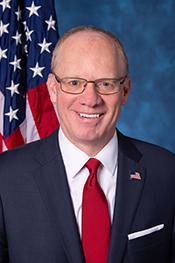
U.S. Representative for Tennessee’s 6th district
Republican
119th Congress, two-year term
Missed 5.8% of roll calls. Chamber median 1.9%.
The full voting recordCounts roll calls where most Democrats and most Republicans voted differently, leaving out procedural votes.
How we countFrom FEC filings, Voteview roll calls and Congress.gov.
Republican. In Congress since 2019, 4 terms in total.
Following saves Rose to your list, which Chamber & Street keeps on its server, linked to a cookie on this browser and not to your name or email. Email alerts will come with constituent verification.
Bills and resolutions Rose signed on to as a cosponsor. An original cosponsor signed on the day the bill was introduced. Source: govinfo bill status files, last updated Nov 6, 2026.
Main Street Tax Certainty Act
Sponsor Lloyd Smucker (R). Joined Feb 4, 2025. 192 cosponsors. H.R. 703 on Congress.gov
Introduced
Main Street Tax Certainty Act
This bill makes permanent the qualified business income (QBI) tax deduction.
Under current law, individuals, estates, and trusts may deduct the lower of (1) 20% of QBI from a qualified business, qualified real estate investment trust dividends, and qualified publicly traded partnership income; or (2) 20% of taxable income less net capital gain. (Some limitations apply.)
However, under current law, the QBI tax deduction expires after December 31, 2025.
Educational Choice for Children Act of 2025
Sponsor Adrian Smith (R). Original cosponsor. 91 cosponsors. H.R. 833 on Congress.gov(opens in a new tab)
Introduced
Recognizing Gold Shield Families and affirming that their sacrifices and difficulties should not be forgotten.
Sponsor Daniel Meuser (R). Original cosponsor. 20 cosponsors. H.Res. 76 on Congress.gov(opens in a new tab)
Introduced
This resolution recognizes and honors Gold Shield Families for their sacrifices and support of their loved ones in service to our nation. Gold Shield Families consist of the families of fallen police officers, firefighters, emergency medical technicians (EMTs), correction officers, emergency dispatch officers, and emergency service providers.
To amend the Internal Revenue Code of 1986 to allow a credit against tax for charitable donations to nonprofit organizations providing education scholarships to qualified elementary and secondary students.
Sponsor Adrian Smith (R). Original cosponsor. 27 cosponsors. H.R. 817 on Congress.gov(opens in a new tab)
Introduced
Educational Choice for Children Act of 2025
This bill establishes a nonrefundable tax credit for contributions (cash or stock) made by an individual to a tax-exempt organization that provides scholarships for qualified elementary and secondary school expenses to eligible students (scholarship granting organization), subject to limitations.
Under the bill, the tax credit is limited to the greater of $5,000 or 10% of adjusted gross income.
Further, the bill establishes a $5 billion annual volume cap (for 2025-2028) for the tax credit (which may be increased under certain circumstances). The volume cap is allocated by the Department of the Treasury for the tax credit on a first-come, first-serve basis (based on the contribution date). However, under the bill, 10% of the volume cap must be divided evenly among states for allocation to individuals residing in those states.
The bill allows any portion of the tax credit that exceeds the individual’s tax liability (less certain other tax credits) to be carried forward for up to five tax years.
The bill also
• establishes specific requirements for a scholarship granting organization,
• requires a scholarship granting organization to distribute all contributions within a specific timeframe (exceptions apply), and
• excludes from gross income scholarships received by an individual from a scholarship granting organization.
Finally, the bill prohibits federal, state, and local government entities, officers, and employees from imposing requirements that prevent the use of scholarship funds for private or religious elementary or secondary education expenses or discouraging the use of scholarship funds at such education institutions.
PROTECTS Act of 2025
Sponsor Richard McCormick (R). Original cosponsor. 39 cosponsors. H.R. 742 on Congress.gov(opens in a new tab)
Introduced
Protecting Resources Of Taxpayers to Eliminate Childhood Transgender Surgeries Act of 2025 or the PROTECTS Act of 2025
This bill prohibits providing or using federal funds to perform, refer for, or reimburse any entity for certain gender transition procedures for an individual under the age of 18.
The bill’s prohibition applies to certain gender transition procedures that are performed to intentionally change an individual’s body to no longer correspond to the individual's biological sex, including surgeries, medications, and implants specified in the bill. The bill provides exceptions for specified procedures, such as treating certain genetic abnormalities or preventing imminent death or impairment of a major bodily function, when performed by a health care provider with the consent of the individual’s parent or legal guardian.
CBO Show Your Work Act
Sponsor Warren Davidson (R). Original cosponsor. 35 cosponsors. H.R. 724 on Congress.gov(opens in a new tab)
Introduced
CBO Show Your Work Act
This bill requires the Congressional Budget Office (CBO) to make available to Congress and the public each fiscal model, policy model, and data preparation routine that the CBO uses to estimate the costs and other fiscal, social, or economic effects of legislation.
For each estimate of the costs and other fiscal effects of legislation, the CBO must also disclose, in a manner sufficient to permit replication by individuals not employed by the CBO, the data, programs, models, assumptions, and other details of the computations used to prepare the estimate.
For data that may not be disclosed, the CBO must make available to Congress and the public
• a complete list of all data variables for the data;
• descriptive statistics for all data variables for the data, to the extent that the descriptive statistics do not violate the rule against disclosure;
• a reference to the statute requiring that the data not be disclosed; and
• contact information for the individual or entity who has unrestricted access to the data.
Life at Conception Act
Sponsor Eric Burlison (R). Original cosponsor. 116 cosponsors. H.R. 722 on Congress.gov(opens in a new tab)
Introduced
Life at Conception Act
This bill declares that the right to life guaranteed by the Constitution is vested in each human being at all stages of life, including the moment of fertilization, cloning, or other moment at which an individual comes into being.
Nothing in this bill shall be construed to authorize the prosecution of any woman for the death of her unborn child.
No Abortion Coverage for Medicaid Act
Sponsor Josh Brecheen (R). Original cosponsor. 20 cosponsors. H.R. 719 on Congress.gov(opens in a new tab)
Introduced
No Abortion Coverage for Medicaid Act
This bill prohibits the Centers for Medicare & Medicaid Services from approving experimental, pilot, or demonstration projects under Medicaid (also known as Section 1115 Demonstrations) if the project provides federal financial assistance for abortions or for health benefits that include abortions, including expenses for related travel or lodging.
The bill's restrictions do not apply to abortions in the cases of rape or incest; treatments to address life-threatening physical disorders, injuries, or illnesses; or treatments for miscarriages or ectopic pregnancies.
Families’ Rights and Responsibilities Act
Sponsor Virginia Foxx (R). Original cosponsor. 21 cosponsors. H.R. 650 on Congress.gov(opens in a new tab)
Introduced
Whole Milk for Healthy Kids Act of 2025
Sponsor Glenn Thompson (R). Original cosponsor. 118 cosponsors. H.R. 649 on Congress.gov(opens in a new tab)
Introduced
Whole Milk for Healthy Kids Act of 2025
This bill revises requirements for milk provided by the National School Lunch Program of the Department of Agriculture (USDA).
Currently, schools participating in the program must provide milk that is consistent with the most recent Dietary Guidelines for Americans; USDA regulations require milk to be fat-free or low-fat and allow milk to be flavored or unflavored. The bill modifies these restrictions and instead permits schools to offer students whole, reduced-fat, low-fat, and fat-free flavored and unflavored milk. The milk that is offered may be organic or nonorganic. Further, USDA may not prohibit a participating school from offering students any of these milk choices.
Further, schools currently must provide a substitute for fluid milk, on receipt of a written statement from a licensed physician, for students whose disability restricts their diet. Under the bill, a parent or legal guardian may also provide the written statement.
In addition, schools currently participating in the program must provide meals that meet certain nutrition requirements; USDA regulations require that the average saturated fat content of the meals offered must be less than 10% of the total calories. Under the bill, fluid milk is excluded from the saturated fat content calculation; milk fat included in any fluid milk provided by the program must not be considered saturated fat for the purposes of measuring compliance with USDA regulations.
Finally, the bill prohibits schools participating in the program from purchasing or offering milk produced by Chinese state-owned enterprises.
National Constitutional Carry Act
Sponsor Thomas Massie (R). Original cosponsor. 78 cosponsors. H.R. 645 on Congress.gov(opens in a new tab)
Introduced
RIFLE Act of 2025
Sponsor Tracey Mann (R). Original cosponsor. 34 cosponsors. H.R. 624 on Congress.gov(opens in a new tab)
Introduced
Reining In Federal Licensing Enforcement Act of 2025 or the RIFLE Act of 2025
This bill revises the federal statutory framework governing the licensing, inspection, and enforcement of federally licensed dealers, importers, and manufacturers of firearms (i.e., federal firearms licensees, or FFLs) by the Bureau of Alcohol, Tobacco, Firearms and Explosives (ATF).
With respect to an application for a license, this bill requires the ATF to make a preliminary determination, provide notice of a proposed denial, and allow the applicant to request a hearing.
With respect to inspections, this bill requires the ATF to establish standards for how it inspects, examines, or investigates FFLs for possible violations.
With respect to the enforcement of violations, this bill establishes a new framework. The new framework establishes a presumption that a violation by an FFL is not willful and requires the ATF to provide notice of and work with an FFL to rectify a violation.
In the case of a violation that is willful, the ATF has the burden of proving by clear and convincing evidence that the violation was committed willfully. The term willfully means that the person had actual knowledge of a legal duty, understood the obligation imposed by the legal duty, and deliberately disregarded the legal duty. The ATF may pursue revocation of an FFL’s license, but only after (1) providing notice and an opportunity to comply; and (2) finding that a lesser administrative action (e.g., warning, warning letter, or warning conference) is not likely to lead to future compliance.
FARM Act
Sponsor Ronny Jackson (R). Original cosponsor. 29 cosponsors. H.R. 620 on Congress.gov(opens in a new tab)
Introduced
Foreign Adversary Risk Management Act or the FARM Act
This bill places the Secretary of Agriculture on the Committee on Foreign Investment in the United States (CFIUS). It also requires CFIUS to review any investment that could result in foreign control of any U.S. agricultural business.
Further, the bill includes agricultural systems and supply chains in the definitions of critical infrastructure and critical technologies for the purposes of reviewing such investments.
The Department of Agriculture and the Government Accountability Office must each annually analyze and report on foreign influence in the U.S. agricultural industry.
REMAIN in Mexico Act of 2025
Sponsor Brandon Gill (R). Joined Jan 22, 2025. 110 cosponsors. H.R. 273 on Congress.gov(opens in a new tab)
Introduced
Return Excessive Migrants and Asylees to International Neighbors in Mexico Act of 2025 or the REMAIN in Mexico Act of 2025
This bill requires the Department of Homeland Security (DHS) to implement the Migrant Protection Protocols as outlined in the January 25, 2019, memo titled Policy Guidance for Implementation of the Migrant Protection Protocols.
(The protocols generally required aliens who are not clearly admissible, including those seeking asylum, arriving by land along the U.S.-Mexico border to be returned to Mexico while their immigration proceedings are pending, rather than remain in the United States. On January 21, 2021, DHS stopped applying the protocols to newly-arrived individuals.)
Proposing an amendment to the Constitution of the United States to require that the Supreme Court of the United States be composed of nine justices.
Sponsor Dusty Johnson (R). Original cosponsor. 108 cosponsors. H.J.Res. 28 on Congress.gov(opens in a new tab)
Introduced
This joint resolution proposes a constitutional amendment requiring the Supreme Court to consist of nine Justices.
Birthright Citizenship Act of 2025
Sponsor Brian Babin (R). Original cosponsor. 95 cosponsors. H.R. 569 on Congress.gov(opens in a new tab)
Introduced
Birthright Citizenship Act of 2025
This bill limits birthright citizenship by redefining what it means to be subject to the jurisdiction of the United States.
Currently, a person born in the United States and subject to U.S. jurisdiction is entitled to citizenship. Under the bill, a person is subject to U.S. jurisdiction if he or she is born to a parent who is (1) a U.S. citizen or national, (2) a lawful permanent resident residing in the United States, or (3) a non-U.S. national (alien under federal law) with a lawful immigration status who is performing active service in the Armed Forces.
The bill does not affect the citizenship or nationality status of any person born before the bill's enactment date.
No Retaining Every Gun In a System That Restricts Your Rights Act
Sponsor Michael Cloud (R). Original cosponsor. 74 cosponsors. H.R. 563 on Congress.gov(opens in a new tab)
Introduced
No Retaining Every Gun In a System That Restricts Your Rights Act
This bill modifies the retention requirements for firearm transaction records of federal firearms licensees (FFLs) that go out of business.
Current law generally requires FFLs that go out of business to deliver their firearm transaction records to the Bureau of Alcohol, Tobacco, Firearms and Explosives (ATF).
This bill removes the requirement for FFLs that go out of business to deliver their firearm transaction records to the ATF. Further, the bill requires the ATF to destroy all out-of-business records it has collected from FFLs.
No Child Tax Credit for Illegals Act of 2025
Sponsor Jefferson Van Drew (R). Original cosponsor. 9 cosponsors. H.R. 547 on Congress.gov(opens in a new tab)
Introduced
No Child Tax Credit for Illegals Act of 2025
This bill extends and expands the Social Security number (SSN) identification requirements for claiming the child tax credit. The bill also provides that the omission of a correct SSN related to a child tax credit claim is to be treated as a mathematical error for certain purposes.
Under current law, to claim the child tax credit, a taxpayer must provide a work-authorized SSN (issued prior to the due date of the federal income tax return) for each qualifying child. Beginning in 2026, to claim the child tax credit, a taxpayer must provide a valid taxpayer identification number (issued on or before the due date of the federal income tax return) for each qualifying child.
Under the bill, to claim the child tax credit, a taxpayer must provide a work-authorized SSN (issued before the due date of the federal tax return) for (1) each qualifying child; and (2) the taxpayer, the taxpayer and the taxpayer’s spouse (if filing jointly), or either the taxpayer or the taxpayer’s spouse (if either is a member of the Armed Forces).
Finally, the bill provides that the omission of a correct SSN related to a claim for the child tax credit is a mathematical error for purposes of certain tax assessment and collection procedures.
Repealing Big Brother Overreach Act
Sponsor Warren Davidson (R). Original cosponsor. 193 cosponsors. H.R. 425 on Congress.gov(opens in a new tab)
Passed committee
Repealing Big Brother Overreach Act
This bill repeals the Corporate Transparency Act. The act requires existing companies and newly created companies to report beneficial ownership information to the Department of the Treasury’s Financial Crimes Enforcement Network for purposes of addressing the financing of terrorism and money laundering.
Equal Representation Act of 2025
Sponsor Chuck Edwards (R). Joined Jan 13, 2025. 66 cosponsors. H.R. 151 on Congress.gov(opens in a new tab)
Introduced
Equal Representation Act
This bill requires that the statement sent by the President to Congress after the decennial census indicating the number of persons in each state exclude noncitizens. (This statement is the basis for reapportionment of U.S. Representatives.)
The bill also requires any questionnaire used in the decennial census to include a checkbox or other similar option for respondents to indicate whether the respondent and each household member is (1) a U.S. citizen, (2) a U.S. national but not a citizen, (3) a non-U.S. national (alien under federal law) lawfully residing in the United States, or (4) a non-U.S. national unlawfully residing in the United States.
The Department of Commerce must make public the number of persons in each state, disaggregated by each of these four categories.
FIND Act
Sponsor Jack Bergman (R). Joined Jan 9, 2025. 154 cosponsors. H.R. 45 on Congress.gov(opens in a new tab)
Introduced
Firearm Industry Non-Discrimination Act or the FIND Act
This bill prohibits the federal government from entering into contracts with an entity that discriminates against firearm trade associations or businesses that deal in firearms, ammunition, or related products.
Specifically, the bill requires a federal agency to include in each contract for the procurement of goods or services awarded by the agency a clause requiring the prime contractor to certify that it (1) has no policy, practice, guidance, or directive that discriminates against a firearm entity or firearm trade association; and (2) will not adopt a policy, practice, guidance, or directive that discriminates against a firearm entity or firearm trade association during the term of the contract.
The bill establishes (1) a similar requirement with respect to subcontracts, and (2) penalties for violations.
The bill makes such prohibition inapplicable to a contract for the procurement of goods or services that is a sole-source contract.
Protection of Women and Girls in Sports Act of 2025
Sponsor W. Steube (R). Joined Jan 9, 2025. 83 cosponsors. H.R. 28 on Congress.gov(opens in a new tab)
Passed the House
Protection of Women and Girls in Sports Act of 2025
This bill generally prohibits school athletic programs from allowing individuals whose biological sex at birth was male to participate in programs that are for women or girls.
Specifically, the bill provides that it is a violation of Title IX of the Education Amendments of 1972 for federally funded education programs or activities to operate, sponsor, or facilitate athletic programs or activities that allow individuals of the male sex to participate in programs or activities that are designated for women or girls. (Title IX prohibits discrimination on the basis of sex in federally funded education programs or activities, including in public elementary and secondary schools and in colleges and universities.) Under the bill, sex is based on an individual's reproductive biology and genetics at birth.
The bill does not prohibit male individuals from training or practicing with programs or activities for women or girls as long as such training or practice does not deprive any female of corresponding opportunities or benefits.
The Government Accountability Office must report on the benefits for women or girls in single-sex sports that would be lost as a result of male participation. In particular, the report must document the negative psychological, developmental, participatory, and sociological effects of male participation on girls.
Born-Alive Abortion Survivors Protection Act
Sponsor Ann Wagner (R). Joined Jan 9, 2025. 163 cosponsors. H.R. 21 on Congress.gov(opens in a new tab)
Passed the House
Born-Alive Abortion Survivors Protection Act
This bill establishes requirements for the degree of care a health care practitioner must provide in the case of a child born alive following an abortion or attempted abortion.
Specifically, a health care practitioner who is present must (1) exercise the same degree of care as would reasonably be provided to any other child born alive at the same gestational age, and (2) ensure the child is immediately admitted to a hospital. Additionally, a health care practitioner or other employee who has knowledge of a failure to comply with the degree-of-care requirements must immediately report such failure to law enforcement.
A health care practitioner who fails to provide the required degree of care, or a health care practitioner or other employee who fails to report such failure, is subject to criminal penalties—a fine, up to five years in prison, or both.
An individual who intentionally kills or attempts to kill a child born alive is subject to prosecution for murder.
The bill bars the criminal prosecution of a mother of a child born alive under this bill and allows her to bring a civil action against a health care practitioner or other employee for violations.
Rescinding the subpoenas issued by the January 6th Select Committee on September 23, 2021, October 6, 2021, and February 9, 2022, and withdrawing the recommendations finding Stephen K. Bannon, Mark Randall Meadows, Daniel Scavino, Jr., and Peter K. Navarro in contempt of Congress.
Sponsor Eric Burlison (R). Joined Jan 7, 2025. 12 cosponsors. H.Res. 15 on Congress.gov(opens in a new tab)
Introduced
This resolution rescinds subpoenas and recommendations issued by the House Select Committee to Investigate the January 6th Attack on the United States Capitol.
Specifically, the resolution rescinds subpoenas issued on September 23, 2021, October 6, 2021, and February 9, 2022, to Steve Bannon, Mark Meadows, Peter Navarro, and Dan Scavino. The resolution also withdraws, dismisses, and concludes resolutions that the House find Steve Bannon, Mark Meadows, Peter Navarro, and Dan Scavino in contempt of Congress.
Laken Riley Act
Sponsor Mike Collins (R). Joined Jan 7, 2025. 54 cosponsors. H.R. 29 on Congress.gov(opens in a new tab)
Passed the House
Laken Riley Act
This bill requires the Department of Homeland Security (DHS) to detain certain non-U.S. nationals (aliens under federal law) who have been arrested for burglary, theft, larceny, or shoplifting. The bill also authorizes states to sue the federal government for decisions or alleged failures related to immigration enforcement.
Under this bill, DHS must detain an individual who (1) is unlawfully present in the United States or did not possess the necessary documents when applying for admission; and (2) has been charged with, arrested for, convicted of, or admits to having committed acts that constitute the essential elements of burglary, theft, larceny, or shoplifting.
The bill also authorizes state governments to sue for injunctive relief over certain immigration-related decisions or alleged failures by the federal government if the decision or failure caused the state or its residents harm, including financial harm of more than $100. Specifically, the state government may sue the federal government over a
• decision to release a non-U.S. national from custody;
• failure to fulfill requirements relating to inspecting individuals seeking admission into the United States, including requirements related to asylum interviews;
• failure to fulfill a requirement to stop issuing visas to nationals of a country that unreasonably denies or delays acceptance of nationals of that country;
• violation of limitations on immigration parole, such as the requirement that parole be granted only on a case-by-case basis; or
• failure to detain an individual who has been ordered removed from the United States.