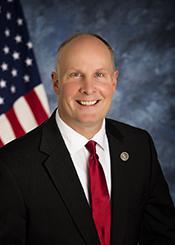
U.S. Representative for Michigan’s 2nd district
Republican
119th Congress, two-year term
Missed 0.3% of roll calls. Chamber median 1.9%.
The full voting recordCounts roll calls where most Democrats and most Republicans voted differently, leaving out procedural votes.
How we countFrom FEC filings, Voteview roll calls and Congress.gov.
Republican. In Congress since 2015, 6 terms in total.
Following saves Moolenaar to your list, which Chamber & Street keeps on its server, linked to a cookie on this browser and not to your name or email. Email alerts will come with constituent verification.
Bills and resolutions where Moolenaar is the primary sponsor. Most bills never leave committee; that is normal for every member. Source: Congress.gov, last updated Oct 29, 2026.
28 of 50 have at least one cosponsor from the other party.
FARMS Act
Introduced Sep 26, 2025. 12 cosponsors. H.R. 5596 on Congress.gov
Introduced
Expressing support for the designation of the week of September 11 through September 17, 2025, as "Patriot Week".
Introduced Sep 11, 2025. 2 cosponsors, 1 from the other party. H.Res. 703 on Congress.gov(opens in a new tab)
Introduced
District of Columbia Sister City Integrity Act
Introduced Jul 17, 2025. 11 cosponsors. H.R. 4519 on Congress.gov(opens in a new tab)
Introduced
No Adversarial AI Act
Introduced Jun 25, 2025. 3 cosponsors, 2 from the other party. H.R. 4142 on Congress.gov(opens in a new tab)
Introduced
Line 5 Act
Introduced Jun 17, 2025. 3 cosponsors. H.R. 4043 on Congress.gov(opens in a new tab)
Introduced
LOCOMOTIVES Act
Introduced May 5, 2025. 27 cosponsors. H.R. 3194 on Congress.gov(opens in a new tab)
Introduced
NO LIMITS Act of 2025
Introduced Apr 14, 2025. 1 cosponsor, 1 from the other party. H.R. 2914 on Congress.gov(opens in a new tab)
Introduced
Defense of Conscience in Health Care Act
Introduced Apr 10, 2025. 0 cosponsors. H.R. 2874 on Congress.gov(opens in a new tab)
Introduced
Defense of Conscience in Health Care Act
This bill requires the Department of Health and Human Services (HHS) to issue a final rule on protecting statutory conscience rights in health care that is identical or equivalent to the rule titled Protecting Statutory Conscience Rights in Health Care; Delegations of Authority, which was scheduled to take effect on July 22, 2019, but was vacated by courts.
Federal law generally prohibits discrimination based on conscience or religious beliefs with respect to federally funded health care programs, including prohibiting recipients of certain federal funding from requiring health care providers to take actions that they find religiously or morally objectionable (e.g., providing referrals for abortions).
In 2019, HHS issued a final rule revising the applicable regulations, including imposing certification and cooperation requirements, as well as establishing additional enforcement provisions and penalties. However, this rule was later vacated by federal courts and never took effect. In 2024, HHS issued another final rule that generally applied a pre-2019 enforcement framework while also maintaining certain aspects of the 2019 rule (e.g., specifically designating HHS' Office for Civil Rights as the entity with the authority to handle relevant complaints).
The bill requires HHS to reinstate the 2019 rule in its entirety.
Adams Memorial-Great American Heroes Act
Introduced Mar 24, 2025. 8 cosponsors, 5 from the other party. H.R. 2306 on Congress.gov(opens in a new tab)
Passed the House
The Adams Memorial-Great American Heroes Act
This bill extends through 2032 the Adams Memorial Commission, whose purpose is to establish a permanent memorial in Washington, DC, to honor John Adams and his legacy.
The bill specifies that the Adams Memorial shall be located within the area specified by the Adams Memorial Commission in a February 25, 2025 map (i.e., south of the White House, adjacent to Ellipse Road and near Pennsylvania Avenue and 15th Street, Northwest).
If the Commission determines that this location is not suitable or feasible due to physical or security constraints, the bill requires that the memorial be located in the Reserve, an area which generally extends from the United States Capitol to the Lincoln Memorial, and from the White House to the Jefferson Memorial.
PARSA
Introduced Mar 11, 2025. 0 cosponsors. H.R. 2067 on Congress.gov(opens in a new tab)
Introduced
Veterans Patient Advocacy Act
Introduced Mar 11, 2025. 6 cosponsors, 5 from the other party. H.R. 2068 on Congress.gov(opens in a new tab)
Introduced
Veterans Patient Advocacy Act
This bill requires the Office of Patient Advocacy within the Veterans Health Administration to ensure that rural veterans may access the services of patient advocates. The bill also requires the Government Accountability Office to report on the implementation of such policies.
Veterans Fellowship Act
Introduced Mar 5, 2025. 5 cosponsors, 5 from the other party. H.R. 1884 on Congress.gov(opens in a new tab)
Introduced
Tribal Labor Sovereignty Act of 2025
Introduced Feb 27, 2025. 7 cosponsors. H.R. 1723 on Congress.gov(opens in a new tab)
Introduced
Tribal Labor Sovereignty Act of 2025
This bill excludes Indian tribes and tribal enterprises and institutions on tribal land from requirements for employers under the National Labor Relations Act (NLRA). (Currently under the NLRA, employers may not engage in unfair labor practices and must allow employees to form unions, engage in collective bargaining, and take collective action.)
Supporting Farm Operations Act of 2025
Introduced Feb 26, 2025. 14 cosponsors, 2 from the other party. H.R. 1624 on Congress.gov(opens in a new tab)
Introduced
No Social Security for Illegal Aliens Act of 2025
Introduced Feb 10, 2025. 15 cosponsors. H.R. 1172 on Congress.gov(opens in a new tab)
Introduced
No Social Security for Illegal Aliens Act of 2025
This bill excludes wages and self-employment income earned by non-U.S. nationals (aliens under federal law) who are not authorized to work in the United States from consideration for purposes of Social Security eligibility and benefits.
This exclusion applies with respect to all such wages and self-employment income earned both before and after the bill’s enactment. However, any change to the amount of an individual’s Social Security benefits as a result of these provisions may only apply to benefits for months after the bill’s enactment.
Shandra Eisenga Human Cell and Tissue Product Safety Act
Introduced Feb 6, 2025. 1 cosponsor, 1 from the other party. H.R. 1082 on Congress.gov(opens in a new tab)
Passed the House
Shandra Eisenga Human Cell and Tissue Product Safety Act
This bill establishes civil penalties for violations of regulations governing the donation and handling of human cell and tissue products. It also requires the Food and Drug Administration (FDA) to report on the regulation of these products and to provide related information to stakeholders. (Human cell and tissue products are articles containing or consisting of human cells or tissues that are intended for use in a human recipient.)
Specifically, the bill establishes civil penalties for violations of the FDA’s regulations on donor eligibility and current good tissue practice for manufacturing and distributing human cell and tissue products.
Also, the bill requires the FDA to conduct workshops to educate stakeholders and facilitate discussion on the science and regulation of human cell and tissue products. The FDA must establish a public docket to receive written comments on this topic, and report to Congress with recommendations. The bill also requires the FDA to support the development of educational materials for health care professionals regarding organ, tissue, and eye donations and related topics.
Additionally, the bill requires the FDA to publish on its website educational materials about the Tissue Reference Group (a working group within the FDA) and best practices for obtaining a recommendation from them about human cell and tissue products. Also, annually for three years, the FDA must publish on its website information on inquiries submitted to the Tissue Reference Group and FDA registrations and inspections regarding human cell and tissue manufacturers.
BOOST Act
Introduced Feb 5, 2025. 5 cosponsors, 4 from the other party. H.R. 1020 on Congress.gov(opens in a new tab)
Introduced
Broadening Online Opportunities through Simple Technologies Act or the BOOST Act
This bill establishes a new refundable tax credit, through 2029, for expenses paid to purchase a Wi-Fi signal booster for use in a principal residence. (Some limitations apply.)
The bill allows a taxpayer located in an unserved area a one-time, refundable tax credit for 75% (up to $400) of expenses paid to purchase
• a communications signal booster (any device that receives a wireless signal or a commercial data service signal in order to increase the strength or range of the signal and in connection with retransmitting a broadband internet access service signal),
• any customer premises equipment for use with satellite networks, or
• any ground station equipment to send and receive transmissions from satellite networks.
Under the bill, an unserved area is defined as an area eligible for certain funding under the Rural Digital Opportunity Fund (generally areas where internet speeds are below 25 megabits per second for downloading and 3 megabits per second for uploading).
Finally, under the bill, the Department of the Treasury is required to issue regulations and guidance on the new tax credit and a program for sellers of signal boosters to voluntarily report sales of such devices in unserved areas.
SOAR Permanent Authorization Act
Introduced Feb 4, 2025. 0 cosponsors. H.R. 954 on Congress.gov(opens in a new tab)
Introduced
Providing amounts for the expenses of the Select Committee on the Strategic Competition Between the United States and the Chinese Communist Party in the One Hundred Nineteenth Congress.
Introduced Feb 4, 2025. 0 cosponsors. H.Res. 104 on Congress.gov(opens in a new tab)
Introduced
This resolution authorizes up to $10,740,218 for the expenses of the House Select Committee on the Strategic Competition between the United States and the Chinese Communist Party for the 119th Congress.
The resolution makes $5,366,830 available during the first session of the 119th Congress and up to $5,373,388 during the second session of the 119th Congress.
A PLUS Act
Introduced Jan 31, 2025. 3 cosponsors. H.R. 838 on Congress.gov(opens in a new tab)
Introduced
Academic Partnerships Lead Us to Success Act or the A PLUS Act
This bill creates a framework under which states may receive federal elementary and secondary education funds on a consolidated basis and use such funds for any educational purpose permitted by state law.
Expressing support for the designation of the week of January 26 through February 1, 2025, as "National School Choice Week".
Introduced Jan 23, 2025. 36 cosponsors. H.Res. 63 on Congress.gov(opens in a new tab)
Introduced
This resolution supports the designation of National School Choice Week.
Restoring Trade Fairness Act
Introduced Jan 23, 2025. 2 cosponsors, 1 from the other party. H.R. 694 on Congress.gov(opens in a new tab)
Introduced
Restoring Trade Fairness Act
This bill establishes various trade measures related to China, including by revoking China's permanent normal trade relations (PNTR) status and increasing the rates of duty (i.e., tariffs) on Chinese imported goods. The bill prohibits imported goods originating from North Korea, China, Russia, or Iran from receiving de minimis treatment. (Current law allows for U.S. imports under a de minimis threshold of $800 per shipment to enter free of tariffs, fees, and taxes.)
Specifically, the bill revokes China's PNTR status. Currently, China's PNTR status allows for Chinese goods to have duty rates set forth in column 1 of the Harmonized Tariff Schedule of the United States (HTS). With the removal of China's PNTR status, the bill generally sets the applicable duty rates on imported Chinese goods at the higher rates listed in column 2 of the HTS, with exceptions.
The bill establishes a minimum duty rate of 35% for all Chinese goods, which requires column 2 rates to be at least 35%. However, the bill establishes a minimum duty rate of 100% for a list of specified goods (e.g., various minerals, certain vaccines and drugs, and certain defense-related articles). Duty rates are phased in over five years and adjusted annually for inflation.
The bill also
• authorizes the President to take additional actions related to trade with China,
• requires merchandise imported from China to be appraised based on U.S. value, and
• establishes a trust fund to compensate U.S. producers for lost revenue resulting from retaliatory actions by China.
Restoring Confidence in the World Anti-Doping Agency Act of 2025
Introduced Jan 23, 2025. 1 cosponsor, 1 from the other party. H.R. 693 on Congress.gov(opens in a new tab)
Introduced
NO GOTION Act
Introduced Jan 16, 2025. 27 cosponsors, 3 from the other party. H.R. 524 on Congress.gov(opens in a new tab)
Introduced
No Official Giveaways Of Taxpayers’ Income to Oppressive Nations Act or the NO GOTION Act
This bill prohibits an entity that is created in, organized in, or controlled (in the aggregate) by China, Russia, Iran, or North Korea, or an entity controlled (in the aggregate) by one or more of such entities, from claiming multiple energy-related federal tax credits and incentives.
Specifically, the bill prohibits such entities from claiming the federal tax credits for
• alternative fuel vehicle refueling property,
• second-generation biofuel,
• biodiesel fuel,
• sustainable aviation fuel,
• renewable electricity production,
• carbon sequestration,
• zero-emission nuclear power production,
• clean hydrogen production,
• clean commercial vehicles,
• advanced manufacturing production,
• clean electricity production,
• clean fuel production,
• investments in energy property,
• advanced energy projects,
• clean electricity investment,
• biodiesel mixtures,
• alternative fuel, and
• alternative fuel mixtures.
Further, such entities are prohibited from claiming the federal tax deduction for energy efficient improvements to commercial buildings.
Finally, such entities are not entitled to a credit or refund of federal excise taxes paid on biodiesel, alternative fuel, or sustainable aviation fuel mixtures produced by the entities.
Native American Health Savings Improvement Act
Introduced Jan 15, 2025. 3 cosponsors, 2 from the other party. H.R. 444 on Congress.gov(opens in a new tab)
Introduced