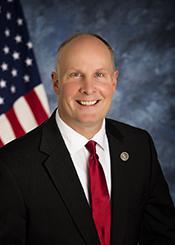
U.S. Representative for Michigan’s 2nd district
Republican
119th Congress, two-year term
Missed 0.3% of roll calls. Chamber median 1.9%.
The full voting recordCounts roll calls where most Democrats and most Republicans voted differently, leaving out procedural votes.
How we countFrom FEC filings, Voteview roll calls and Congress.gov.
Republican. In Congress since 2015, 6 terms in total.
Following saves Moolenaar to your list, which Chamber & Street keeps on its server, linked to a cookie on this browser and not to your name or email. Email alerts will come with constituent verification.
Bills and resolutions Moolenaar signed on to as a cosponsor. An original cosponsor signed on the day the bill was introduced. Source: govinfo bill status files, last updated Nov 6, 2026.
To designate the area between the intersections of 18th Street Northwest and Church Street Northwest, and 18th Street Northwest and P Street Northwest, in the District of Columbia as "Jimmy Lai Way", and for other purposes.
Sponsor Christopher Smith (R). Original cosponsor. 3 cosponsors. H.R. 2522 on Congress.gov
Introduced
SHORT Act
Sponsor Andrew Clyde (R). Original cosponsor. 76 cosponsors. H.R. 2395 on Congress.gov(opens in a new tab)
Introduced
Recognizing the 250th anniversary of the United States Marine Corps.
Sponsor Jack Bergman (R). Original cosponsor. 64 cosponsors. H.Res. 254 on Congress.gov(opens in a new tab)
Introduced
Taiwan Travel and Tourism Coordination Act
Sponsor Young Kim (R). Original cosponsor. 5 cosponsors. H.R. 2370 on Congress.gov(opens in a new tab)
Introduced
Empowering Employer Child and Elder Care Solutions Act
Sponsor Mark Messmer (R). Original cosponsor. 8 cosponsors. H.R. 2270 on Congress.gov(opens in a new tab)
Introduced
Empowering Employer Child and Elder Care Solutions Act
This bill excludes the value of employer-funded child or dependent care from being used in calculating an eligible employee's overtime pay.
Under current law, overtime hours must be paid at one and a half times an employee's regular rate of pay. This rate is an average hourly rate that must include certain types of pay, such as commissions. The bill specifies that an employer can provide or pay for child or dependent care services without the value of the services being included in this calculation.
Foreign Investment Guardrails to Help Thwart (FIGHT) China Act
Sponsor Andy Barr (R). Original cosponsor. 6 cosponsors. H.R. 2246 on Congress.gov(opens in a new tab)
Introduced
Fighting Trade Cheats Act of 2025
Sponsor Mike Bost (R). Joined Mar 21, 2025. 39 cosponsors. H.R. 1284 on Congress.gov(opens in a new tab)
Introduced
Fighting Trade Cheats Act of 2025
This bill increases penalties for, and establishes additional enforcement mechanisms related to, fraudulent and grossly negligent violations of U.S. customs laws.
Specifically, the bill increases the maximum civil penalty for a fraudulent violation to three times the domestic value of the merchandise. (Currently, the maximum penalty is the domestic value of the merchandise.) It prohibits a person who commits a fraudulent violation from importing merchandise into the United States for a five-year period.
Additionally, the bill increases the maximum civil penalty for a grossly negligent violation to the lesser of (1) 3 times the domestic value of the merchandise; or (2) 10 times the lawful duties, taxes, and fees. (Currently, the maximum penalty is the lesser of the domestic value of the merchandise or four times the lawful duties, taxes, and fees.) It prohibits a person who commits a grossly negligent violation from importing merchandise into the United States for a two-year period.
Further, the bill applies these importation bans to an affiliated person (e.g., a family member or employee) of the person who committed the fraudulent or grossly negligent violation.
The bill establishes a private right of action for an interested party (e.g., a manufacturer) affected by customs fraud or grossly negligent violations.
The bill prohibits any person (or an affiliated person) who commits a fraudulent or grossly negligent violation from participating in the U.S. Customs and Border Protection's Importer of Record program, and further requires revocation of their importer of record numbers.
Expressing support for the designation of March 18, 2025, as "National Agriculture Day" and celebrating the importance of agriculture as one of the most impactful industries in the United States.
Sponsor Mark Alford (R). Original cosponsor. 44 cosponsors. H.Res. 227 on Congress.gov(opens in a new tab)
Introduced
This resolution supports the designation of National Agriculture Day.
Innovative FEED Act of 2025
Sponsor Nicholas Langworthy (R). Original cosponsor. 53 cosponsors. H.R. 2203 on Congress.gov(opens in a new tab)
Introduced
Innovative Feed Enhancement and Economic Development Act of 2025 or the Innovative FEED Act of 2025
This bill provides for the regulation of zootechnical animal food substances as food additives.
The bill defines zootechnical animal food substance as a substance that is added to the food or drinking water of animals and that affects only the animal's gastrointestinal tract, with the intended purpose of affecting the byproducts of the animal's digestion, reducing foodborne pathogens, or altering the animal's gastrointestinal biome.
The definition does not include substances that are used to treat or prevent diseases in animals, hormones, or active ingredients of animal drugs. Labels for zootechnical animal food substances must include a disclaimer that the substance may not be used to treat or prevent diseases in animals.
Air America Act of 2025
Sponsor Glenn Grothman (R). Original cosponsor. 178 cosponsors. H.R. 2192 on Congress.gov(opens in a new tab)
Introduced
Enhanced Iran Sanctions Act of 2025
Sponsor Michael Lawler (R). Joined Mar 18, 2025. 295 cosponsors. H.R. 1422 on Congress.gov(opens in a new tab)
Passed the House
Enhanced Iran Sanctions Act of 2025
This bill imposes sanctions on certain foreign persons (individuals and entities) that are involved in Iran's petroleum sector as well as certain associated persons. The bill also requires or authorizes actions to facilitate the enforcement of sanctions on Iran.
Specifically, the bill requires the President to impose visa- and property-blocking sanctions on any foreign person that, after the bill's enactment, knowingly engages in any transaction related to the processing, export, or sale of oil, condensates, gas, liquefied natural gas, or other petrochemical products in whole or in part from Iran. The President must also impose sanctions on certain foreign persons associated with a sanctioned individual or entity. For example, the President must sanction the subsidiaries and corporate officers of a sanctioned business.
The bill provides certain exceptions to these sanctions, including specifying that sanctions do not apply to the importation of goods or to conducting or facilitating transactions for humanitarian assistance.
The Department of State must establish an interagency working group that shall seek to establish a multilateral contact group to coordinate international efforts to enforce sanctions on Iran.
The bill expands the State Department rewards program to authorize a reward payment to any individual who furnishes information leading to the identification of a person (1) subject to sanctions under this bill, or (2) that has attempted or is attempting to evade sanctions under this bill.
Honoring the 108th anniversary of Selfridge Air National Guard Base and the contributions of Selfridge Air National Guard Base to the military and national security of the United States.
Sponsor John James (R). Original cosponsor. 11 cosponsors. H.Res. 223 on Congress.gov(opens in a new tab)
Introduced
This resolution honors Selfridge Air National Guard Base in Harrison Township, Michigan, on its 108th anniversary, commends the thousands of men and women who have worked and trained at the base, and reinforces the commitment of the Armed Forces to the base as a facility that is key to national security. The resolution also encourages continued cooperation and dialogue with the Department of Defense in support of the base and acknowledges Michigan's ongoing investments in its defense assets and workforce.
Expel Illegal Chinese Police Act of 2025
Sponsor Ashley Hinson (R). Original cosponsor. 8 cosponsors. H.R. 2127 on Congress.gov(opens in a new tab)
Introduced
Expel Illegal Chinese Police Act of 2025
This bill requires sanctions on certain foreign persons associated with the Chinese Communist Party (CCP) or Chinese law enforcement institutions, including those seeking to establish a Chinese police presence in the United States.
The bill requires the President to impose visa-blocking sanctions on certain non-U.S. nationals (aliens under federal law), including those who are (1) employees of Chinese law enforcement institutions or their immediate family members, or (2) directly associated with a Chinese police or United Front Work Department (UFWD) presence in the United States. (The CCP's UFWD seeks to win support for the CCP from non-CCP groups at home and abroad, with a focus on ethnic-Chinese diaspora communities.)
The President must also impose property-blocking sanctions on foreign individuals or entities that are (1) Chinese law enforcement institutions, their senior leaders, or those acting under the control of such institutions; (2) directly associated with establishing or maintaining a Chinese police presence in the United States; or (3) acting under the control of the UFWD with the intention of covertly monitoring or intimidating those living in the United States.
Additionally, the bill requires the President to prohibit federal agencies from participating in investigations into foreign persons subject to these sanctions unless the investigation is (1) initiated by the U.S. government; or (2) the President determines that such participation is vital to the health, safety, and well-being of U.S. citizens.
FOCA Act of 2025
Sponsor Clay Higgins (R). Original cosponsor. 107 cosponsors. H.R. 2126 on Congress.gov(opens in a new tab)
Introduced
Fair and Open Competition Act of 2025 or the FOCA Act of 2025
This bill requires that federal contracts for construction projects neither require nor prohibit a bidder, offeror, contractor, or subcontractor from entering into agreements with one or more labor organizations with respect to such projects or related projects.
Under the bill, the controlling documents for federal construction contracts (such as bid specifications and project agreements) may not require or prohibit a bidder, offeror, contractor, or subcontractor from entering into or adhering to such labor agreements. Additionally, the controlling documents may not discriminate against or give preference to a bidder, offeror, contractor, or subcontractor who signs or refuses to sign such a labor agreement.
These requirements also apply to any (1) construction manager acting on behalf of the federal government with respect to such contract, (2) recipient of a federal grant or financial assistance for construction projects or construction manager acting on the recipient's behalf, and (3) party to a federal cooperative agreement for construction projects or construction managers acting on the party's behalf.
An agency may exempt a project from this prohibition to avert an imminent threat to public health or safety or to serve the national security.
Ending China’s Unfair Advantage Act of 2025
Sponsor Neal Dunn (R). Original cosponsor. 2 cosponsors. H.R. 2115 on Congress.gov(opens in a new tab)
Introduced
Block Organ Transplant Purchases from China Act of 2025
Sponsor Neal Dunn (R). Original cosponsor. 3 cosponsors. H.R. 2114 on Congress.gov(opens in a new tab)
Introduced
Block Organ Transplant Purchases from China Act of 2025 or the Block Act of 2025
This bill prohibits Medicare, Medicaid, and private health insurers from covering organ transplants that occur in China or that involve organs that are not procured through the U.S. Organ Procurement and Transplantation Network.
The bill also prohibits health care providers from performing such a transplant or related services, except for life-saving services that are necessary as a result of such a transplant. Violations are subject to criminal and civil penalties.
Major Richard Star Act
Sponsor Gus Bilirakis (R). Original cosponsor. 340 cosponsors. H.R. 2102 on Congress.gov(opens in a new tab)
Introduced
Major Richard Star Act
This bill allows a veteran with a combat-related disability to receive retirement pay, without reduction, concurrently with their disability compensation. This includes veterans with a combat-related disability and fewer than 20 years of creditable service. (Currently, veterans who receive combat-related special compensation and retirement pay are subject to an offset in retirement pay for concurrent receipt of such benefits.)
WISH Act
Sponsor Thomas Suozzi (D). Original cosponsor. 5 cosponsors. H.R. 2082 on Congress.gov(opens in a new tab)
Introduced
Well-Being Insurance for Seniors to be at Home Act or the WISH Act
This bill establishes a federal long-term care insurance benefit and provides specified funds for the program.
To be eligible, an individual must have reached retirement age (currently between 65 and 67, depending on the individual’s year of birth) and have had a continual serious functional disability for between one and five years, depending on the individual’s income.
Under the bill, an individual has a continual serious functional disability if a licensed health care practitioner has certified that the individual
• has been unable to perform at least two activities of daily living (including eating, bathing, dressing, and using the bathroom) without substantial assistance for at least 90 days, or has a similar level of disability; or
• requires substantial supervision to protect them from threats to health and safety due to severe cognitive impairment.
The individual must also be expected to remain disabled for at least one year.
The bill also establishes a Federal Long-Term Care Insurance Trust Fund and provides specified funds for the initial establishment of the benefit program, benefit payments during FY2026-FY2028, and public education related to the program.
Finally, the Government Accountability Office must periodically report to Congress on consumer understanding of long-term insurance offerings, the likelihood of manipulation of eligibility criteria by beneficiaries, and the likelihood of financial exploitation or mistreatment by others on whom a beneficiary is dependent.
Protecting the Right to Keep and Bear Arms Act of 2025
Sponsor Michael Cloud (R). Original cosponsor. 36 cosponsors. H.R. 2039 on Congress.gov(opens in a new tab)
Introduced
Protecting the Right to Keep and Bear Arms Act of 2025
This bill prohibits (1) the President or the Department of Health and Human Services from declaring emergencies or disasters for the purpose of imposing gun control; and (2) a federal officer or employee, or person operating under color of federal law or receiving federal funds, from banning the possession, manufacture, sale, or transfer of weapons to which the Second Amendment of the Constitution applies, ammunition, or firearm accessories while acting in support of relief from a major disaster or emergency.
Joint Task Force to Counter Illicit Synthetic Narcotics Act of 2025
Sponsor Dan Newhouse (R). Original cosponsor. 9 cosponsors. H.R. 2024 on Congress.gov(opens in a new tab)
Introduced
Recognizing the importance of stepped-up basis under section 1014 of the Internal Revenue Code of 1986 in preserving family-owned farms and small businesses.
Sponsor Tracey Mann (R). Original cosponsor. 29 cosponsors. H.Res. 206 on Congress.gov(opens in a new tab)
Introduced
This resolution supports preserving the stepped-up basis of certain inherited assets (such as land, equipment, or buildings), opposes any efforts to impose new taxes on family farms or small businesses, and recognizes the importance of generational transfers of farm and family-owned businesses.
As background, the basis for federal tax purposes of certain inherited assets is reset (or stepped up) from the original cost basis to the fair market value of the asset on the date of the previous owner’s death. Thus, any gain or loss on the subsequent sale of an inherited asset generally is calculated based on the asset’s stepped-up basis (and not the original cost basis).
Securing American Agriculture Act
Sponsor Ashley Hinson (R). Original cosponsor. 18 cosponsors. H.R. 1995 on Congress.gov(opens in a new tab)
Introduced
Securing American Agriculture Act
This bill directs the Department of Agriculture (USDA) to assess, on an annual basis, U.S. dependency on critical agricultural products or inputs that could be exploited in the event that China weaponizes such a dependency. USDA must submit a report to Congress on the assessment, which must include recommendations to reduce U.S. dependency on China to supply critical agricultural products or inputs.
Under the bill, critical inputs include all farm management, agronomic, and field-applied production inputs (e.g., agricultural equipment, fertilizers, veterinary drugs, and seed).
The bill specifies that, in conducting the assessment, USDA may not require a private entity to provide information to USDA. Further, the bill requires USDA to comply with certain confidentiality requirements and restricts disclosures of the information.
American Innovation and R&D Competitiveness Act of 2025
Sponsor Ron Estes (R). Original cosponsor. 81 cosponsors. H.R. 1990 on Congress.gov(opens in a new tab)
Introduced
DETERRENT Act
Sponsor Michael Baumgartner (R). Joined Mar 10, 2025. 21 cosponsors. H.R. 1048 on Congress.gov(opens in a new tab)
Passed the House
Defending Education Transparency and Ending Rogue Regimes Engaging in Nefarious Transactions Act or the DETERRENT Act
This bill expands oversight and disclosure requirements related to foreign sources and institutions of higher education (IHEs).
Specifically, the bill requires an IHE to annually disclose to the Department of Education (ED) any year in which the IHE
• receives a gift from a foreign country of concern (e.g., China or Russia) or foreign entity of concern of any dollar amount;
• receives a gift or contract from a foreign source (other than a foreign country of concern or foreign entity of concern) that is valued at $50,000 or more, considered alone or in combination with all other gifts or contracts within a calendar year (current disclosure threshold is $250,000 or more), or which has an undetermined monetary value;
• enters into a contract with a foreign country of concern or foreign entity of concern after receiving a waiver for such contract; or
• is substantially controlled by a foreign source.
Additionally, the bill
• prohibits IHEs from entering into contracts with a foreign country of concern or with a foreign entity of concern without obtaining a waiver,
• requires certain IHEs to disclose gifts or contracts between covered individuals (e.g., researchers) and foreign sources, and
• requires private IHEs with specified assets or investments to file annual investment disclosure reports.
The bill requires ED to investigate possible violations of this bill and outlines the various penalties for each violation. Penalties may include losing eligibility for federal student financial aid.
Anti-CBDC Surveillance State Act
Sponsor Tom Emmer (R). Original cosponsor. 135 cosponsors. H.R. 1919 on Congress.gov(opens in a new tab)
Passed the House
Anti-CBDC Surveillance State Act
This bill prohibits a Federal Reserve bank from offering products or services directly to an individual, maintaining an account on behalf of an individual, or issuing a central bank digital currency (i.e., a digital dollar). Further, the Board of Governors of the Federal Reserve System is prohibited from using a central bank digital currency to implement monetary policy or from testing, studying, creating, or implementing a central bank digital currency, with exceptions as provided by the bill.