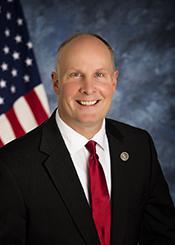
U.S. Representative for Michigan’s 2nd district
Republican
119th Congress, two-year term
Missed 0.3% of roll calls. Chamber median 1.9%.
The full voting recordCounts roll calls where most Democrats and most Republicans voted differently, leaving out procedural votes.
How we countFrom FEC filings, Voteview roll calls and Congress.gov.
Republican. In Congress since 2015, 6 terms in total.
Following saves Moolenaar to your list, which Chamber & Street keeps on its server, linked to a cookie on this browser and not to your name or email. Email alerts will come with constituent verification.
Bills and resolutions Moolenaar signed on to as a cosponsor. An original cosponsor signed on the day the bill was introduced. Source: govinfo bill status files, last updated Nov 6, 2026.
REMAIN in Mexico Act of 2025
Sponsor Brandon Gill (R). Original cosponsor. 110 cosponsors. H.R. 273 on Congress.gov
Introduced
Return Excessive Migrants and Asylees to International Neighbors in Mexico Act of 2025 or the REMAIN in Mexico Act of 2025
This bill requires the Department of Homeland Security (DHS) to implement the Migrant Protection Protocols as outlined in the January 25, 2019, memo titled Policy Guidance for Implementation of the Migrant Protection Protocols.
(The protocols generally required aliens who are not clearly admissible, including those seeking asylum, arriving by land along the U.S.-Mexico border to be returned to Mexico while their immigration proceedings are pending, rather than remain in the United States. On January 21, 2021, DHS stopped applying the protocols to newly-arrived individuals.)
Protecting Life and Taxpayers Act of 2025
Sponsor Michelle Fischbach (R). Original cosponsor. 45 cosponsors. H.R. 272 on Congress.gov(opens in a new tab)
Introduced
Protecting Life and Taxpayers Act of 2025
This bill requires entities receiving federal funds to certify that they will not, subject to certain exceptions, perform abortions or provide funding to other entities that perform abortions.
The bill provides exceptions for abortions performed in cases of rape or incest or when necessary to resolve a physical condition that endangers a woman's life.
Defund Planned Parenthood Act of 2025
Sponsor Michelle Fischbach (R). Original cosponsor. 60 cosponsors. H.R. 271 on Congress.gov(opens in a new tab)
Introduced
Defund Planned Parenthood Act of 2025
This bill restricts federal funding for Planned Parenthood Federation of America, Inc. or any of its affiliates or clinics for one year.
Specifically, it prohibits providing federal funding to those entities unless they certify that the affiliates and clinics will not perform, and will not provide funds to entities that perform, abortions during that year. If the certification requirement is not met, the Department of Health and Human Services and the Department of Agriculture must recoup any federal assistance received by those entities.
However, the bill's funding restriction does not apply to abortions performed in cases of rape or incest or when necessary to resolve a physical condition that endangers a woman's life.
The bill also provides additional funding for community health centers for the one-year period. These funds are subject to the same abortion-related restrictions and exceptions.
Grant Integrity and Border Security Act
Sponsor Virginia Foxx (R). Original cosponsor. 5 cosponsors. H.R. 245 on Congress.gov(opens in a new tab)
Introduced
Grant Integrity and Border Security Act
This bill requires an applicant for a federal grant to certify that the applicant has not violated in the last 10 years, is not currently violating, and will not violate during the term of the grant the federal criminal prohibition against bringing into the United States or harboring certain non-U.S. nationals (i.e., aliens under federal law). Upon determination by the granting agency that a grantee is in violation of this bill, the agency must withhold any federal grant funds from the grantee.
The Department of Justice (DOJ) must report to the Office of Management and Budget (OMB) individuals convicted of, or who admitted to, such a violation. Additionally, the DOJ must report to OMB if DOJ believes there is a reasonable basis to conclude that an individual has committed such a violation.
HOUSE Act of 2025
Sponsor Andy Biggs (R). Joined Jan 7, 2025. 5 cosponsors. H.R. 75 on Congress.gov(opens in a new tab)
Introduced
Helping Owners with Unaffordable Shoddy Edicts Act of 2025 or the HOUSE Act of 2025
This bill directs the Department of Housing and Urban Development (HUD) and the Department of Agriculture (USDA) to withdraw the final determination titled Adoption of Energy Efficiency Standards for New Construction of HUD- and USDA-Financed Housing and published on April 26, 2024.
The determination adopted updated minimum energy efficiency standards for newly built homes (except manufactured housing) financed through certain HUD and USDA programs. Specifically, it adopted the (1) 2021 International Energy Conservation Code (IECC), which applies to single family homes and multifamily low-rise buildings up to three stories; and (2) 2019 American National Standards Institute/American Society of Heating, Refrigerating, and Air-Conditioning Engineers/Illuminating Electrical Society (ANSI/ASHRAE/IES) Standard 90.1, which applies to multifamily residential buildings with four or more stories. HUD and USDA must also revert to using the energy efficiency standards required before the determination.
In addition, the bill prohibits HUD, USDA, and the Department of Veterans Affairs from taking actions or using federal funds to implement or enforce the determination or any substantially similar determination. It also prohibits the Federal Housing Finance Agency from finalizing, implementing, or enforcing a determination or rule relating to energy efficiency standards for single and multifamily housing.
Finally, the bill prohibits HUD and USDA from adopting updates to the IECC or ANSI/ASHRAE/IES Standard 90.1 in certain circumstances unless at least 26 states have adopted codes or standards that meet or exceed the update's requirements.
Born-Alive Abortion Survivors Protection Act
Sponsor Ann Wagner (R). Joined Jan 6, 2025. 163 cosponsors. H.R. 21 on Congress.gov(opens in a new tab)
Passed the House
Born-Alive Abortion Survivors Protection Act
This bill establishes requirements for the degree of care a health care practitioner must provide in the case of a child born alive following an abortion or attempted abortion.
Specifically, a health care practitioner who is present must (1) exercise the same degree of care as would reasonably be provided to any other child born alive at the same gestational age, and (2) ensure the child is immediately admitted to a hospital. Additionally, a health care practitioner or other employee who has knowledge of a failure to comply with the degree-of-care requirements must immediately report such failure to law enforcement.
A health care practitioner who fails to provide the required degree of care, or a health care practitioner or other employee who fails to report such failure, is subject to criminal penalties—a fine, up to five years in prison, or both.
An individual who intentionally kills or attempts to kill a child born alive is subject to prosecution for murder.
The bill bars the criminal prosecution of a mother of a child born alive under this bill and allows her to bring a civil action against a health care practitioner or other employee for violations.
WHO Withdrawal Act
Sponsor Andy Biggs (R). Original cosponsor. 22 cosponsors. H.R. 54 on Congress.gov(opens in a new tab)
Introduced
WHO Withdrawal Act
This bill requires the President to immediately withdraw the United States from the World Health Organization (WHO) and prohibits using any federal funds to provide for U.S. participation in the WHO.
The bill also repeals the 1948 act authorizing the United States to join the WHO.
FIND Act
Sponsor Jack Bergman (R). Original cosponsor. 154 cosponsors. H.R. 45 on Congress.gov(opens in a new tab)
Introduced
Firearm Industry Non-Discrimination Act or the FIND Act
This bill prohibits the federal government from entering into contracts with an entity that discriminates against firearm trade associations or businesses that deal in firearms, ammunition, or related products.
Specifically, the bill requires a federal agency to include in each contract for the procurement of goods or services awarded by the agency a clause requiring the prime contractor to certify that it (1) has no policy, practice, guidance, or directive that discriminates against a firearm entity or firearm trade association; and (2) will not adopt a policy, practice, guidance, or directive that discriminates against a firearm entity or firearm trade association during the term of the contract.
The bill establishes (1) a similar requirement with respect to subcontracts, and (2) penalties for violations.
The bill makes such prohibition inapplicable to a contract for the procurement of goods or services that is a sole-source contract.
Constitutional Concealed Carry Reciprocity Act of 2025
Sponsor Richard Hudson (R). Original cosponsor. 189 cosponsors. H.R. 38 on Congress.gov(opens in a new tab)
Introduced
Constitutional Concealed Carry Reciprocity Act
This bill establishes a federal statutory framework to regulate the carry or possession of concealed firearms across state lines.
Specifically, an individual who is eligible to carry a concealed firearm in one state may carry or possess a concealed handgun (other than a machine gun or destructive device) in another state that allows its residents to carry concealed firearms.
It sets forth requirements for lawful concealed carry across state lines. The bill preempts most state and local laws related to concealed carry and establishes a private right of action for a person adversely affected by interference with a concealed-carry right established by this bill.
HALT Fentanyl Act
Sponsor H. Griffith (R). Original cosponsor. 61 cosponsors. H.R. 27 on Congress.gov(opens in a new tab)
Passed the House
Halt All Lethal Trafficking of Fentanyl Act or the HALT Fentanyl Act
This bill permanently places fentanyl-related substances as a class into schedule I of the Controlled Substances Act. A schedule I controlled substance is a drug, substance, or chemical that has a high potential for abuse; has no currently accepted medical value; and is subject to regulatory controls and administrative, civil, and criminal penalties under the Controlled Substances Act.
Under the bill, offenses involving fentanyl-related substances are triggered by the same quantity thresholds and subject to the same penalties as offenses involving fentanyl analogues (e.g., offenses involving 100 grams or more trigger a 10-year mandatory minimum prison term).
Additionally, the bill establishes a new, alternative registration process for certain schedule I research.
The bill also makes several other changes to registration requirements for conducting research with controlled substances, including
• permitting a single registration for related research sites in certain circumstances,
• waiving the requirement for a new inspection in certain situations, and
• allowing a registered researcher to perform certain manufacturing activities with small quantities of a substance without obtaining a manufacturing registration.
Finally, the bill expresses the sense that Congress agrees with the interpretation of Controlled Substances Act in United States v. McCray, a 2018 case decided by the U.S. District Court for the Western District of New York. In that case, the court held that butyryl fentanyl, a controlled substance, can be considered an analogue of fentanyl even though, under the Controlled Substances Act, the term controlled substance analogue specifically excludes a controlled substance.
Federal Reserve Transparency Act of 2025
Sponsor Thomas Massie (R). Original cosponsor. 46 cosponsors. H.R. 24 on Congress.gov(opens in a new tab)
Introduced
Federal Reserve Transparency Act of 2025
This bill directs the Government Accountability Office (GAO) to complete, within 12 months, an audit of the Federal Reserve Board and Federal Reserve banks. In addition, the bill allows the GAO to audit the Federal Reserve Board and Federal Reserve banks with respect to (1) international financial transactions; (2) deliberations, decisions, or actions on monetary policy matters; (3) transactions made under the direction of the Federal Open Market Committee; and (4) discussions or communications among Federal Reserve officers, board members, and employees regarding any of these matters.
SAVE Act
Sponsor Chip Roy (R). Original cosponsor. 110 cosponsors. H.R. 22 on Congress.gov(opens in a new tab)
Passed the House
Safeguard American Voter Eligibility Act or the SAVE Act
This bill requires individuals to provide documentary proof of U.S. citizenship when registering to vote in federal elections.
Specifically, the bill prohibits states from accepting and processing an application to register to vote in a federal election unless the applicant presents documentary proof of U.S. citizenship. The bill specifies what documents are considered acceptable proof of U.S. citizenship, such as identification that complies with the REAL ID Act of 2005 that indicates U.S. citizenship.
Further, the bill (1) prohibits states from registering an individual to vote in a federal election unless, at the time the individual applies to register to vote, the individual provides documentary proof of U.S. citizenship; and (2) requires states to establish an alternative process under which an applicant may submit other evidence to demonstrate U.S. citizenship.
Each state must take affirmative steps on an ongoing basis to ensure that only U.S. citizens are registered to vote, which shall include establishing a program to identify individuals who are not U.S. citizens using information supplied by certain sources.
Additionally, states must remove noncitizens from their official lists of eligible voters.
The bill allows for a private right of action against an election official who registers an applicant to vote in a federal election who fails to present documentary proof of U.S. citizenship.
The bill establishes criminal penalties for certain offenses, including registering an applicant to vote in a federal election who fails to present documentary proof of U.S. citizenship.
Family and Small Business Taxpayer Protection Act
Sponsor Adrian Smith (R). Original cosponsor. 36 cosponsors. H.R. 196 on Congress.gov(opens in a new tab)
Introduced
Family and Small Business Taxpayer Protection Act
This bill rescinds unobligated funds that were provided by the Inflation Reduction Act of 2022 to the Internal Revenue Service (IRS) for enforcement activities related to the determination and collection of taxes, for operations support for taxpayer services and enforcement activities, and for a task force to research options for a free, direct electronic filing (e-filing) tax return system.
The bill also rescinds unobligated funds that were provided by the Inflation Reduction Act of 2022 for expenses of the
• Treasury Inspector General for Tax Administration,
• Office of Tax Policy,
• U.S. Tax Court, and
• offices within the Department of the Treasury that provide oversight and support for the IRS.
Finish the Wall Act
Sponsor Clay Higgins (R). Original cosponsor. 29 cosponsors. H.R. 163 on Congress.gov(opens in a new tab)
Introduced
Finish the Wall Act
This bill requires the Department of Homeland Security (DHS) to resume activities related to the construction of a barrier system along the U.S.-Mexico border and addresses other border-related issues.
DHS must resume all such construction activities that were planned or underway prior to January 20, 2021. DHS must also expend all funds appropriated or explicitly obligated since October 1, 2016, for construction of this barrier system. DHS may not cancel contracts for activities related to such construction entered into on or before January 20, 2021.
Furthermore, within 14 days of this bill's enactment, DHS must certify to Congress that U.S. Customs and Border Protection facilities that process adults taken into custody at the border are fully compliant with certain laws related to the collection of DNA. (Among other things, these laws allow for the collection of DNA samples from non-U.S. persons detained under U.S. authority.)
TCJA Permanency Act
Sponsor Vern Buchanan (R). Original cosponsor. 53 cosponsors. H.R. 137 on Congress.gov(opens in a new tab)
Introduced
TCJA Permanency Act
This bill makes permanent multiple federal tax provisions enacted in 2017 by the Tax Cuts and Jobs Act.
The bill makes permanent the
• individual tax rates of 10%, 12%, 22%, 24%, 32%, 35%, and 37%;
• increased standard deduction;
• personal exemption allowance repeal;
• exclusion from income of student loans discharged due to death or disability;
• qualified business income tax deduction (199A tax deduction);
• allowance of ABLE account contributions in excess of the annual gift tax exclusion amount;
• base estate and gift tax exclusion amount of $10 million (adjusted annually); and
• alternative minimum tax exemption and phaseout amounts for noncorporate taxpayers.
The bill makes permanent the child tax credit amounts of $2,000 per child and $500 for dependents, the $200,000 phaseout threshold ($400,000 for joint filers), and the refundable portion of the tax credit.
The bill expands the expenses eligible for tax-free withdrawals from qualified tuition plans (529 plans) to include additional expenses associated with homeschool and elementary and secondary schools (e.g., instructional materials, tutoring, test and enrollment fees, and educational therapies).
The bill permanently eliminates certain miscellaneous itemized deductions and makes permanent the
• state and local tax deduction limit of $10,000 ($5,000 for married individuals filing separately),
• mortgage interest tax deduction limit of $750,000 ($375,000 for married individuals filing separately),
• limit on the deduction of cash charitable contributions to 60% of a taxpayer’s adjusted gross income, and
• certain limits on casualty loss tax deductions.
The bill also permanently eliminates the exclusion from income for employer-reimbursed bicycle commuting expenses.