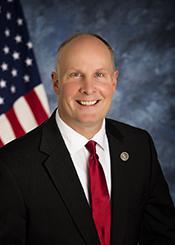
U.S. Representative for Michigan’s 2nd district
Republican
119th Congress, two-year term
Missed 0.3% of roll calls. Chamber median 1.9%.
The full voting recordCounts roll calls where most Democrats and most Republicans voted differently, leaving out procedural votes.
How we countFrom FEC filings, Voteview roll calls and Congress.gov.
Republican. In Congress since 2015, 6 terms in total.
Following saves Moolenaar to your list, which Chamber & Street keeps on its server, linked to a cookie on this browser and not to your name or email. Email alerts will come with constituent verification.
Bills and resolutions Moolenaar signed on to as a cosponsor. An original cosponsor signed on the day the bill was introduced. Source: govinfo bill status files, last updated Nov 6, 2026.
USA Batteries Act
Sponsor Daniel Meuser (R). Original cosponsor. 5 cosponsors. H.R. 1264 on Congress.gov
Introduced
USA Batteries Act
This bill eliminates the Superfund chemical excise tax imposed on lead oxide ($8.28 per ton), antimony ($8.90 per ton), and sulfuric acid ($0.52 per ton).
Under current law, an excise tax is imposed through December 31, 2031, on taxable chemicals and taxable chemical substances that are (1) manufactured or produced in the United States, or (2) imported into the United States. The excise tax rate varies between $0.44 per ton to $9.74 per ton, depending on the chemical and certain other variables. (There are 42 listed taxable chemicals, including lead oxide, antimony, and sulfuric acid.)
Further, under current law, amounts collected from the excise tax on taxable chemicals are deposited into the Superfund, which finances the remediation of certain environmentally contaminated sites.
National Right-to-Work Act
Sponsor Joe Wilson (R). Original cosponsor. 129 cosponsors. H.R. 1232 on Congress.gov(opens in a new tab)
Introduced
Protecting the Second Amendment in Financial Services Act
Sponsor Andrew Ogles (R). Original cosponsor. 17 cosponsors. H.R. 1224 on Congress.gov(opens in a new tab)
Introduced
Stop CCP Land Act
Sponsor Stephanie Bice (R). Original cosponsor. 11 cosponsors. H.R. 1184 on Congress.gov(opens in a new tab)
Introduced
Stop China’s Continuous Purchase of Land Act or the Stop CCP Land Act
This bill requires states that receive certain federal program funds to restrict the purchase of agricultural land by a covered foreign country. Covered foreign country means a country included in Department of State regulations as subject to certain prohibitions (i.e., Belarus, Burma, China, Cuba, Iran, North Korea, Syria, and Venezuela), as well as Russia.
Specifically, a state may not receive funds for certain programs funded by the Inflation Reduction Act of 2022 (e.g., certain energy efficiency and conservation programs) unless that state has a law prohibiting a covered foreign country (or persons acting on behalf of the country) from purchasing agricultural land in the state. Further, a state must require that a person from a covered foreign country that holds agricultural land in the state prior to the state law's enactment submit an annual report to the state on the agricultural holdings.
The Department of Agriculture must submit a report to Congress on how the Agricultural Foreign Investment Disclosure Act of 1978 should be updated to ensure accurate documentation and monitoring of foreign investment in agricultural land.
The Government Accountability Office must submit a report to Congress that includes (1) an assessment of this bill's impact on national security, and (2) any measures that can be taken to better secure U.S. real estate from foreign manipulation.
Decoupling from Foreign Adversarial Battery Dependence Act
Sponsor Carlos Gimenez (R). Original cosponsor. 4 cosponsors. H.R. 1166 on Congress.gov(opens in a new tab)
Passed the House
Decoupling from Foreign Adversarial Battery Dependence Act
This bill prohibits the Department of Homeland Security (DHS) from using appropriated funds to procure a battery produced by certain entities, particularly six specific companies owned and operated in China. This prohibition begins on October 1, 2027.
The bill allows DHS to waive the prohibition if DHS assesses in the affirmative that (1) the batteries to be procured do not pose a risk to U.S. national security, data, or infrastructure; and (2) there is no available alternative to procure batteries that are of similar or better cost and quality and that are produced by an entity not specified in this bill.
DHS may also waive the prohibition upon a determination that the batteries to be procured are for the sole purpose of research, evaluation, training, testing, or analysis.
The bill requires DHS to notify Congress within 15 days after granting a waiver under this bill.
The bill also requires DHS to report to Congress on the anticipated impacts associated with carrying out this bill, including with respect to specified agencies of DHS.
Crime Victims Fund Stabilization Act of 2025
Sponsor Ann Wagner (R). Joined Feb 7, 2025. 327 cosponsors. H.R. 909 on Congress.gov(opens in a new tab)
Passed the House
Crime Victims Fund Stabilization Act of 2025
This bill adds a new source of revenue for the Crime Victims Fund (CVF). Specifically, the bill requires certain civil monetary penalties collected from settlements and judgments in cases involving fraud and false claims against the federal government to be deposited into the CVF through FY2029.
The CVF supports federal, state, and local programs and activities to compensate and assist victims of crimes. Currently, the CVF is funded by deposits from a variety of sources, including federal criminal fines, penalties, and assessments; forfeited bail bonds; and certain other gifts, donations, and bequests.
Family Farm and Small Business Exemption Act
Sponsor Tracey Mann (R). Original cosponsor. 89 cosponsors. H.R. 1131 on Congress.gov(opens in a new tab)
Introduced
Family Farm and Small Business Exemption Act
This bill restores an exemption for certain family farms and small businesses on the Free Application for Federal Student Aid (FAFSA) form. The bill applies to the net worth of (1) a family farm on which the family resides, or (2) a small business with not more than 100 full-time or full-time equivalent employees that is owned and controlled by the family.
Prior to recent changes made to the FAFSA, the net worth of these family farms and small businesses were excluded as assets when calculating a student's financial need to determine federal student aid eligibility. Beginning with the 2024-2025 academic year, the net worth of these farms and businesses are treated as an asset and therefore included in the calculation. This bill restores the exemption to exclude such net worth from the calculation.
No DeepSeek on Government Devices Act
Sponsor Josh Gottheimer (D). Original cosponsor. 32 cosponsors. H.R. 1121 on Congress.gov(opens in a new tab)
Introduced
No DeepSeek on Government Devices Act
This bill directs the Office of Management and Budget to develop standards and guidance requiring removal of the DeepSeek application from federal agency information technology. Such standards and guidance also apply to any successor application developed or provided by High Flyer or entities owned by High Flyer.
DeepSeek is an artificial intelligence start-up founded in 2023 and based in Hangzhou, China. DeepSeek's chief executive officer also created High Flyer, a hedge fund that is reportedly the sole funder of DeepSeek.
Farm Credit Administration Independent Authority Act
Sponsor Brad Finstad (R). Original cosponsor. 14 cosponsors. H.R. 1063 on Congress.gov(opens in a new tab)
Introduced
Farm Credit Administration Independent Authority Act
This bill specifies that the Farm Credit Administration (FCA) is the sole regulator of the Farm Credit System (FCS) and establishes reporting requirements for FCS institutions (i.e., lenders).
Specifically, the bill states that the FCA is the sole and independent regulator of the FCS and exempts entities that are supervised by the FCA from the Equal Credit Opportunity Act (ECOA).
As background, the bill addresses a rule issued by the Consumer Financial Protection Bureau (CFPB) that implements provisions of the ECOA by requiring covered financial institutions, including FCS institutions, to collect and report to the CFPB data on credit applications for small businesses, including the principal owner's race, sex, and ethnicity. This 2023 rule has been challenged in court.
The bill also requires FCS institutions to (1) request that loan applicants and borrowers that are small farmers disclose information identifying their race, sex, and ethnicity; and (2) annually report the collected information to the FCA. The FCA must make the collected information available to the public on annual basis. If an FCS institution customer does not voluntarily report the requested information, the FCA may not require the institution to use other means to deduce the information.
In addition, the bill specifies that FCS institutions shall not be required to comply with the bill's requirements if financial institutions are not required to comply with the CFPB rule due to a court invalidating the rule or a repeal of the rule.
To include the Czech Republic in the list of foreign states whose nationals are eligible for admission into the United States as E1 nonimmigrants if United States nationals are treated similarly by the Government of the Czech Republic.
Sponsor Steve Cohen (D). Original cosponsor. 26 cosponsors. H.R. 1056 on Congress.gov(opens in a new tab)
Introduced
This bill allows a national of the Czech Republic to qualify for E-1 nonimmigrant status if the Czech Republic provides similar nonimmigrant status to U.S. nationals. E-1 classification allows nationals of certain countries (i.e., those with a treaty of commerce and navigation with the United States, those under a qualifying international agreement, or those deemed to qualify through statute) to be admitted solely to engage in international trade, along with their families and employees.
Veterans 2nd Amendment Protection Act
Sponsor Mike Bost (R). Original cosponsor. 70 cosponsors. H.R. 1041 on Congress.gov(opens in a new tab)
Passed the House
Veterans 2nd Amendment Protection Act
This bill prohibits the Department of Veterans Affairs (VA) from transmitting certain information to the National Instant Criminal Background Check System (NICS) utilized by licensed importers or dealers of firearms.
Specifically, the bill prohibits the VA from transmitting personally identifying information of a veteran or a beneficiary to the NICS solely on the basis that such veteran or beneficiary has an appointed fiduciary to manage their benefits, unless there is an order or finding of a judicial authority that such veteran or beneficiary is a danger to themselves or others.
Antisemitism Awareness Act of 2025
Sponsor Michael Lawler (R). Original cosponsor. 89 cosponsors. H.R. 1007 on Congress.gov(opens in a new tab)
Introduced
Antisemitism Awareness Act of 2025
This bill provides statutory authority for the requirement that the Department of Education’s Office for Civil Rights take into consideration the International Holocaust Remembrance Alliance's (IHRA's) working definition of antisemitism when reviewing or investigating complaints of discrimination based on race, color, or national origin in programs or activities that receive federal financial assistance. According to the IHRA's working definition, antisemitism is a certain perception of Jews, which may be expressed as hatred toward Jews.
Cyber PIVOTT Act
Original cosponsor. 12 cosponsors. H.R. 1000 on Congress.gov(opens in a new tab)
Progress not on file
HOPE Act of 2025
Sponsor Blake Moore (R). Original cosponsor. 18 cosponsors. H.R. 955 on Congress.gov(opens in a new tab)
Introduced
No User Fees for Gun Owners Act
Sponsor Ronny Jackson (R). Original cosponsor. 51 cosponsors. H.R. 943 on Congress.gov(opens in a new tab)
Introduced
No User Fees for Gun Owners Act
This bill prohibits a state or local government from imposing any insurance requirement, tax, user fee, or similar charge on the manufacture, import, acquisition, transfer, or continued ownership of a firearm or ammunition. The bill includes an exception for a generally applicable sales tax that is assessed against firearms or ammunition in the same proportion to which the tax applies to other goods or services.
Dismantle DEI Act of 2025
Sponsor Michael Cloud (R). Original cosponsor. 109 cosponsors. H.R. 925 on Congress.gov(opens in a new tab)
Introduced
Pet and Livestock Protection Act
Sponsor Lauren Boebert (R). Original cosponsor. 37 cosponsors. H.R. 845 on Congress.gov(opens in a new tab)
Passed the House
Pet and Livestock Protection Act of 2025
This bill directs the Department of the Interior to remove protections for the gray wolf under the Endangered Species Act of 1973 (ESA). Specifically, the bill requires Interior to reissue the final rule titled Endangered and Threatened Wildlife and Plants; Removing the Gray Wolf (Canis lupus) From the List of Endangered and Threatened Wildlife and published on November 3, 2020.
The rule removed the gray wolf in the lower 48 United States, except for the Mexican wolf (C. l. baileyi) subspecies, from the endangered and threatened species list. However, the U.S. District Court for the Northern District of California vacated the rule on February 10, 2022. As a result, the gray wolf reattained the protection status it had prior to the rule's promulgation.
The bill also prohibits the reissuance of the rule from being subject to judicial review.
Educational Choice for Children Act of 2025
Sponsor Adrian Smith (R). Original cosponsor. 91 cosponsors. H.R. 833 on Congress.gov(opens in a new tab)
Introduced
SHOW UP Act of 2025
Sponsor James Comer (R). Joined Jan 31, 2025. 23 cosponsors. H.R. 473 on Congress.gov(opens in a new tab)
Introduced
Stopping Home Office Work's Unproductive Problems Act of 2025 or the SHOW UP Act of 2025
This bill requires each executive agency (other than the Government Accountability Office) to establish as its current policies the telework policies that were in place on December 31, 2019. Agencies may not implement expanded telework policies unless the Office of Personnel Management certifies that such policies, among other requirements, will have a positive effect on the agency's mission and operational costs.
To amend the Internal Revenue Code of 1986 to allow a credit against tax for charitable donations to nonprofit organizations providing education scholarships to qualified elementary and secondary students.
Sponsor Adrian Smith (R). Original cosponsor. 27 cosponsors. H.R. 817 on Congress.gov(opens in a new tab)
Introduced
Educational Choice for Children Act of 2025
This bill establishes a nonrefundable tax credit for contributions (cash or stock) made by an individual to a tax-exempt organization that provides scholarships for qualified elementary and secondary school expenses to eligible students (scholarship granting organization), subject to limitations.
Under the bill, the tax credit is limited to the greater of $5,000 or 10% of adjusted gross income.
Further, the bill establishes a $5 billion annual volume cap (for 2025-2028) for the tax credit (which may be increased under certain circumstances). The volume cap is allocated by the Department of the Treasury for the tax credit on a first-come, first-serve basis (based on the contribution date). However, under the bill, 10% of the volume cap must be divided evenly among states for allocation to individuals residing in those states.
The bill allows any portion of the tax credit that exceeds the individual’s tax liability (less certain other tax credits) to be carried forward for up to five tax years.
The bill also
• establishes specific requirements for a scholarship granting organization,
• requires a scholarship granting organization to distribute all contributions within a specific timeframe (exceptions apply), and
• excludes from gross income scholarships received by an individual from a scholarship granting organization.
Finally, the bill prohibits federal, state, and local government entities, officers, and employees from imposing requirements that prevent the use of scholarship funds for private or religious elementary or secondary education expenses or discouraging the use of scholarship funds at such education institutions.
STAR Act of 2025
Sponsor Blake Moore (R). Original cosponsor. 28 cosponsors. H.R. 802 on Congress.gov(opens in a new tab)
Introduced
SHIELD Against CCP Act
Sponsor Dale Strong (R). Joined Jan 28, 2025. 8 cosponsors. H.R. 708 on Congress.gov(opens in a new tab)
Passed the House
Strategic Homeland Intelligence and Enforcement Legislation to Defend Against the CCP Act or the SHIELD Against CCP Act
This bill requires the Department of Homeland Security (DHS) to form a working group tasked with duties related to countering terrorist, cybersecurity, border and port security, and transportation security threats posed to the United States by the Chinese Communist Party (CCP).
The working group must assess and annually report on current DHS efforts to counter the CCP’s (1) use of the U.S. immigration system, (2) economic and trade practices, and (3) support for illicit financial activity and trafficking controlled substances. The working group must terminate seven years after its establishment.
DHS must additionally carry out research and development on technologies and techniques for enhancing its security and situational awareness to these threats.
The Government Accountability Office must report on the implementation of this bill.
Expressing the sense of Congress that tax-exempt fraternal benefit societies have historically provided and continue to provide critical benefits to the people and communities of the United States.
Sponsor Darin LaHood (R). Original cosponsor. 122 cosponsors. H.Con.Res. 4 on Congress.gov(opens in a new tab)
Introduced
This concurrent resolution expresses the sense of Congress that tax-exempt fraternal benefit societies serve as a private economic and social support system, providing benefits to their members is necessary to support the charitable and fraternal activities of the volunteer chapters, and their work should continue to be promoted.
Prohibiting Abortion Industry’s Lucrative Loopholes Act
Sponsor Scott Franklin (R). Original cosponsor. 12 cosponsors. H.R. 727 on Congress.gov(opens in a new tab)
Introduced
Life at Conception Act
Sponsor Eric Burlison (R). Original cosponsor. 116 cosponsors. H.R. 722 on Congress.gov(opens in a new tab)
Introduced
Life at Conception Act
This bill declares that the right to life guaranteed by the Constitution is vested in each human being at all stages of life, including the moment of fertilization, cloning, or other moment at which an individual comes into being.
Nothing in this bill shall be construed to authorize the prosecution of any woman for the death of her unborn child.