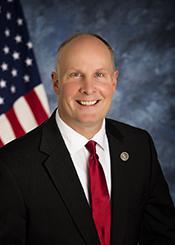
U.S. Representative for Michigan’s 2nd district
Republican
119th Congress, two-year term
Missed 0.3% of roll calls. Chamber median 1.9%.
The full voting recordCounts roll calls where most Democrats and most Republicans voted differently, leaving out procedural votes.
How we countFrom FEC filings, Voteview roll calls and Congress.gov.
Republican. In Congress since 2015, 6 terms in total.
Following saves Moolenaar to your list, which Chamber & Street keeps on its server, linked to a cookie on this browser and not to your name or email. Email alerts will come with constituent verification.
Bills and resolutions Moolenaar signed on to as a cosponsor. An original cosponsor signed on the day the bill was introduced. Source: govinfo bill status files, last updated Nov 6, 2026.
Expressing support for the designation of March 6, 2025, as "Great Lakes Day".
Sponsor John James (R). Original cosponsor. 11 cosponsors. H.Res. 194 on Congress.gov
Introduced
Protecting American Industry and Labor from International Trade Crimes Act of 2026
Sponsor Ashley Hinson (R). Original cosponsor. 44 cosponsors. H.R. 1869 on Congress.gov(opens in a new tab)
Passed the House
Protecting American Industry and Labor from International Trade Crimes Act of 2025
This bill requires the Department of Justice to establish a task force, program, or other similar structure within its Criminal Division to investigate and prosecute trade-related crimes.
Great Lakes Fishery Research Reauthorization Act
Sponsor Mike Quigley (D). Original cosponsor. 10 cosponsors. H.R. 1809 on Congress.gov(opens in a new tab)
Introduced
Expressing support for the Iranian people's desires for a democratic, secular, and nonnuclear Republic of Iran, and condemning the Iranian regime's terrorism, regional proxy war, internal suppression, and for other purposes.
Sponsor Tom McClintock (R). Original cosponsor. 230 cosponsors. H.Res. 166 on Congress.gov(opens in a new tab)
Introduced
Farmland Security Act of 2025
Sponsor Marie Perez (D). Original cosponsor. 2 cosponsors. H.R. 1629 on Congress.gov(opens in a new tab)
Introduced
Farmland Security Act of 2025
This bill authorizes increased civil penalties for violations of the Agricultural Foreign Investment Disclosure Act of 1978 (AFIDA) and increases Department of Agriculture (USDA) oversight of and research into foreign investment in agricultural land. As background, AFIDA and the regulations that implemented the act require foreign investors who acquire, transfer, or hold an interest in U.S. agricultural land to report such holdings and transactions to USDA.
In general, the bill allows USDA to determine an appropriate civil penalty amount for an AFIDA violation by removing the cap that currently prohibits the civil penalty from exceeding 25% of the fair market value of the interest in the agricultural land associated with the violation.
Under an exception in the bill, the civil penalty for a foreign-owned shell corporation is 100% of the fair market value of the interest in the agricultural land. The bill defines a shell corporation to include a company, association, firm, partnership, society, joint stock company, trust, or estate that has no or nominal operations. The penalty does not apply if the shell corporation remedies a defective filing or failure to file within 60 days of USDA providing notice.
USDA must conduct annual compliance audits of at least 10% of the reports. Further, USDA must provide state and county-level personnel certain annual training.
USDA must also annually conduct research and submit a report to Congress on foreign investment in agricultural land, including trends in the purchase of U.S. agricultural land by foreign-owned shell corporations.
Expressing the sense of the House of Representatives that the goal of education in schools across America shall be that virtually every student in the United States achieves grade-level reading proficiency, providing them with the foundation to develop the skills and knowledge needed for success in school, work, and life.
Sponsor Bill Huizenga (R). Original cosponsor. 9 cosponsors. H.Res. 163 on Congress.gov(opens in a new tab)
Introduced
This resolution recognizes the goal of education in U.S. schools as that of ensuring that virtually every student achieves grade-level reading proficiency. It also encourages state and local governments, including educational agencies, to collaborate with private organizations that offer proven literacy programs to (1) identify and implement effective solutions to address illiteracy, and (2) create adult literacy initiatives for adults with reading skills below an 8th grade level.
Protecting American Agriculture from Foreign Adversaries Act of 2025
Sponsor Dan Newhouse (R). Original cosponsor. 60 cosponsors. H.R. 1576 on Congress.gov(opens in a new tab)
Introduced
Protecting American Agriculture from Foreign Adversaries Act of 2025
This bill makes changes to the Committee on Foreign Investment in the United States (CFIUS), including by requiring CFIUS to determine whether a national security review is necessary for reportable agricultural land transactions that are referred by the Department of Agriculture (USDA). (CFIUS oversees the national security risks of certain foreign investment in the United States. CFIUS has the authority to review covered transactions, which include mergers, acquisitions, and takeovers that could result in foreign control of a U.S. business; certain investments in businesses involved in critical technologies, critical infrastructure, or sensitive personal data; and certain real estate transactions.)
Specifically, the bill directs CFIUS to, after receiving notification from USDA, determine (1) whether a reportable agricultural land transaction is a covered transaction, and (2) whether CFIUS should initiate a national security review or take another action with respect to the transaction.
Reportable agricultural land transaction means a transaction (1) that USDA has reason to believe is a covered transaction; (2) that involves the acquisition of an interest in agricultural land by a foreign person of China, North Korea, Russia, or Iran; and (3) with respect to which a foreign person is required to submit a report to USDA regarding their agricultural land transactions.
The bill also expands the membership of CFIUS to include the Secretary of Agriculture for covered transactions that involve agricultural land, agricultural biotechnology, or the agriculture industry (e.g., agricultural transportation, storage, and processing).
No American Land for Communist China Act
Sponsor Dan Newhouse (R). Original cosponsor. 60 cosponsors. H.R. 1575 on Congress.gov(opens in a new tab)
Introduced
Leveling the Playing Field 2.0 Act
Sponsor Beth Van Duyne (R). Original cosponsor. 103 cosponsors. H.R. 1548 on Congress.gov(opens in a new tab)
Introduced
Leveling the Playing Field 2.0 Act
This bill addresses unfair trade practices by making various changes to U.S. antidumping and countervailing duty laws. Antidumping laws provide relief to U.S industries and workers that are materially injured or threatened with injury due to imports of like products sold in the U.S. market at less than fair value, while countervailing duty laws provide such relief from imports of products subsidized by a foreign government or public entity.
Specifically, the bill establishes a process for successive antidumping and countervailing duty investigations. Successive investigations may be concurrent (an ongoing investigation of the same product) or recently completed (not more than two years before the date of the initiation of the successive investigation). Further, the bill establishes a timeline for the Department of Commerce to issue determinations in successive investigations.
Among other provisions, the bill authorizes Commerce to
• apply countervailing duty law to subsidies provided by a foreign government or public entity to a company operating in a different country,
• use another method for calculating the cost of production in specific circumstances, and
• require importers to certify that the imported merchandise is not subject to an antidumping or countervailing duty order.
Additionally, the bill statutorily establishes procedures for Commerce to conduct circumvention inquiries, including by specifying the deadlines for preliminary and final determinations.
The bill also provides statutory authority for Commerce to investigate currency undervaluation as a countervailable subsidy.
Protecting Life from Chemical Abortions Act
Sponsor Kevin Hern (R). Original cosponsor. 25 cosponsors. H.R. 1525 on Congress.gov(opens in a new tab)
Introduced
Protecting Life from Chemical Abortions Act
This bill nullifies certain changes made by the Food and Drug Administration (FDA) to dispensing requirements for mifepristone. (Mifepristone is a drug that is approved to end pregnancies through 10 weeks gestation when used in conjunction with the drug misoprostol. The procedure is often referred to as medication abortion or the abortion pill.)
The FDA regulates mifepristone through the Mifepristone Risk Evaluation and Mitigation Strategy (REMS) program. The program requires health care providers to comply with certain requirements in order to prescribe or dispense mifepristone to end a pregnancy; the program previously included an in-person dispensing requirement that required mifepristone to be directly dispensed to patients in clinics, medical offices, or hospitals. During the COVID-19 public health emergency, the FDA stopped enforcing the in-person dispensing requirement, which allowed mail-order pharmacies to fill and dispense mifepristone prescriptions.
In January 2023, the FDA modified program requirements so as to (1) remove the in-person dispensing requirement, and (2) require pharmacies to be program-certified in order to dispense mifepristone. The modifications allow certified retail pharmacies to dispense mifepristone pursuant to prescriptions that are written by certified prescribers.
The bill nullifies the January 2023 changes and prohibits the FDA from (1) exercising any enforcement discretion with respect to program requirements, or (2) reducing program protections until every state submits certain data regarding abortions to the Centers for Disease Control and Prevention.
The bill also generally prohibits the declaration of a public health emergency with respect to abortions.
Protecting Privacy in Purchases Act
Sponsor Riley Moore (R). Joined Feb 24, 2025. 132 cosponsors. H.R. 1181 on Congress.gov(opens in a new tab)
Passed the House
Protecting Privacy in Purchases Act
This bill prohibits payment card networks from using merchant codes that distinguish firearms retailers from general-merchandise retailers or sporting-goods retailers.
The Department of Justice must enforce this bill and report annually on the resulting investigations and cases.
Expressing the sense of the House of Representatives regarding United Nations General Assembly Resolution 2758 (XXVI) and the harmful conflation of China's "One China Principle" and the United States "One China Policy".
Sponsor Young Kim (R). Original cosponsor. 29 cosponsors. H.Res. 148 on Congress.gov(opens in a new tab)
Introduced
Rare Earth Magnet Security Act of 2025
Sponsor Guy Reschenthaler (R). Original cosponsor. 29 cosponsors. H.R. 1496 on Congress.gov(opens in a new tab)
Introduced
Economic Espionage Prevention Act
Sponsor Richard McCormick (R). Original cosponsor. 3 cosponsors. H.R. 1486 on Congress.gov(opens in a new tab)
Passed the House
Economic Espionage Prevention Act
This bill authorizes the President to impose visa- and property-blocking sanctions on foreign adversary entities that knowingly engage in (1) economic and industrial espionage with respect to trade secrets and proprietary information owned by U.S. persons, (2) the provision of material support or services to a foreign adversaries' national security entities, or (3) the violation of U.S. export control laws. The bill cites regulations that define China, Russia, Iran, North Korea, Cuba, and the Maduro regime of Venezuela as foreign adversaries.
The bill also limits certain exemptions from the President's authority under the International Emergency Economic Powers Act (IEEPA). IEEPA provides the President broad authority to regulate a variety of economic transactions following a declaration of national emergency, but exempts from this authority activities such as (1) the import or export of information or informational materials; (2) transactions ordinarily incident to international travel, such as the importation of personal baggage; and (3) personal communications, such as postal or telephonic communications, that do not transfer anything of value. Under the bill, the first two of these exemptions are not applicable if the President determines such imports and exports would seriously impair the ability to deal with a declared national emergency. Additionally, the bill specifies that the first and third exemptions listed above do not apply to bulk sensitive personal data or source code used in a connected software application.
Protecting America’s Agricultural Land from Foreign Harm Act of 2025
Sponsor Dale Strong (R). Original cosponsor. 17 cosponsors. H.R. 1438 on Congress.gov(opens in a new tab)
Introduced
Protecting America's Agricultural Land from Foreign Harm Act of 2025
This bill prohibits persons associated with the governments of Iran, North Korea, China, or Russia from purchasing or leasing agricultural land in the United States.
Specifically, the President must prohibit any person (individual or entity) owned by, controlled by, or subject to the jurisdiction or direction of these foreign governments from purchasing or leasing (1) public agricultural land that is owned by the United States and administered by a federal department or agency, or (2) private agricultural land that is located in the United States.
A person that violates or attempts to violate this prohibition is subject to civil and criminal penalties. This prohibition does not require a person that owns or leases agricultural land as of the date of this bill's enactment to sell that land.
Further, the President must prohibit a person associated with these foreign governments and who leases, or who has full or partial ownership of, agricultural land in the United States from participating in Department of Agriculture (USDA) programs. Exceptions are included to allow for participation in USDA programs related to food safety, the health and labor safety of individuals, or certain reporting and disclosure requirements.
The bill excludes U.S. citizens or lawful permanent residents from these restrictions.
The bill also amends the Agricultural Foreign Investment Disclosure Act of 1978 (AFIDA) to require reporting on security interests and leases.
Finally, the Government Accountability Office must submit a report to Congress on AFIDA.
Make American Flags in America Act of 2025
Sponsor Nicholas Langworthy (R). Original cosponsor. 53 cosponsors. H.R. 1421 on Congress.gov(opens in a new tab)
Introduced
Nancy Gardner Sewell Medicare Multi-Cancer Early Detection Screening Coverage Act
Sponsor Jodey Arrington (R). Joined Feb 14, 2025. 338 cosponsors. H.R. 842 on Congress.gov(opens in a new tab)
Introduced
Nancy Gardner Sewell Medicare Multi-Cancer Early Detection Screening Coverage Act
This bill allows, beginning in 2028, for Medicare coverage and payment for multi-cancer early detection screening tests that are approved by the Food and Drug Administration and that are used to screen for cancer across many cancer types, if the Centers for Medicare & Medicaid Services determines such coverage is appropriate. Coverage is limited to those under a certain age (age 68 in 2028, increased by one year every year thereafter) and to one test every 11 months.
Expressing support for the designation of February 15 through February 22, 2025, as "National FFA Week", recognizing the important role of the National FFA Organization in developing the next generation of leaders who will change the world, and celebrating the 90th anniversary of New Farmers of America and the 75th anniversary of the Federal charter to Future Farmers of America.
Sponsor Tracey Mann (R). Original cosponsor. 67 cosponsors. H.Res. 133 on Congress.gov(opens in a new tab)
Introduced
This resolution supports the designation of National FFA (Future Farmers of America) Week.
It also celebrates the 90th anniversary of New Farmers of America (NFA), which served Black vocational agriculture students in segregated public schools until NFA and FFA became one organization in 1965.
The resolution also commemorates the 75th anniversary of the federal charter for the Future Farmers of America.
Smithsonian American Women’s History Museum Act
Sponsor Nicole Malliotakis (R). Original cosponsor. 231 cosponsors. H.R. 1329 on Congress.gov(opens in a new tab)
Introduced
Smithsonian American Women’s History Museum Act
This bill authorizes the Smithsonian American Women's History Museum to be located on a particular site within the Reserve of the National Mall in Washington, DC.
Specifically, the bill designates the South Monument site as the location for the museum; however, the President may designate an alternative site within 180 days of the bill's enactment. (The site is the undeveloped land across the National Mall from the National Museum of African American History and Culture.) Administrative jurisdiction of the site must be transferred to the Smithsonian Institution.
The Board of Regents of the Smithsonian Institution must have the approval of specified federal entities (e.g., the Commission of Fine Arts) to plan, design, and construct a museum building. The bill (1) outlines the criteria for considering site and design proposals, and (2) requires the Smithsonian Institution to reimburse for costs resulting from the building approval process.
The bill directs the museum to be dedicated to preserving, researching, and presenting the history, achievements, and lived experiences of biological women in the United States. Under this bill, the museum may not identify, present, describe, or depict any biological male as a female.
In carrying out its duties, the museum's advisory council must (1) seek and utilize guidance from a broad array of knowledgeable and respected sources reflecting the diversity of the political viewpoints and authentic experiences held by women in the United States, and (2) seek guidance for the creation and substantial revision of exhibits and programs.
Modern Worker Empowerment Act
Sponsor Kevin Kiley (I). Original cosponsor. 23 cosponsors. H.R. 1319 on Congress.gov(opens in a new tab)
Introduced
This bill specifies a legal standard for determining whether an individual is considered an independent contractor rather than an employee for the purposes of federal labor laws that address issues such as the federal minimum wage, overtime compensation, and collective bargaining. The rights and protections provided by these laws exclusively apply to employees.
Under the bill, an individual is considered an independent contractor if (1) another individual or entity does not exercise significant control over the details of how the individual's work is performed, without regard to any control the other individual or entity may exercise over the final result of the work performed; and (2) while performing such work, the individual has opportunities and risks inherent with entrepreneurship (for example, the discretion to exercise professional judgment).
The bill also sets forth factors that may not be used to determine whether an individual is an employee. Specifically, factors such as whether another individual or entity requires the individual to meet certain legal, health and safety, insurance, or performance requirements may not be used to make such a determination.
Protect America’s Lands Act
Original cosponsor. 22 cosponsors. H.R. 1309 on Congress.gov(opens in a new tab)
Progress not on file
Protect America’s Lands Act
This bill prohibits national securities exchanges from allowing the trade of securities issued by natural asset companies. Natural asset companies are companies that oversee land for conservation, restoration, or for the sustainable management of the natural resources and ecosystem services on that land.
Protecting America’s Seniors’ Access to Care Act
Sponsor Michelle Fischbach (R). Original cosponsor. 26 cosponsors. H.R. 1303 on Congress.gov(opens in a new tab)
Introduced
Protecting America’s Seniors’ Access to Care Act
This bill prohibits administration, implementation, or enforcement of the rule titled Medicare and Medicaid Programs; Minimum Staffing Standards for Long-Term Care Facilities and Medicaid Institutional Payment Transparency Reporting, which was issued by the Centers for Medicare & Medicaid Services on May 10, 2024.
Specifically, the bill prohibits administration, implementation, or enforcement of provisions that, among other changes, (1) establish minimum staffing standards for nurses in Medicare and Medicaid long-term care facilities, including requiring a nurse to be onsite 24/7 and requiring a minimum of 3.48 total nurse staffing hours per resident per day; and (2) require state Medicaid programs to report on payments to direct care workers and support staff of nursing facilities and intermediate care facilities for individuals with intellectual disabilities.
Death Tax Repeal Act
Sponsor Randy Feenstra (R). Original cosponsor. 182 cosponsors. H.R. 1301 on Congress.gov(opens in a new tab)
Introduced
Supporting the Local Radio Freedom Act.
Sponsor Steve Womack (R). Original cosponsor. 233 cosponsors. H.Con.Res. 12 on Congress.gov(opens in a new tab)
Introduced
This concurrent resolution declares that Congress should not impose any new performance fee, tax, royalty, or other charge relating to the public performance of sound recordings on a local radio station for broadcasting sound recordings over the air, or on any business for such public performance of sound recordings.
Medicare Patient Access and Practice Stabilization Act of 2025
Sponsor Gregory Murphy (R). Joined Feb 12, 2025. 198 cosponsors. H.R. 879 on Congress.gov(opens in a new tab)
Introduced
Medicare Patient Access and Practice Stabilization Act of 2025
This bill increases certain payment adjustments under the Medicare physician fee schedule for services furnished between April 1, 2025, and January 1, 2026.