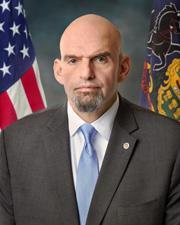
U.S. Senator for Pennsylvania
Democrat
Senate term end not loaded yet
Missed 6.5% of roll calls. Chamber median 2.1%.
The full voting recordCounts roll calls where most Democrats and most Republicans voted differently, leaving out procedural votes.
How we countFrom FEC filings, Voteview roll calls and Congress.gov.
Democrat. In Congress since 2023, 1 term in total.
Following saves Fetterman to your list, which Chamber & Street keeps on its server, linked to a cookie on this browser and not to your name or email. Email alerts will come with constituent verification.
Bills and resolutions Fetterman signed on to as a cosponsor. An original cosponsor signed on the day the bill was introduced. Source: govinfo bill status files, last updated Nov 6, 2026.
FARM Act
Sponsor Tommy Tuberville (R). Original cosponsor. 14 cosponsors. S. 179 on Congress.gov
Introduced
Foreign Adversary Risk Management Act or the FARM Act
This bill places the Secretary of Agriculture on the Committee on Foreign Investment in the United States (CFIUS). It also requires CFIUS to review any investment that could result in foreign control of any U.S. agricultural business.
Further, the bill includes agricultural systems and supply chains in the definitions of critical infrastructure and critical technologies for the purposes of reviewing such investments.
The Department of Agriculture and the Government Accountability Office must each analyze and report on foreign influence in the U.S. agricultural industry.
Protecting Students on Campus Act of 2025
Sponsor Bill Cassidy (R). Original cosponsor. 6 cosponsors. S. 163 on Congress.gov(opens in a new tab)
Introduced
Protecting Students on Campus Act of 2025
This bill requires the Department of Education (ED) and institutions of higher education (IHEs) participating in federal student aid programs to distribute information on how to report alleged violations of civil rights under Title VI of the Civil Rights Act of 1964. (Title VI of the Civil Rights Act of 1964 prohibits discrimination based on race, color, or national origin in federally funded programs or activities.)
Specifically, the bill requires ED's Office for Civil Rights (OCR) to conduct a public awareness campaign regarding the rights of individuals under Title VI. This campaign must be updated annually and distributed to IHEs.
The bill requires an IHE to post a link on its website on how to file a Title VI complaint with OCR. Additionally, the IHE must annually post the materials from OCR's public awareness campaign. The information must be posted in high-traffic public places on campus (e.g., student centers) and high-traffic websites (e.g., the website for student services).
OCR must give monthly congressional briefings on (1) the number of complaints filed with OCR, (2) how OCR plans to address those complaints and the investigations opened in response to those complaints, and (3) how long those complaints remain open. Additionally, the bill prohibits OCR from closing or dismissing a complaint due to resolution via another agency or avenue.
The bill also requires annual reporting by IHEs on discrimination complaints. Further, the bill directs ED's Office of Inspector General to audit and study discrimination complaints.
FAIR Act
Sponsor Brian Schatz (D). Joined Jan 21, 2025. 16 cosponsors. S. 126 on Congress.gov(opens in a new tab)
Introduced
Federal Adjustment of Income Rates Act or the FAIR Act
This bill modifies pay rates for federal employees in 2026. Specifically, the bill increases rates under the statutory pay systems and for prevailing rate employees by 3.3% and increases locality pay by 1%.
Sarah's Law
Sponsor Joni Ernst (R). Joined Jan 16, 2025. 34 cosponsors. S. 84 on Congress.gov(opens in a new tab)
Introduced
Sarah's Law
This bill requires U.S. Immigration and Customs Enforcement (ICE) to detain a non-U.S. national (alien under federal law) who is unlawfully present in the United States and has been charged with a crime that resulted in the death or serious bodily injury of another person.
ICE must make reasonable efforts to obtain information about the identity of any victims of the crimes for which the detained individual was charged or convicted. ICE shall provide the victim, or a relative or guardian of a deceased victim, with information about the detained individual, including name, date of birth, nationality, immigration status, criminal history, and a description of any related removal efforts.
Saving the Civil Service Act
Sponsor Timothy Kaine (D). Original cosponsor. 24 cosponsors. S. 134 on Congress.gov(opens in a new tab)
Introduced
Saving the Civil Service Act
This bill generally prohibits changes to the classification of positions in the competitive service and excepted service unless certain conditions are met. (Competitive service positions are subject to competitive examination while excepted service positions are appointed under one of five schedules. Competitive service positions have notice and appeal requirements for adverse actions that are not applicable to most excepted positions, including those of a confidential, policy-determining, policy-making, or policy-advocating character under Schedule C.)
On October 21, 2020, President Donald Trump issued an executive order that placed executive agency positions that are of a confidential, policy-determining, policy-making, or policy-advocating character, and that are not normally subject to change as a result of a presidential transition, under a new Schedule F in the excepted service. The order was subsequently revoked by President Joe Biden.
The bill prohibits executive agency positions in the competitive service from being placed in the excepted service, unless such positions are placed in a schedule in the excepted service as in effect on September 30, 2020. The bill also prohibits positions in the excepted service from being placed in any schedule other than the aforementioned schedules.
Additionally, agencies may not (1) transfer occupied positions from the competitive or excepted service into Schedule C without the consent of the Office of Personnel Management, or (2) transfer employees in the excepted service to another schedule or transfer employees in the competitive service to the excepted service without employee consent.
A resolution honoring the life and legacy of President Jimmy Carter and commending President Jimmy Carter for his life-long career of public service, humanitarian leadership, diplomacy, and courageous advocacy.
Sponsor Raphael Warnock (D). Original cosponsor. 98 cosponsors. S.Res. 19 on Congress.gov(opens in a new tab)
Passed the Senate
This resolution (1) mourns the passing of former President Jimmy Carter and extends sympathy to his family; and (2) honors his life, legacy, and contributions to the United States.
Health Care Affordability Act of 2025
Sponsor Jeanne Shaheen (D). Original cosponsor. 44 cosponsors. S. 46 on Congress.gov(opens in a new tab)
Introduced
Health Care Affordability Act of 2025
This bill makes permanent temporary changes enacted by the American Rescue Plan Act of 2021 (ARPA) and the Inflation Reduction Act of 2022 (IRA) that generally expand eligibility for and increase the amount of the premium tax credit.
Currently, eligible taxpayers may be able to claim the premium tax credit, which applies toward the cost of obtaining health insurance through health insurance exchanges. To be eligible for the premium tax credit, a taxpayer’s household income must meet or exceed 100% of the federal poverty level (FPL) and, after 2025, may not exceed 400% of the FPL (maximum income limit). For 2021-2025, the ARPA and IRA eliminated the maximum income limit, which generally expands eligibility for the premium tax credit.
Further, under current law, the amount of the premium tax credit is (1) generally the plan premium (conditions apply), minus (2) the taxpayer’s household income multiplied by the applicable percentage. The applicable percentage is a specific percentage that varies depending on which of six income ranges (adjusted for inflation after 2025) the taxpayer’s household income falls within. For 2021-2025, the ARPA and IRA lowered the applicable percentages and eliminated the adjustment of the applicable percentages for inflation, which generally increases the amount of the premium tax credit.
The bill makes permanent the elimination of the 400% maximum income limit, the lower applicable percentages, and the elimination of the inflation adjustment for the applicable percentages.
Laken Riley Act
Sponsor Katie Britt (R). Joined Jan 8, 2025. 53 cosponsors. S. 5 on Congress.gov(opens in a new tab)
Became law
Laken Riley Act
This act requires the Department of Homeland Security (DHS) to detain certain non-U.S. nationals (aliens under federal law) who have been arrested for burglary, theft, larceny, shoplifting, assault of a law enforcement officer, or any crime that results in death or serious bodily injury to another person. The act also authorizes states to sue the federal government for decisions or alleged failures related to immigration enforcement.
Under this act, DHS must detain an individual who (1) is unlawfully present in the United States or did not possess the necessary documents when applying for admission; and (2) has been charged with, arrested for, convicted of, or admits to having committed acts that constitute the essential elements of the above crimes.
The act also authorizes state governments to sue for injunctive relief over certain immigration-related decisions or alleged failures by the federal government if the decision or failure caused the state or its residents harm, including financial harm of more than $100. Specifically, the state government may sue the federal government over a
• decision to release a non-U.S. national from custody;
• failure to fulfill requirements relating to inspecting individuals seeking admission into the United States, including requirements related to asylum interviews;
• failure to fulfill a requirement to stop issuing visas to nationals of a country that unreasonably denies or delays acceptance of nationals of that country;
• violation of limitations on immigration parole, such as the requirement that parole be granted only on a case-by-case basis; or
• failure to detain an individual who has been ordered removed from the United States.