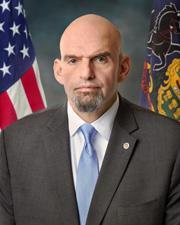
U.S. Senator for Pennsylvania
Democrat
Senate term end not loaded yet
Missed 6.5% of roll calls. Chamber median 2.1%.
The full voting recordCounts roll calls where most Democrats and most Republicans voted differently, leaving out procedural votes.
How we countFrom FEC filings, Voteview roll calls and Congress.gov.
Democrat. In Congress since 2023, 1 term in total.
Following saves Fetterman to your list, which Chamber & Street keeps on its server, linked to a cookie on this browser and not to your name or email. Email alerts will come with constituent verification.
Bills and resolutions Fetterman signed on to as a cosponsor. An original cosponsor signed on the day the bill was introduced. Source: govinfo bill status files, last updated Nov 6, 2026.
Leveling the Playing Field 2.0 Act
Sponsor Todd Young (R). Original cosponsor. 23 cosponsors. S. 691 on Congress.gov
Introduced
Leveling the Playing Field 2.0 Act
This bill addresses unfair trade practices by making various changes to U.S. antidumping and countervailing duty laws. Antidumping laws provide relief to U.S industries and workers that are materially injured or threatened with injury due to imports of like products sold in the U.S. market at less than fair value, while countervailing duty laws provide such relief from imports of products subsidized by a foreign government or public entity.
Specifically, the bill establishes a process for successive antidumping and countervailing duty investigations. Successive investigations may be concurrent (an ongoing investigation of the same product) or recently completed (not more than two years before the date of the initiation of the successive investigation). Further, the bill establishes a timeline for the Department of Commerce to issue determinations in successive investigations.
Among other provisions, the bill authorizes Commerce to
• apply countervailing duty law to subsidies provided by a foreign government or public entity to a company operating in a different country,
• use another method for calculating the cost of production in specific circumstances, and
• require importers to certify that the imported merchandise is not subject to an antidumping or countervailing duty order.
Additionally, the bill statutorily establishes procedures for Commerce to conduct circumvention inquiries, including by specifying the deadlines for preliminary and final determinations.
The bill also provides statutory authority for Commerce to investigate currency undervaluation as a countervailable subsidy.
A resolution expressing support for the designation of February 15 through February 22, 2025, as "National FFA Week", recognizing the important role of the National FFA Organization in developing the next generation of leaders who will change the world, and celebrating the 90th anniversary of New Farmers of America and the 75th anniversary of the Future Farmers of America Federal charter.
Sponsor Todd Young (R). Original cosponsor. 51 cosponsors. S.Res. 89 on Congress.gov(opens in a new tab)
Passed the Senate
This resolution supports the designation of February 15-22, 2025, as National FFA (Future Farmers of America) Week.
It also celebrates the 90th anniversary of New Farmers of America (NFA), which served Black vocational agriculture students in segregated public schools until NFA and FFA became one organization in 1965.
The resolution also commemorates the 75th anniversary of the federal charter for the Future Farmers of America.
Bus Rolling Stock Modernization Act of 2025
Sponsor Tina Smith (D). Original cosponsor. 3 cosponsors. S. 660 on Congress.gov(opens in a new tab)
Introduced
Bus Rolling Stock Modernization Act of 2025
This bill allows a state or local authority (e.g., a transit authority) to use public transportation grants to make a partial advance payment for bus rolling stock (e.g., transit buses).
Specifically, a public transportation grant recipient may use grant funds to make an advance payment of not more than 20% of the total purchase order value of a bus rolling stock vehicle without obtaining preapproval or requiring the vehicle manufacturer to provide a performance bond (or other form of security). In order to make an advance payment, the recipient must meet certain requirements. For example, the recipient must have a signed purchase order and an executed contract with a vehicle manufacturer that includes advance payment provisions.
Stop Tax Penalties on American Hostages Act of 2025
Sponsor Christopher Coons (D). Original cosponsor. 9 cosponsors. S. 655 on Congress.gov(opens in a new tab)
Introduced
Stop Tax Penalties on American Hostages Act of 2025
This bill extends certain federal tax deadlines for U.S. nationals who are unlawfully or wrongfully detained abroad or held hostage abroad and their spouses. The bill also allows for an abatement and refund of additional taxes, interest, and penalties assessed to such individuals for failing to meet a federal tax deadline during a period of detention.
Specifically, under the bill, the time period during which a U.S. national is unlawfully or wrongfully detained abroad or held hostage abroad is disregarded in determining certain federal tax deadlines, including deadlines for
• filing a return for and paying federal income, estate, gift, employment, or excise taxes;
• a tax credit or refund claim; and
• the determination, assessment, and collection of additional taxes, interest, or penalties.
The bill requires the Department of State and the Department of Justice to annually provide the Internal Revenue Service (IRS) with lists to identify U.S. nationals who qualify for an extension.
The bill also requires the IRS to (1) abate and refund additional taxes, interest, and penalties assessed for any tax year ending during a period of detention for which an extension of a federal tax deadline is permitted; and (2) establish a program allowing U.S. nationals unlawfully or wrongfully detained abroad or taken hostage abroad (or their spouse or dependent) to claim a refund of additional taxes, interest, and penalties assessed for any tax year ending during a period of detention from 2021 to the bill’s enactment date.
A resolution affirming that Hamas cannot retain any political or military control in the Gaza Strip.
Sponsor Lindsey Graham (R). Joined Feb 19, 2025. 5 cosponsors. S.Res. 72 on Congress.gov(opens in a new tab)
Passed the Senate
This resolution affirms that Hamas cannot be allowed to retain any political or military control in the Gaza Strip. The resolution also (1) calls on the President to use economic and diplomatic tools to halt funding for Hamas from Iran and elsewhere; and (2) supports Israel as it defends itself from Hamas, Iran, and Iranian proxies.
ENABLE Act
Sponsor Eric Schmitt (R). Original cosponsor. 16 cosponsors. S. 627 on Congress.gov(opens in a new tab)
Introduced
Equal COLA Act
Sponsor Alex Padilla (D). Original cosponsor. 20 cosponsors. S. 624 on Congress.gov(opens in a new tab)
Introduced
Healthy Poultry Assistance and Indemnification Act of 2025
Sponsor Roger Wicker (R). Original cosponsor. 17 cosponsors. S. 574 on Congress.gov(opens in a new tab)
Introduced
Healthy Poultry Assistance and Indemnification Act of 2025
This bill expands the Animal and Plant Health Inspection Service (APHIS) producer indemnity and compensation program to include compensation for all poultry growers and layers located in an APHIS-determined control area, which may include non-infected poultry.
Currently, APHIS provides indemnity and compensation to producers to remove animals classified as affected, suspect, or exposed to diseases of concern, including highly pathogenic avian influenza (HPAI). An APHIS-determined control area consists of both an infected zone and a buffer zone. Under the bill, APHIS must compensate all owners of poultry growing or laying facilities within a control area, which may include facilities that are located in the buffer zones and have non-infected poultry.
Further, the bill establishes a new compensation payment formula that requires payments to be based on the owner’s average income from the five most recent flocks.
First Rhode Island Regiment Congressional Gold Medal Act
Sponsor Sheldon Whitehouse (D). Original cosponsor. 67 cosponsors. S. 567 on Congress.gov(opens in a new tab)
Passed the Senate
First Rhode Island Regiment Congressional Gold Medal Act
This bill provides for the award of a single Congressional Gold Medal to the First Rhode Island Regiment, collectively, in recognition of their dedicated service during the Revolutionary War.
Antisemitism Awareness Act of 2025
Sponsor Tim Scott (R). Original cosponsor. 47 cosponsors. S. 558 on Congress.gov(opens in a new tab)
Introduced
Antisemitism Awareness Act of 2025
This bill provides statutory authority for the requirement that the Department of Education’s Office for Civil Rights take into consideration the International Holocaust Remembrance Alliance's (IHRA's) working definition of antisemitism when reviewing or investigating complaints of discrimination based on race, color, or national origin in programs or activities that receive federal financial assistance. According to the IHRA's working definition, antisemitism is a certain perception of Jews, which may be expressed as hatred toward Jews.
Capping Prescription Costs Act of 2025
Sponsor Raphael Warnock (D). Original cosponsor. 13 cosponsors. S. 529 on Congress.gov(opens in a new tab)
Introduced
GLRI Act of 2026
Sponsor Gary Peters (D). Original cosponsor. 12 cosponsors. S. 528 on Congress.gov(opens in a new tab)
Passed the Senate
Great Lakes Restoration Initiative Act of 2025 or the GLRI Act of 2025
This bill reauthorizes through FY2031 the Great Lakes Restoration Initiative, which carries out programs and projects to protect and restore the Great Lakes.
CAREER Act of 2025
Sponsor Mitch McConnell (R). Original cosponsor. 3 cosponsors. S. 500 on Congress.gov(opens in a new tab)
Introduced
Comprehensive Addiction Recovery through Effective Employment and Reentry Act of 2025 or the CAREER Act of 2025
This bill reauthorizes and expands programs to assist individuals in substance use disorder treatment and recovery to live independently and participate in the workforce.
Specifically, the bill reauthorizes through FY2030 the Substance Abuse and Mental Health Services Administration (SAHMSA) Treatment, Recovery, and Workforce Support Grant Program, which provides employment training and recovery support services in coordination with state and local stakeholders. The bill further authorizes using 5% of such grant funds for transportation services and requires grantees to report on the employment and earnings outcomes of program participants.
The bill also reauthorizes through FY20230 the Department of Housing and Urban Development (HUD) Recovery Housing Pilot Program, which assists states in providing individuals in recovery from a substance use disorder with stable, temporary housing for up to two years.
A resolution supporting the goals and ideals of "Career and Technical Education Month".
Sponsor Timothy Kaine (D). Original cosponsor. 51 cosponsors. S.Res. 66 on Congress.gov(opens in a new tab)
Passed the Senate
This resolution supports the designation of Career and Technical Education Month to celebrate career and technical education across the United States.
Right to Contraception Act
Sponsor Edward Markey (D). Original cosponsor. 41 cosponsors. S. 422 on Congress.gov(opens in a new tab)
Introduced
American Beef Labeling Act of 2025
Sponsor John Thune (R). Original cosponsor. 11 cosponsors. S. 421 on Congress.gov(opens in a new tab)
Introduced
American Beef Labeling Act of 2025
This bill reinstates mandatory country-of-origin labeling (COOL) requirements for beef. COOL is a labeling law that requires retailers, such as full-line grocery stores, supermarkets, and club warehouse stores, to provide information to customers regarding the source of certain foods.
Specifically, the bill requires the Office of the U.S. Trade Representative (USTR), in consultation with the Department of Agriculture (USDA), to determine a means of reinstating mandatory COOL for beef that is compliant with World Trade Organization rules. The USTR and USDA must implement the means of reinstating mandatory COOL for beef within one year of the bill's enactment.
Love Lives On Act of 2025
Sponsor Jerry Moran (R). Original cosponsor. 61 cosponsors. S. 410 on Congress.gov(opens in a new tab)
Passed committee
Love Lives On Act of 2025
This bill extends entitlement for various benefit programs and services for surviving spouses of deceased members of the Armed Forces or veterans.
The bill provides that the remarriage of a surviving spouse must not bar the furnishing of dependency and indemnity compensation or special pension benefits to such spouse.
Additionally, the Department of Defense may not terminate the payment of an annuity for a surviving spouse under the Survivor Benefit Plan solely because the surviving spouse remarries.
The bill also expands the definition of a dependent under TRICARE to include a remarried widow or widower whose subsequent marriage has ended due to death, divorce, or annulment.
No Tax Breaks for Outsourcing Act
Sponsor Sheldon Whitehouse (D). Original cosponsor. 20 cosponsors. S. 409 on Congress.gov(opens in a new tab)
Introduced
Promoting Resilient Buildings Act
Sponsor John Cornyn (R). Original cosponsor. 1 cosponsor. S. 388 on Congress.gov(opens in a new tab)
Passed committee
Promoting Resilient Buildings Act
This bill increases flexibility for predisaster mitigation assistance for building code activities, prohibits using certain loan funds for building code activities, and establishes a pilot program to fund residential resilience retrofits.
Under current law, the Federal Emergency Management Agency (FEMA) may provide predisaster hazard mitigation assistance to government entities for implementing the latest published editions of relevant building codes and standards. Also, FEMA must consider a government entity’s adoption of such building codes when determining whether to award it predisaster hazard mitigation assistance. The bill specifies that the building codes applicable in such instances are the two most recently published editions (i.e., either the current edition or the previous one).
Also, currently, under FEMA's Safeguarding Tomorrow Revolving Loan Fund (STRLF) program, states and Indian tribal governments may provide loans to local governments for establishing and carrying out building codes and standards. The bill removes this authority, so STRLF loans may not be used for such building code-related activities.
Additionally, the bill establishes a pilot program for FEMA to provide grants to government entities that then provide the funding to individuals for residential resilience retrofits. The retrofit projects must reduce risk to homes from local natural hazards and individuals must demonstrate financial need. To implement the pilot program, FEMA may use up to 10% of the funds FEMA provides annually for predisaster hazard mitigation assistance. The pilot program terminates at the end of FY2030.
Rural Hospital Support Act
Sponsor Chuck Grassley (R). Original cosponsor. 16 cosponsors. S. 335 on Congress.gov(opens in a new tab)
Introduced
Rural Hospital Support Act
This bill modifies and extends certain payment adjustments for rural hospitals under Medicare's inpatient prospective payment system.
Specifically, the bill indexes payment adjustments for sole community hospitals and Medicare-dependent hospitals to FY2016 operating costs, if it results in higher payments for such hospitals. The bill also makes payment adjustments for Medicare-dependent hospitals and low-volume hospitals permanent (the adjustments currently expire on March 31, 2025).
A resolution affirming the threats to world stability from a nuclear weapons-capable Islamic Republic of Iran.
Sponsor Lindsey Graham (R). Original cosponsor. 2 cosponsors. S.Res. 43 on Congress.gov(opens in a new tab)
Introduced
This resolution affirms that Iran's pursuit of nuclear weapons is a credible threat to the United States and an existential threat to Israel and other allies and partners in the Middle East.
The resolution also (1) demands that Iran cease engaging in activities such as enriching uranium and developing a nuclear warhead, and (2) asserts that all options should be considered to address the nuclear threat posed by Iran.
A resolution condemning the pardons for individuals who were found guilty of assaulting Capitol Police Officers.
Sponsor Patty Murray (D). Original cosponsor. 46 cosponsors. S.Res. 42 on Congress.gov(opens in a new tab)
Introduced
This resolution disapproves of pardons for individuals who were found guilty of assaulting U.S. Capitol Police officers.
Kids Off Social Media Act
Sponsor Brian Schatz (D). Original cosponsor. 14 cosponsors. S. 278 on Congress.gov(opens in a new tab)
Passed committee
Kids Off Social Media Act
This bill limits children’s access to social media platforms and requires both platforms and schools to implement certain restrictions on children’s social media usage.
Specifically, the bill prohibits social media platforms from knowingly allowing children under the age of 13 to create or maintain accounts. Platforms must delete existing accounts held by children and any personal data collected from child users. Platforms are also generally prohibited from using automated systems to suggest or promote content based on personal data collected from users under the age of 17. The bill directs the Federal Trade Commission to enforce these provisions. States may also bring civil actions against platforms whose violations of these provisions have adversely affected their residents.
Further, as a condition of receiving discounted telecommunications service under the Schools and Libraries Universal Service Support (E-Rate) program, schools must enforce policies preventing the use of E-Rate-supported services, networks, and devices to access social media, and must use blocking or filtering technology to prevent such access. Schools that do not make a good faith effort to comply and correct known violations are required to reimburse any E-Rate support they received for the applicable period. Schools must also submit copies of their internet safety policies to the Federal Communications Commission for publication.
Under the bill, social media platforms are defined as public-facing sites that function primarily as forums for user-generated content. Some categories of online platforms are explicitly excluded, including sites that provide primarily videoconferencing, emailing, or educational services.
Honoring Our Fallen Heroes Act of 2025
Sponsor Amy Klobuchar (D). Original cosponsor. 59 cosponsors. S. 237 on Congress.gov(opens in a new tab)
Passed committee
Honoring Our Fallen Heroes Act of 2025
This bill extends death and disability benefits under the Public Safety Officers' Benefits Program (PSOB) to certain public safety officers who suffer from exposure-related cancer while on duty and their survivors. The PSOB program provides death, disability, and education benefits to public safety officers who are killed or injured in the line of duty and their survivors.
The bill specifies that exposure to a carcinogen shall be presumed to constitute a personal injury in the line of duty if
• the exposure occurred while the officer was in the line of duty;
• the officer began serving as an officer not fewer than 5 years before the date of the diagnosis of an exposure-related cancer and the diagnosis occurred not more than 15 years after the last date of active service; and
• the exposure-related cancer directly and proximately resulted in the death or permanent and total disability of the officer.
The Department of Justice's Bureau of Justice Assistance must periodically review the definition of exposure-related cancer and update the definition if appropriate based on medical evidence and in accordance with the requirements of a petition process.
Whole Milk for Healthy Kids Act of 2025
Sponsor Roger Marshall (R). Original cosponsor. 16 cosponsors. S. 222 on Congress.gov(opens in a new tab)
Became law
Whole Milk for Healthy Kids Act of 2025
This act revises requirements for milk provided by the National School Lunch Program of the Department of Agriculture (USDA) to allow schools to offer students whole and reduced-fat milk. The act also requires that local school food service personnel receive annual training and certification on food allergies.
The act permits schools to offer students whole, reduced-fat (2%), low-fat (1%), and fat-free flavored and unflavored milk. The milk that is offered may be organic or nonorganic. Currently, USDA regulations require milk to be fat-free or low-fat and allow milk to be flavored or unflavored. The act also removes the requirement that schools participating in the program must provide milk that is consistent with the most recent Dietary Guidelines for Americans.
The act also expands the nondairy beverages that are included in the program by allowing schools to offer all students nondairy beverages that are nutritionally equivalent to fluid milk and that meet nutritional standards established by USDA.
Further, schools currently must provide a substitute for fluid milk, on receipt of a written statement from a licensed physician, for students whose disability restricts their diet. Under the act, a parent or legal guardian may also provide the written statement.
In addition, the act excludes fluid milk from the saturated fat content calculation for school meals. Currently, schools participating in the program must provide meals that meet certain nutrition requirements; USDA regulations require that the average saturated fat content of the meals offered must be less than 10% of the total calories. Under the act, milk fat included in any fluid milk provided by the program must not be considered saturated fat for the purposes of measuring compliance with USDA regulations.
Finally, the program's mandatory training and certification for local school food service personnel must include a module on food allergies, including information on the best practices to prevent, recognize, and respond to food-related allergic reactions. Food service personnel must receive an annual certification to demonstrate competence in the food allergies training and other training modules that are provided.