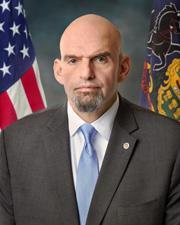
U.S. Senator for Pennsylvania
Democrat
Senate term end not loaded yet
Missed 6.5% of roll calls. Chamber median 2.1%.
The full voting recordCounts roll calls where most Democrats and most Republicans voted differently, leaving out procedural votes.
How we countFrom FEC filings, Voteview roll calls and Congress.gov.
Democrat. In Congress since 2023, 1 term in total.
Following saves Fetterman to your list, which Chamber & Street keeps on its server, linked to a cookie on this browser and not to your name or email. Email alerts will come with constituent verification.
Bills and resolutions Fetterman signed on to as a cosponsor. An original cosponsor signed on the day the bill was introduced. Source: govinfo bill status files, last updated Nov 6, 2026.
WATCH Act
Sponsor Eric Schmitt (R). Original cosponsor. 6 cosponsors. S. 1104 on Congress.gov
Introduced
A resolution designating March 24, 2025, as "National Women of Color in Tech Day".
Sponsor Jacky Rosen (D). Original cosponsor. 7 cosponsors. S.Res. 132 on Congress.gov(opens in a new tab)
Introduced
A resolution recognizing and honoring teachers who have earned or maintained National Board Certification.
Sponsor Martin Heinrich (D). Original cosponsor. 9 cosponsors. S.Res. 129 on Congress.gov(opens in a new tab)
Passed the Senate
This resolution honors the teachers who have earned or maintained National Board Certification as of March 2025.
FIGHT China Act of 2025
Sponsor John Cornyn (R). Original cosponsor. 13 cosponsors. S. 1053 on Congress.gov(opens in a new tab)
Introduced
Foreign Investment Guardrails to Help Thwart China Act of 2025 or FIGHT China Act of 2025
This bill authorizes sanctions on certain foreign persons (individuals and entities) that are involved with China's defense or surveillance technology sectors. The bill also requires U.S. persons to notify the Department of the Treasury about their investments with certain foreign persons in various technologies, and (2) authorizes Treasury to prohibit U.S. persons from making investments with such foreign persons in some of these technologies.
Specifically, the President is authorized to impose property-blocking sanctions on certain foreign persons (including members of the Chinese Communist Party Central Committee, Chinese businesses, Chinese governmental entities, and businesses with equity securities primarily traded on Chinese stock exchanges) that Treasury determines to be knowingly engaged in significant operations in China's defense, defense-related material, or surveillance technology sectors.
Additionally, the bill authorizes Treasury to bar U.S. persons from knowingly engaging in certain transactions (such as acquiring an equity interest, providing a loan, or entering into a joint venture) with most of these categories of foreign persons if they involve a prohibited technology. Prohibited technologies include those that
• develop a quantum computer;
• develop, design, or produce materials, components, or systems for hypersonic systems; or
• develop, design, or produce artificial intelligence models for use by the Chinese government.
Treasury must require U.S. persons to notify Treasury if they engage in such transactions involving a range of technologies, including the prohibited technologies.
Major Richard Star Act
Sponsor Richard Blumenthal (D). Original cosponsor. 80 cosponsors. S. 1032 on Congress.gov(opens in a new tab)
Introduced
Major Richard Star Act
This bill allows a veteran with a combat-related disability to receive retirement pay, without reduction, concurrently with their disability compensation. This includes veterans with a combat-related disability and fewer than 20 years of creditable service. (Currently, veterans who receive combat-related special compensation and retirement pay are subject to an offset in retirement pay for concurrent receipt of such benefits.)
A bill to require the Federal Energy Regulatory Commission to extend the time period during which licensees are required to commence construction of certain hydropower projects.
Sponsor Steve Daines (R). Original cosponsor. 7 cosponsors. S. 1020 on Congress.gov(opens in a new tab)
Became law
This act authorizes the Federal Energy Regulatory Commission (FERC) to extend construction deadlines for hydropower projects that were issued a license before March 13, 2020. FERC is authorized, upon the request of the licensees, to extend the deadline for beginning construction on such projects an additional six years beyond the eight-year extension FERC is authorized to provide under current law. The extension must consist of no more than three consecutive two-year periods.
The act also provides that FERC may reinstate certain expired licenses for projects with construction deadlines extended under this act, effective as of the date they expire.
Rights for the TSA Workforce Act
Sponsor Brian Schatz (D). Original cosponsor. 34 cosponsors. S. 997 on Congress.gov(opens in a new tab)
Introduced
Safe Schools Improvement Act
Sponsor Timothy Kaine (D). Original cosponsor. 42 cosponsors. S. 986 on Congress.gov(opens in a new tab)
Introduced
Safe Schools Improvement Act
This bill requires states to direct their local educational agencies (LEAs) to establish policies that prevent and prohibit bullying and harassment of elementary and secondary school students. In particular, these policies must prohibit bullying and harassment based on race, color, national origin, disability, religion, or sex. Sex includes sexual orientation, gender identity, and sex characteristics (including intersex traits).
Further, LEAs must provide (1) students, parents, and educational professionals with annual notice of the conduct prohibited in their disciplinary policies; (2) students and parents with grievance procedures that target such conduct; and (3) the public with annual data on the incidence and frequency of that conduct at the school and LEA level.
The Department of Education must conduct and report on an independent biennial evaluation of programs and policies to combat bullying and harassment in elementary and secondary schools. The National Center for Education Statistics must collect state data to determine the incidence and frequency of the conduct prohibited by LEA disciplinary policies.
Chesapeake Bay Conservation Acceleration Act of 2025
Sponsor Chris Van Hollen (D). Original cosponsor. 5 cosponsors. S. 971 on Congress.gov(opens in a new tab)
Introduced
Stop Comstock Act
Sponsor Tina Smith (D). Original cosponsor. 28 cosponsors. S. 951 on Congress.gov(opens in a new tab)
Introduced
HOME Investment Partnerships Reauthorization and Improvement Act of 2025
Sponsor Catherine Cortez Masto (D). Original cosponsor. 12 cosponsors. S. 948 on Congress.gov(opens in a new tab)
Introduced
Joint Task Force to Counter Illicit Synthetic Narcotics Act of 2025
Sponsor David McCormick (R). Original cosponsor. 3 cosponsors. S. 938 on Congress.gov(opens in a new tab)
Introduced
A concurrent resolution expressing support for the recognition of March 10, 2025, as "Abortion Provider Appreciation Day".
Sponsor Mazie Hirono (D). Original cosponsor. 12 cosponsors. S.Con.Res. 9 on Congress.gov(opens in a new tab)
Introduced
Stop Shackling and Detaining Pregnant Women Act
Sponsor Patty Murray (D). Original cosponsor. 22 cosponsors. S. 916 on Congress.gov(opens in a new tab)
Introduced
Nancy Gardner Sewell Medicare Multi-Cancer Early Detection Screening Coverage Act
Sponsor Mike Crapo (R). Joined Mar 10, 2025. 68 cosponsors. S. 339 on Congress.gov(opens in a new tab)
Introduced
Nancy Gardner Sewell Medicare Multi-Cancer Early Detection Screening Coverage Act
This bill allows, beginning in 2028, for Medicare coverage and payment for multi-cancer early detection screening tests that are approved by the Food and Drug Administration and that are used to screen for cancer across many cancer types, if the Centers for Medicare & Medicaid Services determines such coverage is appropriate. Coverage is limited to those under a certain age (age 68 in 2028, increased by one year every year thereafter) and to one test every 11 months.
Do No Harm Act
Sponsor Cory Booker (D). Original cosponsor. 25 cosponsors. S. 894 on Congress.gov(opens in a new tab)
Introduced
Do No Harm Act
This bill prohibits the application of the Religious Freedom Restoration Act of 1993 (RFRA) to specified federal laws or the implementation of such laws. Currently, RFRA prohibits the government from substantially burdening a person's exercise of religion even if the burden results from a rule of general applicability, except in furtherance of a compelling governmental interest when using the least restrictive means.
Under the bill, RFRA is inapplicable to laws or the implementation of laws that
• protect against discrimination or require the promotion of equal opportunity (e.g., the Civil Rights Act of 1964);
• require employers to provide wages, other compensation, or benefits, including leave;
• protect collective activity in the workplace;
• protect against child labor, abuse, or exploitation; or
• provide for access to, information about, referrals for, provision of, or coverage for any health care item or service.
The bill prevents RFRA from being used to deny (1) goods or services the government has agreed to provide to a beneficiary of or participant in a program or activity funded by a government contract, grant, agreement, or other award; or (2) a person's full and equal enjoyment of a government-provided good, service, benefit, facility, privilege, advantage, or accommodation.
In order for a person to assert a RFRA claim or defense in a judicial proceeding, the government must be a party to the proceeding.
FARMLAND Act of 2025
Sponsor Joni Ernst (R). Original cosponsor. 4 cosponsors. S. 886 on Congress.gov(opens in a new tab)
Introduced
Foreign Agricultural Restrictions to Maintain Local Agriculture and National Defense Act of 2025 or the FARMLAND Act of 2025
This bill expands federal authority and oversight over foreign investments in the U.S. agricultural industry.
The bill expands the authority of the Committee on Foreign Investment in the United States (CFIUS) to include the review of land transactions (involving foreign entities) that exceed $5 million or 320 acres of land over the preceding three years. This applies to land that is primarily used for agriculture, the extraction of energy sources, or the extraction of critical precursor materials for biological technology industries, information technology components, or national defense technologies. Further, the bill adds the Secretary of Agriculture and the Commissioner of Food and Drugs to CFIUS membership. As background, CFIUS is an interagency committee that oversees the national security risks of certain foreign direct investment in the U.S. economy, including by reviewing certain real estate transactions.
Further, the bill expands enforcement of the Agricultural Foreign Investment Disclosure Act (AFIDA). The Department of Agriculture (USDA) must appoint a Chief of Operations of Investigative Actions to (1) monitor AFIDA compliance, and (2) conduct investigations on efforts to steal agricultural knowledge and technology and to disrupt the U.S. agricultural base.
The bill prohibits foreign persons who own or operate land from participating in Farm Service Agency programs and establishes penalties for violators.
The bill also requires USDA and the Department of Homeland Security to jointly develop a database of agricultural land owned by foreign persons.
Richard L. Trumka Protecting the Right to Organize Act of 2025
Sponsor Bernie Sanders (I). Original cosponsor. 45 cosponsors. S. 852 on Congress.gov(opens in a new tab)
Introduced
A resolution dissenting from the United States delegation's February 24, 2025, vote at the United Nations General Assembly.
Sponsor Jeanne Shaheen (D). Joined Mar 3, 2025. 27 cosponsors. S.Res. 100 on Congress.gov(opens in a new tab)
Introduced
United States-Israel Defense Partnership Act of 2025
Sponsor Dan Sullivan (R). Joined Mar 3, 2025. 32 cosponsors. S. 554 on Congress.gov(opens in a new tab)
Introduced
United States-Israel Defense Partnership Act of 2025
This bill requires or authorizes certain actions to increase defense-related cooperation between the United States and Israel.
Specifically, the bill requires the Department of Defense (DOD) to
• establish a cooperative program, with the concurrence of Israel's Ministry of Defense (MOD), to develop and deploy advanced technologies for countering unmanned systems that threaten the United States and Israel;
• establish in Israel an office of the Defense Innovation Unit (an organization that focuses on rapidly fielding and scaling commercial technology across the U.S. military); and
• seek to engage Israel's MOD on the ascension of Israel into the national technology and industrial base (currently defined in law as the persons and organizations engaged in research, development, production, integration, services, or information technology activities conducted within the United States, the United Kingdom, Australia, New Zealand, and Canada).
The bill authorizes DOD, upon request of Israel's MOD, to jointly conduct research, development, test, and evaluation (RDT&E) of emerging technologies such as artificial intelligence and robotics to meet defense challenges.
Additionally, the bill extends the authority for DOD to (1) carry out RDT&E on a joint basis with Israel to establish anti-tunnel and counter unmanned aerial systems capabilities through 2028, and (2) transfer defense articles intended for use as reserve stocks for Israel through January 1, 2029.
A bill to amend the Internal Revenue Code of 1986 to provide special rules for the taxation of certain residents of Taiwan with income from sources within the United States.
Sponsor Mike Crapo (R). Joined Mar 3, 2025. 48 cosponsors. S. 199 on Congress.gov(opens in a new tab)
Introduced
A resolution affirming the threats to world stability from a nuclear weapons-capable Islamic Republic of Iran.
Sponsor Lindsey Graham (R). Original cosponsor. 2 cosponsors. S.Res. 101 on Congress.gov(opens in a new tab)
Introduced
Accelerating Kids’ Access to Care Act
Sponsor Chuck Grassley (R). Original cosponsor. 45 cosponsors. S. 752 on Congress.gov(opens in a new tab)
Introduced
Accelerating Kids’ Access to Care Act
This bill requires states to establish a process through which qualifying out-of-state providers may temporarily treat children under Medicaid and the Children's Health Insurance Program (CHIP) without undergoing additional screening requirements.
Specifically, states must establish a process through which qualifying out-of-state providers may enroll for five years as participating providers to treat individuals under the age of 21 without undergoing additional screening requirements.
A qualifying out-of-state provider (1) must not have been excluded or terminated from participating in a federal health care program or state Medicaid program; and (2) must have been successfully enrolled in Medicare or a state Medicaid program based on a determination that the provider posed a limited risk of fraud, waste, or abuse.
The bill’s changes take effect three years after enactment.
Ethan's Law
Sponsor Richard Blumenthal (D). Original cosponsor. 40 cosponsors. S. 726 on Congress.gov(opens in a new tab)
Introduced
Ethan's Law
This bill establishes a framework to regulate the storage of firearms on residential premises at the federal, state, and tribal levels.
At the federal level, the bill establishes statutory requirements for firearms on residential premises to be safely stored if a minor is likely to gain access without permission or if a resident is ineligible to possess a firearm.
An individual who violates the requirements is subject to criminal penalties. A firearm stored in violation of the requirements is subject to seizure and forfeiture.
At the state and tribal levels, the bill requires the Department of Justice to award grants to implement functionally identical requirements for the safe storage of firearms.
Veterans Mental Health and Addiction Therapy Quality of Care Act
Sponsor John Cornyn (R). Original cosponsor. 8 cosponsors. S. 702 on Congress.gov(opens in a new tab)
Passed committee
Veterans Mental Health and Addiction Therapy Quality of Care Act
This bill requires the Department of Veterans Affairs (VA) to seek to enter into an agreement with an independent and objective organization to study the difference in quality of mental health and addiction therapy care provided by the VA compared to non-VA providers across various modalities. The organization must publish its findings publicly.