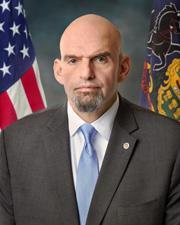
U.S. Senator for Pennsylvania
Democrat
Senate term end not loaded yet
Missed 6.5% of roll calls. Chamber median 2.1%.
The full voting recordCounts roll calls where most Democrats and most Republicans voted differently, leaving out procedural votes.
How we countFrom FEC filings, Voteview roll calls and Congress.gov.
Democrat. In Congress since 2023, 1 term in total.
Following saves Fetterman to your list, which Chamber & Street keeps on its server, linked to a cookie on this browser and not to your name or email. Email alerts will come with constituent verification.
Bills and resolutions Fetterman signed on to as a cosponsor. An original cosponsor signed on the day the bill was introduced. Source: govinfo bill status files, last updated Nov 6, 2026.
VA Employee Fairness Act of 2025
Sponsor Tammy Duckworth (D). Original cosponsor. 11 cosponsors. S. 1650 on Congress.gov
Introduced
Improving Access to Nutrition Act of 2025
Sponsor Peter Welch (D). Original cosponsor. 8 cosponsors. S. 1628 on Congress.gov(opens in a new tab)
Introduced
SHIELD Against CCP Act
Sponsor John Cornyn (R). Original cosponsor. 3 cosponsors. S. 1625 on Congress.gov(opens in a new tab)
Introduced
A resolution expressing support for the designation of the week of May 4, 2025, through May 10, 2025, as "National Small Business Week" to celebrate the contributions of small businesses and entrepreneurs in every community in the United States.
Sponsor Joni Ernst (R). Original cosponsor. 81 cosponsors. S.Res. 201 on Congress.gov(opens in a new tab)
Passed the Senate
This resolution honors the contributions of small businesses in the United States and supports the designation of National Small Business Week.
Freedom to Invest in Tomorrow’s Workforce Act
Sponsor Amy Klobuchar (D). Joined Apr 30, 2025. 16 cosponsors. S. 756 on Congress.gov(opens in a new tab)
Introduced
Freedom to Invest in Tomorrow’s Workforce Act
This bill expands the expenses eligible for tax-free withdrawals from a qualified tuition program (known as a 529 plan) to include tuition, fees (including test fees), books, supplies, equipment, and other expenses related to the enrollment or attendance in a recognized postsecondary credentialing program.
Under the bill, a recognized postsecondary credentialing program includes certain programs identified by a state as providing training services, a program listed in the Web Enabled Approval Management System (WEAMS) maintained by the Department of Veterans Affairs, certain examinations required to obtain or maintain a credential, and other reputable credentialing programs.
Further, under the bill, such programs must be designed for an individual to obtain
• an industry-recognized postsecondary employment credential (e.g., project management professional certificate, advanced emergency medical technician certificate, and welding supervisor certificate),
• a certificate of completion of a registered and certified apprenticeship,
• an occupational or professional license issued or recognized by a state or the federal government (and any certification required for obtaining such license), or
• an associate or baccalaureate degree.
SHIPS for America Act of 2025
Sponsor Mark Kelly (D). Original cosponsor. 28 cosponsors. S. 1541 on Congress.gov(opens in a new tab)
Introduced
Building Ships in America Act of 2025
Sponsor Mark Kelly (D). Original cosponsor. 4 cosponsors. S. 1536 on Congress.gov(opens in a new tab)
Introduced
Assault Weapons Ban of 2025
Sponsor Adam Schiff (D). Original cosponsor. 42 cosponsors. S. 1531 on Congress.gov(opens in a new tab)
Introduced
Assault Weapons Ban of 2025
This bill makes it a crime to knowingly import, sell, manufacture, transfer, or possess a semiautomatic assault weapon (SAW) or large capacity ammunition feeding device (LCAFD).
The prohibition does not apply to a firearm that is (1) manually operated by bolt, pump, lever, or slide action, except for certain shotguns; (2) permanently inoperable; (3) an antique; (4) only capable of firing rimfire ammunition; or (5) a rifle or shotgun specifically identified by make and model.
The bill also exempts from the prohibition the following, with respect to a SAW or LCAFD:
• importation, sale, manufacture, transfer, or possession related to certain law enforcement efforts, or authorized tests or experiments;
• importation, sale, transfer, or possession related to securing nuclear materials; and
• possession by a retired law enforcement officer.
The bill permits continued possession, sale, or transfer of a grandfathered SAW, which must be securely stored. A licensed gun dealer must conduct a background check prior to the sale or transfer of a grandfathered SAW between private parties.
The bill permits continued possession of, but prohibits sale or transfer of, a grandfathered LCAFD.
Newly manufactured LCAFDs must display serial number identification. Newly manufactured SAWs and LCAFDs must display the date of manufacture.
The bill also allows a state or local government to use Edward Byrne Memorial Justice Assistance Grant Program funds to compensate individuals who surrender a SAW or LCAFD under a buy-back program.
A resolution supporting the mission and goals of National Fentanyl Awareness Day in 2025, including increasing individual and public awareness of the impact of fake or counterfeit fentanyl pills on families and young people.
Sponsor Chuck Grassley (R). Original cosponsor. 29 cosponsors. S.Res. 186 on Congress.gov(opens in a new tab)
Passed the Senate
This resolution designates April 29, 2025, as National Fentanyl Awareness Day to bring attention to the impact of fake or counterfeit fentanyl pills.
LIONs Act of 2025
Sponsor Thomas Tillis (R). Joined Apr 29, 2025. 2 cosponsors. S. 901 on Congress.gov(opens in a new tab)
Introduced
Agriculture Resilience Act of 2025
Sponsor Martin Heinrich (D). Original cosponsor. 11 cosponsors. S. 1507 on Congress.gov(opens in a new tab)
Introduced
Agriculture Resilience Act of 2025
This bill establishes, expands, and revises multiple programs and activities of the Department of Agriculture (USDA) primarily to reduce carbon emissions from the agricultural sector.
Specifically, USDA must finalize and implement a plan to achieve net-zero emissions from the sector by 2040. USDA must periodically review and revise the plan, as necessary, and annually report on its implementation.
Additionally, the bill expands the scope of various USDA research, extension, and education programs; conservation programs; and livestock programs to incorporate climate change mitigation and adaptation. Expanded activities include efforts to improve soil health and preserve farmland and grassland.
Further, the bill changes programs that support renewable energy in rural areas to address carbon emissions in the agricultural sector. Among these changes, the bill provides statutory authority for the AgSTAR program for reducing methane emissions from livestock waste and requires the program to be moved from the Environmental Protection Agency to USDA.
The bill also addresses food waste, for example, by (1) standardizing the voluntary labels used by food producers to indicate the date by which food should be used or discarded, and (2) making composting activities eligible for support through USDA conservation programs. Moreover, the bill establishes grants to reduce and prevent food waste in landfills and in schools.
Equality Act
Sponsor Jeff Merkley (D). Original cosponsor. 46 cosponsors. S. 1503 on Congress.gov(opens in a new tab)
Introduced
Equality Act
This bill prohibits discrimination based on sex, sexual orientation, or gender identity with respect to businesses, employment, housing, federally funded programs, and other settings.
Specifically, the bill expands Title II and Title VI of the Civil Rights Act of 1964 to prohibit public accommodations and federally funded programs, respectively, from discriminating based on sex, sexual orientation, or gender identity. It also includes stores, transit services, recreational facilities, and establishments that provide health care, accounting, or legal services as public accommodations under Title II.
The bill also expands Title IV (desegregation of public schools) and Title VII (employment discrimination) to specifically include sexual orientation and gender identity. (The Supreme Court held in Bostock v. Clayton County that Title VII's prohibition of employment discrimination based on sex also prohibits employment discrimination based on sexual orientation or gender identity.)
The bill similarly expands the Fair Housing Act (discrimination in public and private housing) to include sexual orientation and gender identity. It also prohibits discrimination based on sexual orientation or gender identity by creditors and with respect to jury selection.
The bill defines sex for purposes of the aforementioned provisions to include sex stereotypes, pregnancy, childbirth, sexual orientation, gender identity, and sex characteristics.
HELPER Act of 2025
Sponsor Ashley Moody (R). Joined Apr 28, 2025. 27 cosponsors. S. 978 on Congress.gov(opens in a new tab)
Introduced
Homes for Every Local Protector, Educator, and Responder Act of 2025 or the HELPER Act of 2025
This bill establishes a program administered by the Department of Housing and Urban Development to provide mortgage assistance to law enforcement officers, elementary and secondary school teachers, firefighters, or other first responders. Specifically, these individuals may be eligible for a first-time mortgage on a primary family residence with no down payment. Instead, the mortgage is subject to a one-time, up-front mortgage insurance premium.
A resolution designating the week of April 19 through April 27, 2025, as "National Park Week".
Sponsor Steve Daines (R). Original cosponsor. 59 cosponsors. S.Res. 180 on Congress.gov(opens in a new tab)
Passed the Senate
A resolution recognizing and supporting the goals and ideals of National Sexual Assault Awareness and Prevention Month.
Sponsor Chuck Grassley (R). Original cosponsor. 8 cosponsors. S.Res. 179 on Congress.gov(opens in a new tab)
Passed the Senate
This resolution expresses support for the goals and ideals of National Sexual Assault Awareness and Prevention Month.
Washington, D.C. Admission Act
Sponsor Chris Van Hollen (D). Joined Apr 10, 2025. 43 cosponsors. S. 51 on Congress.gov(opens in a new tab)
Introduced
Washington, D.C. Admission Act
This bill provides for the establishment of the State of Washington, Douglass Commonwealth, and its admission into the United States.
The state is composed of most of the territory of the District of Columbia (DC), excluding a specified area that encompasses the U.S. Capitol, the White House, the U.S. Supreme Court building, federal monuments, and federal office buildings adjacent to the National Mall and the U.S. Capitol. The excluded territory shall be known as the Capital and serve as the seat of the government of the United States, as provided for in Article I of the Constitution. The state may not impose taxes on federal property except as Congress permits.
The bill provides for the DC Mayor to issue a proclamation for the first elections to Congress of two Senators and one Representative of the state. The bill eliminates the office of Delegate to the House of Representatives.
The bill applies current DC laws to the state. DC judicial proceedings and contractual obligations shall continue under the state’s authority. The bill also provides for specified federal obligations to transfer to the state upon its certification that it has funds and laws in place to assume the obligations. These include maintaining a retirement fund for judges and operating public defender services.
The bill establishes a commission that is generally comprised of members who are appointed by DC and federal government officials to advise on an orderly transition to statehood.
Clean Cloud Act of 2025
Sponsor Sheldon Whitehouse (D). Original cosponsor. 1 cosponsor. S. 1475 on Congress.gov(opens in a new tab)
Introduced
Clean Cloud Act of 2025
This bill establishes an emissions standard and fee system regarding the electricity used by data centers or cryptomining facilities that exceed a specified size. Additionally, the bill appropriates collected fees for various purposes, including to fund zero-carbon electricity generation, long-duration energy storage, and grants to lower residential electricity consumer costs.
The bill requires the Environmental Protection Agency (EPA) and the Energy Information Administration to annually determine the greenhouse gas emission intensity of the total annual electricity consumed by (1) covered facilities from the electric grid, and (2) covered facilities from electricity generation assets located behind the power meter of the facilities.
The EPA must determine and publish the greenhouse gas emissions intensities of the electric grid of each region to establish a baseline for the assessment of fees. Each calendar year from 2027 through 2034, the baseline for each region is reduced by 11% of the original baseline. For 2035 and after, the baseline is set to zero emissions.
The EPA must assess a fee on (1) owners of any electric utility providing power to a covered facility that exceeds the baseline emissions in that region for that year, and (2) covered facilities with respect to the greenhouse gas emissions from electricity generation assets located behind the power meter of the facility above the baseline of the region for that year. The electric utilities may not recoup the cost of the fee by raising rates or assessing fees on customers that are not covered facilities.
Homebuyers Privacy Protection Act
Sponsor John Reed (D). Original cosponsor. 45 cosponsors. S. 1467 on Congress.gov(opens in a new tab)
Passed the Senate
Homebuyers Privacy Protection Act
This bill limits the circumstances in which credit reporting agencies may provide consumer credit reports to third parties in connection with residential mortgage transactions.
Specifically, the bill prohibits a credit reporting agency from providing a consumer's credit report to a third party in connection with a residential mortgage transaction unless the transaction consists of a firm offer of credit or insurance and (1) the third party provides documentation certifying that it has the consumer's consent; or (2) the third party has originated a mortgage on behalf of the consumer, is a current mortgage loan servicer to the consumer, or has a current specified banking relationship with the consumer.
These provisions take effect 180 days after the bill's enactment.
Resources for Victims of Gun Violence Act of 2025
Sponsor Edward Markey (D). Original cosponsor. 14 cosponsors. S. 1466 on Congress.gov(opens in a new tab)
Introduced
Resources for Victims of Gun Violence Act of 2025
This bill establishes the Advisory Council to Support Victims of Gun Violence.
Among other things, the advisory council must assess the needs of victims of gun violence and disseminate information about helpful resources.
Adoption Tax Credit Refundability Act of 2025
Sponsor Kevin Cramer (R). Original cosponsor. 18 cosponsors. S. 1458 on Congress.gov(opens in a new tab)
Introduced
Adoption Tax Credit Refundability Act of 2025
This bill makes the federal adoption tax credit refundable. The bill also requires the Internal Revenue Service to provide for a standardized third-party affidavit for purposes of verifying a legal adoption.
As background, individuals may claim a tax credit for qualified expenses to adopt a child. The maximum amount of the tax credit is $17,280 per child for 2025, which is adjusted annually for inflation. Income limitations apply. Under current law, the adoption tax credit is not refundable but may be carried forward for up to five subsequent tax years to reduce taxable income in those years.
Trade Adjustment Assistance Reauthorization Act of 2025
Sponsor Gary Peters (D). Original cosponsor. 13 cosponsors. S. 1449 on Congress.gov(opens in a new tab)
Introduced
Child and Dependent Care Tax Credit Enhancement Act of 2025
Sponsor Tina Smith (D). Original cosponsor. 29 cosponsors. S. 1421 on Congress.gov(opens in a new tab)
Introduced
Expanding Access to Family Planning Act
Sponsor Tina Smith (D). Original cosponsor. 12 cosponsors. S. 1394 on Congress.gov(opens in a new tab)
Introduced
American Family Act
Sponsor Michael Bennet (D). Original cosponsor. 44 cosponsors. S. 1393 on Congress.gov(opens in a new tab)
Introduced
BUMP Act
Sponsor Martin Heinrich (D). Original cosponsor. 30 cosponsors. S. 1374 on Congress.gov(opens in a new tab)
Introduced
Banning Unlawful Machinegun Parts Act or the BUMP Act
This bill generally prohibits the import, sale, manufacture, transfer, receipt, or possession of
• a device that is primarily designed, or redesigned, to increase the rate of fire when attached to a semiautomatic firearm;
• a device, part, or combination of parts that is designed and functions to increase the rate of fire of a firearm; or
• a semiautomatic firearm that has been modified to materially increase the rate of fire or to approximate the action or rate of fire of a machine gun.
Additionally, the bill adds to the list of firearms subject to regulation under the National Firearms Act semiautomatic firearms that have been modified to materially increase the rate of fire or approximate the action or rate of fire of a machine gun.