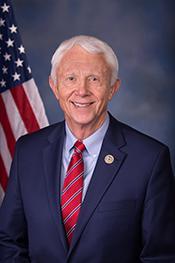
U.S. Representative for Michigan’s 1st district
Republican
119th Congress, two-year term
Missed 2.4% of roll calls. Chamber median 1.9%.
The full voting recordCounts roll calls where most Democrats and most Republicans voted differently, leaving out procedural votes.
How we countFrom FEC filings, Voteview roll calls and Congress.gov.
Republican. In Congress since 2017, 5 terms in total.
Following saves Bergman to your list, which Chamber & Street keeps on its server, linked to a cookie on this browser and not to your name or email. Email alerts will come with constituent verification.
Bills and resolutions Bergman signed on to as a cosponsor. An original cosponsor signed on the day the bill was introduced. Source: govinfo bill status files, last updated Nov 6, 2026.
SAFE STEPS for Veterans Act of 2025
Sponsor Nikki Budzinski (D). Original cosponsor. 12 cosponsors. H.R. 3183 on Congress.gov
Introduced
Supporting Access to Falls Education and prevention and Strengthening Training Efforts and Promoting Safety initiatives for Veterans Act of 2025 or the SAFE STEPS for Veterans Act of 2025
This bill addresses certain mobility and aging care and services provided by the Department of Veterans Affairs (VA).
First, the bill requires the establishment and operation of the Office of Falls Prevention within the Veterans Health Administration (VHA) for purposes of providing, evaluating, and improving VA health care services related to falls prevention.
Among other duties, the office must oversee and support a national education campaign for veterans, their families, and health care providers that focuses on reducing falls and increases awareness of available benefits or services provided by the VA to reduce falls.
The bill also expands membership of the Interagency Coordinating Committee on Healthy Aging and Age-Friendly Communities by including the VA.
The VA must issue or update directives of the VHA for facilities and providers relating to safe patient handling and mobility policies.
Additionally, the VA must determine the feasibility and advisability of implementing a pilot program to provide home improvements and structural alterations to prevent falls for veterans who are eligible for such services under VA laws.
Finally, the bill requires the VA to ensure certain veterans receive a falls risk assessment from a licensed physical therapist or occupational therapist.
Protecting American Families and Servicemembers from Anthrax Act
Sponsor Donald Davis (D). Joined May 5, 2025. 19 cosponsors. H.R. 2707 on Congress.gov(opens in a new tab)
Introduced
REDI Act
Sponsor Brian Babin (R). Joined May 5, 2025. 133 cosponsors. H.R. 2028 on Congress.gov(opens in a new tab)
Introduced
Resident Education Deferred Interest Act or the REDI Act
This bill allows borrowers in medical or dental internships or residency programs to defer student loan payments until the completion of their programs.
SHIPS for America Act of 2025
Sponsor Trent Kelly (R). Original cosponsor. 146 cosponsors. H.R. 3151 on Congress.gov(opens in a new tab)
Introduced
Secure Rural Schools Reauthorization Act of 2025
Joined May 1, 2025. 93 cosponsors. H.R. 1383 on Congress.gov(opens in a new tab)
Progress not on file
Secure Rural Schools Reauthorization Act of 2025
This bill extends and modifies the Secure Rural Schools and Community Self-Determination Act of 2000, including by
• extending payments made to states and counties containing federal land through FY2026,
• providing for payments for FY2024 and FY2025,
• extending the authority of counties to initiate projects using such funds through FY2028, and
• extending the authority to initiate projects proposed by resource advisory committees through FY2028.
Donut Dollies Congressional Gold Medal Act
Joined Apr 30, 2025. 43 cosponsors. H.R. 2081 on Congress.gov(opens in a new tab)
Progress not on file
Canadian Snowbird Act
Sponsor Laurel Lee (R). Original cosponsor. 25 cosponsors. H.R. 3070 on Congress.gov(opens in a new tab)
Introduced
Canadian Snowbird Act
This bill authorizes the Department of Homeland Security to admit into the United States qualifying Canadian citizens as long-term nonimmigrant visitors.
A qualifying Canadian citizen is an individual who (1) is at least 50 years old, (2) maintains a Canadian residence, (3) owns a U.S. residence or has rented a U.S. accommodation for the duration of the individual's stay, (4) is not inadmissible or deportable, (5) will not engage in employment or labor for hire in the United States other than for a non-U.S.-based person or entity by whom the Canadian citizen was employed in Canada or for whom the Canadian citizen performed services in Canada, and (6) will not seek certain forms of assistance or benefits. A qualified individual may be admitted for up to 240 days during any single 365-day period.
The spouse of such an individual may be admitted under the same terms, except that the spouse is not required to separately satisfy the requirement for owning or renting a residence in the United States.
An individual admitted into the United States under this bill shall have nonresident alien tax status.
REPAIR Act
Sponsor Neal Dunn (R). Joined Apr 24, 2025. 44 cosponsors. H.R. 1566 on Congress.gov(opens in a new tab)
Introduced
Recognizing linemen, the profession of linemen, the contributions of these brave men and women who protect public safety, and expressing support for the designation of April 18, 2025, as "National Lineman Appreciation Day".
Sponsor David Rouzer (R). Original cosponsor. 56 cosponsors. H.Res. 337 on Congress.gov(opens in a new tab)
Introduced
To amend the Small Business Act to make disaster loans available for damages caused by prolonged power outages, and for other purposes.
Sponsor Haley Stevens (D). Joined Apr 17, 2025. 7 cosponsors. H.R. 2897 on Congress.gov(opens in a new tab)
Introduced
Smithsonian American Women’s History Museum Act
Sponsor Nicole Malliotakis (R). Joined Apr 17, 2025. 231 cosponsors. H.R. 1329 on Congress.gov(opens in a new tab)
Introduced
Smithsonian American Women’s History Museum Act
This bill authorizes the Smithsonian American Women's History Museum to be located on a particular site within the Reserve of the National Mall in Washington, DC.
Specifically, the bill designates the South Monument site as the location for the museum; however, the President may designate an alternative site within 180 days of the bill's enactment. (The site is the undeveloped land across the National Mall from the National Museum of African American History and Culture.) Administrative jurisdiction of the site must be transferred to the Smithsonian Institution.
The Board of Regents of the Smithsonian Institution must have the approval of specified federal entities (e.g., the Commission of Fine Arts) to plan, design, and construct a museum building. The bill (1) outlines the criteria for considering site and design proposals, and (2) requires the Smithsonian Institution to reimburse for costs resulting from the building approval process.
The bill directs the museum to be dedicated to preserving, researching, and presenting the history, achievements, and lived experiences of biological women in the United States. Under this bill, the museum may not identify, present, describe, or depict any biological male as a female.
In carrying out its duties, the museum's advisory council must (1) seek and utilize guidance from a broad array of knowledgeable and respected sources reflecting the diversity of the political viewpoints and authentic experiences held by women in the United States, and (2) seek guidance for the creation and substantial revision of exhibits and programs.
Homebuyers Privacy Protection Act
Sponsor John Rose (R). Original cosponsor. 89 cosponsors. H.R. 2808 on Congress.gov(opens in a new tab)
Became law
Homebuyers Privacy Protection Act
This act limits the circumstances in which credit reporting agencies may provide consumer credit reports to third parties in connection with residential mortgage transactions.
Specifically, the act prohibits a credit reporting agency from providing a consumer's credit report to a third party in connection with a residential mortgage transaction unless the transaction consists of a firm offer of credit or insurance and (1) the third party provides documentation certifying that it has the consumer's consent; or (2) the third party has originated a mortgage on behalf of the consumer, is a current mortgage loan servicer to the consumer, or has a current specified banking relationship with the consumer.
These provisions take effect 180 days after enactment.
The Government Accountability Office must study and report on the value of trigger leads (a marketing tactic facilitated by credit reporting agencies that may result in unsolicited credit offers to a consumer after a consumer applies for a separate type of credit) received by text message.
Great Lakes Mapping Act of 2025
Sponsor Lisa McClain (R). Original cosponsor. 18 cosponsors. H.R. 2731 on Congress.gov(opens in a new tab)
Introduced
Affordable Housing Credit Improvement Act of 2025
Sponsor Darin LaHood (R). Original cosponsor. 168 cosponsors. H.R. 2725 on Congress.gov(opens in a new tab)
Introduced
Great Lakes Mass Marking Program Act of 2025
Sponsor Debbie Dingell (D). Joined Apr 7, 2025. 6 cosponsors. H.R. 1917 on Congress.gov(opens in a new tab)
Passed the House
Great Lakes Mass Marking Program Act of 2025
This bill provides statutory authority for a program of the U.S. Fish and Wildlife Service (FWS) for the mass marking of hatchery-produced fish in the Great Lakes basin. Mass marking is the practice of tagging large numbers of hatchery-produced fish in order to distinguish them from the wild fish population. The FWS initiated the program in 2010 on a limited scale. Under the existing program, the FWS (1) tags hatchery-produced fish stocked in the Great Lakes, and (2) produces data used by state and tribal fish management agencies to make management decisions regarding Great Lakes fisheries.
This bill allows the FWS, in carrying out the program, to (1) purchase items to support and carry out tagging and tag recovery operations on a greater scale, and (2) hire additional personnel.
The FWS must make the data collected under the program available to applicable federal, state, and tribal fish management agencies to
• increase the understanding of the outcomes of management action;
• assist in meeting the restoration objectives of the Great Lakes;
• assist in balancing predators and prey;
• support and improve the economic status of tribal, recreational, and commercial fisheries; and
• assist in evaluating the effectiveness of habitat restoration efforts in the Great Lakes.
Innovative Therapies Centers of Excellence Act of 2025
Sponsor J. Correa (D). Original cosponsor. 28 cosponsors. H.R. 2623 on Congress.gov(opens in a new tab)
Introduced
RIFLE Act
Sponsor Ashley Hinson (R). Original cosponsor. 33 cosponsors. H.R. 2552 on Congress.gov(opens in a new tab)
Introduced
Establishing the Select Committee to Defeat the Mexican Drug Cartels.
Sponsor Dan Crenshaw (R). Joined Mar 31, 2025. 23 cosponsors. H.Res. 262 on Congress.gov(opens in a new tab)
Introduced
SPEED for BEAD Act
Sponsor Richard Hudson (R). Joined Mar 31, 2025. 22 cosponsors. H.R. 1870 on Congress.gov(opens in a new tab)
Introduced
Streamlining Program Efficiency and Expanding Deployment for BEAD Act or the SPEED for BEAD Act
This bill makes certain changes to the Broadband, Equity, Access, and Deployment (BEAD) Program, including by expanding the broadband technologies that may qualify for funding and prohibiting states from regulating broadband rates in connection with the program.
(The BEAD Program is administered by the National Telecommunications and Information Administration (NTIA) and provides funding to eligible entities for broadband deployment, connectivity, mapping, and adoption projects. Eligible entities include U.S. states, territories, and the District of Columbia.)
Specifically, the bill establishes that projects using any broadband technology (e.g., satellite, fixed wireless, or fiber) may qualify for funding, provided the technology meets specified performance criteria. (Original BEAD rules established a preference for fiber projects.)
The bill also explicitly prohibits eligible entities from regulating, setting, or otherwise mandating pursuant to the BEAD Program (1) rates charged for broadband service, or (2) methodologies used to calculate such rates. The prohibition includes rate regulation carried out in conjunction with the existing requirement that subgrantees offer at least one low-cost broadband service option to certain subscribers.
Further, the bill prohibits the NTIA and eligible entities from establishing or enforcing conditions, preferences, or other requirements related to collective bargaining and labor agreements; climate change; diversity, equity, and inclusion; and other topics. The bill also modifies the purposes for which the funds may be used and the treatment of unused funds.
Finally, the bill replaces the term Equity in the program’s name with Expansion.
SHORT Act
Sponsor Andrew Clyde (R). Original cosponsor. 76 cosponsors. H.R. 2395 on Congress.gov(opens in a new tab)
Introduced
ACRE Act of 2025
Sponsor Randy Feenstra (R). Joined Mar 27, 2025. 63 cosponsors. H.R. 1822 on Congress.gov(opens in a new tab)
Introduced
Safer Skies Act of 2025
Sponsor Nicholas Langworthy (R). Original cosponsor. 52 cosponsors. H.R. 2353 on Congress.gov(opens in a new tab)
Introduced
Safer Skies Act of 2025
This bill directs the Transportation Security Administration (TSA) to require that certain small public charter air carrier operations comply with the Aircraft Operator Standard Security Program (AOSSP).
As background, the TSA has different types of security programs based on the nature of the air carrier’s operations. Currently, the AOSSP requirements apply to all scheduled passenger service with a seating capacity of 61 or more seats that operate into or out of a TSA-controlled sterile area.
The TSA also has other security programs that have less stringent security requirements than the AOSSP. These programs are designed for different types of aircraft operators, including operations under Part 135 (e.g., scheduled commuter flights in smaller aircraft) and Part 380 (e.g., public charter flights) of the Department of Transportation’s regulations.
This bill applies the AOSSP requirements to air carriers operating under Part 135 and Part 380 that (1) operate scheduled public charter service, (2) operate airplanes configured with 10 or more passenger seats, and (3) do not enplane or deplane in a TSA-managed checkpoint.
To amend title 14, United States Code, to require the retention of certain enlisted members of the Coast Guard who have completed 18 or more, but less than 20, years of service, and for other purposes.
Sponsor Jennifer Kiggans (R). Joined Mar 26, 2025. 20 cosponsors. H.R. 2200 on Congress.gov(opens in a new tab)
Introduced
Unity through Service Act of 2025
Sponsor Chrissy Houlahan (D). Original cosponsor. 10 cosponsors. H.R. 2324 on Congress.gov(opens in a new tab)
Introduced
Sarah Debbink Langenkamp Active Transportation Safety Act
Sponsor Jamie Raskin (D). Joined Mar 24, 2025. 17 cosponsors. H.R. 2011 on Congress.gov(opens in a new tab)
Introduced
Sarah Debbink Langenkamp Active Transportation Safety Act
This bill expands the Highway Safety Improvement Program (HSIP) to include additional bicyclist and pedestrian safety measures and increases the federal cost share for certain safety projects.
Specifically, the bill allows HSIP to fund projects (1) for the connection of two or more segments of existing bicyclist or pedestrian infrastructure, or (2) that are based on a state's plan to improve the safety of vulnerable road users (e.g., bicyclists or pedestrians) in areas identified as high-risk. In addition, the bill allows an increased federal cost share of up to 100% for these projects.
The bill also allows an increased federal cost share of up to 100% for transportation projects that meet certain criteria, including (1) the project includes a Federal Highway Administration Proven Safety Countermeasure for bicyclists or pedestrians (e.g., bicycle lanes, walkways, and crosswalk visibility enhancements), or (2) the relevant state strategic highway safety plan includes an emphasis area that is related to vulnerable road users.