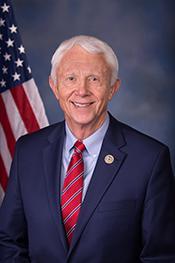
U.S. Representative for Michigan’s 1st district
Republican
119th Congress, two-year term
Missed 2.4% of roll calls. Chamber median 1.9%.
The full voting recordCounts roll calls where most Democrats and most Republicans voted differently, leaving out procedural votes.
How we countFrom FEC filings, Voteview roll calls and Congress.gov.
Republican. In Congress since 2017, 5 terms in total.
Following saves Bergman to your list, which Chamber & Street keeps on its server, linked to a cookie on this browser and not to your name or email. Email alerts will come with constituent verification.
Bills and resolutions Bergman signed on to as a cosponsor. An original cosponsor signed on the day the bill was introduced. Source: govinfo bill status files, last updated Nov 6, 2026.
Providing Veterans Essential Medications Act
Sponsor Mariannette Miller-Meeks (R). Joined Mar 24, 2025. 53 cosponsors. H.R. 1970 on Congress.gov
Introduced
No Wrong Door for Veterans Act
Sponsor Mariannette Miller-Meeks (R). Joined Mar 24, 2025. 1 cosponsor. H.R. 1969 on Congress.gov(opens in a new tab)
Passed the House
No Wrong Door for Veterans Act
This bill reauthorizes through FY2028 and modifies the Staff Sergeant Parker Gordon Fox Suicide Prevention Grant Program of the Department of Veterans Affairs (VA), which awards grants to eligible entities to provide or coordinate suicide prevention services for veterans and members of the Armed Forces and their families.
Among other elements, the bill
• adjusts the maximum amount for grants awarded under the program and provides for additional funding per individual who receives suicide prevention services provided or coordinated by a grantee;
• requires the VA to provide briefings about the grant program at least once a year to certain personnel at each VA medical center located within 100 miles from the primary location of a grantee;
• requires baseline mental health screenings for risk provided as suicide prevention services under the program to use a protocol selected by the VA; and
• modifies eligibility requirements for entities seeking grants, including by authorizing applications from health care providers.
In subsequent applications, grantees who have previously received funds under the program must include evidence that previously awarded funds served a significant number of veterans.
The bill requires grantees to notify (1) eligible individuals that they may receive emergent suicide care furnished or paid for by the VA, and (2) the VA if eligible individuals request emergent suicide care.
UPRISERS Act
Sponsor August Pfluger (R). Original cosponsor. 9 cosponsors. H.R. 2273 on Congress.gov(opens in a new tab)
Introduced
Expressing the sense of the House of Representatives that Congress should take all appropriate measures to ensure that the United States Postal Service remains an independent establishment of the Federal Government and is not subject to privatization.
Sponsor Stephen Lynch (D). Joined Mar 18, 2025. 238 cosponsors. H.Res. 70 on Congress.gov(opens in a new tab)
Introduced
This resolution expresses the sense of the House of Representatives that Congress should ensure that the U.S. Postal Service is not privatized and remains an independent establishment of the federal government.
SLOT Act of 2025
Sponsor Dina Titus (D). Original cosponsor. 11 cosponsors. H.R. 2233 on Congress.gov(opens in a new tab)
Introduced
Early Action and Responsiveness Lifts Youth Minds Act
Sponsor August Pfluger (R). Joined Mar 18, 2025. 32 cosponsors. H.R. 1735 on Congress.gov(opens in a new tab)
Introduced
Commemorating the centennial of Delta Air Lines.
Sponsor Nikema Williams (D). Original cosponsor. 22 cosponsors. H.Res. 226 on Congress.gov(opens in a new tab)
Introduced
This resolution commemorates the centennial of Delta Air Lines.
Honoring the 108th anniversary of Selfridge Air National Guard Base and the contributions of Selfridge Air National Guard Base to the military and national security of the United States.
Sponsor John James (R). Original cosponsor. 11 cosponsors. H.Res. 223 on Congress.gov(opens in a new tab)
Introduced
This resolution honors Selfridge Air National Guard Base in Harrison Township, Michigan, on its 108th anniversary, commends the thousands of men and women who have worked and trained at the base, and reinforces the commitment of the Armed Forces to the base as a facility that is key to national security. The resolution also encourages continued cooperation and dialogue with the Department of Defense in support of the base and acknowledges Michigan's ongoing investments in its defense assets and workforce.
Protect Postal Performance Act
Sponsor Nikki Budzinski (D). Original cosponsor. 31 cosponsors. H.R. 2103 on Congress.gov(opens in a new tab)
Introduced
Aviation Workforce Development Act
Sponsor Mike Collins (R). Joined Mar 14, 2025. 27 cosponsors. H.R. 1818 on Congress.gov(opens in a new tab)
Introduced
To amend the Internal Revenue Code of 1986 to modify the railroad track maintenance credit.
Sponsor Mike Kelly (R). Joined Mar 10, 2025. 183 cosponsors. H.R. 516 on Congress.gov(opens in a new tab)
Introduced
This bill increases the annual limit on the tax credit for qualified railroad track maintenance expenses (also referred to as the short line railroad tax credit) and expands eligibility for claiming the credit.
Under current law, the tax credit is limited each tax year to $3,500 multiplied by the sum of the number of miles of railroad track owned or leased by the taxpayer (miles owned or leased) and the number of railroad track miles assigned to the taxpayer by a Class II or III railroad (miles assigned). This bill increases the annual limit to $6,100 multiplied by the sum of miles owned or leased and miles assigned. The $6,100 amount used in the calculation of the tax credit limit is adjusted for inflation for tax years beginning after 2025.
The bill also expands eligibility for the tax credit to include gross expenses for maintaining railroad tracks owned or leased as of January 1, 2024. Under current law, the tax credit is limited to gross expenses for maintaining railroad tracks owned or leased as of January 1, 2015.
States’ Education Reclamation Act of 2025
Sponsor David Rouzer (R). Joined Mar 10, 2025. 12 cosponsors. H.R. 369 on Congress.gov(opens in a new tab)
Introduced
States' Education Reclamation Act of 2025
This bill abolishes the Department of Education (ED) and repeals any program for which it has administrative responsibility.
The Department of the Treasury must provide grants to states, for FY2025-FY2033, for elementary, secondary, and postsecondary education purposes permitted by state law. The level of funding is set at the amount provided to states for federal elementary and secondary education programs and the amount provided for federal postsecondary education programs, respectively, for FY2025, minus the funding provided for education programs that the bill transfers to other federal agencies.
States must contract for an annual audit of their expenditures or transfers of grant funds.
Program administrative responsibility and delegation of authority are transferred as follows:
• ED's job training programs to the Department of Labor,
• each special education grant program under the Individuals with Disabilities Education Act to the Department of Health and Human Services (HHS),
• ED's Indian education programs to the Department of the Interior,
• each Impact Aid program under the Elementary and Secondary Education Act of 1965 to the Department of Defense,
• the Federal Pell Grant program and each federal student loan program to Treasury, and
• programs under the jurisdiction of the Institute of Education Sciences or the D.C. Opportunity Scholarship Program to HHS.
The Government Accountability Office must report to Congress on (1) the feasibility of reducing the federal tax burden and eliminating federal involvement in providing grants for education programs, and (2) the feasibility of successor federal agencies maintaining transferred education programs.
Pay Our Troops Act of 2025
Sponsor Jennifer Kiggans (R). Joined Mar 10, 2025. 34 cosponsors. H.R. 1932 on Congress.gov(opens in a new tab)
Introduced
Pay Our Troops Act of 2025
This bill provides continuing appropriations for military pay for any period during which interim or full-year appropriations for FY2025 are not in effect (i.e., a government shutdown).
Specifically, the bill provides FY2025 continuing appropriations for the pay and allowances of (1) members of the Armed Forces, including reserve components, who perform active service during the period; and (2) civilian personnel and contractors of the Department of Defense (and the Department of Homeland Security in the case of the Coast Guard) who are providing support to such members of the Armed Forces.
If a government shutdown occurs, the bill provides the continuing appropriations until the earlier of (1) the enactment into law of specified appropriations legislation, or (2) January 1, 2026.
Wildland Firefighter Paycheck Protection Act of 2025
Sponsor Joe Neguse (D). Original cosponsor. 15 cosponsors. H.R. 1943 on Congress.gov(opens in a new tab)
Introduced
Anti-CBDC Surveillance State Act
Sponsor Tom Emmer (R). Original cosponsor. 135 cosponsors. H.R. 1919 on Congress.gov(opens in a new tab)
Passed the House
Anti-CBDC Surveillance State Act
This bill prohibits a Federal Reserve bank from offering products or services directly to an individual, maintaining an account on behalf of an individual, or issuing a central bank digital currency (i.e., a digital dollar). Further, the Board of Governors of the Federal Reserve System is prohibited from using a central bank digital currency to implement monetary policy or from testing, studying, creating, or implementing a central bank digital currency, with exceptions as provided by the bill.
Expressing support for the designation of March 6, 2025, as "Great Lakes Day".
Sponsor John James (R). Original cosponsor. 11 cosponsors. H.Res. 194 on Congress.gov(opens in a new tab)
Introduced
Regulation Decimation Act
Sponsor David Taylor (R). Joined Mar 5, 2025. 12 cosponsors. H.R. 710 on Congress.gov(opens in a new tab)
Introduced
Regulation Decimation Act
This bill requires federal agencies to repeal certain existing rules prior to issuing a new rule.
Specifically, the bill prohibits an agency from issuing a rule that imposes a cost or responsibility on a nongovernmental person or a state or local government unless it repeals ten or more related rules.
Additionally, an agency may not issue a major rule that imposes such a cost or responsibility unless (1) the agency has repealed ten or more related rules, and (2) the cost of the new rule is less than or equal to the cost of the rules being repealed. A major rule is a rule that has resulted in or is likely to result in (1) an annual economic effect of at least $100 million; (2) a major increase in costs or prices for consumers, individual industries, government agencies, or geographic regions; or (3) significant adverse effects on competition, employment, investment, productivity, or innovation.
Any such repealed rule must be published in the Federal Register.
This bill does not apply to a rule or major rule that (1) relates to an internal agency policy or practice, (2) relates to procurement, or (3) is being revised to be less burdensome to decrease requirements imposed or compliance costs.
Additionally, each federal agency must submit to Congress and the Office of Management and Budget a report that includes a review of each rule of the agency and that identifies whether each rule is costly, ineffective, duplicative, or outdated.
Fighter Force Preservation and Recapitalization Act of 2025
Sponsor Don Bacon (R). Original cosponsor. 40 cosponsors. H.R. 1851 on Congress.gov(opens in a new tab)
Introduced
Crime Victims Fund Stabilization Act of 2025
Sponsor Ann Wagner (R). Joined Mar 4, 2025. 327 cosponsors. H.R. 909 on Congress.gov(opens in a new tab)
Passed the House
Crime Victims Fund Stabilization Act of 2025
This bill adds a new source of revenue for the Crime Victims Fund (CVF). Specifically, the bill requires certain civil monetary penalties collected from settlements and judgments in cases involving fraud and false claims against the federal government to be deposited into the CVF through FY2029.
The CVF supports federal, state, and local programs and activities to compensate and assist victims of crimes. Currently, the CVF is funded by deposits from a variety of sources, including federal criminal fines, penalties, and assessments; forfeited bail bonds; and certain other gifts, donations, and bequests.
Improper Payments Transparency Act
Sponsor Rudy Yakym (R). Original cosponsor. 7 cosponsors. H.R. 1771 on Congress.gov(opens in a new tab)
Introduced
Improper Payments Transparency Act
This bill requires the President's annual budget to include specified information regarding improper payment amounts and rates for programs and activities at certain federal agencies. (An improper payment is any payment that should not have been made or that was made in an incorrect amount, including an overpayment or underpayment, under a statutory, contractual, administrative, or other legally applicable requirement.)
Specifically, the President's budget must include (1) a narrative description, including a detailed explanation of why any improper payment amounts and rates occurred and related trends for programs and activities; and (2) corrective actions and steps the agencies will take to address improper payment amount and rate issues.
Expressing the sense of the House of Representatives that the goal of education in schools across America shall be that virtually every student in the United States achieves grade-level reading proficiency, providing them with the foundation to develop the skills and knowledge needed for success in school, work, and life.
Sponsor Bill Huizenga (R). Joined Feb 26, 2025. 9 cosponsors. H.Res. 163 on Congress.gov(opens in a new tab)
Introduced
This resolution recognizes the goal of education in U.S. schools as that of ensuring that virtually every student achieves grade-level reading proficiency. It also encourages state and local governments, including educational agencies, to collaborate with private organizations that offer proven literacy programs to (1) identify and implement effective solutions to address illiteracy, and (2) create adult literacy initiatives for adults with reading skills below an 8th grade level.
Supporting Farm Operations Act of 2025
Sponsor John Moolenaar (R). Original cosponsor. 14 cosponsors. H.R. 1624 on Congress.gov(opens in a new tab)
Introduced
Enhancing Energy Recovery Act
Sponsor Kevin Hern (R). Joined Feb 26, 2025. 3 cosponsors. H.R. 1003 on Congress.gov(opens in a new tab)
Introduced
Military and Educational Data Integration Act
Sponsor Susie Lee (D). Original cosponsor. 13 cosponsors. H.R. 1573 on Congress.gov(opens in a new tab)
Introduced
Fair Access to Banking Act
Sponsor Andy Barr (R). Joined Feb 24, 2025. 151 cosponsors. H.R. 987 on Congress.gov(opens in a new tab)
Introduced
Fair Access to Banking Act
This bill places restrictions on certain banks, credit unions, and payment card networks if they refuse to do business with a person who complies with the law. Restrictions include prohibiting the use of electronic funds transfer systems and lending programs, termination of an institution's depository insurance, and specified civil penalties.
Banks and other specified financial institutions are allowed to deny financial services to a person only if the denial is justified by a documented failure of that person to meet quantitative, impartial, risk-based standards established in advance by the institution. This justification may not be based upon reputational risks to the institution.
The bill establishes the right for a person to bring a civil action for a violation of this bill.