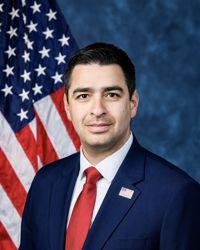
U.S. Representative for Colorado’s 8th district
Republican
119th Congress, two-year term
Missed 0.0% of roll calls. Chamber median 1.9%.
The full voting recordCounts roll calls where most Democrats and most Republicans voted differently, leaving out procedural votes.
How we countFrom FEC filings, Voteview roll calls and Congress.gov.
Republican. In Congress since 2025, 1 term in total.
Following saves Evans to your list, which Chamber & Street keeps on its server, linked to a cookie on this browser and not to your name or email. Email alerts will come with constituent verification.
Bills and resolutions Evans signed on to as a cosponsor. An original cosponsor signed on the day the bill was introduced. Source: govinfo bill status files, last updated Nov 6, 2026.
Sanctioning Russia Act of 2025
Sponsor Brian Fitzpatrick (R). Joined Apr 9, 2025. 155 cosponsors. H.R. 2548 on Congress.gov
Introduced
Sanctioning Russia Act of 2025
This bill imposes penalties on certain persons (individuals and entities) if the President determines that the Russian government or a person acting at Russia's direction is involved with (1) refusing to negotiate a peace agreement with Ukraine; (2) violating a negotiated peace agreement; (3) initiating another invasion of Ukraine; or (4) overthrowing, dismantling, or seeking to subvert the Ukrainian government.
If the President makes such a determination, the bill requires certain actions including
• the President must impose visa- and property-blocking sanctions on specified persons such as the Russian president, certain Russian military commanders, and any foreign person that knowingly provides defense items to the Russian armed forces;
• the President must increase the rate of duty on all goods and services imported from Russia into the United States to at least 500% relative to the value of such goods and services;
• the President must increase the rate of duty on all goods and services imported into the United States from countries that knowingly engage in the exchange of Russian-origin uranium and petroleum products to at least 500% relative to the value of such goods and services;
• the Department of the Treasury must impose property-blocking sanctions on any financial institution organized under Russian law and owned wholly or partly by Russia, and any financial institution that engages in transactions with those entities; and
• the Department of Commerce must prohibit the export, reexport, or in-country transfer to or in Russia of any U.S.-produced energy or energy product.
To transfer the functions, duties, responsibilities, assets, liabilities, orders, determinations, rules, regulations, permits, grants, loans, contracts, agreements, certificates, licenses, and privileges of the United States Agency for International Development relating to implementing and administering the Food for Peace Act to the Department of Agriculture.
Sponsor Tracey Mann (R). Joined Apr 9, 2025. 44 cosponsors. H.R. 1207 on Congress.gov(opens in a new tab)
Introduced
Medicare Patient Access and Practice Stabilization Act of 2025
Sponsor Gregory Murphy (R). Joined Apr 8, 2025. 198 cosponsors. H.R. 879 on Congress.gov(opens in a new tab)
Introduced
Medicare Patient Access and Practice Stabilization Act of 2025
This bill increases certain payment adjustments under the Medicare physician fee schedule for services furnished between April 1, 2025, and January 1, 2026.
Affordable Housing Credit Improvement Act of 2025
Sponsor Darin LaHood (R). Original cosponsor. 168 cosponsors. H.R. 2725 on Congress.gov(opens in a new tab)
Introduced
To amend title XI of the Social Security Act to equalize the negotiation period between small-molecule and biologic candidates under the Drug Price Negotiation Program.
Sponsor Gregory Murphy (R). Joined Apr 8, 2025. 68 cosponsors. H.R. 1492 on Congress.gov(opens in a new tab)
Introduced
This bill lengthens the amount of time for which drug products must have market approval in order for the products to qualify for negotiation under the Medicare Drug Price Negotiation Program.
The Medicare Drug Price Negotiation Program requires the Centers for Medicare & Medicaid Services to negotiate the prices of certain prescription drugs under Medicare beginning in 2026. Among other requirements, drugs must have had market approval for at least 7 years (for drug products) or 11 years (for biologics) to qualify for negotiation.
The bill modifies these provisions so as to require drug products to also have had at least 11 years of market approval in order to qualify for negotiation.
The bill's changes apply retroactively.
CBO Scoring Accountability Act
Sponsor Andy Barr (R). Original cosponsor. 22 cosponsors. H.R. 2666 on Congress.gov(opens in a new tab)
Introduced
CBO Scoring Accountability Act
This bill requires the Congressional Budget Office (CBO) to provide additional cost estimates and reports regarding major legislation that has been enacted into law.
Under the bill, major legislation is any bill or joint resolution that would be projected to result in outlays of mandatory spending or receipts of federal revenue equal to or greater than 0.25% of the current projected gross domestic product of the United States for that year.
For the first 10 years after major legislation has been enacted into law, the bill requires CBO to annually prepare and make publicly available an analysis of the results of carrying out the provisions of the legislation. The analysis must include
• an estimate of the costs and the change in federal revenue as a result of the legislation,
• a comparison of the current and previous estimates of the costs and change in revenue, and
• any applicable updates to the estimates.
The bill also requires CBO to submit reports to Congress that explain any discrepancy between the actual and estimated costs and change in revenue that is greater than or equal to 10%.
Military Installation Retail Security Act of 2025
Sponsor Pat Harrigan (R). Joined Apr 7, 2025. 22 cosponsors. H.R. 2551 on Congress.gov(opens in a new tab)
Introduced
Physician Led and Rural Access to Quality Care Act
Sponsor H. Griffith (R). Joined Apr 7, 2025. 34 cosponsors. H.R. 2191 on Congress.gov(opens in a new tab)
Introduced
Physician Led and Rural Access to Quality Care Act
This bill expands flexibilities for physicians and physician-owned hospitals under the Stark law (i.e., the Physician Self-Referral Law).
The Stark law generally prohibits physicians from referring patients to receive services that are payable under Medicare or Medicaid from entities in which the physician or an immediate family member has a financial relationship. The bill allows physicians or their immediate family members to have financial interests in rural hospitals that are located more than 35 miles (or 15 miles in certain mountainous areas or areas with only secondary roads) from a hospital or critical access hospital.
The Stark law also generally prohibits physician-owned hospitals from expanding the number of operating rooms, procedure rooms, or beds beyond the number in existence as of March 23, 2010, in order to be excepted under the Stark law. The bill removes this restriction.
Iranian Terror Prevention Act
Sponsor W. Steube (R). Original cosponsor. 35 cosponsors. H.R. 2581 on Congress.gov(opens in a new tab)
Introduced
Trucker Bathroom Access Act
Sponsor Troy Nehls (R). Joined Apr 1, 2025. 18 cosponsors. H.R. 2514 on Congress.gov(opens in a new tab)
Introduced
Trucker Bathroom Access Act
This bill expands access to restroom facilities for certain commercial truck drivers, including drayage truck operators.
Drayage truck operator means the driver of any in-use on-road vehicle with a gross vehicle weight rating of greater than 33,000 pounds operating on or transgressing through port or intermodal rail yard property for the purpose of loading, unloading, or transporting cargo, including containerized, bulk, or break-bulk goods.
Specifically, the bill requires certain retailers, warehouses, and other establishments to give commercial truck drivers access to existing restroom facilities when they are loading or delivering cargo, or waiting to load or transport cargo.
Further, operators of marine terminals, including port authorities, must provide drayage truck operators with (1) access to existing restrooms, (2) additional restrooms if necessary, and (3) parking while accessing such restrooms.
Improving Law Enforcement Officer Safety and Wellness Through Data Act
Sponsor Tim Moore (R). Joined Apr 1, 2025. 22 cosponsors. H.R. 2240 on Congress.gov(opens in a new tab)
Passed the House
Improving Law Enforcement Officer Safety and Wellness Through Data Act of 2025
This bill requires the Department of Justice to report on (1) targeted attacks on law enforcement officers, (2) the feasibility of incorporating such attacks into existing crime reporting systems, and (3) the mental health resources that are available to law enforcement officers.
Enhanced Iran Sanctions Act of 2025
Sponsor Michael Lawler (R). Joined Apr 1, 2025. 295 cosponsors. H.R. 1422 on Congress.gov(opens in a new tab)
Passed the House
Enhanced Iran Sanctions Act of 2025
This bill imposes sanctions on certain foreign persons (individuals and entities) that are involved in Iran's petroleum sector as well as certain associated persons. The bill also requires or authorizes actions to facilitate the enforcement of sanctions on Iran.
Specifically, the bill requires the President to impose visa- and property-blocking sanctions on any foreign person that, after the bill's enactment, knowingly engages in any transaction related to the processing, export, or sale of oil, condensates, gas, liquefied natural gas, or other petrochemical products in whole or in part from Iran. The President must also impose sanctions on certain foreign persons associated with a sanctioned individual or entity. For example, the President must sanction the subsidiaries and corporate officers of a sanctioned business.
The bill provides certain exceptions to these sanctions, including specifying that sanctions do not apply to the importation of goods or to conducting or facilitating transactions for humanitarian assistance.
The Department of State must establish an interagency working group that shall seek to establish a multilateral contact group to coordinate international efforts to enforce sanctions on Iran.
The bill expands the State Department rewards program to authorize a reward payment to any individual who furnishes information leading to the identification of a person (1) subject to sanctions under this bill, or (2) that has attempted or is attempting to evade sanctions under this bill.
United States-Israel Defense Partnership Act of 2025
Sponsor Joe Wilson (R). Joined Apr 1, 2025. 178 cosponsors. H.R. 1229 on Congress.gov(opens in a new tab)
Introduced
United States-Israel Defense Partnership Act of 2025
This bill requires or authorizes certain actions to increase defense-related cooperation between the United States and Israel.
Specifically, the bill requires the Department of Defense (DOD) to
• establish a cooperative program, with the concurrence of Israel's Ministry of Defense (MOD), to develop and deploy advanced technologies for countering unmanned systems that threaten the United States and Israel;
• establish in Israel an office of the Defense Innovation Unit (an organization that focuses on rapidly fielding and scaling commercial technology across the U.S. military); and
• seek to engage Israel's MOD on the ascension of Israel into the national technology and industrial base (currently defined in law as the persons and organizations engaged in research, development, production, integration, services, or information technology activities conducted within the United States, the United Kingdom, Australia, New Zealand, and Canada).
The bill authorizes DOD, upon request of Israel's MOD, to jointly conduct research, development, test, and evaluation (RDT&E) of emerging technologies such as artificial intelligence and robotics to meet defense challenges.
Additionally, the bill extends the authority for DOD to (1) carry out RDT&E on a joint basis with Israel to establish anti-tunnel and counter unmanned aerial systems capabilities through 2028, and (2) transfer defense articles intended for use as reserve stocks for Israel through January 1, 2029.
Protecting Privacy in Purchases Act
Sponsor Riley Moore (R). Joined Apr 1, 2025. 132 cosponsors. H.R. 1181 on Congress.gov(opens in a new tab)
Passed the House
Protecting Privacy in Purchases Act
This bill prohibits payment card networks from using merchant codes that distinguish firearms retailers from general-merchandise retailers or sporting-goods retailers.
The Department of Justice must enforce this bill and report annually on the resulting investigations and cases.
Hot Foods Act of 2025
Sponsor Grace Meng (D). Original cosponsor. 120 cosponsors. H.R. 2512 on Congress.gov(opens in a new tab)
Introduced
Hot Foods Act of 2025
This bill expands the Supplemental Nutrition Assistance Program (SNAP) to permit the use of SNAP benefits to purchase hot foods or hot food products ready for immediate consumption.
Dairy Nutrition Incentive Program Act of 2025
Sponsor Jim Costa (D). Original cosponsor. 23 cosponsors. H.R. 2496 on Congress.gov(opens in a new tab)
Introduced
Dairy Nutrition Incentive Program Act of 2025
This bill directs the Department of Agriculture (USDA) to establish a dairy nutrition incentive program to develop and test methods to increase the purchase and consumption of dairy under the Supplemental Nutrition Assistance Program (SNAP).
Specifically, the program must provide an incentive to SNAP benefit recipients for the purchase of naturally nutrient-rich dairy, which the bill defines to include fluid milk, yogurt, and cheese made from cow's milk. To carry out the program, USDA must enter into cooperative agreements with, or provide competitive grants to, state or local governments and nonprofit organizations for projects. The bill provides funding for the program for each fiscal year.
USDA must provide for an independent evaluation of each project that measures, to the maximum extent practicable, the effect of incentives on purchases of naturally nutrient-rich dairy by SNAP recipients.
Projects currently carried out by the USDA Healthy Fluid Milk Incentives (HFMI) program must be transitioned to the new dairy nutrition incentive program; the bill repeals the HFMI program one year after USDA certifies that the transition is complete.
Love Lives On Act of 2025
Sponsor Richard Hudson (R). Joined Mar 31, 2025. 183 cosponsors. H.R. 1004 on Congress.gov(opens in a new tab)
Introduced
Love Lives On Act of 2025
This bill extends entitlement for various benefit programs and services for surviving spouses of deceased members of the Armed Forces or veterans.
The bill provides that the remarriage of a surviving spouse must not bar the furnishing of dependency and indemnity compensation or special pension benefits to such spouse.
Additionally, the Department of Defense may not terminate the payment of an annuity for a surviving spouse under the Survivor Benefit Plan solely because the surviving spouse remarries.
The bill also expands the definition of a dependent under TRICARE to include a remarried widow or widower whose subsequent marriage has ended due to death, divorce, or annulment.
Expressing the sense of the House of Representatives regarding United Nations General Assembly Resolution 2758 (XXVI) and the harmful conflation of China's "One China Principle" and the United States "One China Policy".
Sponsor Young Kim (R). Joined Mar 26, 2025. 29 cosponsors. H.Res. 148 on Congress.gov(opens in a new tab)
Introduced
Recognizing the importance of stepped-up basis under section 1014 of the Internal Revenue Code of 1986 in preserving family-owned farms and small businesses.
Sponsor Tracey Mann (R). Joined Mar 25, 2025. 29 cosponsors. H.Res. 206 on Congress.gov(opens in a new tab)
Introduced
This resolution supports preserving the stepped-up basis of certain inherited assets (such as land, equipment, or buildings), opposes any efforts to impose new taxes on family farms or small businesses, and recognizes the importance of generational transfers of farm and family-owned businesses.
As background, the basis for federal tax purposes of certain inherited assets is reset (or stepped up) from the original cost basis to the fair market value of the asset on the date of the previous owner’s death. Thus, any gain or loss on the subsequent sale of an inherited asset generally is calculated based on the asset’s stepped-up basis (and not the original cost basis).
Expressing support for the Iranian people's desires for a democratic, secular, and nonnuclear Republic of Iran, and condemning the Iranian regime's terrorism, regional proxy war, internal suppression, and for other purposes.
Sponsor Tom McClintock (R). Joined Mar 25, 2025. 230 cosponsors. H.Res. 166 on Congress.gov(opens in a new tab)
Introduced
Medicare and Medicaid Fraud Prevention Act
Sponsor Scott Peters (D). Original cosponsor. 7 cosponsors. H.R. 2309 on Congress.gov(opens in a new tab)
Introduced
Medicare and Medicaid Fraud Prevention Act
This bill provides statutory authority for the requirement that state Medicaid programs check, as part of the provider enrollment and reenrollment process, whether providers are deceased through the Social Security Administration's Death Master File. The bill requires states to continue to check this database on at least a quarterly basis after providers are enrolled.
National Strategy for School Security Act of 2025
Original cosponsor. 9 cosponsors. H.R. 2259 on Congress.gov(opens in a new tab)
Progress not on file
National Strategy for School Security Act of 2025
This bill requires the Department of Homeland Security (DHS) to develop a national strategy to secure elementary and secondary schools from acts of terrorism. DHS must submit this strategy to Congress, annually update the strategy (if appropriate) through 2033, and provide annual briefings to Congress on those updates.
DHS Intelligence Rotational Assignment Program and Law Enforcement Support Act
Sponsor Ryan Mackenzie (R). Joined Mar 21, 2025. 3 cosponsors. H.R. 2212 on Congress.gov(opens in a new tab)
Passed the House
DHS Intelligence Rotational Assignment Program and Law Enforcement Support Act
This bill requires all components of the Department of Homeland Security (DHS) Intelligence Enterprise to participate in the Office of the Director of National Intelligence (ODNI) Intelligence Community (IC) Civilian Joint Duty Program.
The DHS Intelligence Enterprise is the primary mechanism to integrate DHS's intelligence programs. It is composed of the DHS Office of Intelligence and Analysis and the intelligence components of nine other DHS organizations, such as the Transportation Security Administration, the Coast Guard, and U.S. Customs and Border Protection. The IC Civilian Joint Duty Program offers federal civilian intelligence professionals the opportunity to broaden their experience by serving at a different IC element or relevant organization, or in certain positions within the individual's own IC element, for up to three years.
Expressing support for the designation of March 18, 2025, as "National Agriculture Day" and celebrating the importance of agriculture as one of the most impactful industries in the United States.
Sponsor Mark Alford (R). Original cosponsor. 44 cosponsors. H.Res. 227 on Congress.gov(opens in a new tab)
Introduced
This resolution supports the designation of National Agriculture Day.
Innovative FEED Act of 2025
Sponsor Nicholas Langworthy (R). Original cosponsor. 53 cosponsors. H.R. 2203 on Congress.gov(opens in a new tab)
Introduced
Innovative Feed Enhancement and Economic Development Act of 2025 or the Innovative FEED Act of 2025
This bill provides for the regulation of zootechnical animal food substances as food additives.
The bill defines zootechnical animal food substance as a substance that is added to the food or drinking water of animals and that affects only the animal's gastrointestinal tract, with the intended purpose of affecting the byproducts of the animal's digestion, reducing foodborne pathogens, or altering the animal's gastrointestinal biome.
The definition does not include substances that are used to treat or prevent diseases in animals, hormones, or active ingredients of animal drugs. Labels for zootechnical animal food substances must include a disclaimer that the substance may not be used to treat or prevent diseases in animals.