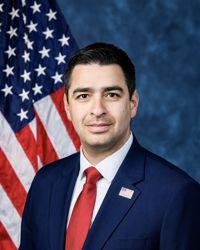
U.S. Representative for Colorado’s 8th district
Republican
119th Congress, two-year term
Missed 0.0% of roll calls. Chamber median 1.9%.
The full voting recordCounts roll calls where most Democrats and most Republicans voted differently, leaving out procedural votes.
How we countFrom FEC filings, Voteview roll calls and Congress.gov.
Republican. In Congress since 2025, 1 term in total.
Following saves Evans to your list, which Chamber & Street keeps on its server, linked to a cookie on this browser and not to your name or email. Email alerts will come with constituent verification.
Bills and resolutions Evans signed on to as a cosponsor. An original cosponsor signed on the day the bill was introduced. Source: govinfo bill status files, last updated Nov 6, 2026.
Water Infrastructure Resilience and Sustainability Act
Sponsor Salud Carbajal (D). Joined Nov 4, 2025. 10 cosponsors. H.R. 5566 on Congress.gov
Introduced
Safer Skies Act of 2025
Sponsor Nicholas Langworthy (R). Joined Nov 4, 2025. 52 cosponsors. H.R. 2353 on Congress.gov(opens in a new tab)
Introduced
Safer Skies Act of 2025
This bill directs the Transportation Security Administration (TSA) to require that certain small public charter air carrier operations comply with the Aircraft Operator Standard Security Program (AOSSP).
As background, the TSA has different types of security programs based on the nature of the air carrier’s operations. Currently, the AOSSP requirements apply to all scheduled passenger service with a seating capacity of 61 or more seats that operate into or out of a TSA-controlled sterile area.
The TSA also has other security programs that have less stringent security requirements than the AOSSP. These programs are designed for different types of aircraft operators, including operations under Part 135 (e.g., scheduled commuter flights in smaller aircraft) and Part 380 (e.g., public charter flights) of the Department of Transportation’s regulations.
This bill applies the AOSSP requirements to air carriers operating under Part 135 and Part 380 that (1) operate scheduled public charter service, (2) operate airplanes configured with 10 or more passenger seats, and (3) do not enplane or deplane in a TSA-managed checkpoint.
Guard and Reserve GI Bill Parity Act of 2025
Sponsor Mike Levin (D). Joined Nov 4, 2025. 57 cosponsors. H.R. 1423 on Congress.gov(opens in a new tab)
Introduced
Guard and Reserve GI Bill Parity Act of 2025
This bill expands eligibility for Post-9/11 educational assistance for members of the reserve components of the Armed Forces and members of the National Guard. Specifically, the bill expands the types of activities that count towards Post-9/11 GI Bill eligibility to include active duty, inactive-duty training, annual training duty, and full-time National Guard duty or active duty. (Generally, under current law, only federal active duty counts towards educational assistance eligibility.)
Veteran Burial Timeliness and Death Certificate Accountability Act
Sponsor Tom Emmer (R). Joined Oct 17, 2025. 158 cosponsors. H.R. 4398 on Congress.gov(opens in a new tab)
Introduced
LOCOMOTIVES Act
Sponsor John Moolenaar (R). Joined Oct 17, 2025. 27 cosponsors. H.R. 3194 on Congress.gov(opens in a new tab)
Introduced
Combating Illicit Xylazine Act
Sponsor Jimmy Panetta (D). Joined Oct 17, 2025. 114 cosponsors. H.R. 1266 on Congress.gov(opens in a new tab)
Passed the House
Combating Illicit Xylazine Act
This bill regulates xylazine under the Controlled Substances Act (CSA).
Xylazine, also known as tranq, is a nonopioid sedative and pain reliever that is approved for use in animals. Recently, the Drug Enforcement Administration (DEA) has reported an increase in trafficking of fentanyl mixed with xylazine.
This bill adds xylazine, including its salts, isomers, and salts of isomers, to schedule III of the CSA. Schedule III controlled substances, including anabolic steroids, buprenorphine, and ketamine, have less potential for abuse than a schedule I or II substance, have a currently accepted medical use, and have low or moderate risk of dependence if abused.
Under the bill, manufacturing, distributing, or dispensing xylazine, or possessing with intent to manufacture, distribute, or dispense xylazine for illicit use is subject to criminal penalties under the CSA. The bill also requires xylazine transactions to be tracked in the drug reporting system maintained by the DEA.
The bill exempts from registration under the CSA persons and entities that possess xylazine (1) lawfully dispensed by a veterinarian or pharmacy and (2) for an animal or for use in certain animal-control or wildlife programs.
The bill also exempts xylazine manufacturers from the CSA's physical security requirements.
Finally, the bill requires the DEA, in coordination with the Food and Drug Administration, to report on (1) the prevalence and impact of illicit xylazine use in the United States, and (2) updated information on the prevalence and proliferation of xylazine trafficking and misuse in the United States.
Baseload Reliability Protection Act
Sponsor Julie Fedorchak (R). Joined Oct 8, 2025. 26 cosponsors. H.R. 3843 on Congress.gov(opens in a new tab)
Introduced
VALID Act of 2025
Sponsor Brittany Pettersen (D). Joined Oct 6, 2025. 94 cosponsors. H.R. 3694 on Congress.gov(opens in a new tab)
Introduced
CHOICE for Veterans Act of 2025
Sponsor Jack Bergman (R). Joined Oct 3, 2025. 60 cosponsors. H.R. 3132 on Congress.gov(opens in a new tab)
Passed committee
PLUS for Veterans Act of 2025
Sponsor Jack Bergman (R). Joined Oct 3, 2025. 20 cosponsors. H.R. 1656 on Congress.gov(opens in a new tab)
Introduced
Pay Our Troops Act of 2026
Sponsor Jennifer Kiggans (R). Joined Sep 30, 2025. 210 cosponsors. H.R. 5401 on Congress.gov(opens in a new tab)
Introduced
Pay Our Troops Act of 2026
This bill provides continuing appropriations for military pay for any period during which interim or full-year appropriations for FY2026 are not in effect (i.e., a government shutdown).
Specifically, the bill provides FY2026 continuing appropriations for the pay and allowances of (1) members of the Armed Forces, including reserve components, who perform active service during the period; and (2) civilian personnel and contractors of the Department of Defense (and the Department of Homeland Security in the case of the Coast Guard) who are providing support to such members of the Armed Forces.
If a government shutdown occurs, the bill provides the continuing appropriations until the earlier of (1) the enactment into law of specified appropriations legislation, or (2) January 1, 2027.
FIGHT Act of 2025
Sponsor Don Bacon (R). Joined Sep 30, 2025. 150 cosponsors. H.R. 3946 on Congress.gov(opens in a new tab)
Introduced
Expressing support for "National Public Lands Day" and encouraging the people of the United States to visit public lands on this fee-free day and recognize their spiritual and cultural value, as well as their contribution to the economy of the United States.
Sponsor Dina Titus (D). Original cosponsor. 34 cosponsors. H.Res. 772 on Congress.gov(opens in a new tab)
Introduced
SPEED Act
Sponsor Bruce Westerman (R). Joined Sep 17, 2025. 14 cosponsors. H.R. 4776 on Congress.gov(opens in a new tab)
Passed the House
Standardizing Permitting and Expediting Economic Development Act or the SPEED Act
This bill limits the scope of the National Environmental Policy Act of 1969 (NEPA) and modifies the environmental review of major federal actions under NEPA to generally limit the number of federal actions that trigger NEPA review and to expedite the review process.
For example, the bill redefines major federal actions, including to specify that an agency may not determine that an action is a major federal action based solely on the provision of federal funds.
It also excludes from the requirement for NEPA review certain proposed agency actions that have already been reviewed under another federal, state, or tribal environmental review statute that meets the requirements of NEPA.
The bill directs an agency, when preparing an environmental document for a proposed agency action, to consider only those effects proximately caused by the immediate project or action under consideration. Agencies may not consider effects that are speculative, attenuated from the project or action, separate in time or place from the project or action, or in relation to separate projects or actions.
The bill modifies the requirement for agencies to prepare an environmental assessment to apply to agency actions that are not likely to have a reasonably foreseeable significant effect on the quality of the human environment. (Currently, the requirement only applies to actions that do not have such an effect.)
The bill makes a variety of other modifications to NEPA, including by limiting judicial review of NEPA cases.
Condemning the tragic act of violence on September 10, 2025, in Evergreen, Colorado, recognizing the victims, survivors, and responders and expressing condolences and support to their families and their communities.
Sponsor Brittany Pettersen (D). Original cosponsor. 7 cosponsors. H.Res. 728 on Congress.gov(opens in a new tab)
Introduced
Honoring the life and legacy of Charles Charlie James Kirk.
Sponsor Mike Johnson (R). Original cosponsor. 196 cosponsors. H.Res. 719 on Congress.gov(opens in a new tab)
Passed the House
This resolution (1) condemns the assassination of Charles "Charlie" James Kirk and all forms of political violence; and (2) honors the life, leadership, and legacy of Charlie Kirk.
Supporting the designation of the week of September 15 through September 19, 2025, as "National Clean Energy Week".
Sponsor Mariannette Miller-Meeks (R). Original cosponsor. 25 cosponsors. H.Res. 716 on Congress.gov(opens in a new tab)
Introduced
This resolution expresses support for the designation of National Clean Energy Week.
911 SAVES Act
Sponsor Norma Torres (D). Joined Sep 15, 2025. 89 cosponsors. H.R. 637 on Congress.gov(opens in a new tab)
Introduced
Supporting Accurate Views of Emergency Services Act of 2025 or the 911 SAVES Act
This bill requires the Office of Management and Budget to categorize public safety telecommunicators as a protective service occupation under the Standard Occupational Classification system no later than 30 days after the enactment of this bill. (The Standard Occupational Classification system is a federal statistical standard used by federal agencies to classify workers into occupational categories for the purpose of collecting, calculating, or disseminating data.)
ePermit Act
Sponsor Dusty Johnson (R). Joined Sep 10, 2025. 11 cosponsors. H.R. 4503 on Congress.gov(opens in a new tab)
Passed the House
ePermit Act
This bill establishes requirements related to digitizing environmental reviews conducted under the National Environmental Policy Act of 1969 (NEPA).
The Council on Environmental Quality (CEQ) must develop, publish, and iteratively update data standards for the collection and curation of certain data related to environmental reviews. CEQ must also design, test, and build prototype tools for environmental reviews.
Additionally, CEQ must publish guidance to assist relevant agencies in implementing such standards as well as certain minimum functional requirements, such as data sharing that enables automated transfer of relevant data among federal agencies. Federal agencies responsible for environmental reviews or authorizations must implement the data standards and such minimum functional requirements.
To the maximum extent practicable, CEQ and such agencies must iteratively develop and maintain a unified interagency data system consisting of interconnected federal agency systems and shared services for environmental reviews and authorizations, including a common interactive, digital, cloud-based authorization portal.
Within a year, CEQ must oversee a pilot of shared services for environmental reviews and authorizations, including the portal. To the maximum extent practicable, CEQ must develop and implement the unified interagency data system by December 1, 2027.
SAFETY Act of 2025
Sponsor Dusty Johnson (R). Joined Sep 10, 2025. 6 cosponsors. H.R. 2558 on Congress.gov(opens in a new tab)
Introduced
Safeguarding American Food and Export Trade Yields Act of 2025 or the SAFETY Act of 2025
This bill directs the Department of Agriculture (USDA) to secure foreign markets for goods using common names.
In general, the bill defines common name as a name that (1) is ordinarily or customarily used for an agricultural commodity or food product, (2) is typically placed on the packaging and product label of the agricultural commodity or food product, and (3) the use of which is consistent with standards of the Codex Alimentarius Commission. The bill includes a list of names that will be considered common names for (1) food products (e.g., basmati, bratwurst, and parmesan); (2) wine, including grape varietal terms, grape variety designations, and non-varietal descriptors such as chateau and vintage; and (3) beer (e.g., bitter, pale ale, and hefeweizen).
Specifically, USDA must coordinate efforts with the Office of the U.S. Trade Representative (USTR) to secure the right of U.S. agricultural producers, processors, and exporters to use common names for agricultural commodities or food products in foreign markets. Through the negotiation of bilateral, plurilateral, or multilateral agreements, memoranda of understanding, or exchanges of letters, USDA and the USTR must assure the current and future use of each common name in connection with U.S. agricultural commodities or food products.
USDA and the USTR must jointly brief Congress on these efforts on a semi-annual basis.
Supporting the commemoration of August 14, 2025, as the 90th anniversary of the establishment of Social Security.
Sponsor Robert Bresnahan (R). Joined Sep 2, 2025. 8 cosponsors. H.Res. 651 on Congress.gov(opens in a new tab)
Introduced
Supporting the goals and ideals of "Career and Technical Education Month".
Sponsor Glenn Thompson (R). Joined Sep 2, 2025. 44 cosponsors. H.Res. 115 on Congress.gov(opens in a new tab)
Introduced
This resolution supports the designation of Career and Technical Education Month to celebrate career and technical education across the United States.
PILLAR Act
Sponsor Andrew Ogles (R). Original cosponsor. 4 cosponsors. H.R. 5078 on Congress.gov(opens in a new tab)
Passed the House
Protecting Information by Local Leaders for Agency Resilience Act or the PILLAR Act
This bill extends the State and Local Cybersecurity Grant Program through FY2035, expands the scope of the program, and imposes certain limits on the use of grant funds. (The program provides grants to states and Indian tribes to address cybersecurity risks to government information systems.)
The bill expands the scope of systems that may be secured using grant funds to include operational technology systems and specifies that systems using artificial intelligence are included. Such systems must be maintained, owned, or operated by or on behalf of state, local, or tribal governments.
The bill also specifies that grant funds may not be used to purchase software, hardware, or related products or services that do not align with relevant guidance provided by the Cybersecurity and Infrastructure Security Agency (CISA).
Further, the bill increases the federal share of costs available to entities that implement or enable multifactor authentication and identity and access management tools for critical infrastructure by a specified date.
The bill requires annual reports by grant recipients to include a description of recipients’ progress in assuming the cost of continuing cybersecurity programs after grant funds are fully expended.
The Government Accountability Office must periodically review the program. This effort must include a review of artificial intelligence adoption across a sample of grants.
Finally, CISA must implement an outreach plan to inform local governments, including governments in rural areas or areas with small populations, about CISA’s no-cost cybersecurity offerings.
Cellphone Jamming Reform Act of 2025
Sponsor David Kustoff (R). Joined Sep 2, 2025. 23 cosponsors. H.R. 2350 on Congress.gov(opens in a new tab)
Introduced
Strengthening Oversight of DHS Intelligence Act
Sponsor Pablo Hernández (D). Joined Sep 2, 2025. 2 cosponsors. H.R. 2261 on Congress.gov(opens in a new tab)
Passed the House
Strengthening Oversight of DHS Intelligence Act
This bill increases privacy protections associated with Department of Homeland Security (DHS) intelligence information.
Specifically, the bill requires designated DHS officials to ensure that certain intelligence information is shared, stored, and disseminated in a manner consistent with the protection of civil rights, civil liberties, and privacy rights.
The bill also provides statutory authority for requirements for DHS to train intelligence personnel on civil rights, civil liberties, privacy rights, and privacy-related regulations and information practices. Such training must focus on those who disseminate information analyzed by DHS or who review such information for dissemination.