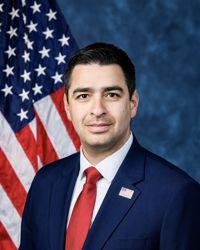
U.S. Representative for Colorado’s 8th district
Republican
119th Congress, two-year term
Missed 0.0% of roll calls. Chamber median 1.9%.
The full voting recordCounts roll calls where most Democrats and most Republicans voted differently, leaving out procedural votes.
How we countFrom FEC filings, Voteview roll calls and Congress.gov.
Republican. In Congress since 2025, 1 term in total.
Following saves Evans to your list, which Chamber & Street keeps on its server, linked to a cookie on this browser and not to your name or email. Email alerts will come with constituent verification.
Bills and resolutions Evans signed on to as a cosponsor. An original cosponsor signed on the day the bill was introduced. Source: govinfo bill status files, last updated Nov 6, 2026.
PLAN for School Safety Act of 2025
Sponsor John Rutherford (R). Joined Feb 2, 2026. 27 cosponsors. H.R. 2577 on Congress.gov
Introduced
To amend the Internal Revenue Code of 1986 to eliminate the dollar limitations on the exclusion of gain from sales of principal residences, and for other purposes.
Sponsor Craig Goldman (R). Joined Jan 27, 2026. 6 cosponsors. H.R. 7034 on Congress.gov(opens in a new tab)
Introduced
Stop Insider Trading Act
Sponsor Bryan Steil (R). Joined Jan 27, 2026. 93 cosponsors. H.R. 7008 on Congress.gov(opens in a new tab)
Passed the House
Stop Insider Trading Act
This bill generally prohibits Members of Congress and their spouses and dependent children from purchasing stocks and requires public notice before these individuals may sell stocks.
Specifically, Members of Congress and the spouses and dependent children of Members of Congress may not purchase covered investments. Between 7 and 14 days before a Member or a covered spouse or dependent sells a covered investment, the relevant Member must file public notice of the intent to sell with the Clerk of the House of Representatives or the Secretary of the Senate, as appropriate. The Clerk or Secretary must publish this notice online. If the individual decides not to sell the covered investment, the notice must be withdrawn.
Under the bill, a covered investment is a security issued by a publicly traded company or a comparable economic interest. Some investments are exempt, including interest in a widely held investment fund and certain investments held in a trust.
Violations of these provisions are subject to a fee and, in the case of a purchase, a requirement to sell the covered investment. The fee must equal (1) the greater of $2,000 or 10% of the transaction value, and (2) any net gain realized from the transaction during a specified period. The fee may not be paid using campaign donations or Members’ official allowances.
Certain transactions by covered spouses and dependents are exempt, including transactions made on behalf of another person or made as part of compensation from the individual’s employer.
Chiropractic Medicare Coverage Modernization Act of 2025
Sponsor W. Steube (R). Joined Jan 27, 2026. 174 cosponsors. H.R. 539 on Congress.gov(opens in a new tab)
Introduced
Chiropractic Medicare Coverage Modernization Act of 2025
This bill expands Medicare coverage of chiropractic services to include all services provided by chiropractors, rather than only subluxation corrections through manual manipulation of the spine.
Home School Graduation Recognition Act
Sponsor Mark Harris (R). Joined Jan 15, 2026. 9 cosponsors. H.R. 6392 on Congress.gov(opens in a new tab)
Passed the House
Home School Graduation Recognition Act
This bill clarifies that students who complete their secondary education in a home school setting recognized under state law are high school graduates for purposes of eligibility for federal student aid.
Hemp Planting Predictability Act
Sponsor James Baird (R). Original cosponsor. 40 cosponsors. H.R. 7024 on Congress.gov(opens in a new tab)
Introduced
Hemp Planting Predictability Act
This bill extends by two years the implementation of changes to the regulation of hemp products, which reimpose certain federal controls over some hemp products.
Specifically, Congress enacted the FY2026 agriculture appropriations act (P.L. 119-37) on November 12, 2025. Effective November 12, 2026, the act modifies the statutory definition of hemp products that are considered to be lawful. This bill extends the effective date to November 12, 2028.
As background, the 2018 farm bill excluded hemp from the Controlled Substances Act definition of marijuana and defined hemp. As a result, hemp and hemp-derived products at or below the 0.3% delta-9 tetrahydrocannabinol (THC, the psychoactive component of marijuana) concentration threshold were no longer regulated as Schedule I controlled substances and registration with the Drug Enforcement Administration was no longer required to cultivate or handle hemp and hemp-derived products. However, hemp remained subject to Department of Agriculture and Food and Drug Administration regulation.
The 2025 changes to the definition of hemp, include
• changing the limit to a total THC concentration of not more than 0.3% on a dry weight basis rather than only delta-9 THC,
• explicitly including industrial hemp,
• excluding seeds from a cannabis plant that exceed a certain THC concentration, and
• excluding various types of hemp-derived cannabinoid products.
Cannabinoids refer to unique chemical compounds that are found in hemp and marijuana (e.g., THC) and are known to exhibit a range of psychological and physiological effects.
To amend the Agriculture, Rural Development, Food and Drug Administration, and Related Agency Appropriations Act, 2026, to delay the implementation of amendments made by such Act to the hemp production provisions of the Agricultural Marketing Act of 1946.
Sponsor James Baird (R). Original cosponsor. 4 cosponsors. H.R. 7010 on Congress.gov(opens in a new tab)
Introduced
This bill extends by two years the implementation of changes to the regulation of hemp products, which reimpose certain federal controls over some hemp products.
Specifically, Congress enacted the FY2026 agriculture appropriations act (P.L. 119-37) on November 12, 2025. Effective November 12, 2026, the act modifies the statutory definition of hemp products that are considered to be lawful. This bill extends the effective date to November 12, 2028.
As background, the 2018 farm bill excluded hemp from the Controlled Substances Act definition of marijuana and defined hemp. As a result, hemp and hemp-derived products at or below the 0.3% delta-9 tetrahydrocannabinol (THC, the psychoactive component of marijuana) concentration threshold were no longer regulated as Schedule I controlled substances and registration with the Drug Enforcement Administration was no longer required to cultivate or handle hemp and hemp-derived products. However, hemp remained subject to Department of Agriculture and Food and Drug Administration regulation.
The 2025 changes to the definition of hemp, include
• changing the limit to a total THC concentration of not more than 0.3% on a dry weight basis rather than only delta-9 THC,
• explicitly including industrial hemp,
• excluding seeds from a cannabis plant that exceed a certain THC concentration, and
• excluding various types of hemp-derived cannabinoid products.
Cannabinoids refer to unique chemical compounds that are found in hemp and marijuana (e.g., THC) and are known to exhibit a range of psychological and physiological effects.
Immersive Technology for the American Workforce Act of 2025
Sponsor John Mannion (D). Original cosponsor. 3 cosponsors. H.R. 6968 on Congress.gov(opens in a new tab)
Introduced
Empower Parents to Protect their Kids Act
Sponsor Mary Miller (R). Joined Jan 7, 2026. 15 cosponsors. H.R. 5116 on Congress.gov(opens in a new tab)
Introduced
Empower Parents to Protect their Kids Act
This bill prohibits an elementary or secondary school from receiving federal funds unless the school notifies parents about a student's gender identity and obtains parental consent for any associated school accommodations.
Among other requirements, school employees may not withhold information from parents about a minor student's purported identity that is incongruent with the student's sex, the student's discomfort with their sex, or the student's desire to undergo a gender transition procedure. Schools must also obtain parental consent before proceeding with any accommodations for such students. The Department of Justice or a parent or guardian may bring a civil action against a school for violations.
Protecting Students on Campus Act of 2025
Sponsor Lois Frankel (D). Original cosponsor. 23 cosponsors. H.R. 6857 on Congress.gov(opens in a new tab)
Introduced
Protecting Students on Campus Act of 2025
This bill requires the Department of Education (ED) and institutions of higher education (IHEs) participating in federal student aid programs to distribute information on how to report alleged violations of civil rights under Title VI of the Civil Rights Act of 1964. (Title VI of the Civil Rights Act of 1964 prohibits discrimination based on race, color, or national origin in federally funded programs or activities.)
Specifically, the bill requires ED's Office for Civil Rights (OCR) to conduct a public awareness campaign regarding the rights of individuals under Title VI. This campaign must be updated annually and distributed to IHEs.
The bill requires an IHE to post a link on its website on how to file a Title VI complaint with OCR. Additionally, the IHE must annually post the materials from OCR's public awareness campaign. The information must be posted in high-traffic public places on campus (e.g., student centers) and high-traffic websites (e.g., the website for student services).
OCR must give monthly congressional briefings on (1) the number of complaints filed with OCR, (2) how OCR plans to address those complaints and the investigations opened in response to those complaints, and (3) how long those complaints remain open.
The bill also requires annual reporting by IHEs on discrimination complaints. Further, the bill directs ED's Office of Inspector General to audit and study discrimination complaints.
Smithsonian American Women’s History Museum Act
Sponsor Nicole Malliotakis (R). Joined Dec 18, 2025. 231 cosponsors. H.R. 1329 on Congress.gov(opens in a new tab)
Introduced
Smithsonian American Women’s History Museum Act
This bill authorizes the Smithsonian American Women's History Museum to be located on a particular site within the Reserve of the National Mall in Washington, DC.
Specifically, the bill designates the South Monument site as the location for the museum; however, the President may designate an alternative site within 180 days of the bill's enactment. (The site is the undeveloped land across the National Mall from the National Museum of African American History and Culture.) Administrative jurisdiction of the site must be transferred to the Smithsonian Institution.
The Board of Regents of the Smithsonian Institution must have the approval of specified federal entities (e.g., the Commission of Fine Arts) to plan, design, and construct a museum building. The bill (1) outlines the criteria for considering site and design proposals, and (2) requires the Smithsonian Institution to reimburse for costs resulting from the building approval process.
The bill directs the museum to be dedicated to preserving, researching, and presenting the history, achievements, and lived experiences of biological women in the United States. Under this bill, the museum may not identify, present, describe, or depict any biological male as a female.
In carrying out its duties, the museum's advisory council must (1) seek and utilize guidance from a broad array of knowledgeable and respected sources reflecting the diversity of the political viewpoints and authentic experiences held by women in the United States, and (2) seek guidance for the creation and substantial revision of exhibits and programs.
DOC Access Act of 2025
Sponsor Earl Carter (R). Joined Dec 17, 2025. 122 cosponsors. H.R. 1521 on Congress.gov(opens in a new tab)
Introduced
Dentist and Optometric Care Access Act of 2025 or the DOC Access Act of 2025
This bill prohibits private health insurance plans from setting rates for items and services, except for dental cleanings, provided by a doctor of optometry, of dental surgery, or of dental medicine (or an employer of such a doctor) for which the plan does not pay a substantial amount.
Additionally, an agreement between a plan and such a doctor for limited scope dental or vision benefits may last longer than two years only with the prior acceptance of the doctor for each term extension. Plans also may not restrict such a doctor's choice of laboratories or suppliers.
Such doctors may elect to waive the application of the payment amount and choice of laboratories provisions of this bill.
The bill does not supersede state laws regarding health insurers and dental or vision benefit plans.
Protect and Serve Act of 2025
Sponsor John Rutherford (R). Joined Dec 15, 2025. 120 cosponsors. H.R. 1551 on Congress.gov(opens in a new tab)
Introduced
Temporary Family Visitation Act
Sponsor Scott Peters (D). Original cosponsor. 21 cosponsors. H.R. 6670 on Congress.gov(opens in a new tab)
Introduced
Rural Recovery Act of 2025
Sponsor April McClain Delaney (D). Original cosponsor. 6 cosponsors. H.R. 6462 on Congress.gov(opens in a new tab)
Introduced
Celebrating the 50th anniversary of the Individuals with Disabilities Education Act on November 29, 2025, and recognizing its transformative impact on the education of children with disabilities.
Sponsor Glenn Thompson (R). Original cosponsor. 29 cosponsors. H.Res. 920 on Congress.gov(opens in a new tab)
Introduced
PCS Leave for Military Spouse Federal Workers Act
Sponsor Andrea Salinas (D). Original cosponsor. 1 cosponsor. H.R. 6311 on Congress.gov(opens in a new tab)
Introduced
Regional Leadership in Wildland Fire Research Act of 2025
Sponsor Dave Min (D). Original cosponsor. 1 cosponsor. H.R. 6154 on Congress.gov(opens in a new tab)
Introduced
Educational Choice for Children Act of 2025
Sponsor Adrian Smith (R). Joined Nov 17, 2025. 91 cosponsors. H.R. 833 on Congress.gov(opens in a new tab)
Introduced
Captive Primate Safety Act of 2025
Sponsor Mike Quigley (D). Joined Nov 17, 2025. 53 cosponsors. H.R. 3199 on Congress.gov(opens in a new tab)
Introduced
To repeal certain provisions relating to notification to Senate offices regarding legal process on disclosure of Senate data, and for other purposes.
Sponsor Austin Scott (R). Original cosponsor. 39 cosponsors. H.R. 6019 on Congress.gov(opens in a new tab)
Passed the House
This bill repeals the authority for a Senator to bring a civil action against the federal government if an internet service provider or the Senate Sergeant at Arms (SAA) accessed or disclosed, or accesses or discloses, data from the Senator's office to provide to a federal agency without following prescribed notice requirements. The authority applies to a qualifying instance occurring on or after January 1, 2022.
The authority for the civil action was enacted in H.R. 5371, the Continuing Appropriations, Agriculture, Legislative Branch, Military Construction and Veterans Affairs, and Extensions Act, 2026, which was signed by the President on November 12, 2026. The relevant provision requires written notice from the internet service provider or the SAA to the Senate office upon receipt of any legal process seeking access or disclosure of covered data. A Senator affected by a federal violation of the provision may sue the federal government for the greater of $500,000 per violation or the actual damages, plus attorney's fees and related costs.
Supporting Healthy Mothers and Infants Act of 2025
Sponsor Eugene Vindman (D). Joined Nov 12, 2025. 27 cosponsors. H.R. 3743 on Congress.gov(opens in a new tab)
Introduced
Supporting Healthy Mothers and Infants Act of 2025
This bill modifies the Special Supplemental Nutrition Program for Women, Infants, and Children (WIC) to add requirements for supporting individuals impacted by a substance use disorder.
Specifically, the bill requires the Department of Agriculture to
• collaborate with the Department of Health and Human Services (HHS) to develop and disseminate nutrition education materials for individuals impacted by a substance use disorder, including materials for infants impacted by prenatal substance exposure and neonatal abstinence syndrome;
• conduct outreach to individuals who are potentially eligible for the WIC program and who are impacted by such a disorder; and
• make available to states through an online clearinghouse any nutrition education and training materials related to nutrition for individuals impacted by a substance use disorder or neonatal abstinence syndrome.
In addition, the nutrition education materials developed in collaboration with HHS must be included in (1) Center for Substance Abuse Prevention-developed education materials, and (2) HHS guidance on improving care for infants with neonatal abstinence syndrome and their families.
Under current law, the WIC program includes certain education related to drug abuse. This bill replaces references to drug abuse with substance use disorder.
Peace Corps Volunteers Congressional Gold Medal Act of 2025
Sponsor Betty McCollum (D). Joined Nov 10, 2025. 26 cosponsors. H.R. 5521 on Congress.gov(opens in a new tab)
Introduced
American Families United Act
Sponsor Veronica Escobar (D). Joined Nov 10, 2025. 43 cosponsors. H.R. 2366 on Congress.gov(opens in a new tab)
Introduced
American Families United Act
This bill authorizes the Department of Homeland Security (DHS) or the Department of Justice (DOJ) to exercise discretion in certain immigration cases.
Under this bill, DOJ or DHS may, on a case-by-case basis, exercise discretion by declining to remove a non-U.S. national (alien under federal law) or bar an alien from entering the United States to prevent hardship for the alien's U.S. citizen spouse, parent, or child. This discretion may also be exercised if the alien is the spouse or child of a deceased U.S. citizen.
For the purposes of this bill, it shall be presumed that family separation constitutes hardship.
However, DOJ or DHS may not exercise this discretion if the alien is removable or inadmissible due to certain grounds, including specified crime- and security-related grounds.
This exercise of discretion may be applied to an alien who was ordered removed or denied entry prior to this bill's enactment if the alien files a motion to reopen or reconsider within two years of this bill's enactment.
Supporting the Local Radio Freedom Act.
Sponsor Steve Womack (R). Joined Nov 7, 2025. 233 cosponsors. H.Con.Res. 12 on Congress.gov(opens in a new tab)
Introduced
This concurrent resolution declares that Congress should not impose any new performance fee, tax, royalty, or other charge relating to the public performance of sound recordings on a local radio station for broadcasting sound recordings over the air, or on any business for such public performance of sound recordings.