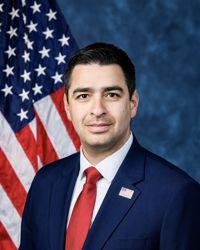
U.S. Representative for Colorado’s 8th district
Republican
119th Congress, two-year term
Missed 0.0% of roll calls. Chamber median 1.9%.
The full voting recordCounts roll calls where most Democrats and most Republicans voted differently, leaving out procedural votes.
How we countFrom FEC filings, Voteview roll calls and Congress.gov.
Republican. In Congress since 2025, 1 term in total.
Following saves Evans to your list, which Chamber & Street keeps on its server, linked to a cookie on this browser and not to your name or email. Email alerts will come with constituent verification.
Bills and resolutions Evans signed on to as a cosponsor. An original cosponsor signed on the day the bill was introduced. Source: govinfo bill status files, last updated Nov 6, 2026.
To amend the Food and Nutrition Act of 2008 to modify the definition of food.
Sponsor Eric Crawford (R). Original cosponsor. 26 cosponsors. H.R. 8403 on Congress.gov
Introduced
This bill includes hot rotisserie chicken as an eligible food to purchase with Supplemental Nutrition Assistance Program (SNAP) benefits.
Military Financial Literacy Act of 2026
Sponsor Kristen McDonald Rivet (D). Joined Apr 21, 2026. 23 cosponsors. H.R. 8056 on Congress.gov(opens in a new tab)
Introduced
RESULTS Act
Sponsor Richard Hudson (R). Joined Apr 16, 2026. 129 cosponsors. H.R. 5269 on Congress.gov(opens in a new tab)
Introduced
Reforming and Enhancing Sustainable Updates to Laboratory Testing Services Act of 2025 or the RESULTS Act
This bill requires the use of particular data from the private sector to inform Medicare payment rates for certain widely available laboratory tests.
Specifically, the Centers for Medicare & Medicaid Services (CMS) must contract with an entity that maintains a database of claims data for clinical diagnostic laboratory tests that (1) are not advanced diagnostic tests, and (2) were furnished by more than 100 providers and suppliers of such services over a specified six-month period (i.e., widely available tests).
The database must meet specified requirements, such as having data that is representative of the entire country and from more than 50 private payors and claims administrators. The contracted entity must be a nonprofit entity that is not affiliated with any government agency, any insurance issuer or provider, or any other organization in the health care sector.
Beginning January 1, 2028, the CMS must use the information obtained from the database to inform Medicare payment rates for these widely available laboratory tests.
The bill additionally specifies processes for determining payment rates for laboratory tests that are not advanced diagnostic tests, are not widely available, and lack adequate claims data. The CMS must use certain existing processes to set appropriate rates.
The bill also delays scheduled payment reductions for laboratory tests until 2028 and allows for judicial and administrative review of payment rates.
CERTAIN Act
Sponsor Scott Peters (D). Original cosponsor. 9 cosponsors. H.R. 8308 on Congress.gov(opens in a new tab)
Introduced
Water Systems PFAS Liability Protection Act
Sponsor Marie Perez (D). Joined Apr 15, 2026. 34 cosponsors. H.R. 1267 on Congress.gov(opens in a new tab)
Introduced
Water Systems PFAS Liability Protection Act
This bill exempts specified water management entities from liability under the Comprehensive Environmental Response, Compensation, and Liability Act of 1980 (CERCLA) for releases of certain perfluoroalkyl or polyfluoroalkyl substances, commonly referred to as PFAS. Specifically, the entities covered under the bill are public water systems, publicly or privately owned or operated treatment works, municipalities with a stormwater discharge permit, political subdivisions or special districts of a state that act as a wholesale water agency, and contractors performing the management or disposal activities for such entities.
Under the bill, the exemption only applies if a specified entity transports, treats, disposes of, or arranges for the transport, treatment or disposal of PFAS consistent with applicable laws and during and following the conveyance or treatment of water under federal or state law, such as through the management or disposal of biosolids consistent with the Federal Water Pollution Control Act.
Liability for damages or costs associated with the release of certain PFAS must not be precluded if an entity acted with gross negligence or willful misconduct.
Non-Domiciled CDL Integrity Act
Sponsor David Rouzer (R). Joined Apr 14, 2026. 80 cosponsors. H.R. 5688 on Congress.gov(opens in a new tab)
Passed committee
Honoring our K9 Heroes Act
Sponsor Brian Fitzpatrick (R). Joined Apr 9, 2026. 41 cosponsors. H.R. 3144 on Congress.gov(opens in a new tab)
Introduced
Supporting recognition of 2026 as the "International Year of Rangelands and Pastoralists".
Sponsor Celeste Maloy (R). Original cosponsor. 8 cosponsors. H.Res. 1144 on Congress.gov(opens in a new tab)
Introduced
This resolution supports recognizing the International Year of Rangelands and Pastoralists. It also encourages federal agencies, universities, and organizations across the country to promote education, research, and outreach related to rangeland management.
Preserving Patient Access to Long-Term Care Pharmacies Act
Sponsor Beth Van Duyne (R). Joined Mar 26, 2026. 46 cosponsors. H.R. 5031 on Congress.gov(opens in a new tab)
Introduced
Expressing support for the designation of March 24, 2026, as "National Agriculture Day" and celebrating the importance of agriculture as one of the most impactful industries in the United States.
Sponsor Mark Alford (R). Original cosponsor. 24 cosponsors. H.Res. 1132 on Congress.gov(opens in a new tab)
Introduced
This resolution supports the designation of National Agriculture Day.
Expressing the support of the House of Representatives for the Department of Homeland Security.
Sponsor Ryan Mackenzie (R). Joined Mar 24, 2026. 14 cosponsors. H.Res. 1128 on Congress.gov(opens in a new tab)
Passed the House
This resolution recognizes the importance of fully funding the Department of Homeland Security (DHS).
The resolution also (1) cautions that Americans are at greater risk each day DHS is subject to a lapse in appropriations, and (2) expresses gratitude to DHS employees for their commitment to protect the United States.
No Federal Tax Dollars for Illegal Aliens Health Insurance Act of 2026
Sponsor Lauren Boebert (R). Original cosponsor. 15 cosponsors. H.R. 7817 on Congress.gov(opens in a new tab)
Introduced
Generating Retirement Ownership through Long-Term Holding
Sponsor Beth Van Duyne (R). Joined Mar 4, 2026. 130 cosponsors. H.R. 2089 on Congress.gov(opens in a new tab)
Introduced
Incentivize Savings Act
Sponsor Richard McCormick (R). Joined Mar 3, 2026. 69 cosponsors. H.R. 5438 on Congress.gov(opens in a new tab)
Passed committee
Incentivize Savings Act
This bill establishes requirements for allocating unexpended appropriations for federal agencies.
If appropriations are provided to a federal agency for a definite period and the agency does not spend the funds during the period of availability, the bill requires
• 49% of the funds to remain available for an additional fiscal year,
• 49% of the funds to be used for payments of principal and interest on the public debt, and
• 2% of the funds to be used for retention bonuses within the agency that do not exceed 10% of an employee's basic pay.
If an agency's unexpended appropriations are allocated under this bill, the agency's budget request for the fiscal year following the fiscal year in which the funds expired may not exceed the prior year's budget request with an adjustment for inflation.
ALERT Act
Sponsor Sam Graves (R). Joined Feb 24, 2026. 87 cosponsors. H.R. 7613 on Congress.gov(opens in a new tab)
Passed the House
Airspace Location and Enhanced Risk Transparency Act of 2026 or the ALERT Act
This bill addresses aviation safety by increasing requirements for aircraft tracking and communication using Automatic Dependent Surveillance-Broadcast (ADS-B) technology and expanding oversight. As background, ADS-B for broadcasting (Out) and receiving (In) transmits information (e.g., location and weather) among aircraft and air traffic control (ATC).
The bill requires the Department of Defense (DOD) and the Department of Transportation (DOT) to enter into an agreement regarding the use of collision prevention technologies on DOD aircraft. The agreement must require the use of ADS-B Out as the default practice for DOD helicopters operating in the national airspace, unless such use would affect operational security. For DOD helicopters that are carrying out special missions in the Washington, DC, metropolitan area and are exempt from ADS-B Out transmission requirements, DOD must coordinate with DOT to conduct a safety risk assessment and implement appropriate mitigations.
By December 31, 2031, DOD aircraft (other than certain special mission aircraft) must be equipped with and operating integrated ADS-B In technology.
With respect to civil aircraft, by December 31, 2031, the Federal Aviation Administration (FAA) must generally require aircraft that are currently required to be equipped with ADS-B Out to also be equipped with ADS-B In.
Additionally, among other requirements, the FAA must
• establish time-on-position limits for supervisory ATC personnel;
• establish a process to timely notify parties involved in certain near-miss incidents; and
• evaluate and revise, as necessary, helicopter routes around Ronald Reagan Washington National Airport.
Rural Water Security Act
Sponsor Brittany Pettersen (D). Original cosponsor. 6 cosponsors. H.R. 7631 on Congress.gov(opens in a new tab)
Introduced
FRAMER Act
Sponsor Jeff Crank (R). Joined Feb 17, 2026. 2 cosponsors. H.R. 7282 on Congress.gov(opens in a new tab)
Introduced
American Franchise Act
Sponsor Kevin Hern (R). Joined Feb 12, 2026. 158 cosponsors. H.R. 5267 on Congress.gov(opens in a new tab)
Introduced
Recycled Materials Attribution Act of 2026
Sponsor Nicholas Langworthy (R). Original cosponsor. 13 cosponsors. H.R. 7502 on Congress.gov(opens in a new tab)
Passed committee
Preventing Domestic Violence Homicides Through Lethality Assessment Training and Technical Assistance Act
Sponsor Sarah Elfreth (D). Original cosponsor. 7 cosponsors. H.R. 7494 on Congress.gov(opens in a new tab)
Introduced
CMMSA 2.0
Sponsor Raul Ruiz (D). Original cosponsor. 1 cosponsor. H.R. 7473 on Congress.gov(opens in a new tab)
Introduced
CARGO Act of 2025
Sponsor Troy Nehls (R). Joined Feb 10, 2026. 29 cosponsors. H.R. 1085 on Congress.gov(opens in a new tab)
Introduced
Cease Animal Research Grants Overseas Act of 2025 or the CARGO Act of 2025
This bill prohibits the National Institutes of Health from awarding support for any research that uses live animals unless the research occurs in the United States (including U.S. territories and possessions).
Ensuring Lasting Smiles Act
Sponsor Neal Dunn (R). Joined Feb 9, 2026. 222 cosponsors. H.R. 3277 on Congress.gov(opens in a new tab)
Introduced
CONNECT for Health Act of 2025
Sponsor Mike Thompson (D). Joined Feb 3, 2026. 248 cosponsors. H.R. 4206 on Congress.gov(opens in a new tab)
Introduced
Energy Threat Analysis Center Act of 2026
Sponsor Kathy Castor (D). Original cosponsor. 1 cosponsor. H.R. 7305 on Congress.gov(opens in a new tab)
Passed the House
Energy Threat Analysis Center Act of 2026
This bill reauthorizes through FY2031 and expands the pilot Energy Sector Operational Support for Cyber Resilience Program of the Department of Energy (DOE). The program aims to protect energy infrastructure through collaboration between the federal government and the energy sector and enhancing DOE’s emergency response capabilities.
Specifically, the bill expands the program objectives to include
• enhancing collaboration between the government and the energy sector to address threats to energy systems,
• advancing the collective understanding of national security risks and vulnerabilities associated with the energy sector that may be exploited by adversaries, and
• helping the energy sector increase its understanding of tactics of adversaries that present risks to the energy sector.
The bill allows DOE to establish an Energy Threat Analysis Center at one or more physical locations for program activities.
The bill also eliminates technical assistance provided under the program to small electric utilities.
Under the bill, the decision to provide assistance or information under the program to a governmental or private entity is at the sole discretion of the Secretary of Energy and is unreviewable.
The bill authorizes the Secretary to (1) enter into and perform contracts, grants, and other transactions with public agencies, private organizations, and persons to carry out the program; and (2) establish and utilize preapproved national security contracting mechanisms, model partnership agreements, and expedited review procedures for purposes of entering into such transactions.
In addition, the bill exempts the program from certain public disclosure and other transparency requirements.