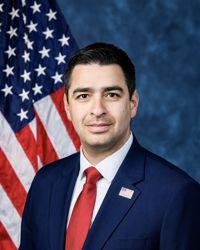
U.S. Representative for Colorado’s 8th district
Republican
119th Congress, two-year term
Missed 0.0% of roll calls. Chamber median 1.9%.
The full voting recordCounts roll calls where most Democrats and most Republicans voted differently, leaving out procedural votes.
How we countFrom FEC filings, Voteview roll calls and Congress.gov.
Republican. In Congress since 2025, 1 term in total.
Following saves Evans to your list, which Chamber & Street keeps on its server, linked to a cookie on this browser and not to your name or email. Email alerts will come with constituent verification.
Bills and resolutions Evans signed on to as a cosponsor. An original cosponsor signed on the day the bill was introduced. Source: govinfo bill status files, last updated Nov 6, 2026.
Lifeline for First Responders Act
Sponsor Andrea Salinas (D). Original cosponsor. 3 cosponsors. H.R. 10116 on Congress.gov
Introduced
FAIR Act
Sponsor Diana Harshbarger (R). Joined Aug 6, 2026. 21 cosponsors. H.R. 2314 on Congress.gov(opens in a new tab)
Introduced
Fair Access In Residency Act of 2025 or the FAIR Act of 2025
This bill requires hospitals that receive graduate medical education (GME) payments under Medicare to report certain information about the composition of their medical residency training programs.
Specifically, hospitals must provide to the Centers for Medicare & Medicaid Services (CMS) (1) the number of applicants for residencies who are from osteopathic medical schools and from allopathic medical schools, (2) the number of applicants who are accepted from each of these types of medical schools, and (3) an affirmation that the hospital considers applicants from each of these types of medical schools and accepts specified related examination results, as appropriate. Hospitals that do not provide this information are subject to a 2% reduction in their GME payments.
The CMS must post the information it receives on a public website.
To amend title XIX of the Social Security Act to establish a definition of essential health system in statute and for other related purposes.
Sponsor Lori Trahan (D). Joined Aug 3, 2026. 25 cosponsors. H.R. 7145 on Congress.gov(opens in a new tab)
Introduced
BO’s Act
Sponsor Rudy Yakym (R). Joined Aug 3, 2026. 13 cosponsors. H.R. 2168 on Congress.gov(opens in a new tab)
Introduced
Freedom from Unfair Gun Taxes Act of 2025
Sponsor Darrell Issa (R). Joined Jul 30, 2026. 105 cosponsors. H.R. 2442 on Congress.gov(opens in a new tab)
Introduced
Freedom from Unfair Gun Taxes Act of 2025
This bill prohibits a state or any political subdivision of a state from imposing or collecting an excise tax on the sale of a firearm, ammunition, or any part or component of a firearm or ammunition by a manufacture or dealer.
Stopping Harmful and Outrageous Torts Act
Sponsor Derek Schmidt (R). Joined Jul 27, 2026. 126 cosponsors. H.R. 9298 on Congress.gov(opens in a new tab)
Introduced
Honoring the lives and service of Emily Barker, Nick Hutcherson, Sydney Watson, Nicholas Dale, and all those who serve on the front lines of America's wildland firefighting efforts.
Sponsor Jeff Hurd (R). Original cosponsor. 11 cosponsors. H.Res. 1446 on Congress.gov(opens in a new tab)
Introduced
Wildfire Emergency Preparedness Act of 2025
Sponsor Josh Harder (D). Joined Jul 21, 2026. 16 cosponsors. H.R. 4852 on Congress.gov(opens in a new tab)
Introduced
Wildfire Emergency Preparedness Act of 2025
This bill establishes grants, training, and interagency coordination for responding to wildfires and fires in the wildland-urban interface (WUI) (i.e., where undeveloped land or vegetation meets human infrastructure). It also requires measures for protecting the health of firefighters and emergency responders.
The bill establishes an Under Secretary of Agriculture for Fire Coordination to manage coordination of government preparation and response to wildfires and WUI fires. Such office may award grants to fire departments and emergency medical services organizations for training firefighting personnel or obtaining personal protective equipment for responding to such fires.
Also, the Forest Service must establish a national plan with guidelines for training structural (i.e., urban) firefighters to respond to wildfires and WUI fires. The Forest Service may provide grants to certain nonprofit organizations to carry out training programs pursuant to the plan.
Upon request from agencies, the Department of Defense (DOD) may allow its firefighters to conduct operations or assist in responding to wildfires and WUI fires. Agencies must reimburse DOD for such services.
Additionally, the National Institute for Occupational Safety and Health must perform research and development and report to Congress on protecting the respiratory health of firefighters and identifying certain hazardous substances in areas affected by wildfires and WUI fires. Also, task forces within the National Urban Search and Rescue Response System of the Federal Emergency Management Agency (FEMA) must train each member in peer mental health support and include members who are mental health practitioners.
PFAS Alternatives Act
Sponsor Debbie Dingell (D). Joined Jul 20, 2026. 151 cosponsors. H.R. 3184 on Congress.gov(opens in a new tab)
Introduced
FIRE Cancer Act of 2025
Sponsor Josh Gottheimer (D). Joined Jul 20, 2026. 7 cosponsors. H.R. 1610 on Congress.gov(opens in a new tab)
Introduced
Firefighter Investments to Recognize Exposure to Cancer Act of 2025 or the FIRE Cancer Act of 2025
This bill expands the Federal Emergency Management Agency's (FEMA's) Assistance to Firefighters Grant program for fire departments and emergency medical services organizations to include cancer prevention programs (e.g., multi-cancer early detection testing) for firefighting personnel. It also establishes a joint cancer research program between FEMA and the Centers for Disease Control and Prevention (CDC) through which firefighting personnel may voluntarily share the anonymized results of preventative cancer testing so the CDC can study trends or causes of cancer in such personnel.
Replace UNRWA with Real Humanitarian Assistance Act
Sponsor Michael Lawler (R). Joined Jul 16, 2026. 30 cosponsors. H.R. 9680 on Congress.gov(opens in a new tab)
Introduced
Quantum-Enhanced Critical Minerals Mapping Act of 2026
Sponsor Jeff Hurd (R). Joined Jul 16, 2026. 2 cosponsors. H.R. 9646 on Congress.gov(opens in a new tab)
Introduced
Local Foods for Healthy Schools Act of 2026
Sponsor Kristen McDonald Rivet (D). Joined Jul 13, 2026. 13 cosponsors. H.R. 9474 on Congress.gov(opens in a new tab)
Introduced
ReCement Act
Sponsor Jay Obernolte (R). Joined Jul 9, 2026. 11 cosponsors. H.R. 9293 on Congress.gov(opens in a new tab)
Introduced
Securing Agriculture's Workforce Act of 2026
Sponsor Glenn Thompson (R). Original cosponsor. 61 cosponsors. H.R. 9535 on Congress.gov(opens in a new tab)
Introduced
Securing Agriculture's Workforce Act of 2026
This bill expands the H-2A agricultural visa program; creates online platforms for H-2A employers, workers, and agencies; and codifies certain wage calculations.
Under current law, workers on H-2A visas are only allowed to perform agricultural work of a seasonal or temporary nature. Under the bill, the seasonal work requirement is removed, thus allowing H-2A workers to qualify for agricultural work that occurs year-round. The bill also expands the type of agricultural work that qualifies, including reforestation, aquaculture, and livestock work. The Department of Agriculture must issue rules to define agricultural labor or services for purposes of the H-2A program.
The bill also establishes an H-2A visa pathway for current unauthorized agricultural workers who otherwise meet requirements.
The Department of Labor must maintain a national, publicly accessible online job registry and database of all job offers submitted by employers seeking a labor certification required to employ H-2A workers. The Department of Homeland Security must establish an online platform for employers to submit information and documentation for review by federal agencies in the course of admitting H-2A workers.
The H-2A program requires employers to provide workers with wage rates at or above those set in regulations and such wages must not adversely affect the wages and working conditions of workers similarly employed in the United States. The bill codifies the current calculation method for the adverse effect wage rate as set in regulation.
Advanced Transmission Technology to Reduce Rates Act
Sponsor Craig Goldman (R). Joined Jun 30, 2026. 2 cosponsors. H.R. 9335 on Congress.gov(opens in a new tab)
Passed committee
Nuclear REFUEL (Recycling Efficient Fuels Utilizing Expedited Licensing) Act
Sponsor Robert Latta (R). Joined Jun 30, 2026. 28 cosponsors. H.R. 3978 on Congress.gov(opens in a new tab)
Introduced
The following analysis is based on draft bill text that was made available by the House of Representatives and may differ from the bill text as introduced.
Nuclear REFUEL (Recycling Efficient Fuels Utilizing Expedited Licensing) Act
This bill directs the Nuclear Regulatory Commission (NRC) to license future recycling facilities that reprocess certain spent nuclear fuel (i.e., radioactive waste) under regulations for special nuclear material rather than regulations for production and utilization facilities. The bill applies to domestic facilities that reprocess spent nuclear fuel in a manner that does not isolate plutonium. Generally, such recycling facilities reprocess spent nuclear fuel into materials that may be reused as nuclear fuel for electricity.
While there are no commercial reprocessing facilities currently operating in the United States, the bill specifies which regulatory framework the NRC must use when issuing licenses to future facilities by excluding such facilities from the statutory definition of production facility. The licensing process under regulations for special nuclear material has fewer steps than the licensing process under regulations for production and utilization facilities.
GHOSTRUCK Act
Sponsor W. Steube (R). Joined Jun 29, 2026. 11 cosponsors. H.R. 9369 on Congress.gov(opens in a new tab)
Introduced
COMPASS Act
Sponsor Pat Harrigan (R). Joined Jun 29, 2026. 6 cosponsors. H.R. 9351 on Congress.gov(opens in a new tab)
Introduced
Affordable Innovation for the Grid Act
Sponsor Diana Harshbarger (R). Joined Jun 29, 2026. 6 cosponsors. H.R. 9339 on Congress.gov(opens in a new tab)
Passed the House
Affordable Innovation for the Grid Act
This bill directs the Department of Energy to assess and report on the use of artificial intelligence and high-performance computing technologies to enhance the capacity, reliable operation, and operational efficiency of the bulk-power system.
Efficient Nuclear Licensing Hearings Act
Sponsor H. Griffith (R). Joined Jun 29, 2026. 25 cosponsors. H.R. 5549 on Congress.gov(opens in a new tab)
Introduced
Efficient Nuclear Licensing Hearings Act
This bill expedites the process of reviewing certain uncontested permits and licenses for nuclear power plants (e.g., construction permits and operating licenses) by removing a requirement for the Nuclear Regulatory Commission (NRC) to hold a public hearing at the end of the process. The bill applies to the licenses and permits if a hearing has not been requested by a person whose interest may be affected. The bill also directs the NRC to use informal adjudicatory procedures if such a hearing is held.
Additionally, the bill directs the NRC to hold an adjudicatory hearing regarding the licensing of the construction and operation of a uranium enrichment facility only if the person whose interest may be affected by such construction and operation has requested the hearing.
Maintaining Investments in New Innovation Act
Sponsor Donald Davis (D). Joined Jun 25, 2026. 51 cosponsors. H.R. 1672 on Congress.gov(opens in a new tab)
Introduced
Maintaining Investments in New Innovation Act
This bill requires drug products with genetically targeted technology to have had market approval for at least 11 years in order to qualify for the Medicare Drug Price Negotiation Program. (The program requires the Centers for Medicare & Medicaid Services to negotiate the prices of certain prescription drugs under Medicare beginning in 2026. Among other requirements, drugs must have had market approval for at least 7 years (for drug products) or 11 years (for biologics) to qualify for negotiation.)
Artemis II Congressional Gold Medal Act
Sponsor Don Bacon (R). Original cosponsor. 51 cosponsors. H.R. 9417 on Congress.gov(opens in a new tab)
Introduced
To amend the Internal Revenue Code of 1986 to modify the railroad track maintenance credit.
Sponsor Mike Kelly (R). Joined Jun 24, 2026. 183 cosponsors. H.R. 516 on Congress.gov(opens in a new tab)
Introduced
This bill increases the annual limit on the tax credit for qualified railroad track maintenance expenses (also referred to as the short line railroad tax credit) and expands eligibility for claiming the credit.
Under current law, the tax credit is limited each tax year to $3,500 multiplied by the sum of the number of miles of railroad track owned or leased by the taxpayer (miles owned or leased) and the number of railroad track miles assigned to the taxpayer by a Class II or III railroad (miles assigned). This bill increases the annual limit to $6,100 multiplied by the sum of miles owned or leased and miles assigned. The $6,100 amount used in the calculation of the tax credit limit is adjusted for inflation for tax years beginning after 2025.
The bill also expands eligibility for the tax credit to include gross expenses for maintaining railroad tracks owned or leased as of January 1, 2024. Under current law, the tax credit is limited to gross expenses for maintaining railroad tracks owned or leased as of January 1, 2015.
Essential Caregivers Act of 2025
Sponsor Claudia Tenney (R). Joined Jun 22, 2026. 160 cosponsors. H.R. 6766 on Congress.gov(opens in a new tab)
Introduced
Essential Caregivers Act of 2025
This bill prohibits certain health care facilities from limiting the access of essential caregivers to residents of those facilities, including during designated emergency periods.
Specifically, the bill generally prohibits Medicare skilled nursing facilities, Medicaid nursing facilities, Medicaid intermediate care facilities, and associated inpatient rehabilitation facilities from restricting the access of essential caregivers to residents of the facilities, including during emergency periods in which visitation rights are otherwise restricted. During emergency periods, facilities may restrict access for an initial period of up to seven days and for one additional maximum seven-day period (if the additional period is approved by the state health department). Facilities may restrict access for a total of 7 days (or 14 days with the approval of the state health department) during an emergency period.
Essential caregivers must agree to comply with any safety protocols set by the facility, which may be no more stringent for caregivers compared to those for staff. Caregivers who fail to comply with these requirements may be denied access, subject to an appeals process.