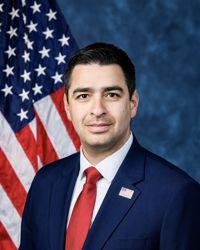
U.S. Representative for Colorado’s 8th district
Republican
119th Congress, two-year term
Missed 0.0% of roll calls. Chamber median 1.9%.
The full voting recordCounts roll calls where most Democrats and most Republicans voted differently, leaving out procedural votes.
How we countFrom FEC filings, Voteview roll calls and Congress.gov.
Republican. In Congress since 2025, 1 term in total.
Following saves Evans to your list, which Chamber & Street keeps on its server, linked to a cookie on this browser and not to your name or email. Email alerts will come with constituent verification.
Bills and resolutions Evans signed on to as a cosponsor. An original cosponsor signed on the day the bill was introduced. Source: govinfo bill status files, last updated Nov 6, 2026.
Countering Transnational Repression Act of 2025
Sponsor August Pfluger (R). Original cosponsor. 8 cosponsors. H.R. 2158 on Congress.gov
Passed committee
Strengthening State and Local Efforts to Counter Transnational Repression Act
Sponsor Seth Magaziner (D). Original cosponsor. 6 cosponsors. H.R. 2139 on Congress.gov(opens in a new tab)
Passed committee
Major Richard Star Act
Sponsor Gus Bilirakis (R). Original cosponsor. 340 cosponsors. H.R. 2102 on Congress.gov(opens in a new tab)
Introduced
Major Richard Star Act
This bill allows a veteran with a combat-related disability to receive retirement pay, without reduction, concurrently with their disability compensation. This includes veterans with a combat-related disability and fewer than 20 years of creditable service. (Currently, veterans who receive combat-related special compensation and retirement pay are subject to an offset in retirement pay for concurrent receipt of such benefits.)
SPEAK Act of 2025
Sponsor Monica De La Cruz (R). Original cosponsor. 17 cosponsors. H.R. 2092 on Congress.gov(opens in a new tab)
Introduced
Supporting Patient Education And Knowledge Act of 2025 or the SPEAK Act of 2025
This bill requires the Department of Health and Human Services to issue guidance with best practices for improving telehealth services for non-English speakers, including with respect to using interpreters, providing accessible instructions, and enabling multi-person video calls.
Pay Our Troops Act of 2025
Sponsor Jennifer Kiggans (R). Joined Mar 14, 2025. 34 cosponsors. H.R. 1932 on Congress.gov(opens in a new tab)
Introduced
Pay Our Troops Act of 2025
This bill provides continuing appropriations for military pay for any period during which interim or full-year appropriations for FY2025 are not in effect (i.e., a government shutdown).
Specifically, the bill provides FY2025 continuing appropriations for the pay and allowances of (1) members of the Armed Forces, including reserve components, who perform active service during the period; and (2) civilian personnel and contractors of the Department of Defense (and the Department of Homeland Security in the case of the Coast Guard) who are providing support to such members of the Armed Forces.
If a government shutdown occurs, the bill provides the continuing appropriations until the earlier of (1) the enactment into law of specified appropriations legislation, or (2) January 1, 2026.
Charitable Act
Sponsor Blake Moore (R). Joined Mar 11, 2025. 54 cosponsors. H.R. 801 on Congress.gov(opens in a new tab)
Introduced
Charitable Act
This bill allows an individual taxpayer who does not itemize their tax deductions to claim a tax deduction for charitable contributions and eliminates the tax penalty for overstating charitable contributions. (Some limitations apply).
Under the bill, for tax years beginning in 2026 or 2027, an individual taxpayer who does not itemize their tax deductions may deduct charitable contributions of up to one-third of the standard deduction allowed to such individual. (Under current law, an individual taxpayer generally must itemize their tax deductions to deduct charitable contributions.)
The bill also eliminates the tax penalty for an underpayment of taxes attributable to overstated charitable contributions by taxpayers who do not itemize deductions. (Under current law, taxpayers who claim a deduction under this bill may be assessed a tax penalty in the amount of 50% of the portion of an understatement of tax liability attributable to overstated charitable contributions.)
Unlocking our Domestic LNG Potential Act of 2025
Sponsor August Pfluger (R). Joined Mar 11, 2025. 43 cosponsors. H.R. 1949 on Congress.gov(opens in a new tab)
Passed the House
Unlocking our Domestic LNG Potential Act of 2025
This bill repeals certain restrictions on the import and export of natural gas under the Natural Gas Act, including requirements for Department of Energy (DOE) approval and related provisions that address free trade agreements.
In addition, the bill grants the Federal Energy Regulatory Commission (FERC) the exclusive authority to approve or deny applications to authorize the siting, construction, expansion, or operation of facilities (e.g., liquefied natural gas terminals) to export natural gas to foreign countries or import natural gas from foreign countries. (Currently, DOE authorizes the export or import of natural gas, and FERC authorizes related facilities.)
In determining whether to approve or deny an application, FERC must deem the exportation or importation of natural gas to be consistent with the public interest.
Honoring Our Fallen Heroes Act of 2025
Sponsor Mary Gay Scanlon (D). Joined Mar 11, 2025. 180 cosponsors. H.R. 1269 on Congress.gov(opens in a new tab)
Introduced
Honoring Our Fallen Heroes Act of 2025
This bill extends death and disability benefits under the Public Safety Officers' Benefits Program (PSOB) to certain public safety officers who suffer from exposure-related cancer while on duty and their survivors. The PSOB program provides death, disability, and education benefits to public safety officers who are killed or injured in the line of duty and their survivors.
The bill specifies that exposure to a carcinogen shall be presumed to constitute a personal injury in the line of duty if
• the exposure occurred while the officer was in the line of duty;
• the officer began serving as an officer not fewer than 5 years before the date of the diagnosis of an exposure-related cancer and the diagnosis occurred not more than 15 years after the last date of active service; and
• the exposure-related cancer directly and proximately resulted in the death or permanent and total disability of the officer.
The Department of Justice's Bureau of Justice Assistance must periodically review the definition of exposure-related cancer and update the definition if appropriate based on medical evidence and in accordance with the requirements of a petition process.
Productive Public Lands Act
Sponsor Jeff Hurd (R). Original cosponsor. 6 cosponsors. H.R. 1997 on Congress.gov(opens in a new tab)
Introduced
Nancy Gardner Sewell Medicare Multi-Cancer Early Detection Screening Coverage Act
Sponsor Jodey Arrington (R). Joined Mar 4, 2025. 338 cosponsors. H.R. 842 on Congress.gov(opens in a new tab)
Introduced
Nancy Gardner Sewell Medicare Multi-Cancer Early Detection Screening Coverage Act
This bill allows, beginning in 2028, for Medicare coverage and payment for multi-cancer early detection screening tests that are approved by the Food and Drug Administration and that are used to screen for cancer across many cancer types, if the Centers for Medicare & Medicaid Services determines such coverage is appropriate. Coverage is limited to those under a certain age (age 68 in 2028, increased by one year every year thereafter) and to one test every 11 months.
National Law Enforcement Officers Remembrance, Support, and Community Outreach Act
Sponsor Troy Nehls (R). Joined Mar 3, 2025. 124 cosponsors. H.R. 309 on Congress.gov(opens in a new tab)
Passed the House
National Law Enforcement Officers Remembrance, Support and Community Outreach Act. [sic]
This bill temporarily directs the Department of the Interior to award a grant to the National Law Enforcement Officers Memorial Fund for the expenses associated with operating and enhancing the community outreach, public education, and officer safety and wellness programs of the National Law Enforcement Museum.
Federal Firearms Licensee Protection Act of 2025
Sponsor John Rutherford (R). Original cosponsor. 145 cosponsors. H.R. 1773 on Congress.gov(opens in a new tab)
Introduced
Federal Firearms Licensee Protection Act of 2025
This bill modifies criminal penalties for an offense involving the theft of a firearm from a licensed importer, manufacturer, or dealer, or from their business premises.
Specifically, the bill does the following:
• increases from 10 to 20 years the maximum prison term, and
• creates a 3- or 5-year mandatory minimum prison term for an offense that occurs during the commission of a burglary or robbery.
An attempt to commit an offense is subject to the same penalties as a substantive offense.
To nullify the final rule issued by the Environmental Protection Agency relating to "New Source Performance Standards for Greenhouse Gas Emissions From New, Modified, and Reconstructed Fossil Fuel-Fired Electric Generating Units; Emission Guidelines for Greenhouse Gas Emissions From Existing Fossil Fuel-Fired Electric Generating Units; and Repeal of the Affordable Clean Energy Rule".
Sponsor Troy Balderson (R). Joined Mar 3, 2025. 37 cosponsors. H.R. 1651 on Congress.gov(opens in a new tab)
Introduced
Generative AI Terrorism Risk Assessment Act
Sponsor August Pfluger (R). Original cosponsor. 3 cosponsors. H.R. 1736 on Congress.gov(opens in a new tab)
Passed the House
Generative AI Terrorism Risk Assessment Act
This bill requires the Department of Homeland Security (DHS) to periodically provide Congress with an assessment of threats to the United States posed by the use of generative artificial intelligence (AI) for terrorism. Generative AI is defined as the class of AI models that emulate the structure and characteristics of input data to generate derived synthetic content, including images, videos, audio, text, and other digital content.
The bill also (1) requires DHS to review and disseminate related information gathered by state and major urban area fusion centers and the National Network of Fusion Centers, and (2) requires other federal agencies to share related information with DHS. (A fusion center is a collaborative effort of two or more federal, state, local, or tribal government agencies that combines resources, expertise, or information with the goal of maximizing the ability of such agencies to detect, prevent, investigate, apprehend, and respond to criminal or terrorist activity.)
DHS Intelligence and Analysis Oversight and Transparency Act
Sponsor Laurel Lee (R). Original cosponsor. 2 cosponsors. H.R. 1711 on Congress.gov(opens in a new tab)
Introduced
Main Street Tax Certainty Act
Sponsor Lloyd Smucker (R). Joined Feb 25, 2025. 192 cosponsors. H.R. 703 on Congress.gov(opens in a new tab)
Introduced
Main Street Tax Certainty Act
This bill makes permanent the qualified business income (QBI) tax deduction.
Under current law, individuals, estates, and trusts may deduct the lower of (1) 20% of QBI from a qualified business, qualified real estate investment trust dividends, and qualified publicly traded partnership income; or (2) 20% of taxable income less net capital gain. (Some limitations apply.)
However, under current law, the QBI tax deduction expires after December 31, 2025.
Protecting American Agriculture from Foreign Adversaries Act of 2025
Sponsor Dan Newhouse (R). Original cosponsor. 60 cosponsors. H.R. 1576 on Congress.gov(opens in a new tab)
Introduced
Protecting American Agriculture from Foreign Adversaries Act of 2025
This bill makes changes to the Committee on Foreign Investment in the United States (CFIUS), including by requiring CFIUS to determine whether a national security review is necessary for reportable agricultural land transactions that are referred by the Department of Agriculture (USDA). (CFIUS oversees the national security risks of certain foreign investment in the United States. CFIUS has the authority to review covered transactions, which include mergers, acquisitions, and takeovers that could result in foreign control of a U.S. business; certain investments in businesses involved in critical technologies, critical infrastructure, or sensitive personal data; and certain real estate transactions.)
Specifically, the bill directs CFIUS to, after receiving notification from USDA, determine (1) whether a reportable agricultural land transaction is a covered transaction, and (2) whether CFIUS should initiate a national security review or take another action with respect to the transaction.
Reportable agricultural land transaction means a transaction (1) that USDA has reason to believe is a covered transaction; (2) that involves the acquisition of an interest in agricultural land by a foreign person of China, North Korea, Russia, or Iran; and (3) with respect to which a foreign person is required to submit a report to USDA regarding their agricultural land transactions.
The bill also expands the membership of CFIUS to include the Secretary of Agriculture for covered transactions that involve agricultural land, agricultural biotechnology, or the agriculture industry (e.g., agricultural transportation, storage, and processing).
No American Land for Communist China Act
Sponsor Dan Newhouse (R). Original cosponsor. 60 cosponsors. H.R. 1575 on Congress.gov(opens in a new tab)
Introduced
CATCH Fentanyl Act
Sponsor Clay Higgins (R). Original cosponsor. 21 cosponsors. H.R. 1569 on Congress.gov(opens in a new tab)
Introduced
Contraband Awareness Technology Catches Harmful Fentanyl Act or the CATCH Fentanyl Act
This bill establishes a pilot program for improving the inspection of conveyances or modes of transportation at land ports of entry along U.S. borders to detect contraband, illegal drugs, illegal weapons, human smuggling, and threats. Specifically, the U.S. Customs and Border Protection Innovation Team must test technology in at least one of the categories of artificial intelligence, machine learning, high-performance computing, quantum information sciences, or other emerging technologies. The team must also test and collect data regarding at least five types of enhancements to nonintrusive inspection technology (e.g., X-ray machines) able to be deployed at land ports of entry.
Repealing Big Brother Overreach Act
Sponsor Warren Davidson (R). Joined Feb 24, 2025. 193 cosponsors. H.R. 425 on Congress.gov(opens in a new tab)
Passed committee
Repealing Big Brother Overreach Act
This bill repeals the Corporate Transparency Act. The act requires existing companies and newly created companies to report beneficial ownership information to the Department of the Treasury’s Financial Crimes Enforcement Network for purposes of addressing the financing of terrorism and money laundering.
Mikaela Naylon Give Kids a Chance Act
Sponsor Michael McCaul (R). Joined Feb 24, 2025. 313 cosponsors. H.R. 1262 on Congress.gov(opens in a new tab)
Passed the House
Give Kids a Chance Act of 2025
This bill expands the Food and Drug Administration’s (FDA’s) authority with respect to research on rare pediatric diseases, including by permitting the FDA to take enforcement action against drug sponsors that fail to satisfy pediatric study requirements and by reauthorizing programs that support pediatric research.
Specifically, the bill
• modifies requirements relating to molecularly targeted pediatric cancer investigations to permit research on new drugs in combination with active ingredients that have already been approved, provided certain conditions are met;
• permits the FDA to take enforcement action against drug sponsors that fail to comply with pediatric study requirements, if such sponsors demonstrated a lack of due diligence in satisfying the requirement;
• renews the FDA’s authority to award priority review vouchers to sponsors of new products intended to treat rare pediatric diseases through September 30, 2029; and
• reauthorizes through FY2027 certain funding for the National Institutes of Health to support priority pediatric research.
The bill also provides statutory authority for the FDA’s interpretation of the orphan drug exclusivity period. The bill specifies, consistent with FDA regulations, that the seven-year market exclusivity period for drugs for rare diseases or conditions (i.e., orphan drugs) prohibits the approval of the same drug for the same approved use or indication with respect to the disease or condition. (In Catalyst Pharmaceuticals, Inc. v. Becerra, a court rejected the FDA’s interpretation and held that orphan drug exclusivity extends to all uses or indications for the disease or condition.)
Death Tax Repeal Act
Sponsor Randy Feenstra (R). Original cosponsor. 182 cosponsors. H.R. 1301 on Congress.gov(opens in a new tab)
Introduced
Deport Alien Gang Members Act
Sponsor Tom McClintock (R). Joined Feb 11, 2025. 27 cosponsors. H.R. 175 on Congress.gov(opens in a new tab)
Passed committee
Deport Alien Gang Members Act
This bill makes non-U.S. nationals (aliens under federal law) associated with criminal gangs inadmissible for entry into the United States and deportable. The bill also establishes procedures to designate groups as criminal gangs.
An individual shall be inadmissible if certain officers or agencies know or have reason to believe that the individual is or was a criminal gang member or has participated or aided such a group's illegal activities. An individual who is or was a member of such a gang, has participated or aided such a group's illegal activities, or seeks to enter or has entered the United States in furtherance of such activity shall be deportable.
Such individuals must be subject to mandatory detention. Furthermore, such individuals shall not be eligible for (1) asylum; (2) temporary protected status; (3) special immigrant juvenile visas; or (4) parole, unless they are assisting the government in a law enforcement matter.
The bill defines a criminal gang as a group of five or more persons (1) where one of its primary purposes is committing specified criminal offenses and its members have engaged in a continuing series of such offenses within the past five years, or (2) that has been designated as a criminal gang by the Department of Homeland Security (DHS).
The bill also establishes procedures for DHS to designate a group as a criminal gang, including notifying Congress, publishing a notice in the Federal Register, and providing an opportunity for the group to petition for review of the designation.
Countering Online Radicalization and Terrorism Act
Sponsor August Pfluger (R). Original cosponsor. 6 cosponsors. H.R. 1212 on Congress.gov(opens in a new tab)
Introduced
Crime Victims Fund Stabilization Act of 2025
Sponsor Ann Wagner (R). Joined Feb 10, 2025. 327 cosponsors. H.R. 909 on Congress.gov(opens in a new tab)
Passed the House
Crime Victims Fund Stabilization Act of 2025
This bill adds a new source of revenue for the Crime Victims Fund (CVF). Specifically, the bill requires certain civil monetary penalties collected from settlements and judgments in cases involving fraud and false claims against the federal government to be deposited into the CVF through FY2029.
The CVF supports federal, state, and local programs and activities to compensate and assist victims of crimes. Currently, the CVF is funded by deposits from a variety of sources, including federal criminal fines, penalties, and assessments; forfeited bail bonds; and certain other gifts, donations, and bequests.