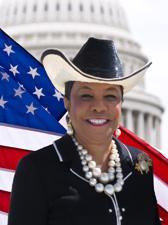
U.S. Representative for Florida’s 24th district
Democrat
119th Congress, two-year term
Missed 28.6% of roll calls. Chamber median 1.9%.
The full voting recordCounts roll calls where most Democrats and most Republicans voted differently, leaving out procedural votes.
How we countFrom FEC filings, Voteview roll calls and Congress.gov.
Democrat. In Congress since 2011, 8 terms in total.
Following saves Wilson to your list, which Chamber & Street keeps on its server, linked to a cookie on this browser and not to your name or email. Email alerts will come with constituent verification.
Bills and resolutions where Wilson is the primary sponsor. Most bills never leave committee; that is normal for every member. Source: Congress.gov, last updated Oct 29, 2026.
3 of 30 have at least one cosponsor from the other party.
American Teacher Act
Introduced Mar 10, 2025. 102 cosponsors, 1 from the other party. H.R. 2021 on Congress.gov
Introduced
American Teacher Act
This bill establishes grants to increase the minimum salary of public elementary and secondary school teachers. It also authorizes a national campaign regarding the value of the teaching profession.
First, the bill directs the Department of Education (ED) to award four-year grants to state educational agencies (SEAs) and, through them, subgrants to local educational agencies to establish a minimum annual salary of $60,000 (to be adjusted annually for inflation) for these teachers.
Second, the bill directs ED to award grants to eligible SEAs to provide cost-of-living adjustments to the annual base salary of teachers.
Finally, the bill authorizes ED to carry out a national campaign to (1) increase awareness about the importance of teachers and the value of the teaching profession, (2) encourage secondary school and college students to consider teaching as a professional career, and (3) diversify the pool of individuals who enter the teaching profession.
Homeowners’ Defense Act of 2025
Introduced Jan 28, 2025. 2 cosponsors. H.R. 827 on Congress.gov(opens in a new tab)
Introduced
Homeowners' Defense Act of 2025
This bill allows the Department of the Treasury to guarantee the debt issued by an eligible state catastrophe insurance program, with limitations on the total amount of debt guaranteed.
To qualify, a state program must (1) be established and authorized by state law as an insurance program or a reinsurance program designed to support the private insurance market, and (2) offer residential property insurance coverage for losses arising from any personal residential line of insurance. Treasury must pay the portion of the principal and interest on guaranteed debt due for payment if the state program has insufficient funds.
Treasury must also make reinsurance coverage available to eligible state programs. (Reinsurance protects insurers from large losses.) The bill also establishes the Federal Natural Catastrophe Reinsurance Fund, funded in part by the sale of reinsurance contracts, to pay out eligible losses.
The bill also establishes the National Catastrophe Risk Consortium which must maintain an inventory of catastrophe risk obligations held by providers of natural catastrophe insurance, among other functions.
The Department of Housing and Urban Development must provide grants to entities (such as states) for the purpose of preventing and mitigating losses from natural catastrophes.
The Government Accountability Office must report on risk-based rate pricing and state insurance program rates.
Salad Bars in Schools Expansion Act
Introduced Jan 24, 2025. 1 cosponsor. H.R. 739 on Congress.gov(opens in a new tab)
Introduced
Salad Bars in Schools Expansion Act
This bill requires the Department of Agriculture (USDA) to establish and implement a plan, including through a five-year program of competitive grants, to promote the use of salad bars in schools participating in the school lunch program.
Priority in the award of grants may be given to entities (i.e., a school or a school food authority) that (1) serve schools in which at least 50% of the students are eligible for free or reduced-price lunches, (2) serve schools in food deserts, or (3) provide nutrition education to students. Under the bill, food desert is defined as a census tract with a substantial share of residents who live in low-income areas that have low levels of access to a grocery store or a healthy, affordable food retail outlet.
Eligible entities must use the grant funds to award schools a one-time payment for the anticipated cost of installing a salad bar, including the purchase of any required durable equipment.
USDA must also submit a report to Congress that includes recommendations for promoting and establishing more salad bars in schools.
Jobs Now Act of 2025
Introduced Jan 23, 2025. 1 cosponsor. H.R. 714 on Congress.gov(opens in a new tab)
Introduced
Jobs Now Act of 2025
This bill directs the Department of Labor to conduct a two-year pilot program to award grants to general local governmental units or community-based organizations to retain, employ, or train individuals for positions that provide a public service. At least 50% of grant funds must be used to retain employees who would otherwise be laid off due to budget cuts.
Labor must encourage grantees to use grant funds to retain, employ, or train veterans, individuals with disabilities, individuals receiving unemployment benefits, or dislocated workers.
One School, One Nurse Act of 2025
Introduced Jan 9, 2025. 5 cosponsors. H.R. 305 on Congress.gov(opens in a new tab)
Introduced
One School, One Nurse Act of 2025
This bill directs the Department of Education (ED) to award competitive grants to eligible entities for recruiting, hiring, and retaining school nurses. An eligible entity is a local educational agency (LEA) or a partnership between a state educational agency and a consortium of LEAs in the state.
Further, ED must specify in regulation the recommended nurse-to-student ratios for elementary and secondary schools.