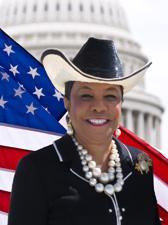
U.S. Representative for Florida’s 24th district
Democrat
119th Congress, two-year term
Missed 28.6% of roll calls. Chamber median 1.9%.
The full voting recordCounts roll calls where most Democrats and most Republicans voted differently, leaving out procedural votes.
How we countFrom FEC filings, Voteview roll calls and Congress.gov.
Democrat. In Congress since 2011, 8 terms in total.
Following saves Wilson to your list, which Chamber & Street keeps on its server, linked to a cookie on this browser and not to your name or email. Email alerts will come with constituent verification.
Bills and resolutions Wilson signed on to as a cosponsor. An original cosponsor signed on the day the bill was introduced. Source: govinfo bill status files, last updated Nov 6, 2026.
Commemorating 9 years since the Pulse nightclub shooting in Orlando, Florida, on June 12, 2016.
Sponsor Darren Soto (D). Original cosponsor. 41 cosponsors. H.Res. 514 on Congress.gov
Introduced
Domestic Workers Bill of Rights Act
Sponsor Pramila Jayapal (D). Original cosponsor. 115 cosponsors. H.R. 3971 on Congress.gov(opens in a new tab)
Introduced
Pride In Mental Health Act of 2025
Sponsor Sharice Davids (D). Joined Jun 12, 2025. 170 cosponsors. H.R. 3757 on Congress.gov(opens in a new tab)
Introduced
My Body, My Data Act of 2025
Sponsor Sara Jacobs (D). Original cosponsor. 101 cosponsors. H.R. 3916 on Congress.gov(opens in a new tab)
Introduced
Enhanced Background Checks Act of 2025
Sponsor James Clyburn (D). Joined Jun 11, 2025. 136 cosponsors. H.R. 3868 on Congress.gov(opens in a new tab)
Introduced
Enhanced Background Checks Act of 2025
This bill establishes more stringent background check requirements for proposed firearm transfers from a federal firearms licensee (e.g., a licensed gun dealer) to an unlicensed person.
Specifically, it increases the amount of time, from 3 business days to a minimum of 10 business days, that a federal firearms licensee must wait to receive a completed background check prior to transferring a firearm to an unlicensed person. (This type of transaction is often referred to as a default proceed transaction.)
If a submitted background check remains incomplete after 10 business days, then the prospective purchaser may submit a petition for a final firearms eligibility determination. If an additional 10 days elapse without a final determination, then the federal firearms licensee may transfer the firearm to the prospective purchaser.
The Government Accountability Office must report on the extent to which the changes have prevented firearms transfers to prohibited persons.
The Federal Bureau of Investigation must report on the number of petitions it receives for final federal firearms determinations.
The Department of Justice, in consultation with the National Resource Center on Domestic Violence and Firearms, must report on further amendments to the background check process that would likely reduce the risk of death or great bodily harm to victims of domestic violence, domestic abuse, dating partner violence, sexual assault, and stalking.
Bipartisan Background Checks Act of 2025
Sponsor Mike Thompson (D). Original cosponsor. 214 cosponsors. H.R. 18 on Congress.gov(opens in a new tab)
Introduced
Bipartisan Background Checks Act of 2025
This bill establishes new background check requirements for firearm transfers between private parties (i.e., unlicensed individuals).
Specifically, it prohibits a firearm transfer between private parties unless a licensed gun dealer, manufacturer, or importer first takes possession of the firearm to conduct a background check.
The prohibition does not apply to certain firearm transfers or exchanges, such as a gift between spouses.
Supporting the Local Radio Freedom Act.
Sponsor Steve Womack (R). Joined Jun 5, 2025. 233 cosponsors. H.Con.Res. 12 on Congress.gov(opens in a new tab)
Introduced
This concurrent resolution declares that Congress should not impose any new performance fee, tax, royalty, or other charge relating to the public performance of sound recordings on a local radio station for broadcasting sound recordings over the air, or on any business for such public performance of sound recordings.
Coordinated Federal Response to Extreme Heat Act of 2025
Sponsor Yassamin Ansari (D). Original cosponsor. 27 cosponsors. H.R. 3704 on Congress.gov(opens in a new tab)
Introduced
Excess Urban Heat Mitigation Act of 2025
Sponsor Yassamin Ansari (D). Original cosponsor. 30 cosponsors. H.R. 3703 on Congress.gov(opens in a new tab)
Introduced
Extreme Heat Economic Study Act of 2025
Sponsor Yassamin Ansari (D). Original cosponsor. 28 cosponsors. H.R. 3702 on Congress.gov(opens in a new tab)
Introduced
Mikaela Naylon Give Kids a Chance Act
Sponsor Michael McCaul (R). Joined Jun 3, 2025. 313 cosponsors. H.R. 1262 on Congress.gov(opens in a new tab)
Passed the House
Give Kids a Chance Act of 2025
This bill expands the Food and Drug Administration’s (FDA’s) authority with respect to research on rare pediatric diseases, including by permitting the FDA to take enforcement action against drug sponsors that fail to satisfy pediatric study requirements and by reauthorizing programs that support pediatric research.
Specifically, the bill
• modifies requirements relating to molecularly targeted pediatric cancer investigations to permit research on new drugs in combination with active ingredients that have already been approved, provided certain conditions are met;
• permits the FDA to take enforcement action against drug sponsors that fail to comply with pediatric study requirements, if such sponsors demonstrated a lack of due diligence in satisfying the requirement;
• renews the FDA’s authority to award priority review vouchers to sponsors of new products intended to treat rare pediatric diseases through September 30, 2029; and
• reauthorizes through FY2027 certain funding for the National Institutes of Health to support priority pediatric research.
The bill also provides statutory authority for the FDA’s interpretation of the orphan drug exclusivity period. The bill specifies, consistent with FDA regulations, that the seven-year market exclusivity period for drugs for rare diseases or conditions (i.e., orphan drugs) prohibits the approval of the same drug for the same approved use or indication with respect to the disease or condition. (In Catalyst Pharmaceuticals, Inc. v. Becerra, a court rejected the FDA’s interpretation and held that orphan drug exclusivity extends to all uses or indications for the disease or condition.)
Expressing support for the designation of June 6, 2025, as "National Gun Violence Awareness Day" and June 2025 as "National Gun Violence Awareness Month".
Sponsor Robin Kelly (D). Original cosponsor. 87 cosponsors. H.Res. 457 on Congress.gov(opens in a new tab)
Introduced
Water Affordability, Transparency, Equity, and Reliability Act of 2025
Sponsor Bonnie Watson Coleman (D). Joined May 29, 2025. 90 cosponsors. H.R. 3376 on Congress.gov(opens in a new tab)
Introduced
Equity and Inclusion Enforcement Act of 2025
Sponsor Robert Scott (D). Original cosponsor. 14 cosponsors. H.R. 3606 on Congress.gov(opens in a new tab)
Introduced
Venezuela TPS Act of 2025
Sponsor Darren Soto (D). Joined May 20, 2025. 11 cosponsors. H.R. 3310 on Congress.gov(opens in a new tab)
Introduced
Henrietta Lacks Congressional Gold Medal Act
Sponsor Kweisi Mfume (D). Original cosponsor. 35 cosponsors. H.R. 3498 on Congress.gov(opens in a new tab)
Introduced
Henrietta Lacks Congressional Gold Medal Act
This bill awards posthumously a Congressional Gold Medal in commemoration of Henrietta Lacks, in recognition of the contributions of her immortal cells to global health, scientific research, quality of life, and patients' rights.
Protect Our Letter Carriers Act of 2025
Sponsor Brian Fitzpatrick (R). Joined May 19, 2025. 231 cosponsors. H.R. 1065 on Congress.gov(opens in a new tab)
Introduced
Protect Our Letter Carriers Act of 2025
This bill requires or authorizes certain actions related to the U.S. Postal Service (USPS).
The bill requires the Department of Justice to appoint an assistant U.S. attorney in each judicial district to coordinate and supervise the investigation and prosecution of various crimes related to postal services (for example, assault on a postal service employee, breaking into a post office, or obstruction of mails).
The bill also requires the U.S. Sentencing Commission to amend sentencing guidelines to provide that the assault or robbery of a postal employee shall be treated the same as the assault of a law enforcement officer.
Additionally, the bill authorizes appropriations for the USPS to install high security collection boxes and replace older versions of the universal mailbox key with electronic versions.
Stronger Communities through Better Transit Act
Sponsor Henry Johnson (D). Original cosponsor. 150 cosponsors. H.R. 3449 on Congress.gov(opens in a new tab)
Introduced
Stronger Communities through Better Transit Act
This bill requires the Department of Transportation (DOT) to establish a grant program to support operating projects for public transportation and related service improvements, particularly in underserved communities and areas of persistent poverty.
Specifically, the bill requires DOT to allocate funding under the program for urbanized areas, states, and Indian tribes that are recipients of funds under either the Federal Transit Administration's (FTA's) Urbanized Area Formula Funding program or Formula Grants for Rural Areas program. Eligible recipients may use funding for operating costs associated with projects that improve public transportation service for transit-dependent populations and support increased transit ridership (e.g., service expansion, information technology enhancements, and workforce development). DOT must apportion the funding so that recipients receive funds that are proportional to their share of operating costs.
The bill also provides for an increased federal cost share for operating assistance for projects or programs carried out in areas of persistent poverty or underserved communities.
DOT must set up a multimodal access measurement interface for public agencies to aid transit agencies in determining and reporting on access to jobs and essential services.
A grant recipient must (1) report specific information to the FTA for inclusion in the National Transit Database, and (2) survey transit riders and non-riding residents regarding transit service improvements.
Further, the bill expands the purposes of the public transportation programs to include supporting public transportation's role in combating climate change through growing/retaining transit ridership.
Mental Health in Aviation Act of 2025
Sponsor Sean Casten (D). Joined May 15, 2025. 43 cosponsors. H.R. 2591 on Congress.gov(opens in a new tab)
Passed the House
Mental Health in Aviation Act of 2025
This bill requires the Federal Aviation Administration (FAA) to review and update its regulations and policies on mental health for pilots and air traffic controllers.
The FAA must update regulations and take any other actions necessary to implement the recommendations of (1) the Aviation Workforce Mental Health Task Group, and (2) the Mental Health and Aviation Medical Clearances Aviation Rulemaking Committee (the ARC).
The FAA must also annually review and update, as appropriate, the applicable regulations and policies on mental health-related special issuance for pilots and air traffic controllers. As background, an Authorization for Special Issuance of a Medical Certificate is a discretionary document from the FAA which allows an airman with a disqualifying medical condition to fly under a restricted medical certificate.
Among other things, the review and update must
• reclassify and approve additional medications that may be safely prescribed to airmen to treat mental health conditions,
• delegate additional authority to aviation medical examiners (AMEs) consistent with the ARC recommendations, and
• improve the special issuance process for pilots and air traffic controllers.
The bill authorizes the FAA to take actions to recruit and train additional AMEs.
The bill also authorizes an FAA public information campaign or education efforts to (1) destigmatize individuals in (or interested in joining) the aviation industry who seek mental health care, (2) broaden awareness of available supportive services, and (3) establish trust with pilots and air traffic controllers.
AM Radio for Every Vehicle Act of 2025
Sponsor Gus Bilirakis (R). Joined May 13, 2025. 317 cosponsors. H.R. 979 on Congress.gov(opens in a new tab)
Passed the House
AM Radio for Every Vehicle Act of 2025
This bill requires the Department of Transportation (DOT) to issue a rule requiring AM radio capabilities to be standard in all new passenger vehicles. (AM radio is often used to deliver emergency alerts and news and entertainment programming; some newer vehicles do not include AM equipment.)
Specifically, this bill applies to passenger vehicles (1) manufactured in the United States for sale in the United States, imported into the United States, or shipped in interstate commerce; and (2) manufactured after the rule's effective date. The rule must require all such vehicles to have devices that can receive signals and play content transmitted by AM stations or digital audio AM stations installed as standard equipment and made easily accessible to drivers.
Prior to the rule's effective date, manufacturers that do not include devices that can access AM radio as standard equipment (1) must inform purchasers of this fact through clear and conspicuous labeling, and (2) may not charge an additional or separate fee for AM radio access.
DOT may assess civil penalties for any violation of the rule. The Department of Justice may also bring a civil action to enjoin a violation.
The rule, including DOT’s authority to enforce it, must expire 10 years after the bill’s enactment.
Further, the Government Accountability Office must study and report on the dissemination of emergency alerts to the public, including by conducting an assessment of AM radio relative to other Integrated Public Alert and Warning System communication technologies.
Born in the USA Act of 2025
Sponsor Delia Ramirez (D). Original cosponsor. 140 cosponsors. H.R. 3368 on Congress.gov(opens in a new tab)
Introduced
Antisemitism Awareness Act of 2025
Sponsor Michael Lawler (R). Joined May 8, 2025. 89 cosponsors. H.R. 1007 on Congress.gov(opens in a new tab)
Introduced
Antisemitism Awareness Act of 2025
This bill provides statutory authority for the requirement that the Department of Education’s Office for Civil Rights take into consideration the International Holocaust Remembrance Alliance's (IHRA's) working definition of antisemitism when reviewing or investigating complaints of discrimination based on race, color, or national origin in programs or activities that receive federal financial assistance. According to the IHRA's working definition, antisemitism is a certain perception of Jews, which may be expressed as hatred toward Jews.
Supporting the designation of the week of May 5 through May 9, 2025, as "Teacher Appreciation Week".
Sponsor Jahana Hayes (D). Original cosponsor. 36 cosponsors. H.Res. 380 on Congress.gov(opens in a new tab)
Introduced
Closing the Bump Stock Loophole Act of 2025
Sponsor Dina Titus (D). Joined May 1, 2025. 152 cosponsors. H.R. 2799 on Congress.gov(opens in a new tab)
Introduced
Closing the Bump Stock Loophole Act of 2025
This bill generally prohibits the import, sale, manufacture, transfer, receipt, or possession of
• a device that is primarily designed, or redesigned, to increase the rate of fire when attached to a semiautomatic firearm;
• a device, part, or combination of parts that is designed and functions to increase the rate of fire of a firearm; or
• a semiautomatic firearm that has been modified to materially increase the rate of fire or to approximate the action or rate of fire of a machine gun.
Additionally, the bill adds to the list of firearms subject to regulation under the National Firearms Act semiautomatic firearms that have been modified to materially increase the rate of fire or approximate the action or rate of fire of a machine gun.
Assault Weapons Ban of 2025
Sponsor Lucy McBath (D). Original cosponsor. 194 cosponsors. H.R. 3115 on Congress.gov(opens in a new tab)
Introduced
Assault Weapons Ban of 2025
This bill makes it a crime to knowingly import, sell, manufacture, transfer, or possess a semiautomatic assault weapon (SAW) or large capacity ammunition feeding device (LCAFD).
The prohibition does not apply to a firearm that is (1) manually operated by bolt, pump, lever, or slide action, except for certain shotguns; (2) permanently inoperable; (3) an antique; (4) only capable of firing rimfire ammunition; or (5) a rifle or shotgun specifically identified by make and model.
The bill also exempts from the prohibition the following, with respect to a SAW or LCAFD:
• importation, sale, manufacture, transfer, or possession related to certain law enforcement efforts, or authorized tests or experiments;
• importation, sale, transfer, or possession related to securing nuclear materials; and
• possession by a retired law enforcement officer.
The bill permits continued possession, sale, or transfer of a grandfathered SAW, which must be securely stored. A licensed gun dealer must conduct a background check prior to the sale or transfer of a grandfathered SAW between private parties.
The bill permits continued possession of, but prohibits sale or transfer of, a grandfathered LCAFD.
Newly manufactured LCAFDs must display serial number identification. Newly manufactured SAWs and LCAFDs must display the date of manufacture.
The bill also allows a state or local government to use Edward Byrne Memorial Justice Assistance Grant Program funds to compensate individuals who surrender a SAW or LCAFD under a buy-back program.