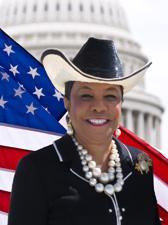
U.S. Representative for Florida’s 24th district
Democrat
119th Congress, two-year term
Missed 28.6% of roll calls. Chamber median 1.9%.
The full voting recordCounts roll calls where most Democrats and most Republicans voted differently, leaving out procedural votes.
How we countFrom FEC filings, Voteview roll calls and Congress.gov.
Democrat. In Congress since 2011, 8 terms in total.
Following saves Wilson to your list, which Chamber & Street keeps on its server, linked to a cookie on this browser and not to your name or email. Email alerts will come with constituent verification.
Bills and resolutions Wilson signed on to as a cosponsor. An original cosponsor signed on the day the bill was introduced. Source: govinfo bill status files, last updated Nov 6, 2026.
No Shame at School Act of 2025
Sponsor Ilhan Omar (D). Original cosponsor. 45 cosponsors. H.R. 5655 on Congress.gov
Introduced
Supporting the designation of the week of September 22 through September 28, 2025, as "National Falls Prevention Awareness Week" to raise awareness, and encourage the prevention, of falls among older adults.
Sponsor Lois Frankel (D). Original cosponsor. 29 cosponsors. H.Con.Res. 52 on Congress.gov(opens in a new tab)
Introduced
Recognizing the continuing disparities in Black youth mental health access and treatment.
Sponsor Bonnie Watson Coleman (D). Original cosponsor. 21 cosponsors. H.Res. 764 on Congress.gov(opens in a new tab)
Introduced
Algorithmic Accountability Act of 2025
Sponsor Yvette Clarke (D). Original cosponsor. 32 cosponsors. H.R. 5511 on Congress.gov(opens in a new tab)
Introduced
Tyler Clementi Higher Education Anti-Harassment Act of 2025
Sponsor Mark Pocan (D). Original cosponsor. 174 cosponsors. H.R. 5486 on Congress.gov(opens in a new tab)
Introduced
FAMILY Act
Sponsor Rosa DeLauro (D). Original cosponsor. 208 cosponsors. H.R. 5390 on Congress.gov(opens in a new tab)
Introduced
Nancy Gardner Sewell Medicare Multi-Cancer Early Detection Screening Coverage Act
Sponsor Jodey Arrington (R). Joined Sep 15, 2025. 338 cosponsors. H.R. 842 on Congress.gov(opens in a new tab)
Introduced
Nancy Gardner Sewell Medicare Multi-Cancer Early Detection Screening Coverage Act
This bill allows, beginning in 2028, for Medicare coverage and payment for multi-cancer early detection screening tests that are approved by the Food and Drug Administration and that are used to screen for cancer across many cancer types, if the Centers for Medicare & Medicaid Services determines such coverage is appropriate. Coverage is limited to those under a certain age (age 68 in 2028, increased by one year every year thereafter) and to one test every 11 months.
George Floyd Justice in Policing Act of 2025
Sponsor Glenn Ivey (D). Original cosponsor. 136 cosponsors. H.R. 5361 on Congress.gov(opens in a new tab)
Introduced
George Floyd Justice in Policing Act of 2025
This bill addresses a wide range of policies and issues regarding policing practices and law enforcement accountability. It increases accountability for law enforcement misconduct, restricts the use of certain policing practices, enhances transparency and data collection, and establishes best practices and training requirements.
The bill enhances existing enforcement mechanisms to remedy violations by law enforcement. Among other things, it does the following:
• lowers the criminal intent standard—from willful to knowing or reckless—to convict a law enforcement officer for misconduct in a federal prosecution,
• limits qualified immunity as a defense to liability in a private civil action against a law enforcement officer, and
• grants administrative subpoena power to the Department of Justice (DOJ) in pattern-or-practice investigations.
It establishes a framework to prevent and remedy racial profiling by law enforcement at the federal, state, and local levels. It also limits the unnecessary use of force and restricts the use of no-knock warrants, chokeholds, and carotid holds.
The bill creates a national registry—the National Police Misconduct Registry—to compile data on complaints and records of police misconduct. It also establishes new reporting requirements, including on the use of force, officer misconduct, and routine policing practices (e.g., stops and searches).
Finally, it directs DOJ to create uniform accreditation standards for law enforcement agencies and requires law enforcement officers to complete training on racial profiling, implicit bias, and the duty to intervene when another officer uses excessive force.
Congressional Tribute to Constance Baker Motley Act of 2025
Sponsor Rosa DeLauro (D). Original cosponsor. 209 cosponsors. H.R. 5309 on Congress.gov(opens in a new tab)
Introduced
25th Anniversary of 9/11 Commemorative Coin Act
Sponsor Daniel Goldman (D). Joined Sep 11, 2025. 302 cosponsors. H.R. 1993 on Congress.gov(opens in a new tab)
Passed the House
25th Anniversary of 9/11 Commemorative Coin Act
This bill directs the Department of the Treasury to mint and issue coins to commemorate the 25th anniversary of the September 11, 2001, terrorist attacks on the United States and the establishment of the National September 11 Memorial and Museum at the World Trade Center.
The sale of all coins issued under this bill must include a surcharge to be paid to the National September 11 Memorial and Museum at the World Trade Center to support operations and maintenance. However, if the issuance of this commemorative coin exceeds certain annual limits, no surcharge may be included.
HOPE for Haitian Prosperity Act of 2025
Sponsor Stacey Plaskett (D). Original cosponsor. 21 cosponsors. H.R. 5209 on Congress.gov(opens in a new tab)
Introduced
LOAN Act
Sponsor Robert Scott (D). Joined Sep 8, 2025. 27 cosponsors. H.R. 4862 on Congress.gov(opens in a new tab)
Introduced
Lowering Obstacles to Achievement Now Act or the LOAN Act
This bill revises federal student aid programs, including the Federal Pell Grant program and the Public Service Loan Forgiveness (PSLF) program. It also repeals the education provisions that were enacted under P.L. 119-21 (commonly known as the One Big Beautiful Bill Act).
Among other provisions, the bill revises the Federal Pell Grant program by (1) providing funding to increase the maximum award for each eligible student, and (2) allowing income-eligible graduate students to utilize their remaining Pell Grant eligibility toward their first graduate degree.
Changes to the PSLF program include (1) reducing the number of monthly loan payments required for loan forgiveness, and (2) removing the requirement that a borrower must be employed in a public service job at the time of forgiveness.
The bill makes Dreamer students (i.e., students who have been granted Deferred Action for Childhood Arrivals status and who entered the United States before the age of 18) who meet certain educational criteria eligible for federal financial aid.
The bill also (1) establishes refinancing programs for federal and private student loans; (2) creates a new income-driven repayment plan; and (3) repeals origination fees for Direct Subsidized Loans, Direct Unsubsidized Loans, and Direct PLUS Loans.
The bill repeals the education provisions that were enacted under P.L. 119-21. For example, the act addressed the amount of federal financial aid available to students by changing the mix and availability of student loans. (For more information, see CRS Report R48727.)
PrEP and PEP are Prevention Act
Sponsor Maxine Waters (D). Original cosponsor. 35 cosponsors. H.R. 5127 on Congress.gov(opens in a new tab)
Introduced
HIV Prevention Now Act
Sponsor Maxine Waters (D). Original cosponsor. 33 cosponsors. H.R. 5126 on Congress.gov(opens in a new tab)
Introduced
Union Participation for All Act
Sponsor Summer Lee (D). Original cosponsor. 8 cosponsors. H.R. 5088 on Congress.gov(opens in a new tab)
Introduced
Health Care Affordability Act of 2025
Sponsor Lauren Underwood (D). Joined Sep 2, 2025. 165 cosponsors. H.R. 247 on Congress.gov(opens in a new tab)
Introduced
Health Care Affordability Act of 2025
This bill makes permanent temporary changes enacted by the American Rescue Plan Act of 2021 (ARPA) and the Inflation Reduction Act of 2022 (IRA) that generally expand eligibility for and increase the amount of the premium tax credit.
Currently, eligible taxpayers may be able to claim the premium tax credit, which applies toward the cost of obtaining health insurance through health insurance exchanges. To be eligible for the premium tax credit, a taxpayer’s household income must meet or exceed 100% of the federal poverty level (FPL) and, after 2025, may not exceed 400% of the FPL (maximum income limit). For 2021-2025, the ARPA and IRA eliminated the maximum income limit, which generally expands eligibility for the premium tax credit.
Further, under current law, the amount of the premium tax credit is (1) generally the plan premium (conditions apply), minus (2) the taxpayer’s household income multiplied by the applicable percentage. The applicable percentage is a specific percentage that varies depending on which of six income ranges (adjusted for inflation after 2025) the taxpayer’s household income falls within. For 2021-2025, the ARPA and IRA lowered the applicable percentages and eliminated the adjustment of the applicable percentages for inflation, which generally increases the amount of the premium tax credit.
The bill makes permanent the elimination of the 400% maximum income limit, the lower applicable percentages, and the elimination of the inflation adjustment for the applicable percentages.
MORE Act
Sponsor Jerrold Nadler (D). Original cosponsor. 74 cosponsors. H.R. 5068 on Congress.gov(opens in a new tab)
Introduced
Marijuana Opportunity Reinvestment and Expungement Act or the MORE Act
This bill decriminalizes marijuana.
Specifically, it removes marijuana from the list of scheduled substances under the Controlled Substances Act and eliminates criminal penalties for an individual who manufactures, distributes, or possesses marijuana.
The bill replaces statutory references to marijuana and marihuana with cannabis.
The bill also makes changes related to the economic impact of decriminalization, including the following:
• requires the Bureau of Labor Statistics to regularly publish demographic data on cannabis business owners and employees,
• establishes a trust fund to support various programs and services for individuals and businesses in communities impacted by the war on drugs,
• imposes an excise tax on cannabis products produced in or imported into the United States and an occupational tax on cannabis production facilities and export warehouses, and
• makes Small Business Administration loans and services available to entities that are cannabis-related legitimate businesses or service providers.
The bill also makes changes to other federal programs and legal processes to account for decriminalization, including the following:
• prohibits the denial of federal public benefits to a person on the basis of certain cannabis-related conduct or convictions,
• prohibits the denial of benefits and protections under immigration laws on the basis of an event (e.g., conduct or conviction) relating to possession or use of cannabis that is no longer prohibited under the bill, and
• establishes a process to expunge convictions and conduct sentencing review hearings related to federal cannabis offenses.
Expressing support for the designation of August 17, 2025, as "Marcus Garvey Recognition Day".
Sponsor Yvette Clarke (D). Joined Aug 19, 2025. 6 cosponsors. H.Res. 655 on Congress.gov(opens in a new tab)
Introduced
Expressing the sense of the House of Representatives with respect to Marcus Garvey.
Sponsor Yvette Clarke (D). Joined Aug 19, 2025. 6 cosponsors. H.Res. 654 on Congress.gov(opens in a new tab)
Introduced
Hands Off Our Social Security Act
Sponsor Melanie Stansbury (D). Joined Aug 8, 2025. 38 cosponsors. H.R. 4734 on Congress.gov(opens in a new tab)
Introduced
Deceptive Practices and Voter Intimidation Prevention Act of 2025
Sponsor Jennifer McClellan (D). Original cosponsor. 34 cosponsors. H.R. 4894 on Congress.gov(opens in a new tab)
Introduced
Deceptive Practices and Voter Intimidation Prevention Act of 2025
This bill generally prohibits deceptive communications and voter interference regarding federal elections.
Specifically, the bill prohibits any person, within 60 days before a federal election, from communicating, causing to be communicated, or producing for communication certain information on voting, if the person (1) knows such information to be materially false, and (2) has the intent to impede or prevent another person from voting in an election.
Additionally, the bill prohibits any person, within 60 days before a federal election, from using an artificial intelligence system to produce certain information on voting, if the person has the intent to use the system to (1) produce false information, and (2) impede or prevent another person from voting in an election.
The bill also prohibits hindering, interfering with, or preventing voting or registering to vote.
A private right of action for preventive relief is established for persons aggrieved by violations of these prohibitions.
Criminal penalties are also established for violations.
If the Department of Justice (DOJ) receives a credible report that materially false information has been or is being communicated in violation of the prohibitions on deceptive communications, and state and local election officials have not adequately communicated corrected information, then DOJ must communicate to the public accurate information designed to correct the materially false information.
The bill extends the prohibition on certain types of intimidation in federal elections to also prohibit intimidation for processing ballots or tabulating, canvassing, or certifying votes.
Reproductive Freedom for Veterans Act
Sponsor Julia Brownley (D). Original cosponsor. 154 cosponsors. H.R. 4876 on Congress.gov(opens in a new tab)
Introduced
Restoring Essential Healthcare Act
Sponsor Laura Friedman (D). Original cosponsor. 155 cosponsors. H.R. 4796 on Congress.gov(opens in a new tab)
Introduced
Combating Organized Retail Crime Act of 2025
Sponsor David Joyce (R). Joined Jul 25, 2025. 206 cosponsors. H.R. 2853 on Congress.gov(opens in a new tab)
Passed the House
Combating Organized Retail Crime Act of 2025
This bill expands federal enforcement of criminal offenses related to organized retail and supply chain crime. The term organized retail and supply chain crime includes criminal offenses involving the interstate transportation of stolen property, the sale or receipt of stolen goods, or theft from an interstate or foreign shipment that is committed by, in coordination with, or at the instruction of an organization.
First, with respect to criminal offenses involving the interstate transportation of stolen property or the sale or receipt of stolen goods, the bill broadens the scope of conduct that qualifies as offenses by allowing prosecutions to be based on the aggregate value of stolen items over a 12-month period. Additionally, the bill makes the offenses predicate offenses (i.e., underlying offenses) for prosecutions under the federal money laundering statute and authorizes the criminal forfeiture of any property obtained from the proceeds of an offense.
Second, with respect to criminal offenses involving theft from an interstate or foreign shipment, the bill also makes an offense an underlying offense for prosecution under the federal money laundering statute and authorizes the criminal forfeiture of any associated property.
Third, the bill expands the federal money laundering statute to include offenses involving general-use prepaid cards, gift certificates, or store gift cards.
Finally, the bill temporarily establishes a center within the Department of Homeland Security to coordinate federal law enforcement activities related to organized retail and supply chain crime.
RAP Act of 2025
Sponsor Henry Johnson (D). Original cosponsor. 21 cosponsors. H.R. 4678 on Congress.gov(opens in a new tab)
Introduced