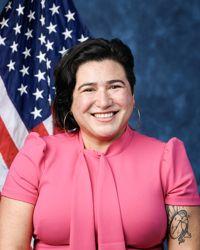
U.S. Representative for Washington’s 6th district
Democrat
119th Congress, two-year term
Missed 3.0% of roll calls. Chamber median 1.9%.
The full voting recordCounts roll calls where most Democrats and most Republicans voted differently, leaving out procedural votes.
How we countFrom FEC filings, Voteview roll calls and Congress.gov.
Democrat. In Congress since 2025, 1 term in total.
Following saves Randall to your list, which Chamber & Street keeps on its server, linked to a cookie on this browser and not to your name or email. Email alerts will come with constituent verification.
Bills and resolutions Randall signed on to as a cosponsor. An original cosponsor signed on the day the bill was introduced. Source: govinfo bill status files, last updated Nov 6, 2026.
Expanding Access to Mental Health Services in Schools Act of 2025
Sponsor Rosa DeLauro (D). Joined Oct 21, 2025. 130 cosponsors. H.R. 4253 on Congress.gov
Introduced
Family Vaccine Protection Act
Sponsor Frank Pallone (D). Joined Oct 21, 2025. 80 cosponsors. H.R. 3701 on Congress.gov(opens in a new tab)
Introduced
Food Secure Strikers Act of 2025
Sponsor Alma Adams (D). Joined Oct 21, 2025. 89 cosponsors. H.R. 2357 on Congress.gov(opens in a new tab)
Introduced
Food Secure Strikers Act of 2025
This bill allows certain striking workers and their households to maintain their eligibility for the Supplemental Nutrition Assistance Program (SNAP).
Specifically, the bill provides that a household that would otherwise be eligible to participate in SNAP is eligible for benefits if any member of the household is on strike because of a labor dispute. Current law generally prohibits a household from participating in SNAP if any member of the household is on strike unless the household was eligible for SNAP immediately prior to the strike. Also, under current law, households are not eligible for an increased SNAP allotment as a result of the decreased income of a striking member of the household. The bill expands SNAP eligibility for households with striking workers by repealing both of these restrictions.
The bill also allows a government employee who is dismissed for striking and their household to maintain SNAP program eligibility. Specifically, current law prohibits certain individuals who voluntarily and without good cause quit a job from participating in SNAP. Further, a federal, state, or local government employee who participates in a strike against the government that results in their dismissal is considered to have voluntarily quit without good cause. The bill eliminates the provision that considers the dismissed government employee to have voluntarily quit without good cause, thereby allowing the employee and their household to maintain SNAP program eligibility if they are otherwise eligible for the program.
Head Start Shutdown Protection Act of 2025
Sponsor Maxine Waters (D). Original cosponsor. 55 cosponsors. H.R. 5790 on Congress.gov(opens in a new tab)
Introduced
Head Start Shutdown Protection Act of 2025
This bill requires the Department of Health and Human Services to reimburse a state, local government, or school district that uses its funds to maintain participation in the Head Start program or the Early Head Start program during a government shutdown in which there is a lapse in federal appropriations for the programs.
The Head Start programs provide comprehensive early childhood education and development services to low-income children. The programs seek to promote school readiness through the provision of educational, health, nutritional, social, and other services.
Voter Purge Protection Act
Sponsor Joyce Beatty (D). Joined Oct 17, 2025. 28 cosponsors. H.R. 5707 on Congress.gov(opens in a new tab)
Introduced
Voter Purge Protection Act
This bill prohibits a state from removing registrants from the official list of eligible voters unless it meets certain verification and notice requirements.
Specifically, the bill prohibits a state from removing a registrant from the official list of eligible voters unless it verifies, on the basis of objective and reliable evidence, that the registrant is ineligible to vote in federal elections. Further, a state is prohibited from considering failure to vote in an election or failure to respond to a notice as evidence of ineligibility to vote.
Additionally, the bill requires a state to provide individual registrants who are removed with a notice, which must include the grounds for the removal and information on contesting the removal. Public notice must be provided after conducting any general program to remove the names of ineligible voters.
Shutdown Guidance for Financial Institutions Act
Sponsor Suhas Subramanyam (D). Joined Oct 17, 2025. 22 cosponsors. H.R. 5689 on Congress.gov(opens in a new tab)
Introduced
Shutdown Guidance for Financial Institutions Act
This bill directs financial regulators—including the Federal Reserve Board, the Consumer Financial Protection Bureau, the Office of the Comptroller of the Currency, the Federal Deposit Insurance Corporation, and the National Credit Union Administration—to jointly issue guidance relating to a government shutdown.
Specifically, financial regulators must issue guidance encouraging financial institutions to
• work with consumers and businesses affected by a shutdown,
• recognize that consumers and businesses affected by a shutdown may lose access to credit and face temporary hardship in making payments on debts,
• consider efforts to modify terms on existing loans or extend new credit to assist consumers and businesses affected by a shutdown, and
• take steps to prevent adverse credit information from being reported in a manner that harms consumers affected by a shutdown.
In addition, financial regulators must jointly issue a press release to notify financial institutions, consumers, and businesses of this guidance in the event of a government shutdown.
Financial regulators must also complete a report after a government shutdown regarding the guidance's effectiveness and update the guidance if any shortcoming are identified in the report.
RRLEF Act of 2025
Sponsor Gabe Amo (D). Joined Oct 17, 2025. 29 cosponsors. H.R. 5453 on Congress.gov(opens in a new tab)
Introduced
Responsible Retirement of Law Enforcement Firearms Act of 2025 or the RRLEF Act of 2025
This bill establishes a framework to limit the transfer of firearms to and purchase from federally licensed gun dealers whose firearms have a short time to crime. The term short time to crime means a period of three years or less between the date of the last known retail sale of a firearm and the date a firearm is recovered in an actual or suspected criminal offense.
Specifically, the bill directs the Bureau of Alcohol, Tobacco, Firearms and Explosives (ATF) to notify a state or local law enforcement agency if a firearm transferred by the agency is used, or suspected of being used, in the commission of a criminal offense, as traced by the National Tracing Center.
Additionally, the bill directs the ATF to publish annually a list of federally licensed gun dealers who have 25 or more traces of firearms with a short time to crime in at least two of the three previous years.
The bill prohibits a state (including the District of Columbia), territory, or local government that receives funds under the Edward Byrne Memorial Justice Assistance Grant Program from transferring a firearm to, or purchasing a firearm from, a dealer on the list.
The bill removes limits on the authority of the ATF to disclose firearms tracing data.
Saving the Civil Service Act
Joined Oct 17, 2025. 112 cosponsors. H.R. 492 on Congress.gov(opens in a new tab)
Progress not on file
Saving the Civil Service Act
This bill generally prohibits changes to the classification of positions in the competitive service and excepted service unless certain conditions are met. (Competitive service positions are subject to competitive examination while excepted service positions are appointed under one of five schedules. Competitive service positions have notice and appeal requirements for adverse actions that are not applicable to most excepted positions, including those of a confidential, policy-determining, policy-making, or policy-advocating character under Schedule C.)
On October 21, 2020, President Donald Trump issued an executive order that placed executive agency positions that are of a confidential, policy-determining, policy-making, or policy-advocating character, and that are not normally subject to change as a result of a presidential transition, under a new Schedule F in the excepted service. The order was subsequently revoked by President Joe Biden.
The bill prohibits executive agency positions in the competitive service from being placed in the excepted service, unless such positions are placed in a schedule in the excepted service as in effect on September 30, 2020. The bill also prohibits positions in the excepted service from being placed in any schedule other than the aforementioned schedules.
Additionally, agencies may not (1) transfer occupied positions from the competitive or excepted service into Schedule C without the consent of the Office of Personnel Management, or (2) transfer employees in the excepted service to another schedule or transfer employees in the competitive service to the excepted service without employee consent.
SHIPS for America Act of 2025
Sponsor Trent Kelly (R). Joined Oct 17, 2025. 146 cosponsors. H.R. 3151 on Congress.gov(opens in a new tab)
Introduced
Abortion Care Awareness Act of 2025
Sponsor Jasmine Crockett (D). Joined Oct 17, 2025. 52 cosponsors. H.R. 2497 on Congress.gov(opens in a new tab)
Introduced
Protecting Students with Disabilities Act
Sponsor John Mannion (D). Joined Oct 17, 2025. 39 cosponsors. H.R. 2333 on Congress.gov(opens in a new tab)
Introduced
Protecting Students with Disabilities Act
This bill prohibits the use of appropriated funds to eliminate the Department of Education's (ED's) oversight of the Individuals with Disabilities Education Act (IDEA). (The IDEA authorizes grant programs that support special education and early intervention services for children with disabilities. Currently, the IDEA is administered by the Office of Special Education Programs in the Office of Special Education and Rehabilitative Services in ED.)
Specifically, the bill prohibits the use of appropriated funds to eliminate, consolidate, or otherwise restructure any office within ED that administers or enforces programs under the IDEA.
Further, appropriated funds may not be used to (1) terminate, reassign, or alter the responsibilities of any personnel of any such office; or (2) contract with, or delegate to, any entity outside of ED to administer or enforce IDEA programs.
(On March 20, 2025, President Donald Trump signed an executive order titled Improving Education Outcomes by Empowering Parents, States, and Communities, calling for the closure of ED and giving authority over education to the states. Further, the Trump Administration has announced plans to transfer ED's oversight of services for students with disabilities to the Department of Health and Human Services.)
Stop Comstock Act
Sponsor Becca Balint (D). Joined Oct 17, 2025. 146 cosponsors. H.R. 2029 on Congress.gov(opens in a new tab)
Introduced
Proposing an amendment to the Constitution of the United States relating to the authority of Congress and the States to regulate contributions and expenditures intended to affect elections and to enact public financing systems for political campaigns.
Sponsor Joe Neguse (D). Joined Oct 17, 2025. 113 cosponsors. H.J.Res. 122 on Congress.gov(opens in a new tab)
Introduced
This joint resolution proposes a constitutional amendment authorizing Congress and the states to (1) regulate and impose reasonable viewpoint-neutral limitations on the raising and spending of money by candidates and others to influence elections; and (2) regulate and enact public campaign financing systems, including those designed to restrict the influence of private wealth by offsetting the raising and spending of money by candidates and others with increased public funding.
The amendment grants Congress and the states the power to implement and enforce this amendment by legislation. They are allowed to distinguish between natural persons and corporations or other artificial entities created by law, including by prohibiting such entities from spending money to influence elections.
Proposing an amendment to the Constitution of the United States providing that there is no immunity from criminal prosecution for an act on the grounds that such act was within the constitutional authority or official duties of an individual, and providing that the President may not grant a pardon to himself or herself.
Sponsor Joseph Morelle (D). Joined Oct 17, 2025. 187 cosponsors. H.J.Res. 108 on Congress.gov(opens in a new tab)
Introduced
Of inquiry requesting the President to transmit certain information to the House of Representatives referring to the firings, dismissal, reduction in force, or withholding of pay for the period of the lapse in appropriations of furloughed employees of the United States Government.
Sponsor Kweisi Mfume (D). Original cosponsor. 23 cosponsors. H.Res. 807 on Congress.gov(opens in a new tab)
Introduced
This resolution requests that the President submit certain information to Congress regarding a reduction in force or the withholding of pay due to the lapse in appropriations (i.e., government shutdown) that began on October 1, 2025.
Specifically, the resolution requests that the President submit to Congress any and all documents and communications related to
• any proposed reduction in force at a federal agency related to the lapse in appropriations,
• efforts to create a legal determination at the Office of Management and Budget finding or suggesting that the Government Employee Fair Treatment Act of 2019 does not create a self-executing requirement that furloughed federal employees must receive pay for the period in which they were furloughed during a lapse in appropriations immediately after the lapse in appropriations ends, and
• efforts or plans to withhold pay for the period of the lapse of appropriations for excepted or furloughed federal or District of Columbia employees.
The resolution also requests that the President submit to Congress any documents or communications between the President's office, the Vice President's office, the Office of Personnel Management, the Office of Management and Budget, the Office of Special Counsel, and the Merit System Protection Board regarding these topics.
Requiring the House of Representatives to convene and hold recorded quorum calls during a Government shutdown, and for other purposes.
Sponsor Jared Moskowitz (D). Joined Oct 14, 2025. 29 cosponsors. H.Res. 802 on Congress.gov(opens in a new tab)
Introduced
This resolution requires the House of Representatives to convene and hold recorded quorum calls during a government shutdown. It also limits recesses and adjournments during a government shutdown.
Under the resolution, a government shutdown occurs when there is a lapse in appropriations for any federal agency or department as a result of a failure to enact a regular appropriations bill or a continuing resolution.
The resolution requires the House to convene on each day on which a government shutdown is in effect unless a recess or adjournment is permitted. Under the resolution, such a recess or adjournment is only permitted if
• the House has met for each of the first five consecutive calendar days on which the government shutdown is in effect,
• the proposed period of adjournment or recess does not last for more than two consecutive calendar days, and
• the House has met for at least five consecutive calendar days since the expiration of the most recent period of adjournment or recess.
The resolution also requires the House to hold at least one recorded quorum call on each day that the House is in session during a government shutdown.
Members of the House who fail to record their presence during a quorum call on two or more consecutive days must be fined $500 for a first offense and $2,500 for any subsequent offense unless the failure is due to an illness. A Member may not use official or campaign funds to pay the fine.
Emergency Relief for Federal Workers Act of 2025
Sponsor Donald Beyer (D). Joined Oct 14, 2025. 38 cosponsors. H.R. 5674 on Congress.gov(opens in a new tab)
Introduced
Veterans Healthcare Equality Act of 2025
Sponsor Timothy Kennedy (D). Joined Oct 14, 2025. 28 cosponsors. H.R. 5635 on Congress.gov(opens in a new tab)
Introduced
Preparing And Retaining All (PARA) Educators Act
Sponsor Lucy McBath (D). Joined Oct 14, 2025. 67 cosponsors. H.R. 5476 on Congress.gov(opens in a new tab)
Introduced
District of Columbia Police Home Rule Act
Sponsor Eleanor Norton (D). Joined Oct 14, 2025. 5 cosponsors. H.R. 5092 on Congress.gov(opens in a new tab)
Introduced
Connected MOM Act
Sponsor Lois Frankel (D). Joined Oct 14, 2025. 12 cosponsors. H.R. 4977 on Congress.gov(opens in a new tab)
Introduced
Connected Maternal Online Monitoring Act or the Connected MOM Act
This bill requires the Centers for Medicare & Medicaid Services to report, and provide resources for states, on coverage of remote physiologic devices and related services (e.g., blood glucose monitors) under Medicaid, so as to improve maternal and child health outcomes for pregnant and postpartum women.
To authorize the reimbursement by the Federal Government of State funds used to maintain participation in the Special Supplemental Nutrition Program for Women, Infants, and Children in the event of a Government shutdown.
Sponsor Gabe Amo (D). Joined Oct 10, 2025. 87 cosponsors. H.R. 5705 on Congress.gov(opens in a new tab)
Introduced
This bill requires the federal government to reimburse state agencies that use state funds to carry out operations necessary to maintain participation in the Special Supplemental Nutrition Program for Women, Infants, and Children (WIC) during a lapse in discretionary appropriations (i.e., government shutdown). WIC provides nutrition-rich foods, nutrition education, and health care and social services referrals to eligible low-income women, infants, and children.
Pay Our Troops Act of 2026
Sponsor Jennifer Kiggans (R). Joined Oct 10, 2025. 210 cosponsors. H.R. 5401 on Congress.gov(opens in a new tab)
Introduced
Pay Our Troops Act of 2026
This bill provides continuing appropriations for military pay for any period during which interim or full-year appropriations for FY2026 are not in effect (i.e., a government shutdown).
Specifically, the bill provides FY2026 continuing appropriations for the pay and allowances of (1) members of the Armed Forces, including reserve components, who perform active service during the period; and (2) civilian personnel and contractors of the Department of Defense (and the Department of Homeland Security in the case of the Coast Guard) who are providing support to such members of the Armed Forces.
If a government shutdown occurs, the bill provides the continuing appropriations until the earlier of (1) the enactment into law of specified appropriations legislation, or (2) January 1, 2027.
Preventing Authoritarian Policing Tactics on America’s Streets Act
Sponsor Suzanne Bonamici (D). Joined Oct 10, 2025. 15 cosponsors. H.R. 4476 on Congress.gov(opens in a new tab)
Introduced
A joint resolution to direct the removal of United States Armed Forces from hostilities that have not been authorized by Congress.
Sponsor Jason Crow (D). Joined Oct 10, 2025. 55 cosponsors. H.J.Res. 126 on Congress.gov(opens in a new tab)
Introduced
This joint resolution directs the President to remove U.S. Armed Forces from hostilities against any organization designated on or after February 20, 2025, as a foreign terrorist organization or specially designated global terrorist, any states in which such entities operate, or any non-state organization engaged in illegal drug trafficking unless a declaration of war or authorization to use military force for such purpose has been enacted.
The resolution specifies that it shall not be construed to prevent the United States from defending itself from an armed attack or the threat of an imminent armed attack or from using the U.S. Armed Forces in support of civil authorities as part of authorized counternarcotics operations.