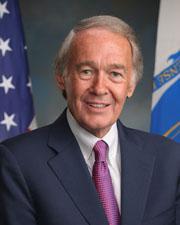
U.S. Senator for Massachusetts
Democrat
Senate term end not loaded yet
Missed 0.8% of roll calls. Chamber median 2.1%.
The full voting recordCounts roll calls where most Democrats and most Republicans voted differently, leaving out procedural votes.
How we countFrom FEC filings, Voteview roll calls and Congress.gov.
Democrat. In Congress since 1975, 23 terms in total.
Following saves Markey to your list, which Chamber & Street keeps on its server, linked to a cookie on this browser and not to your name or email. Email alerts will come with constituent verification.
Bills and resolutions where Markey is the primary sponsor. Most bills never leave committee; that is normal for every member. Source: Congress.gov, last updated Oct 29, 2026.
68 of 164 have at least one cosponsor from the other party.
A resolution honoring the life of Dr. Paul Farmer by recognizing the duty of the Federal Government to adopt a 21st century global health solidarity strategy and take actions to address past and ongoing harms that undermine the health and well-being of people around the world.
Introduced Jul 31, 2025. 1 cosponsor. S.Res. 358 on Congress.gov
Introduced
This resolution expresses the sense that
• the federal government should adopt a global health solidarity strategy to end medically unnecessary deaths and respond to the full burden of disease in poor countries;
• the federal government should use laws and diplomatic influence to stop ongoing economic harms to developing countries; and
• it is the duty of the federal government to issue reparations, including for slavery and colonialism.
Warehouse Worker Protection Act
Introduced Jul 31, 2025. 12 cosponsors, 3 from the other party. S. 2613 on Congress.gov(opens in a new tab)
Introduced
Gun Violence Prevention Research Act of 2025
Introduced Jul 29, 2025. 32 cosponsors, 2 from the other party. S. 2514 on Congress.gov(opens in a new tab)
Introduced
All Aboard Act of 2025
Introduced Jul 29, 2025. 10 cosponsors, 1 from the other party. S. 2520 on Congress.gov(opens in a new tab)
Introduced
End Solitary Confinement Act
Introduced Jul 28, 2025. 5 cosponsors, 1 from the other party. S. 2477 on Congress.gov(opens in a new tab)
Introduced
End Solitary Confinement Act
This bill restricts the use of solitary confinement and establishes minimum standards for incarceration at the federal, state, and local levels.
At the federal level, the bill generally prohibits the use of solitary confinement in federal facilities with limited exceptions, such as if necessary to de-escalate an emergency situation. The bill also establishes minimum standards for incarceration, including at least 14 hours per day of out-of-cell congregate interaction in a shared space that is conducive to meaningful group interaction.
The bill requires state and local governments to implement laws, policies, and programs that substantially comply with the restrictions on solitary confinement and minimum standards for incarceration in order to receive full funding under the Edward Byrne Memorial Justice Assistance Grant program.
The bill establishes an independent community monitoring body, as well as an advisory body of stakeholders, to help provide oversight.
Finally, the bill allows a prisoner to file a federal civil action for mental or emotional injury suffered if there is a prior showing of placement in solitary confinement or an alternative unit.
Disability and Age in Jury Service Nondiscrimination Act
Introduced Jul 28, 2025. 12 cosponsors, 1 from the other party. S. 2476 on Congress.gov(opens in a new tab)
Introduced
Disability and Age in Jury Service Nondiscrimination Act
This bill prohibits the exclusion of individuals from jury service on the basis of their disability or age.
Further, the bill prohibits the disqualification of individuals from jury service who fail to meet certain qualifications (e.g., adequate proficiency in English) on the basis of their disability if reasonable accommodations can be made.
Freedom to Move Act
Introduced Jul 28, 2025. 1 cosponsor. S. 2478 on Congress.gov(opens in a new tab)
Introduced
Freedom to Move Act
This bill directs the Department of Transportation to award competitive five-year grants (i.e., Freedom to Move Grants) to states, local governments, transit agencies, and nonprofit organizations in both rural and urban areas to cover the lost fare revenue for fare-free public transportation and improve public transportation.
Grants must be used to support (1) implementing a fare-free transit program; and (2) efforts to improve public transportation, particularly in underserved communities, such as costs associated with efforts to provide more safe, frequent, and reliable bus service, including bus stop safety and accessibility improvements, and pedestrian and bike shelters.
Community Mental Wellness and Resilience Act of 2025
Introduced Jul 24, 2025. 2 cosponsors. S. 2445 on Congress.gov(opens in a new tab)
Introduced
Pay Paraprofessionals and Support Staff Act
Introduced Jul 24, 2025. 11 cosponsors, 1 from the other party. S. 2451 on Congress.gov(opens in a new tab)
Introduced
ICBM Act
Introduced Jul 23, 2025. 3 cosponsors, 1 from the other party. S. 2422 on Congress.gov(opens in a new tab)
Introduced
Climate Change Health Protection and Promotion Act of 2025
Introduced Jul 17, 2025. 3 cosponsors. S. 2340 on Congress.gov(opens in a new tab)
Introduced
Ensuring Safe and Toxic-Free Foods Act of 2025
Introduced Jul 17, 2025. 4 cosponsors. S. 2341 on Congress.gov(opens in a new tab)
Introduced
Ensuring Safe and Toxic-Free Foods Act of 2025
This bill limits the circumstances in which a food additive may be considered generally recognized as safe (GRAS) and requires the Food and Drug Administration (FDA) to review the safety of all such additives.
Under current law, food additives generally require pre-market FDA approval unless they are considered GRAS (generally recognized among qualified experts as safe for their intended use). When a manufacturer determines that an additive is GRAS, it may, but is not required to, notify the FDA of that determination. Under the bill, before an additive may be used in food, it must be (1) approved by the FDA, or (2) the subject of a GRAS notification submitted up to two years after the bill’s enactment to which the FDA has not objected.
GRAS notifications submitted after enactment must include specified supporting information. The FDA must publish and seek public comment on such notifications. The FDA must ultimately publish a written determination stating whether it objects to the GRAS determination along with its reasoning.
The FDA may also reassess GRAS notifications submitted before the bill’s enactment and require a manufacturer to submit the same supporting information required of post-enactment notifications.
The FDA must annually review or reassess at least 50 GRAS notifications until all notifications have been reviewed or reassessed. Separately, the FDA must regularly reassess the safety of approved food additives and those considered GRAS.
Finally, the bill makes toxic and carcinogenic substances ineligible to be considered GRAS.
Preparing And Retaining All (PARA) Educators Act
Introduced Jul 17, 2025. 11 cosponsors, 1 from the other party. S. 2330 on Congress.gov(opens in a new tab)
Introduced
A resolution urging the United States to lead a global effort to halt and reverse the nuclear arms race.
Introduced Jul 16, 2025. 9 cosponsors, 1 from the other party. S.Res. 323 on Congress.gov(opens in a new tab)
Introduced
State-Based Universal Health Care Act of 2025
Introduced Jul 15, 2025. 3 cosponsors. S. 2286 on Congress.gov(opens in a new tab)
Introduced
A resolution recognizing that climate change poses a growing threat to public health and necessitates coordinated action to mitigate its impacts and safeguard the health and well-being of all people in the United States.
Introduced Jul 10, 2025. 4 cosponsors. S.Res. 318 on Congress.gov(opens in a new tab)
Introduced
SOS Act of 2025
Introduced Jul 10, 2025. 0 cosponsors. S. 2246 on Congress.gov(opens in a new tab)
Introduced
GLOBE Act of 2025
Introduced Jul 9, 2025. 20 cosponsors, 1 from the other party. S. 2231 on Congress.gov(opens in a new tab)
Introduced
Expanding the Surety Bond Program Act of 2025
Introduced Jul 9, 2025. 0 cosponsors. S. 2232 on Congress.gov(opens in a new tab)
Passed the Senate
LGBTQ+ Panic Defense Prohibition Act of 2025
Introduced Jun 27, 2025. 14 cosponsors, 1 from the other party. S. 2201 on Congress.gov(opens in a new tab)
Introduced
LGBTQ+ Panic Defense Prohibition Act of 2025
This bill generally prohibits a federal criminal defendant from asserting, as a defense, that the nonviolent sexual advance of an individual or a perception or belief of the gender, gender identity or expression, or sexual orientation of an individual excuses or justifies conduct or mitigates the severity of an offense.
3D Printed Gun Safety Act of 2025
Introduced Jun 25, 2025. 23 cosponsors, 1 from the other party. S. 2165 on Congress.gov(opens in a new tab)
Introduced
3D Printed Gun Safety Act of 2025
This bill makes it unlawful to intentionally publish digital instructions that can automatically program a three-dimensional printer or similar device to produce or complete a firearm from an unfinished frame or receiver.
NRC Office of Public Engagement and Participation Act of 2025
Introduced Jun 25, 2025. 1 cosponsor. S. 2161 on Congress.gov(opens in a new tab)
Introduced
MASS Act
Introduced Jun 24, 2025. 1 cosponsor. S. 2156 on Congress.gov(opens in a new tab)
Introduced
Making America Safe and Secure Act of 2025 or the MASS Act
This bill authorizes grants for states to implement or maintain firearms and firearms dealer licensing requirements.
A state's requirements must incorporate certain elements, including the following:
• an individual must have a firearms license at the time of acquiring, and during the entire period of possessing, a firearm or ammunition; and
• an individual who sells, rents, or leases a minimum number of firearms, or sells ammunition, must obtain a firearms dealer license.
Gun Violence Prevention Through Financial Intelligence Act
Introduced Jun 24, 2025. 4 cosponsors. S. 2157 on Congress.gov(opens in a new tab)
Introduced
Keeping Gun Dealers Honest Act of 2025
Introduced Jun 24, 2025. 13 cosponsors. S. 2155 on Congress.gov(opens in a new tab)
Introduced
Keeping Gun Dealers Honest Act of 2025
This bill broadens the authority of the Bureau of Alcohol, Tobacco, Firearms and Explosives (ATF) to administer federal laws governing the licensing, inspection, and enforcement of federally licensed dealers, importers, and manufacturers of firearms (federal firearms licensees, or FFLs). The bill also increases criminal penalties for FFLs and licensed collectors who commit certain recordkeeping violations.
With respect to licensing, the bill allows the ATF to deny an application for a federal firearms license if it would endanger public safety or if the applicant is unlikely to comply with the law.
Additionally, the bill enhances the ATF's inspection authority, including by increasing the maximum number of annual compliance inspections to three (currently, one) and by authorizing an additional 80 personnel to conduct inspections.
The bill also expands the ATF's enforcement authority, including by allowing it to suspend the license of or impose a civil penalty on an FFL who violates federal firearms laws or regulations and by allowing it to require an FFL to conduct physical inventories if the FFL unlawfully transfers a firearm or if 10 or more firearms used in a crime are traced back to the FFL.
Finally, the bill increases the maximum prison term to five years (currently, one year) for an FFL or licensed collector who knowingly makes a false statement or representation in required firearms records.