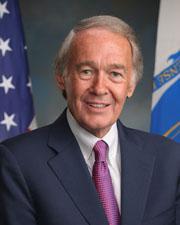
U.S. Senator for Massachusetts
Democrat
Senate term end not loaded yet
Missed 0.8% of roll calls. Chamber median 2.1%.
The full voting recordCounts roll calls where most Democrats and most Republicans voted differently, leaving out procedural votes.
How we countFrom FEC filings, Voteview roll calls and Congress.gov.
Democrat. In Congress since 1975, 23 terms in total.
Following saves Markey to your list, which Chamber & Street keeps on its server, linked to a cookie on this browser and not to your name or email. Email alerts will come with constituent verification.
Bills and resolutions Markey signed on to as a cosponsor. An original cosponsor signed on the day the bill was introduced. Source: govinfo bill status files, last updated Nov 6, 2026.
Markey also withdrew as a cosponsor from 1 bill, not listed here.
Protecting Sensitive Locations Act
Sponsor Richard Blumenthal (D). Original cosponsor. 33 cosponsors. S. 455 on Congress.gov
Introduced
Protecting Sensitive Locations Act
This bill prohibits immigration enforcement actions within 1,000 feet of a sensitive location except in exigent circumstances, such as the imminent risk of death, violence, or physical harm to any person.
Sensitive locations include
• health care facilities;
• schools and school bus stops;
• places that provide assistance for people such as children, pregnant women, and abuse victims;
• child care facilities;
• places that provide disaster or emergency services;
• places of worship;
• courthouses and lawyers’ offices;
• facilities used as polling places;
• certain labor union facilities; and
• public assistance offices.
The prohibition shall apply to Department of Homeland Security officers and agents, as well as state employees pursuing immigration enforcement actions.
If an enforcement action is carried out in violation of this prohibition (1) no information resulting from the action may be entered into the record in a resulting removal proceeding, and (2) the affected individual may move to immediately terminate such a proceeding.
U.S. Immigration and Customs Enforcement and U.S. Customs and Border Protection shall annually report to Congress about enforcement actions taken at sensitive locations in the preceding year.
Carried Interest Fairness Act of 2025
Sponsor Tammy Baldwin (D). Original cosponsor. 14 cosponsors. S. 445 on Congress.gov(opens in a new tab)
Introduced
Carried Interest Fairness Act of 2025
This bill taxes income from carried interest at ordinary income tax rates and makes other changes related to carried interest. (Some exceptions apply.)
As background, a general partner in a private equity firm or hedge fund (typically structured as a partnership) generally receives a share of the profits from the assets managed by the general partner (known as carried interest). Under current law, carried interest is characterized (for federal tax purposes) as an interest in a partnership’s capital and, thus, taxed at capital gains tax rates (which may be lower than the applicable ordinary income tax rates).
Under the bill, net capital gain and loss attributable to carried interest is recharacterized as ordinary income and loss and, thus, taxed at ordinary income tax rates. (Some exceptions apply.)
The bill also treats as ordinary the money (or fair market value of property) received by a partner in a sale or exchange of carried interest. (Thus, the bill extends what is known as the hot asset rule to include carried interest.)
Further, the bill deems distributions of carried interest by a partnership in exchange for interest in other partnership property a sale or exchange of such property and, thus, requires the partner to recognize ordinary gain on the distributed carried interest.
Finally, the bill imposes self-employment taxes on carried interest income.
No Tax Breaks for Outsourcing Act
Sponsor Sheldon Whitehouse (D). Original cosponsor. 20 cosponsors. S. 409 on Congress.gov(opens in a new tab)
Introduced
A resolution recognizing January 2025 as "National Mentoring Month".
Sponsor Sheldon Whitehouse (D). Original cosponsor. 25 cosponsors. S.Res. 55 on Congress.gov(opens in a new tab)
Passed the Senate
This resolution recognizes January 2025 as National Mentoring Month.
NO BAN Act
Sponsor Christopher Coons (D). Original cosponsor. 36 cosponsors. S. 398 on Congress.gov(opens in a new tab)
Introduced
National Origin-Based Antidiscrimination for Nonimmigrants Act or the NO BAN Act
This bill imposes limitations on the President's authority to suspend or restrict aliens from entering the United States. It also prohibits religious discrimination in various immigration-related decisions, such as whether to issue an immigrant or nonimmigrant visa, unless there is a statutory basis for such discrimination.
The President may temporarily restrict the entry of any aliens or class of aliens after the Department of State determines that the restriction would address specific and credible facts that threaten U.S. interests such as public safety.
The bill also imposes limitations on such restrictions, such as requiring the President, State Department, and the Department of Homeland Security (DHS) to (1) only issue a restriction when required to address a compelling government interest, and (2) narrowly tailor the suspension to use the least restrictive means to achieve such an interest.
Before imposing a restriction, the State Department and DHS shall consult with Congress. The State Department and DHS shall report to Congress about the restriction within 48 hours of the restriction's imposition. If such a report is not made, the restriction shall immediately terminate.
Individuals or entities present in the United States and unlawfully harmed by such a restriction may sue in federal court.
The bill transfers the authority to suspend the entry of aliens traveling to the United States on a commercial airline that failed to comply with regulations related to detecting fraudulent travel documents from the Department of Justice to DHS.
Access to Counsel Act of 2025
Sponsor Alex Padilla (D). Original cosponsor. 18 cosponsors. S. 391 on Congress.gov(opens in a new tab)
Introduced
Access to Counsel Act of 2025
This bill provides various protections for covered individuals subject to secondary or deferred inspections when seeking admission into the United States. Covered individuals include U.S. nationals, lawful permanent residents, non-U.S. nationals (aliens under federal law) in possession of a visa, returning asylees, and refugees.
The Department of Homeland Security must ensure that a covered individual subject to secondary or deferred inspection has a meaningful opportunity to consult with counsel and certain related parties, such as a relative, within an hour of the start of the secondary inspection and as necessary during the inspection process. The counsel and related party must be allowed to advocate on behalf of the covered individual, including by providing evidence and information to the examining immigration officer.
A lawful permanent resident subject to secondary or deferred inspection may not abandon lawful permanent resident status until the individual has had a meaningful opportunity to seek advice from counsel, unless the individual voluntarily and knowingly waives in writing this opportunity to seek counsel's advice.
A resolution expressing the sense of the Senate that the United States Agency for International Development is essential for advancing the national security interests of the United States.
Sponsor Christopher Coons (D). Original cosponsor. 43 cosponsors. S.Res. 51 on Congress.gov(opens in a new tab)
Introduced
This resolution affirms the centrality of the U.S. Agency for International Development for advancing the national security interests of the United States, including by promoting global stability and mitigating threats abroad before they reach the United States.
Keep Our PACT Act
Sponsor Chris Van Hollen (D). Original cosponsor. 24 cosponsors. S. 343 on Congress.gov(opens in a new tab)
Introduced
Keep Our Promise to America's Children and Teachers Act or the Keep Our PACT Act
This bill provides funding through FY2035 for grant programs operated by local educational agencies to provide supplementary educational and related services to low-achieving students and other students who attend elementary and secondary schools with relatively high concentrations of students from low-income families. Additionally, the bill permanently reauthorizes the grant program to assist states and outlying areas in providing special education and related services to children with disabilities.
The amounts provided by the bill are designated as an emergency requirement for the purposes of Pay-As-You-Go (PAYGO) rules and other budget enforcement procedures.
A resolution condemning the pardons for individuals who were found guilty of assaulting Capitol Police Officers.
Sponsor Patty Murray (D). Original cosponsor. 46 cosponsors. S.Res. 42 on Congress.gov(opens in a new tab)
Introduced
This resolution disapproves of pardons for individuals who were found guilty of assaulting U.S. Capitol Police officers.
TICKET Act
Sponsor Eric Schmitt (R). Original cosponsor. 1 cosponsor. S. 281 on Congress.gov(opens in a new tab)
Passed committee
Transparency In Charges for Key Events Ticketing Act or the TICKET Act
This bill requires ticket sellers (including sellers on the secondary market) for concerts, performances, sporting events, and similar activities to clearly and prominently disclose the total ticket price for the event at the time the ticket is first displayed to an individual (and anytime thereafter during the purchasing process). Prior to completing a purchase, ticket sellers also must provide an itemized list of the base ticket price and each fee (e.g., service fee, processing fee, or other charge). The total ticket price must also be disclosed in any advertisement, marketing, or price list.
Additionally, a ticket seller, secondary market seller, or ticket exchange that does not have actual or constructive possession of an event ticket is prohibited from selling or advertising a ticket for the event. However, a secondary market seller or exchange may sell or advertise a service to obtain an event ticket for an individual if the seller or exchange (1) does not market the service as an event ticket, (2) maintains a clear separation between the provided service and the event tickets throughout the entire purchasing process, and (3) clearly discloses that the service is not an event ticket.
The bill establishes additional disclosure requirements for ticket sellers, secondary market sellers, and ticket exchanges, and requires such entities to issue a refund for the total ticket price if an event is canceled or postponed.
The Federal Trade Commission must enforce these requirements.
Global Health, Empowerment and Rights Act
Sponsor Jeanne Shaheen (D). Original cosponsor. 42 cosponsors. S. 280 on Congress.gov(opens in a new tab)
Introduced
A resolution expressing the sense of the Senate that the people of the United States should have continuous access to timely, up-to-date, and accurate health information.
Sponsor Brian Schatz (D). Original cosponsor. 11 cosponsors. S.Res. 37 on Congress.gov(opens in a new tab)
Introduced
This resolution expresses the Senate’s sense that the Department of Health and Human Services should provide the public with continuous access to timely, up-to-date, and accurate health information.
Honoring Our Fallen Heroes Act of 2025
Sponsor Amy Klobuchar (D). Original cosponsor. 59 cosponsors. S. 237 on Congress.gov(opens in a new tab)
Passed committee
Honoring Our Fallen Heroes Act of 2025
This bill extends death and disability benefits under the Public Safety Officers' Benefits Program (PSOB) to certain public safety officers who suffer from exposure-related cancer while on duty and their survivors. The PSOB program provides death, disability, and education benefits to public safety officers who are killed or injured in the line of duty and their survivors.
The bill specifies that exposure to a carcinogen shall be presumed to constitute a personal injury in the line of duty if
• the exposure occurred while the officer was in the line of duty;
• the officer began serving as an officer not fewer than 5 years before the date of the diagnosis of an exposure-related cancer and the diagnosis occurred not more than 15 years after the last date of active service; and
• the exposure-related cancer directly and proximately resulted in the death or permanent and total disability of the officer.
The Department of Justice's Bureau of Justice Assistance must periodically review the definition of exposure-related cancer and update the definition if appropriate based on medical evidence and in accordance with the requirements of a petition process.
Neighbors Not Enemies Act
Sponsor Mazie Hirono (D). Original cosponsor. 10 cosponsors. S. 193 on Congress.gov(opens in a new tab)
Introduced
Neighbors Not Enemies Act
This bill repeals provisions authorizing the President to apprehend and remove from the United States the citizens of a particular nation, if the United States has declared war against that nation or that nation has threatened an invasion against the United States.
Saving the Civil Service Act
Sponsor Timothy Kaine (D). Original cosponsor. 24 cosponsors. S. 134 on Congress.gov(opens in a new tab)
Introduced
Saving the Civil Service Act
This bill generally prohibits changes to the classification of positions in the competitive service and excepted service unless certain conditions are met. (Competitive service positions are subject to competitive examination while excepted service positions are appointed under one of five schedules. Competitive service positions have notice and appeal requirements for adverse actions that are not applicable to most excepted positions, including those of a confidential, policy-determining, policy-making, or policy-advocating character under Schedule C.)
On October 21, 2020, President Donald Trump issued an executive order that placed executive agency positions that are of a confidential, policy-determining, policy-making, or policy-advocating character, and that are not normally subject to change as a result of a presidential transition, under a new Schedule F in the excepted service. The order was subsequently revoked by President Joe Biden.
The bill prohibits executive agency positions in the competitive service from being placed in the excepted service, unless such positions are placed in a schedule in the excepted service as in effect on September 30, 2020. The bill also prohibits positions in the excepted service from being placed in any schedule other than the aforementioned schedules.
Additionally, agencies may not (1) transfer occupied positions from the competitive or excepted service into Schedule C without the consent of the Office of Personnel Management, or (2) transfer employees in the excepted service to another schedule or transfer employees in the competitive service to the excepted service without employee consent.
Competition and Antitrust Law Enforcement Reform Act of 2025
Sponsor Amy Klobuchar (D). Original cosponsor. 13 cosponsors. S. 130 on Congress.gov(opens in a new tab)
Introduced
Competition and Antitrust Law Enforcement Reform Act of 2025
This bill revises antitrust laws applicable to mergers and anticompetitive conduct.
Specifically, the bill applies a stricter standard for permissible mergers by prohibiting mergers that (1) create an appreciable risk of materially lessening competition, or (2) create a monopsony (i.e., where a single buyer or employer has sufficient market power to lower the price of goods or wages due to a lack of competition)
Additionally, for some large mergers or mergers that concentrate markets beyond a certain threshold, the bill shifts the burden of proof to the merging parties to prove that the merger does not violate the law.
The bill also prohibits exclusionary conduct that presents an appreciable risk of harming competition.
No predispute arbitration agreements or predispute joint-action waivers are valid or enforceable with respect to an antitrust dispute.
The bill also establishes monetary penalties for violations, requires annual reporting for certain mergers and acquisitions, establishes within the Federal Trade Commission (FTC) the Office of the Competition Advocate, and sets forth whistleblower protections.
The Government Accountability Office must report on (1) the success of merger remedies required by the Department of Justice or the FTC in recent consent decrees; and (2) the impact of mergers and acquisitions on wages, employment, innovation, and new business formation.
FAIR Act
Sponsor Brian Schatz (D). Original cosponsor. 16 cosponsors. S. 126 on Congress.gov(opens in a new tab)
Introduced
Federal Adjustment of Income Rates Act or the FAIR Act
This bill modifies pay rates for federal employees in 2026. Specifically, the bill increases rates under the statutory pay systems and for prevailing rate employees by 3.3% and increases locality pay by 1%.
Inaugural Committee Transparency Act of 2025
Sponsor Catherine Cortez Masto (D). Original cosponsor. 4 cosponsors. S. 118 on Congress.gov(opens in a new tab)
Introduced
Inaugural Committee Transparency Act of 2025
This bill requires the presidential inaugural committee to disclose to the Federal Election Commission, by 90 days after the presidential inaugural ceremony, any disbursement made in an amount equal to or greater than $200 and the purpose of each disbursement. The committee must also disclose the name and address of the person to whom the disbursement was made, the date of the disbursement, and the total amount and purpose of the disbursement.
The bill prohibits (1) an inaugural committee from soliciting or receiving a donation from a foreign national, in addition to the current ban on a committee accepting such a donation; (2) a person from making a donation to an inaugural committee in the name of another; (3) a foreign national from making a donation or making a promise to make a donation to such a committee; or (4) converting a donation to an inaugural committee to personal use.
The committee must disburse any remaining donated funds not later than 90 days after the inaugural ceremony to tax-exempt charitable organizations, but may request an extension of such 90-day period.
A resolution honoring the life and legacy of President Jimmy Carter and commending President Jimmy Carter for his life-long career of public service, humanitarian leadership, diplomacy, and courageous advocacy.
Sponsor Raphael Warnock (D). Original cosponsor. 98 cosponsors. S.Res. 19 on Congress.gov(opens in a new tab)
Passed the Senate
This resolution (1) mourns the passing of former President Jimmy Carter and extends sympathy to his family; and (2) honors his life, legacy, and contributions to the United States.
Washington, D.C. Admission Act
Sponsor Chris Van Hollen (D). Original cosponsor. 43 cosponsors. S. 51 on Congress.gov(opens in a new tab)
Introduced
Washington, D.C. Admission Act
This bill provides for the establishment of the State of Washington, Douglass Commonwealth, and its admission into the United States.
The state is composed of most of the territory of the District of Columbia (DC), excluding a specified area that encompasses the U.S. Capitol, the White House, the U.S. Supreme Court building, federal monuments, and federal office buildings adjacent to the National Mall and the U.S. Capitol. The excluded territory shall be known as the Capital and serve as the seat of the government of the United States, as provided for in Article I of the Constitution. The state may not impose taxes on federal property except as Congress permits.
The bill provides for the DC Mayor to issue a proclamation for the first elections to Congress of two Senators and one Representative of the state. The bill eliminates the office of Delegate to the House of Representatives.
The bill applies current DC laws to the state. DC judicial proceedings and contractual obligations shall continue under the state’s authority. The bill also provides for specified federal obligations to transfer to the state upon its certification that it has funds and laws in place to assume the obligations. These include maintaining a retirement fund for judges and operating public defender services.
The bill establishes a commission that is generally comprised of members who are appointed by DC and federal government officials to advise on an orderly transition to statehood.
Health Care Affordability Act of 2025
Sponsor Jeanne Shaheen (D). Original cosponsor. 44 cosponsors. S. 46 on Congress.gov(opens in a new tab)
Introduced
Health Care Affordability Act of 2025
This bill makes permanent temporary changes enacted by the American Rescue Plan Act of 2021 (ARPA) and the Inflation Reduction Act of 2022 (IRA) that generally expand eligibility for and increase the amount of the premium tax credit.
Currently, eligible taxpayers may be able to claim the premium tax credit, which applies toward the cost of obtaining health insurance through health insurance exchanges. To be eligible for the premium tax credit, a taxpayer’s household income must meet or exceed 100% of the federal poverty level (FPL) and, after 2025, may not exceed 400% of the FPL (maximum income limit). For 2021-2025, the ARPA and IRA eliminated the maximum income limit, which generally expands eligibility for the premium tax credit.
Further, under current law, the amount of the premium tax credit is (1) generally the plan premium (conditions apply), minus (2) the taxpayer’s household income multiplied by the applicable percentage. The applicable percentage is a specific percentage that varies depending on which of six income ranges (adjusted for inflation after 2025) the taxpayer’s household income falls within. For 2021-2025, the ARPA and IRA lowered the applicable percentages and eliminated the adjustment of the applicable percentages for inflation, which generally increases the amount of the premium tax credit.
The bill makes permanent the elimination of the 400% maximum income limit, the lower applicable percentages, and the elimination of the inflation adjustment for the applicable percentages.
Commission to Study and Develop Reparation Proposals for African Americans Act
Sponsor Cory Booker (D). Original cosponsor. 20 cosponsors. S. 40 on Congress.gov(opens in a new tab)
Introduced
Commission to Study and Develop Reparation Proposals for African Americans Act
This bill establishes the Commission to Study and Develop Reparation Proposals for African Americans.
The commission must (1) compile documentary evidence of slavery in the United States; (2) study the role of the federal and state governments in supporting the institution of slavery; (3) analyze discriminatory laws and policies against formerly enslaved Africans and their descendants; and (4) recommend ways the United States may recognize and remedy the effects of slavery and discrimination on African Americans, including through a formal apology and compensation (i.e., reparations).
The commission consists of individuals from civil society and reparations organizations and individuals appointed by the President and congressional leadership. The commission may hold hearings, subpoena witnesses and records, and contract with other entities to conduct its work.
The commission must submit its final report within one year of its first meeting.
Sunshine Protection Act of 2025
Sponsor Rick Scott (R). Original cosponsor. 18 cosponsors. S. 29 on Congress.gov(opens in a new tab)
Introduced
Sunshine Protection Act of 2025
This bill makes daylight saving time the new, permanent standard time.
States with areas exempt from daylight saving time may choose the standard time for those areas.
Polluters Pay Climate Fund Act of 2025
Sponsor Chris Van Hollen (D). Original cosponsor. 6 cosponsors. S. 25 on Congress.gov(opens in a new tab)
Introduced