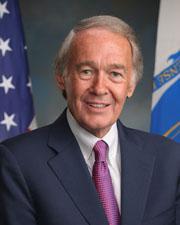
U.S. Senator for Massachusetts
Democrat
Senate term end not loaded yet
Missed 0.8% of roll calls. Chamber median 2.1%.
The full voting recordCounts roll calls where most Democrats and most Republicans voted differently, leaving out procedural votes.
How we countFrom FEC filings, Voteview roll calls and Congress.gov.
Democrat. In Congress since 1975, 23 terms in total.
Following saves Markey to your list, which Chamber & Street keeps on its server, linked to a cookie on this browser and not to your name or email. Email alerts will come with constituent verification.
Bills and resolutions Markey signed on to as a cosponsor. An original cosponsor signed on the day the bill was introduced. Source: govinfo bill status files, last updated Nov 6, 2026.
Markey also withdrew as a cosponsor from 1 bill, not listed here.
Water Affordability, Transparency, Equity, and Reliability Act of 2025
Sponsor Bernie Sanders (I). Original cosponsor. 5 cosponsors. S. 1730 on Congress.gov
Introduced
Due Process Continuity of Care Act
Sponsor Bill Cassidy (R). Original cosponsor. 5 cosponsors. S. 1720 on Congress.gov(opens in a new tab)
Introduced
Due Process Continuity of Care Act
This bill allows an otherwise eligible individual who is in custody pending disposition of charges (i.e., pretrial detainees) to receive Medicaid benefits at the option of the state. The bill also provides for state planning grants to support the provision of such benefits.
Nurse Staffing Standards for Hospital Patient Safety and Quality Care Act of 2025
Sponsor Alex Padilla (D). Original cosponsor. 5 cosponsors. S. 1709 on Congress.gov(opens in a new tab)
Introduced
A resolution recognizing the significance of Asian American, Native Hawaiian, and Pacific Islander Heritage Month as an important time to celebrate the significant contributions of Asian Americans, Native Hawaiians, and Pacific Islanders to the history of the United States.
Sponsor Mazie Hirono (D). Original cosponsor. 29 cosponsors. S.Res. 214 on Congress.gov(opens in a new tab)
Passed the Senate
This resolution recognizes the significance of Asian American, Native Hawaiian, and Pacific Islander Heritage Month as an important time to celebrate the significant contributions of Asian Americans, Native Hawaiians, and Pacific Islanders to the history of the United States.
A resolution supporting the designation of May 10, 2025, as "National Asian American, Native Hawaiian, and Pacific Islander Mental Health Day".
Sponsor Mazie Hirono (D). Original cosponsor. 7 cosponsors. S.Res. 208 on Congress.gov(opens in a new tab)
Introduced
This resolution supports the designation of May 10, 2025, as National Asian American, Native Hawai'ian, and Pacific Islander Mental Health Day.
Traveler Privacy Protection Act of 2025
Sponsor Jeff Merkley (D). Original cosponsor. 5 cosponsors. S. 1691 on Congress.gov(opens in a new tab)
Introduced
Traveler Privacy Protection Act of 2025
This bill limits the use of facial recognition or matching technology (e.g., matching and identification software) in airports for passenger screening.
In general, the bill restricts the Transportation Security Administration’s (TSA’s) use of the technology to performing passenger identity verification at airport screening locations. The TSA must notify passengers prior to each use of the technology and receive affirmative express consent. If a passenger opts out of the use of the technology, then the TSA must perform identity verification using an approved identification document (e.g., a state driver's license) without collecting biometric information (e.g., fingerprints).
For a passenger using a trusted traveler program (e.g., Global Entry), the TSA must provide notice on the use of the technology at the time of program enrollment and renewal and as the passenger approaches the point of identity verification. The passenger must have the option to opt out.
The bill prohibits the TSA from (1) subjecting a passenger who opts out of the screening to discriminatory treatment or less favorable screening conditions; (2) using the technology to track or identify passengers outside of the screening location or to enable systemic, indiscriminate, or wide-scale monitoring, surveillance, or tracking; and (3) sharing biometric information collected through the use of the technology. The bill also limits the amount of time that the TSA may store the information collected.
Further, these restrictions and requirements apply to the TSA's use of the technology in other specified circumstances (e.g., employee screenings).
End Crypto Corruption Act of 2025
Sponsor Jeff Merkley (D). Original cosponsor. 25 cosponsors. S. 1668 on Congress.gov(opens in a new tab)
Passed committee
Therapeutic Fraud Prevention Act of 2025
Sponsor Patty Murray (D). Original cosponsor. 42 cosponsors. S. 1663 on Congress.gov(opens in a new tab)
Introduced
A resolution expressing support for the designation of the week of May 4, 2025, through May 10, 2025, as "National Small Business Week" to celebrate the contributions of small businesses and entrepreneurs in every community in the United States.
Sponsor Joni Ernst (R). Original cosponsor. 81 cosponsors. S.Res. 201 on Congress.gov(opens in a new tab)
Passed the Senate
This resolution honors the contributions of small businesses in the United States and supports the designation of National Small Business Week.
Captive Primate Safety Act
Sponsor Richard Blumenthal (D). Original cosponsor. 11 cosponsors. S. 1594 on Congress.gov(opens in a new tab)
Introduced
A resolution expressing the sense of the Senate that the Secretary of Health and Human Services should withdraw a reduction in public notice and comment opportunities.
Sponsor Ron Wyden (D). Original cosponsor. 18 cosponsors. S.Res. 198 on Congress.gov(opens in a new tab)
Introduced
Assault Weapons Ban of 2025
Sponsor Adam Schiff (D). Original cosponsor. 42 cosponsors. S. 1531 on Congress.gov(opens in a new tab)
Introduced
Assault Weapons Ban of 2025
This bill makes it a crime to knowingly import, sell, manufacture, transfer, or possess a semiautomatic assault weapon (SAW) or large capacity ammunition feeding device (LCAFD).
The prohibition does not apply to a firearm that is (1) manually operated by bolt, pump, lever, or slide action, except for certain shotguns; (2) permanently inoperable; (3) an antique; (4) only capable of firing rimfire ammunition; or (5) a rifle or shotgun specifically identified by make and model.
The bill also exempts from the prohibition the following, with respect to a SAW or LCAFD:
• importation, sale, manufacture, transfer, or possession related to certain law enforcement efforts, or authorized tests or experiments;
• importation, sale, transfer, or possession related to securing nuclear materials; and
• possession by a retired law enforcement officer.
The bill permits continued possession, sale, or transfer of a grandfathered SAW, which must be securely stored. A licensed gun dealer must conduct a background check prior to the sale or transfer of a grandfathered SAW between private parties.
The bill permits continued possession of, but prohibits sale or transfer of, a grandfathered LCAFD.
Newly manufactured LCAFDs must display serial number identification. Newly manufactured SAWs and LCAFDs must display the date of manufacture.
The bill also allows a state or local government to use Edward Byrne Memorial Justice Assistance Grant Program funds to compensate individuals who surrender a SAW or LCAFD under a buy-back program.
Agriculture Resilience Act of 2025
Sponsor Martin Heinrich (D). Original cosponsor. 11 cosponsors. S. 1507 on Congress.gov(opens in a new tab)
Introduced
Agriculture Resilience Act of 2025
This bill establishes, expands, and revises multiple programs and activities of the Department of Agriculture (USDA) primarily to reduce carbon emissions from the agricultural sector.
Specifically, USDA must finalize and implement a plan to achieve net-zero emissions from the sector by 2040. USDA must periodically review and revise the plan, as necessary, and annually report on its implementation.
Additionally, the bill expands the scope of various USDA research, extension, and education programs; conservation programs; and livestock programs to incorporate climate change mitigation and adaptation. Expanded activities include efforts to improve soil health and preserve farmland and grassland.
Further, the bill changes programs that support renewable energy in rural areas to address carbon emissions in the agricultural sector. Among these changes, the bill provides statutory authority for the AgSTAR program for reducing methane emissions from livestock waste and requires the program to be moved from the Environmental Protection Agency to USDA.
The bill also addresses food waste, for example, by (1) standardizing the voluntary labels used by food producers to indicate the date by which food should be used or discarded, and (2) making composting activities eligible for support through USDA conservation programs. Moreover, the bill establishes grants to reduce and prevent food waste in landfills and in schools.
Medicare for All Act
Sponsor Bernie Sanders (I). Original cosponsor. 18 cosponsors. S. 1506 on Congress.gov(opens in a new tab)
Introduced
Medicare for All Act
This bill establishes a national health insurance program that is administered by the Department of Health and Human Services (HHS).
Among other requirements, the program must (1) cover all U.S. residents; (2) provide for automatic enrollment of individuals upon birth or residency in the United States; and (3) cover items and services that are medically necessary or appropriate to maintain health or to diagnose, treat, or rehabilitate a health condition, including hospital services, prescription drugs, mental health and substance abuse treatment, dental and vision services, home- and community-based long-term care, gender affirming care, and reproductive care, including contraception and abortions.
The bill prohibits cost-sharing (e.g., deductibles, coinsurance, and copayments) and other charges for covered services, with the exception of prescription drugs. Additionally, private health insurers and employers may only offer coverage that is supplemental to, and not duplicative of, benefits provided under the program.
Health insurance exchanges and specified federal health programs terminate upon program implementation. However, the program does not affect coverage provided through the Department of Veterans Affairs, TRICARE, or the Indian Health Service. Additionally, state Medicaid programs must cover certain institutional long-term care services.
The bill also establishes a series of implementing provisions relating to (1) health care provider participation; (2) HHS administration; and (3) payments and costs, including the requirement that HHS negotiate prices for prescription drugs and establish a formulary.
Individuals who are age 18 or younger may enroll in the program starting one year after enactment of this bill; other individuals may buy into a transitional plan or an expanded Medicare program at this time, depending on age. The bill's program must be fully implemented four years after enactment.
Equality Act
Sponsor Jeff Merkley (D). Original cosponsor. 46 cosponsors. S. 1503 on Congress.gov(opens in a new tab)
Introduced
Equality Act
This bill prohibits discrimination based on sex, sexual orientation, or gender identity with respect to businesses, employment, housing, federally funded programs, and other settings.
Specifically, the bill expands Title II and Title VI of the Civil Rights Act of 1964 to prohibit public accommodations and federally funded programs, respectively, from discriminating based on sex, sexual orientation, or gender identity. It also includes stores, transit services, recreational facilities, and establishments that provide health care, accounting, or legal services as public accommodations under Title II.
The bill also expands Title IV (desegregation of public schools) and Title VII (employment discrimination) to specifically include sexual orientation and gender identity. (The Supreme Court held in Bostock v. Clayton County that Title VII's prohibition of employment discrimination based on sex also prohibits employment discrimination based on sexual orientation or gender identity.)
The bill similarly expands the Fair Housing Act (discrimination in public and private housing) to include sexual orientation and gender identity. It also prohibits discrimination based on sexual orientation or gender identity by creditors and with respect to jury selection.
The bill defines sex for purposes of the aforementioned provisions to include sex stereotypes, pregnancy, childbirth, sexual orientation, gender identity, and sex characteristics.
Lumbee Fairness Act
Sponsor Thomas Tillis (R). Joined Apr 29, 2025. 20 cosponsors. S. 107 on Congress.gov(opens in a new tab)
Introduced
Lumbee Fairness Act
This bill extends federal recognition to the Lumbee Tribe of North Carolina and makes its members eligible for the services and benefits provided to members of federally recognized tribes.
Members of the tribe residing in Robeson, Cumberland, Hoke, and Scotland Counties in North Carolina are deemed to be within the delivery area for such services.
The Department of the Interior and the Department of Health and Human Services must develop, in consultation with the tribe, a determination of needs to provide the services for which members of the tribe are eligible.
Interior may take land into trust for the benefit of the tribe.
Finally, North Carolina must exercise jurisdiction over all criminal offenses committed, and all civil actions that arise, on North Carolina lands owned by, or held in trust for, the Lumbee Tribe or any dependent Indian community of the tribe unless jurisdiction is transferred to the United States pursuant to an agreement between the tribe and the state.
Early Childhood Nutrition Improvement Act
Sponsor Richard Blumenthal (D). Joined Apr 28, 2025. 7 cosponsors. S. 1447 on Congress.gov(opens in a new tab)
Introduced
Child Care Nutrition Enhancement Act of 2025
Sponsor Richard Blumenthal (D). Joined Apr 28, 2025. 10 cosponsors. S. 1420 on Congress.gov(opens in a new tab)
Introduced
Child Care Nutrition Enhancement Act of 2025
This bill increases and modifies reimbursements for meals and snacks served under the Child and Adult Care Food Program (CACFP).
CACFP is a Food and Nutrition Service program that provides federal reimbursements for meals and snacks provided to eligible children and adults who are enrolled at participating child care centers, day care homes (i.e., private homes that provide nonresidential child care services), and adult day care centers.
Specifically, the bill eliminates the two-tiered system for CACFP reimbursement rates for day care homes and generally makes all day care homes eligible for the same reimbursement rates. Under current law, day care homes located in a low-income area or with a low-income provider receive higher reimbursement rates (i.e., Tier I rates). Day care homes that do not qualify for Tier I rates receive Tier II rates, which are lower.
Further, the bill provides an additional 10-cent reimbursement for each eligible meal and snack served in the CACFP.
The bill also allows the provider of a family or group day care home to serve reimbursable meals and snacks to their own children when serving meals and snacks to children in their care. Specifically, the bill eliminates the current requirement that the child of a day care home provider meet the program's income eligibility requirement in order for the day care provider to receive reimbursement for the meals and snacks served to their child.
A resolution supporting the designation of the week of April 11 through April 17, 2025, as the eighth annual "Black Maternal Health Week", founded by Black Mamas Matter Alliance, Inc., to bring national attention to the maternal and reproductive health crisis in the United States and the importance of reducing maternal mortality and morbidity among Black women and birthing people.
Sponsor Cory Booker (D). Original cosponsor. 18 cosponsors. S.Res. 172 on Congress.gov(opens in a new tab)
Introduced
Anti-Racism in Public Health Act of 2025
Sponsor Elizabeth Warren (D). Original cosponsor. 4 cosponsors. S. 1489 on Congress.gov(opens in a new tab)
Introduced
COAST Anti-Drilling Act of 2025
Sponsor Cory Booker (D). Original cosponsor. 16 cosponsors. S. 1486 on Congress.gov(opens in a new tab)
Introduced
Housing for All Act of 2025
Sponsor Alex Padilla (D). Original cosponsor. 9 cosponsors. S. 1477 on Congress.gov(opens in a new tab)
Introduced
New England Coastal Protection Act
Sponsor Sheldon Whitehouse (D). Original cosponsor. 10 cosponsors. S. 1472 on Congress.gov(opens in a new tab)
Introduced
Homebuyers Privacy Protection Act
Sponsor John Reed (D). Original cosponsor. 45 cosponsors. S. 1467 on Congress.gov(opens in a new tab)
Passed the Senate
Homebuyers Privacy Protection Act
This bill limits the circumstances in which credit reporting agencies may provide consumer credit reports to third parties in connection with residential mortgage transactions.
Specifically, the bill prohibits a credit reporting agency from providing a consumer's credit report to a third party in connection with a residential mortgage transaction unless the transaction consists of a firm offer of credit or insurance and (1) the third party provides documentation certifying that it has the consumer's consent; or (2) the third party has originated a mortgage on behalf of the consumer, is a current mortgage loan servicer to the consumer, or has a current specified banking relationship with the consumer.
These provisions take effect 180 days after the bill's enactment.
Trade Adjustment Assistance Reauthorization Act of 2025
Sponsor Gary Peters (D). Original cosponsor. 13 cosponsors. S. 1449 on Congress.gov(opens in a new tab)
Introduced