
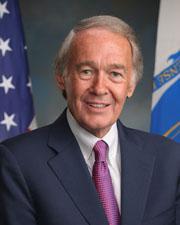
U.S. Senator for Massachusetts
Democrat
Senate term end not loaded yet
Missed 0.8% of roll calls. Chamber median 2.1%.
The full voting recordCounts roll calls where most Democrats and most Republicans voted differently, leaving out procedural votes.
How we countFrom FEC filings, Voteview roll calls and Congress.gov.
Democrat. In Congress since 1975, 23 terms in total.
Following saves Markey to your list, which Chamber & Street keeps on its server, linked to a cookie on this browser and not to your name or email. Email alerts will come with constituent verification.
Bills and resolutions Markey signed on to as a cosponsor. An original cosponsor signed on the day the bill was introduced. Source: govinfo bill status files, last updated Nov 6, 2026.
Markey also withdrew as a cosponsor from 1 bill, not listed here.
A concurrent resolution recognizing a health and safety emergency disproportionately affecting the fundamental rights of children due to the Trump administration's directives that unleash fossil fuels and greenhouse gas emissions that contribute to climate change, while suppressing climate change science.
Sponsor Jeff Merkley (D). Original cosponsor. 12 cosponsors.
Introduced
Access to Birth Control Act
Sponsor Cory Booker (D). Original cosponsor. 25 cosponsors. S. 2302 on Congress.gov(opens in a new tab)
Introduced
A bill to amend section 2112 of title 44, United States Code, to appropriately limit donations to Presidential Libraries and Centers.
Sponsor Elizabeth Warren (D). Original cosponsor. 15 cosponsors. S. 2300 on Congress.gov(opens in a new tab)
Introduced
Asunción Valdivia Heat Illness, Injury, and Fatality Prevention Act of 2025
Sponsor Alex Padilla (D). Original cosponsor. 27 cosponsors. S. 2298 on Congress.gov(opens in a new tab)
Introduced
Tribal Access to Clean Water Act of 2025
Sponsor Michael Bennet (D). Joined Jul 15, 2025. 7 cosponsors. S. 2272 on Congress.gov(opens in a new tab)
Introduced
Tribal Access to Clean Water Act of 2025
This bill expands access to water resources for Indian tribes and Native Hawaiian communities.
Under a current program, the Department of Agriculture (USDA) makes loans and grants to provide water and waste disposal facilities and services to low-income rural areas whose residents are facing significant health risks. This bill expands eligibility for the program to include Native Hawaiian organizations. Additionally, these loans and grants may be used to provide water or waste services to residents on tribal lands.
The bill authorizes USDA to make additional loans and grants under existing programs to tribes and Native Hawaiian organizations to develop, use, and control water. The bill also allows USDA to support technical assistance for tribes and Native Hawaiian organizations.
Additionally, the bill allows the Indian Health Service to (1) provide and maintain essential sanitation facilities for noncommercial community structures (e.g., schools, hospitals, and tribal offices), (2) provide technical assistance, and (3) provide financial assistance to operate and maintain drinking water and sanitation facilities serving tribes that are owned and operated by a tribe.
The bill also increases the authorization of appropriations for the Bureau of Reclamation's Native American Affairs Technical Assistance Program through FY2030.
A concurrent resolution recognizing the significance of equal pay and the disparity in wages paid to men and to Black women.
Sponsor Lisa Blunt Rochester (D). Original cosponsor. 32 cosponsors. S.Con.Res. 16 on Congress.gov(opens in a new tab)
Introduced
America the Beautiful Act
Sponsor Steve Daines (R). Joined Jul 9, 2025. 70 cosponsors. S. 1547 on Congress.gov(opens in a new tab)
Passed committee
A resolution expressing support for the designation of July 10, 2025, as Journeyman Lineworkers Recognition Day.
Sponsor Catherine Cortez Masto (D). Original cosponsor. 22 cosponsors. S.Res. 315 on Congress.gov(opens in a new tab)
Passed the Senate
Roadless Area Conservation Act of 2025
Sponsor Maria Cantwell (D). Joined Jul 8, 2025. 30 cosponsors. S. 2042 on Congress.gov(opens in a new tab)
Introduced
A resolution recognizing June 2025, as "LGBTQ Pride Month".
Sponsor Tina Smith (D). Original cosponsor. 45 cosponsors. S.Res. 312 on Congress.gov(opens in a new tab)
Introduced
This resolution expresses support for the rights, freedoms, and equal treatment of lesbian, gay, bisexual, transgender, and queer (LGBTQ) individuals.
The resolution recognizes that LGBTQ rights are human rights and protected by the laws of the United States and international treaties.
Additionally, the resolution encourages the celebration of LGBTQ Pride Month in June.
Break the Cycle of Violence Act
Sponsor Cory Booker (D). Original cosponsor. 21 cosponsors. S. 2203 on Congress.gov(opens in a new tab)
Introduced
Break the Cycle of Violence Act
This bill establishes federal grant programs and related entities to support violence intervention initiatives.
Specifically, the bill directs the Department of Health and Human Services (HHS) to award grants for coordinated community violence intervention initiatives in communities disproportionately impacted by homicides and community violence. HHS must also establish several related entities, including
• an Office of Community Violence Intervention to administer programs and activities related to violence intervention;
• the Community Violence Intervention Advisory Committee to advise and assist the office and HHS; and
• the National Community Violence Response Center to provide training and technical assistance, coordinate research, and develop data collection policies.
Additionally, the bill directs the Department of Labor to award grants for job training and workforce programs in communities disproportionately affected by gun violence to connect youth ages 16 to 24 to in-demand occupations.
A resolution expressing support for the designation of June 26 as "LGBTQI+ Equality Day".
Sponsor Tammy Baldwin (D). Original cosponsor. 25 cosponsors. S.Res. 306 on Congress.gov(opens in a new tab)
Introduced
This resolution expresses support for (1) equal rights and protections for all people, regardless of actual or perceived sexual orientation, gender identity, or sex characteristics; and (2) the designation of LGBTQI+ Equality Day to commemorate Supreme Court decisions handed down on June 26 in 2003, 2013, and 2015.
The resolution also acknowledges the need for further legislation to ensure that people in the United States are free from all forms of discrimination on the basis of actual or perceived sexual orientation, gender identity, or sex characteristics.
A resolution affirming that diversity, equity, inclusion, and accessibility are fundamental values of the United States and emphasizing the ongoing need to address discrimination and inequality in the workplace, pre-K through 12th grade and higher education systems, government programs, the military, and our society.
Sponsor Mazie Hirono (D). Joined Jun 26, 2025. 21 cosponsors. S.Res. 240 on Congress.gov(opens in a new tab)
Introduced
Refund Equality Act of 2025
Sponsor Elizabeth Warren (D). Original cosponsor. 46 cosponsors. S. 2197 on Congress.gov(opens in a new tab)
Introduced
Strengthening Protections for Domestic Violence and Stalking Survivors Act of 2025
Sponsor Amy Klobuchar (D). Original cosponsor. 17 cosponsors. S. 2196 on Congress.gov(opens in a new tab)
Introduced
Strengthening Protections for Domestic Violence and Stalking Survivors Act of 2025
This bill extends federal restrictions on the receipt, possession, shipment, and transportation of firearms and ammunition to new types of stalking and domestic violence offenders.
Specifically, the bill extends federal firearms-related restrictions to individuals who are convicted of a misdemeanor crime of stalking. The term misdemeanor crime of stalking means a federal, state, tribal, or local offense involving harassment, intimidation, or surveillance that (1) causes emotional distress; or (2) places a person in reasonable fear of harm to themselves, an immediate family member, a current or former cohabitant, an intimate partner, or a pet.
Additionally, the bill extends federal firearms-related restrictions to individuals who are subject to a domestic violence protection order that restrains them from harassing, stalking, or threatening a current or former dating partner (regardless of when the relationship occurred) or an individual similarly situated to a spouse. Currently, the restrictions only apply if the domestic violence protection order restrains the individual from harassing, stalking, or threatening a co-parent, a current or former spouse, or a current or former cohabitant.
Finally, the bill extends federal firearms-related restrictions to individuals who commit a misdemeanor crime of domestic violence against the child of a current or recent former dating partner. Currently, the restrictions only apply if the offense is committed against a current or recent former dating partner.
Global Respect Act of 2025
Sponsor Jeanne Shaheen (D). Original cosponsor. 14 cosponsors. S. 2180 on Congress.gov(opens in a new tab)
Introduced
Equal Dignity for Married Taxpayers Act of 2025
Sponsor Ron Wyden (D). Original cosponsor. 44 cosponsors. S. 2178 on Congress.gov(opens in a new tab)
Introduced
A resolution commemorating the 90th birthday of His Holiness the 14th Dalai Lama on July 6, 2025, as "A Day of Compassion" and expressing support for the human rights and distinct religious, cultural, linguistic, and historical identity of the Tibetan people.
Sponsor Jeff Merkley (D). Joined Jun 25, 2025. 12 cosponsors. S.Res. 283 on Congress.gov(opens in a new tab)
Passed the Senate
Women’s Health Protection Act of 2025
Sponsor Tammy Baldwin (D). Original cosponsor. 46 cosponsors. S. 2150 on Congress.gov(opens in a new tab)
Introduced
Women's Health Protection Act of 2025
This bill prohibits governmental restrictions on the provision of, and access to, abortion services.
Before fetal viability, governments may not restrict providers from
• using particular abortion procedures or drugs,
• offering abortion services via telemedicine, or
• immediately providing abortion services if delaying risks the patient's health.
Furthermore, governments may not require providers to
• perform unnecessary medical procedures,
• provide medically inaccurate information, or
• comply with credentialing or other conditions that do not apply to providers who offer medically comparable services to abortions.
Additionally, governments may not require patients to make medically unnecessary in-person visits before receiving abortion services or disclose their reasons for obtaining services.
After fetal viability, governments may not restrict providers from performing abortions when necessary to protect a patient's life and health. The same provisions that apply to abortions before viability also apply to necessary abortions after viability. Additionally, states may authorize post-viability abortions in circumstances beyond those that the bill considers necessary.
Further, the bill recognizes an individual's right to interstate travel, including for abortion services.
The bill also prohibits governments from implementing measures that are similar to those restricted by the bill or that otherwise target and impede access to abortion services, unless the measure significantly advances the safety of abortion services or health of patients and cannot be achieved through less restrictive means.
The Department of Justice, individuals, or providers may sue states or government officials to enforce this bill, regardless of certain immunity that would otherwise apply.
Health Equity and Access under the Law for Immigrant Families Act of 2025
Sponsor Cory Booker (D). Original cosponsor. 10 cosponsors. S. 2149 on Congress.gov(opens in a new tab)
Introduced
A resolution reaffirming the importance of the United States promoting the safety, health, and well-being of refugees and displaced persons in the United States and around the world.
Sponsor Jeanne Shaheen (D). Original cosponsor. 24 cosponsors. S.Res. 287 on Congress.gov(opens in a new tab)
Introduced
Election Worker Protection Act of 2025
Sponsor Amy Klobuchar (D). Original cosponsor. 17 cosponsors. S. 2124 on Congress.gov(opens in a new tab)
Introduced
Election Worker Protection Act of 2025
This bill establishes certain protections for election workers.
Specifically, the bill makes it a crime to intimidate, threaten, coerce, or harass an election worker with the intent to interfere with the official duties of, or retaliate against, the worker.
The bill extends (1) the prohibition on certain types of intimidation in federal elections to also prohibit intimidation for processing ballots or tabulating, canvassing, or certifying votes; and (2) the prohibition on public disclosure of restricted personal information to also prohibit the disclosure of information about election officials, poll workers, or election volunteers in connection with a federal election.
The bill also authorizes election officials to remove poll observers who are interfering with or attempting to disrupt the administration of an election.
Additionally, the bill directs the Election Assistance Commission to award grants to states (or local governments under specified circumstances) for (1) recruiting and training individuals to serve as poll workers and election volunteers on dates of elections for public office, and (2) physical security services and social media threat monitoring for election workers.
The bill directs the Department of Justice to (1) provide training to law enforcement and federal attorneys on addressing threats to election workers, and (2) establish a grant program to support programs to prevent the disclosure of personally identifiable information of election workers.
Jury ACCESS Act of 2025
Sponsor Jeanne Shaheen (D). Original cosponsor. 10 cosponsors. S. 2122 on Congress.gov(opens in a new tab)
Introduced
Jury Access for Capable Citizens and Equality in Service Selection Act of 2025 or the Jury ACCESS Act of 2025
This bill prohibits the exclusion of individuals from jury service on the basis of their sexual orientation or gender identity.
Older Americans Act Reauthorization Act of 2025
Sponsor Bill Cassidy (R). Original cosponsor. 15 cosponsors. S. 2120 on Congress.gov(opens in a new tab)
Passed the Senate
Older Americans Act Reauthorization Act of 2025
This bill reauthorizes through FY2030, modifies, and establishes programs under the Older Americans Act, which supports social services and activities for individuals aged 60 years or older.
Reauthorized programs and activities include
• the national eldercare locator service;
• regional aging and disability resource centers;
• grants to support counseling and assistance on pensions and other retirement benefits;
• grants to support home-delivered nutrition services (sometimes referred to as meals on wheels programs);
• programs to facilitate the delivery of supportive services to tribal organizations; and
• programs to prevent elder abuse, neglect, and exploitation.
The bill also modifies existing programs for older individuals, including by explicitly permitting states to use certain grant funds to make carryout meals available at congregate meal sites or community locations. (Some providers began offering carryout meals to seniors in response to the COVID-19 pandemic.)
Further, the bill permits the Administration on Aging to establish and operate, through grants to or contracts with eligible entities, a national resource center to support growth of the direct care workforce. The center’s activities may include the provision of training and technical assistance and the promotion of strategies to recruit and retain direct care workers.
Finally, the bill establishes or reconvenes certain advisory groups, including (1) an advisory committee to provide guidance regarding the needs of older Native Americans and the implementation of related programs, and (2) a White House Conference on Aging to recommend improvements to federal programs that serve older individuals.
SECURE Act
Sponsor Chris Van Hollen (D). Original cosponsor. 35 cosponsors. S. 2106 on Congress.gov(opens in a new tab)
Introduced
Safe Environment from Countries Under Repression and Emergency Act or the SECURE Act
This bill allows qualified nationals of a country that has or had a temporary protected status designation (certain countries in which nationals experience conflict or other unsafe conditions) to obtain lawful permanent residence (sometimes referred to as a green card).
To qualify for a green card, such an individual must (1) have or had temporary protected status, (2) have qualified for such status on certain dates, or (3) have been present in the United States due to having been granted deferred enforced departure status that extended past a certain date. Furthermore, the individual must (1) have been continuously present in the United States for three years before applying for a green card or before being removed after a certain date, (2) not be inadmissible or deportable for certain reasons, and (3) pass applicable background checks.
The continuous presence requirement may be waived in certain instances.
Such an individual's spouse, domestic partner, child, or unmarried child may also obtain a green card under this bill upon meeting certain requirements.
An individual with a pending application shall receive work authorization and be eligible for travel authorization.
An individual may not be removed if the individual (1) has a pending application, or (2) is prima facie eligible for a green card under this bill and intends to apply.
Information from applications may not be used or shared for immigration enforcement, with limited exceptions such as for identifying fraudulent claims.