
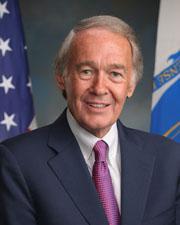
U.S. Senator for Massachusetts
Democrat
Senate term end not loaded yet
Missed 0.8% of roll calls. Chamber median 2.1%.
The full voting recordCounts roll calls where most Democrats and most Republicans voted differently, leaving out procedural votes.
How we countFrom FEC filings, Voteview roll calls and Congress.gov.
Democrat. In Congress since 1975, 23 terms in total.
Following saves Markey to your list, which Chamber & Street keeps on its server, linked to a cookie on this browser and not to your name or email. Email alerts will come with constituent verification.
Bills and resolutions Markey signed on to as a cosponsor. An original cosponsor signed on the day the bill was introduced. Source: govinfo bill status files, last updated Nov 6, 2026.
Markey also withdrew as a cosponsor from 1 bill, not listed here.
National Plan for Epilepsy Act
Sponsor Eric Schmitt (R). Joined Sep 2, 2025. 27 cosponsors. S. 494 on Congress.gov
Passed the Senate
National Plan for Epilepsy Act
This bill requires the Department of Health and Human Services (HHS) to establish a national plan, form an advisory council, and take other actions to address epilepsy. The requirements sunset on December 31, 2035.
Specifically, the bill requires HHS to carry out a National Plan for Epilepsy to prevent, diagnose, treat, and cure epilepsy. In carrying out the plan, HHS must implement activities such as coordinating research and services across all federal agencies and soliciting public comments.
Also, HHS must establish an Advisory Council on Epilepsy Research, Care, and Services. The advisory council must report to HHS and Congress every two years with an evaluation of federally funded efforts.
Additionally, HHS must annually report to Congress with recommended actions based on its assessments of the nation’s progress on epilepsy.
Child Care for Working Families Act
Sponsor Patty Murray (D). Joined Sep 2, 2025. 43 cosponsors. S. 2295 on Congress.gov(opens in a new tab)
Introduced
VISIBLE Act
Sponsor Alex Padilla (D). Joined Sep 2, 2025. 23 cosponsors. S. 2212 on Congress.gov(opens in a new tab)
Introduced
Lowering Electric Bills Act
Sponsor Charles Schumer (D). Original cosponsor. 39 cosponsors. S. 2681 on Congress.gov(opens in a new tab)
Introduced
Reproductive Rights Are Human Rights Act of 2025
Sponsor Brian Schatz (D). Original cosponsor. 17 cosponsors. S. 2671 on Congress.gov(opens in a new tab)
Introduced
Cruise Passenger Protection Act of 2025
Sponsor Richard Blumenthal (D). Original cosponsor. 1 cosponsor. S. 2640 on Congress.gov(opens in a new tab)
Introduced
Expanding the VOTE Act
Sponsor Alex Padilla (D). Original cosponsor. 15 cosponsors. S. 2589 on Congress.gov(opens in a new tab)
Introduced
Expanding the Voluntary Opportunities for Translations in Elections Act or the Expanding the VOTE Act
This bill expands access to voting materials for individuals with limited proficiency in the English language.
Section 203 of the Voting Rights Act of 1965 (VRA) requires covered states and political subdivisions to provide voting materials and other language assistance to persons who are American Indian, Asian American, Alaskan Natives, or of Spanish heritage and whose ability to speak or understand English limits electoral participation. A state or political subdivision that is subject to Section 203 is prohibited from providing English-only voting materials in an election. Among other requirements, this bill (1) requires the Department of Justice to issue a notice of prohibition, including the trigger threshold at which the prohibition applies, to certain states and political subdivisions; and (2) requires covered states and political subdivisions to provide written translations of all voting materials, with the consent of any applicable tribal government, to election workers.
Additionally, the bill requires the Election Assistance Commission to make incentive grants for states and political subdivisions to provide translated voting materials.
The bill also directs the Government Accountability Office to study and report on the impact of (1) reducing the threshold requirement under Section 203 of the VRA, and (2) expanding the definition of language minorities to include native speakers of additional languages.
Sustaining Our Democracy Act
Sponsor Alex Padilla (D). Original cosponsor. 15 cosponsors. S. 2588 on Congress.gov(opens in a new tab)
Introduced
Sustaining Our Democracy Act
This bill establishes and provides funds through FY2035 for the State Election Assistance and Innovation Trust Fund for purposes of promoting election activities.
Specifically, the bill establishes the Democracy Advancement and Innovation Program, through which the Office of Democracy Advancement and Innovation (also established by this bill) shall make allocations to states for carrying out democracy promotion activities. These activities include improving the administration of federal elections, recruiting and training nonpartisan election officials and poll workers, and increasing voting access.
The bill requires each state, in order to receive allocated funds, to (1) submit a plan for approval that describes how the state will distribute resources and carry out democracy promotion activities, and (2) establish uniform and nondiscriminatory state-based administrative complaint procedures.
The bill prohibits states from using funds for certain activities, including any activity that diminishes the ability of any eligible voter to participate in the electoral process.
Protecting Health Care and Lowering Costs Act
Sponsor Charles Schumer (D). Original cosponsor. 46 cosponsors. S. 2556 on Congress.gov(opens in a new tab)
Introduced
Protecting Health Care and Lowering Costs Act
This bill makes permanent temporary provisions that generally expand eligibility for and increase the amount of the premium tax credit. This bill also repeals multiple Medicaid, Medicare, and health-related tax provisions enacted by the One Big Beautiful Bill Act (OBBBA).
Currently, eligible taxpayers may claim the premium tax credit, which applies toward the cost of obtaining health insurance through health insurance exchanges. To qualify, a taxpayer’s household income must meet or exceed 100% of the federal poverty level (FPL) and, after 2025, may not exceed 400% of the FPL (maximum income limit). For 2021-2025, the maximum income limit is eliminated, which generally expands eligibility for the premium tax credit.
Further, under current law, the amount of the premium tax credit is partially based on the taxpayer’s household income multiplied by the applicable percentage. The applicable percentage varies depending on which of six income ranges (adjusted for inflation after 2025) the taxpayer’s household income falls within. For 2021-2025, the applicable percentages are lowered and the adjustment of the applicable percentages for inflation is eliminated, which generally increases the amount of the premium tax credit.
The bill permanently eliminates the 400% maximum income limit, lowers the applicable percentages, and eliminates the inflation adjustment for the applicable percentages.
Finally, the bill repeals multiple Medicaid, Medicare, and health-related tax provisions enacted by the OBBBA, including
• certain Medicare and Medicare eligibility and verification requirements,
• the reduced window for retroactive Medicaid coverage, and
• premium tax credit verification requirements.
A resolution recognizing the important work of the United States Preventive Services Task Force.
Sponsor Angus King (I). Original cosponsor. 9 cosponsors. S.Res. 343 on Congress.gov(opens in a new tab)
Introduced
A resolution designating July 30, 2025, as "National Whistleblower Appreciation Day".
Sponsor Chuck Grassley (R). Original cosponsor. 15 cosponsors. S.Res. 340 on Congress.gov(opens in a new tab)
Passed the Senate
Restoring Essential Healthcare Act
Sponsor Tina Smith (D). Original cosponsor. 30 cosponsors. S. 2524 on Congress.gov(opens in a new tab)
Introduced
John R. Lewis Voting Rights Advancement Act of 2025
Sponsor Richard Durbin (D). Original cosponsor. 46 cosponsors. S. 2523 on Congress.gov(opens in a new tab)
Introduced
John R. Lewis Voting Rights Advancement Act of 2025
This bill establishes new criteria for determining which states and political subdivisions must obtain preclearance before changes to voting practices may take effect. Preclearance is the process of receiving preapproval from the Department of Justice (DOJ) or the U.S. District Court for the District of Columbia before making legal changes that would affect voting rights.
A state and all of its political subdivisions shall be subject to preclearance of voting practice changes for a 10-year period if, during the previous 25 years:
• 15 or more voting rights violations occurred in the state; or
• 10 or more violations occurred, at least 1 of which was committed by the state itself.
A political subdivision as a separate unit shall also be subject to preclearance for a 10-year period if three or more voting rights violations occurred there during the previous 25 years.
States and political subdivisions that meet certain thresholds regarding minority groups must preclear covered practices before implementation, such as redistricting.
States and political subdivisions must notify the public of changes to voting practices.
The bill authorizes DOJ to require states or political subdivisions to provide certain documents or answers to questions for enforcing voting rights.
The bill outlines factors courts must consider when hearing challenges to voting practices, such as the extent of any history of official voting discrimination in the state or political subdivision.
The bill also includes certain protections for election workers, polling places, and election infrastructure.
Gas Pipeline Leak Detection and Repair Act of 2025
Sponsor Ben Luján (D). Original cosponsor. 7 cosponsors. S. 2508 on Congress.gov(opens in a new tab)
Introduced
A resolution recognizing the 250th anniversary of the postal service of the United States.
Sponsor Gary Peters (D). Joined Jul 28, 2025. 14 cosponsors. S.Res. 337 on Congress.gov(opens in a new tab)
Passed the Senate
Pay Teachers Act
Sponsor Bernie Sanders (I). Original cosponsor. 10 cosponsors. S. 2481 on Congress.gov(opens in a new tab)
Introduced
Renewing Immigration Provisions of the Immigration Act of 1929
Sponsor Alex Padilla (D). Original cosponsor. 15 cosponsors. S. 2468 on Congress.gov(opens in a new tab)
Introduced
End Polluter Welfare Act of 2025
Sponsor Bernie Sanders (I). Original cosponsor. 6 cosponsors. S. 2444 on Congress.gov(opens in a new tab)
Introduced
A resolution supporting the designation of the week of August 25 through August 29, 2025, as the third annual "National Community Health Worker Awareness Week".
Sponsor Ron Wyden (D). Original cosponsor. 9 cosponsors. S.Res. 334 on Congress.gov(opens in a new tab)
Introduced
Charting My Path for Future Success Act
Sponsor Timothy Kaine (D). Original cosponsor. 2 cosponsors. S. 2407 on Congress.gov(opens in a new tab)
Introduced
CANADA Act
Sponsor Peter Welch (D). Original cosponsor. 7 cosponsors. S. 2383 on Congress.gov(opens in a new tab)
Introduced
Creating Access to Necessary American-Canadian Duty Adjustments Act or the CANADA Act
This bill exempts goods imported by or for the use of small business concerns from duties (i.e., tariffs) imposed under Executive Order 14193. This executive order, issued by President Donald J. Trump on February 1, 2025, imposed a 25% tariff on most imports from Canada (except for Canadian energy or energy resources, which have a 10% tariff).
EACH Act of 2025
Sponsor Tammy Duckworth (D). Original cosponsor. 34 cosponsors. S. 2377 on Congress.gov(opens in a new tab)
Introduced
Young Fishermen’s Development Program Reauthorization Act
Sponsor Dan Sullivan (R). Original cosponsor. 4 cosponsors. S. 2357 on Congress.gov(opens in a new tab)
Passed committee
Young Fishermen’s Development Program Reauthorization Act
This bill reauthorizes through FY2031 and expands the purposes of the Young Fishermen’s Development Program. The bill also directs the National Sea Grant Office within the National Oceanic and Atmospheric Administration (NOAA) to track and evaluate the career progression of program participants.
As background, the Young Fishermen’s Development Program awards grants to support training, education, outreach, and technical assistance initiatives for young fishermen. Currently, grants may be used for specified topics, including vessel and engine maintenance, sustainable fishing practices, and financial and risk management. The bill expands these topics to include
• crew management,
• disaster preparedness,
• seafood handling,
• fishing portfolio diversification and expansion, and
• management of working waterfronts and related shoreside infrastructure.
In addition, the bill eliminates NOAA's discretionary authority to determine other activities, opportunities, or programs that are eligible for grants under the program.
The bill also prohibits recipients from receiving concurrent grants. (Consecutive grants are permitted under the bill and current law.)
Finally, the bill directs the National Sea Grant Office, to the extent practicable, to (1) track the career progression of program participants; (2) identify participants who subsequently enter or remain in commercial fisheries in the United States or related industries; and (3) use these outcomes as a key factor in evaluating future grant applications.
Protect DREAMer Confidentiality Act of 2025
Sponsor Martin Heinrich (D). Original cosponsor. 28 cosponsors. S. 2350 on Congress.gov(opens in a new tab)
Introduced
Price Gouging Prevention Act of 2025
Sponsor Elizabeth Warren (D). Original cosponsor. 9 cosponsors. S. 2321 on Congress.gov(opens in a new tab)
Introduced