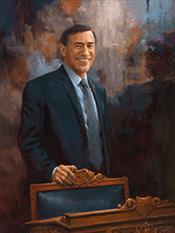
U.S. Representative for California’s 48th district
Republican
119th Congress, two-year term
Missed 1.0% of roll calls. Chamber median 1.9%.
The full voting recordCounts roll calls where most Democrats and most Republicans voted differently, leaving out procedural votes.
How we countFrom FEC filings, Voteview roll calls and Congress.gov.
Republican. In Congress since 2001, 12 terms in total.
Following saves Issa to your list, which Chamber & Street keeps on its server, linked to a cookie on this browser and not to your name or email. Email alerts will come with constituent verification.
Bills and resolutions Issa signed on to as a cosponsor. An original cosponsor signed on the day the bill was introduced. Source: govinfo bill status files, last updated Nov 6, 2026.
Prosecutors Need to Prosecute Act
Sponsor Nicole Malliotakis (R). Original cosponsor. 8 cosponsors. H.R. 350 on Congress.gov
Introduced
Prosecutors Need to Prosecute Act
This bill requires certain state and local prosecutors to report data on criminal referrals and outcomes of cases involving murder or non-negligent manslaughter, forcible rape, robbery, aggravated assault, burglary, larceny, motor vehicle theft, arson, or any offense involving the illegal use or possession of a firearm.
The reporting requirement applies to state and local prosecutors in a jurisdiction with 380,000 or more persons that receives funding under the Edward Byrne Memorial Justice Assistance Grant program. The report must contain data on
• cases referred for prosecution,
• cases declined for prosecution,
• cases resulting in a plea agreement with the defendant,
• cases initiated against defendants with previous arrests or convictions, and
• defendants charged who were released or eligible for bail.
FIND Act
Sponsor Jack Bergman (R). Joined Jan 9, 2025. 154 cosponsors. H.R. 45 on Congress.gov(opens in a new tab)
Introduced
Firearm Industry Non-Discrimination Act or the FIND Act
This bill prohibits the federal government from entering into contracts with an entity that discriminates against firearm trade associations or businesses that deal in firearms, ammunition, or related products.
Specifically, the bill requires a federal agency to include in each contract for the procurement of goods or services awarded by the agency a clause requiring the prime contractor to certify that it (1) has no policy, practice, guidance, or directive that discriminates against a firearm entity or firearm trade association; and (2) will not adopt a policy, practice, guidance, or directive that discriminates against a firearm entity or firearm trade association during the term of the contract.
The bill establishes (1) a similar requirement with respect to subcontracts, and (2) penalties for violations.
The bill makes such prohibition inapplicable to a contract for the procurement of goods or services that is a sole-source contract.
Border Safety and Security Act of 2025
Sponsor Chip Roy (R). Original cosponsor. 47 cosponsors. H.R. 318 on Congress.gov(opens in a new tab)
Introduced
Border Safety and Security Act of 2025
This bill requires the Department of Homeland Security (DHS) to suspend the entry of any non-U.S. nationals (aliens under federal law) without valid entry documents during any period when DHS cannot detain such an individual or return the individual to a foreign country contiguous to the United States. A state may sue DHS to enforce this requirement.
(Under current law, non-U.S. nationals who arrive at the border without entry documents are generally subject to expedited removal. However, if such an individual is found to have a credible fear of persecution, they are typically subject to detention while their asylum claim is being considered.)
The bill also authorizes DHS to suspend the entry of non-U.S. nationals without entry documents at the border if DHS determines that such a suspension is necessary to achieve operational control over such a border.
Born-Alive Abortion Survivors Protection Act
Sponsor Ann Wagner (R). Joined Jan 7, 2025. 163 cosponsors. H.R. 21 on Congress.gov(opens in a new tab)
Passed the House
Born-Alive Abortion Survivors Protection Act
This bill establishes requirements for the degree of care a health care practitioner must provide in the case of a child born alive following an abortion or attempted abortion.
Specifically, a health care practitioner who is present must (1) exercise the same degree of care as would reasonably be provided to any other child born alive at the same gestational age, and (2) ensure the child is immediately admitted to a hospital. Additionally, a health care practitioner or other employee who has knowledge of a failure to comply with the degree-of-care requirements must immediately report such failure to law enforcement.
A health care practitioner who fails to provide the required degree of care, or a health care practitioner or other employee who fails to report such failure, is subject to criminal penalties—a fine, up to five years in prison, or both.
An individual who intentionally kills or attempts to kill a child born alive is subject to prosecution for murder.
The bill bars the criminal prosecution of a mother of a child born alive under this bill and allows her to bring a civil action against a health care practitioner or other employee for violations.
Constitutional Concealed Carry Reciprocity Act of 2025
Sponsor Richard Hudson (R). Original cosponsor. 189 cosponsors. H.R. 38 on Congress.gov(opens in a new tab)
Introduced
Constitutional Concealed Carry Reciprocity Act
This bill establishes a federal statutory framework to regulate the carry or possession of concealed firearms across state lines.
Specifically, an individual who is eligible to carry a concealed firearm in one state may carry or possess a concealed handgun (other than a machine gun or destructive device) in another state that allows its residents to carry concealed firearms.
It sets forth requirements for lawful concealed carry across state lines. The bill preempts most state and local laws related to concealed carry and establishes a private right of action for a person adversely affected by interference with a concealed-carry right established by this bill.
Proven Forest Management Act of 2025
Sponsor Tom McClintock (R). Original cosponsor. 8 cosponsors. H.R. 179 on Congress.gov(opens in a new tab)
Introduced
Proven Forest Management Act of 2025
This bill sets forth provisions to expedite the approval and implementation of forest management activities and establishes related requirements.
First, the bill categorically excludes a forest management activity conducted on National Forest System land for reducing forest fuels from certain environmental review requirements under the National Environmental Policy Act of 1969 if the activity (1) does not exceed 10,000 acres (including not more than 3,000 acres of mechanical thinning), (2) is developed in a collaborative manner, and (3) is consistent with the forest plan developed for the relevant National Forest System land.
Next, the bill directs the Forest Service to conduct forest management activities in a manner that attains multiple ecosystem benefits unless the costs associated with attaining such benefits are excessive.
Additionally, the Forest Service must (1) establish any post-program ground condition criteria for a ground disturbance caused by a forest management activity required by the applicable forest plan, and (2) provide for monitoring to ascertain the attainment of relevant post-program conditions.
The bill also allows the Forest Service or the Department of the Interior, as appropriate, to enter into contracts and cooperative agreements with certain entities to provide for fuel reduction, erosion control, reforestation, and similar activities on federal and nonfederal lands within land adjustment programs.
Finally, the bill directs the Forest Service, when conducting a forest management activity on National Forest System land, to coordinate with impacted parties to increase efficiency and maximize the compatibility of management practices across such land.
To require the Secretary of Agriculture to carry out activities to suppress wildfires, and for other purposes.
Sponsor Tom McClintock (R). Original cosponsor. 9 cosponsors. H.R. 178 on Congress.gov(opens in a new tab)
Introduced
This bill sets out requirements for wildfire suppression and management activities carried out by the Forest Service.
These requirements apply to Forest Service land that (1) has a severe, extreme, or exceptional drought intensity rating; (2) has a National Wildland Fire Preparedness level of 5 (i.e., the highest level of wildland fire activity); or (3) is located in a fireshed ranked in the top 10% of wildfire exposure.
Within 24 hours of detecting a wildfire on such Forest Service land, the service must use all available resources to extinguish the wildfire. Additionally, the service may not inhibit the firefighting activities of state and local agencies that are authorized to respond to wildfires on the Forest Service land.
Further, the service may only initiate a backfire or burnout as part of a fire suppression strategy if it is ordered by the responsible incident commander or is necessary to protect the health and safety of firefighting personnel. The service must use all available resources to control any initiated fire until it is extinguished.
The bill also limits the service's use of prescribed fires (i.e., the controlled application of fire by a team of experts under specified weather conditions to restore health to ecosystems that depend on fire). When using prescribed fires as a fire resource management tool, the service must comply with applicable laws and regulations and immediately suppress any prescribed fire that exceeds its prescription.
Regulations from the Executive in Need of Scrutiny Act of 2025
Sponsor Kat Cammack (R). Original cosponsor. 93 cosponsors. H.R. 142 on Congress.gov(opens in a new tab)
Introduced
Regulations from the Executive in Need of Scrutiny Act of 2025
This bill revises provisions relating to congressional review of agency rulemaking.
Specifically, the bill establishes a congressional approval process for a major rule. A major rule may only take effect if Congress approves of the rule. A major rule is a rule that has resulted in or is likely to result in (1) an annual effect on the economy of $100 million or more; (2) a major increase in costs or prices for consumers, individual industries, government agencies, or geographic regions; or (3) significant adverse effects on competition, employment, investment, productivity, innovation, or the ability of U.S.-based enterprises to compete with foreign-based enterprises.
The bill generally preserves the current congressional review process for a nonmajor rule.
Protecting our Communities from Sexual Predators Act
Sponsor Vern Buchanan (R). Original cosponsor. 10 cosponsors. H.R. 134 on Congress.gov(opens in a new tab)
Introduced
Protecting our Communities from Sexual Predators Act
This bill requires the Department of Justice (DOJ) to detain certain non-U.S. nationals (aliens under federal law) who have been arrested for sexual assault. The bill also provides for the inadmissibility and deportability of certain individuals convicted of sexual assault.
Under this bill, the DOJ must detain an individual who (1) is unlawfully present in the United States, made certain misrepresentations, or did not possess the necessary documents when applying for admission; and (2) has been charged with, arrested for, convicted of, or admits to having committed acts which constitute the essential elements of, an offense involving sexual assault.
The bill also establishes under statute that a conviction for certain crimes related to sexual assault shall be grounds for (1) barring an individual from entering the United States, and (2) deportability. (Under current law, convictions for certain crimes, including crimes involving moral turpitude, are grounds for inadmissibility and deportability.)